Credit Top-Up Triggers and Automated Reload Rules

Credit-based pricing has crossed from AI-vendor curiosity into mainstream SaaS practice. Growth Unhinged's 2025 State of SaaS Pricing report counted 79 companies in the PricingSaaS 500 Index running a credit model, up from 35 at the end of 2024. That's a jump of 126% in a single year, and the list now includes Figma, HubSpot, and Salesforce, which tells you something: this isn't a workaround cooked up by AI startups drowning in GPU bills anymore. It's turning into the default way to sell anything with usage that's hard to pin down in advance.
The economics took me a while to fully untangle, but they hold up once you trace the cash flow. AI vendors pay their own model providers on prepaid or usage-linked terms, so postpaid billing to customers opens a gap between what a vendor owes upstream and what it eventually collects downstream. Prepaid credits close that gap by pulling payment forward. There's a buyer-side benefit too: someone budgeting against a known credit ceiling doesn't need to track raw tokens or API calls just to understand their own spend. That's a real product benefit, not an accounting trick dressed up as one.
So the credit wallet ends up load-bearing. When it hits zero and service cuts off, the reload mechanism is the only thing standing between a user and a workflow that dies mid-task. Designing that mechanism is a product decision as much as a billing one, and I've watched teams treat it as an afterthought that comes back to bite them six months later.
What "automated reload" actually means and the two axes it operates on
Two top-up methods show up in practice: manual, where the user buys more on demand, and automatic, where the system reloads the wallet based on rules set ahead of time. Automated reload sounds like one feature. It took me longer than I expected to see that it's actually two independent decisions bolted together, and mixing them up is where most designs go sideways.
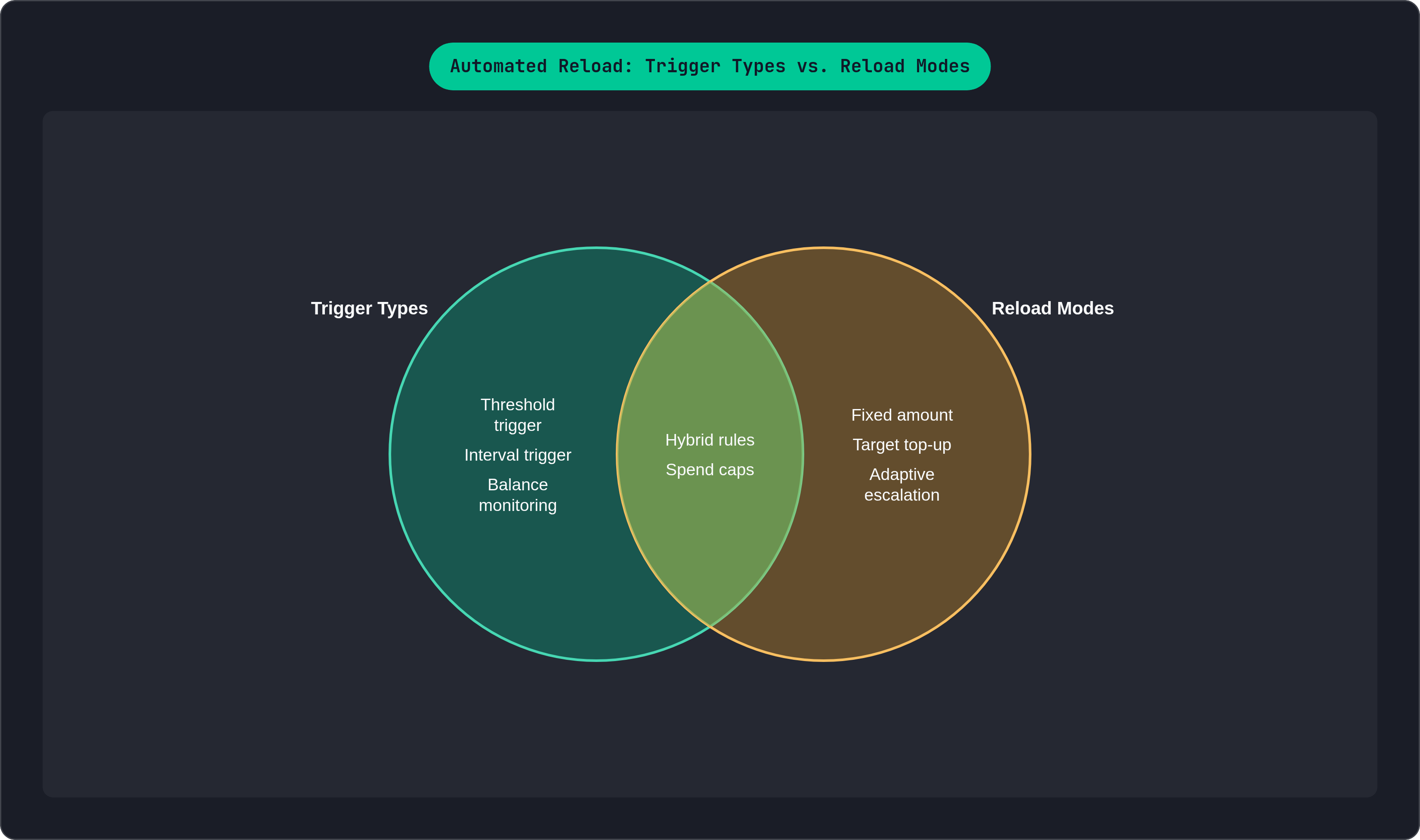
The first decision is trigger type, the condition that fires the reload. Usually that's a balance crossing some threshold, or a calendar interval passing. The second is reload mode, how much credit gets added once the trigger fires. Fixed mode adds a set amount no matter what the current balance is, say $50 every time the balance drops below $10. Target mode tops the balance back up to a ceiling instead; if the balance sits at $7 and the target is $100, the system adds $93, not a flat $50.
These two don't have to move together. A threshold trigger can run fixed or target, and so can an interval trigger. Fixed mode gives customers and vendors a predictable line item on the invoice, which matters more than people think for expense reports and for a finance team's patience. Target mode keeps a wallet from bloating with unused credit when someone's usage slows down out of nowhere, and that happens more often than anyone plans for. Get the mode wrong for the use case and you land in one of two bad places: chronic underfunding, where the customer keeps hitting zero, or padded charges that quietly erode trust in the whole pricing model.
One more wrinkle worth flagging, one that's easy to overlook until it bites someone: credits don't land the instant a reload fires. Payment has to clear first. That gap means reload is never instantaneous, and any system built around it has to design around that lag instead of pretending it isn't there.
How threshold triggers work and where teams set them wrong
The mechanics aren't complicated. The system watches the wallet balance, and when it drops below a defined low-water mark, a reload fires automatically. The hard part is picking that mark, because it isn't really a fixed number so much as a function of burn rate and how much interruption risk the business can stomach.
Set it too high and reloads fire constantly. Customers see small charges stacking up on their card, and issuers start flagging the activity as suspicious, which turns into its own support headache. Set it too low and the reload fires too late: balance hits zero before payment clears, and the workflow breaks mid-task. Getting this threshold right means understanding burn during a typical session, not just averaged out across a day.
I've seen teams set the threshold at a round number, 100 credits, without ever checking how long payment processing actually takes. Take a high-volume user burning 80 credits a minute. If the charge takes 30 to 60 seconds to clear, that user has already burned through most of the buffer before new credits land. A threshold of 100 in that case isn't a safety margin. It's already too late by the time it fires. I only caught this by walking through the arithmetic on a real account, not by reading it off a spec.
Before the automatic trigger ever kicks in, there should be an alert cascade: warnings at 50%, 25%, and 10% of balance remaining, so the user sees what's coming. These need to fire on real balance events as they happen, not on a batch job that checks in once an hour and misses the exact moment someone is burning through credits in the product. A well-built alert sequence with a one-click top-up link converts a meaningful share of recipients into buyers, and that conversion rate climbs as urgency does, usually peaking around the 10% mark. Threshold configuration and alert configuration are two separate levers. Teams that only touch one have shipped half a system.
Interval triggers and when they belong in the design
Interval triggers refill credits on a calendar schedule, weekly or monthly, regardless of balance. They fit naturally into subscription-bundled credit grants, where the pitch is simple: your plan includes a set number of credits per month, you use them, they refresh next cycle. The interval trigger doesn't need to justify itself in that setup.
It fits badly with high-velocity or unpredictable AI workloads, where consumption spikes don't care what day the billing cycle resets. An autonomous agent that burns a month's worth of credits in two days sits at zero for the rest of the month, waiting on an interval trigger with no reason to fire early.
Most AI SaaS products land on a hybrid: interval covers the base allocation, threshold handles overflow. Bundled monthly credits cover the baseline, and auto-recharge kicks in above it. The two triggers have to be built so they don't collide; an interval reload landing right after a threshold reload already topped things off can over-fund an account in a way nobody asked for.
Expiration rules make this messier. If unused credits from the last interval expire before the next grant lands, the customer loses value they thought they had. That's a perception problem, and it belongs to the product team, not to the user who reasonably assumed unused credits would roll forward, or at least not vanish before the next batch showed up.
Adaptive reload: when static thresholds and fixed amounts stop working
Static rules get calibrated for one usage level. As a customer's consumption grows, that same threshold and that same reload amount start producing worse behavior: more frequent reloads, more friction, more exposure on the payment side.
Adaptive reload logic fixes this by watching how often the trigger fires. In implementations I've seen documented, when the same reload amount fires more than three times in any seven-day window, the system escalates to the next preset tier on its own. A $200 reload that fires four times in a week steps up to $500 going forward, no one touching a config panel.
This isn't only about convenience, though it helps. Frequent small charges rack up holds on a card and can trip risk-flag reviews from the issuer, a rough experience for someone who did nothing wrong except use the product a lot. Larger, less frequent reloads cut that exposure and keep billing clean. There's a signal buried in here too, one it took some digging to notice: a customer whose reload frequency keeps climbing is a customer who's growing, and that's exactly the kind of thing an account team wants to know before the renewal call, not after.
Adaptive rules still need a ceiling. Without a maximum reload cap, a runaway agent workflow or a compromised credential can escalate again and again with nothing to stop it.
Guardrails: spend caps, failure handling, and the cases that break naive implementations
Spend caps exist for that exact scenario: a hard ceiling on what automated reload can ever charge, full stop. Without one, adaptive escalation or a stray bug in the metering pipeline can charge a customer an order of magnitude more than they expected. The cap should be configurable per customer, not set globally, since an enterprise account legitimately needs headroom a self-serve account doesn't.
Payment failure is where a lot of naive builds fall apart. When a reload fires and the charge fails, there are two real paths. One is a hard stop: service suspends immediately. Predictable, but disruptive if the user is mid-workflow. The other is a grace period, a small credit buffer extended while retry logic runs in the background, smoother for the user but it needs a defined fallback for when retries run out. Retry cadence matters here. An immediate retry on a declined card almost always fails again for the same reason it failed the first time; exponential backoff paired with a customer notification is the standard approach, and it's standard for good reason.
Webhook events hold this whole thing together. Credits granted, balance low, credits expiring, credits depleted: each maps to a different downstream action, an email, a dashboard update, a dunning flow kicking off. If these events don't fire reliably, nothing downstream stays in sync.
Concurrency is the edge case that breaks systems nobody bothered to test for it. A high-velocity AI workload can throw off thousands of events a minute, and if the metering pipeline is reading stale balance state during that burst, enforcement decisions get made on bad data. A customer can blow past their limit before the reload even has a chance to process. This isn't hypothetical. An agent running 3,000 events a minute will find every lag in your enforcement layer within minutes of going live.
Deduplication matters just as much. A retried or re-delivered event carrying the same balance-low signal should never cause the reload to fire twice and charge the customer twice for one threshold crossing. For enterprise customers especially, silent reloads, resets, or expirations create real trust problems with finance teams that need to map every charge back to a workload. Every reload event needs a clear audit trail behind it, no exceptions.
What the metering layer must do for reload rules to work correctly
Reload rules are only as good as the balance data feeding them. A threshold trigger reading a balance that's 30 seconds stale fires at the wrong moment, and no amount of clever rule design fixes a data freshness problem underneath it.
The pipeline has three jobs, and it has to do all three well. Event ingestion needs to capture usage and attribute it to the right wallet without delay. Deduplication needs to keep retried events from inflating consumption and tripping a threshold that shouldn't have tripped. Real-time aggregation needs to make sure the balance a trigger reads reflects what's happening right now, not a cached snapshot from the last batch run.
Here's the AI agent problem in plain terms: workflows generating thousands of usage events a minute will overwhelm a pipeline built to handle thousands of events a day. The metering layer has to match the product's actual event volume, not the volume it had when someone first designed the system two years ago. Flexprice's metering backend runs on Kafka for event capture and ClickHouse for real-time aggregation, processing more than 10 billion API requests a month with sub-50ms P99 latency, so that balance checks and threshold evaluations run against current data instead of lagged aggregates.
When this layer isn't built right, the failure modes are predictable. Reload fires too late, service interrupts. Reload fires on a stale low-balance signal that's already corrected, customer gets double-charged. Enforcement reads stale state, customer blows past their limit before anyone, human or system, gets a chance to stop it. Every one of these is a metering problem wearing a billing-rules costume.
Designing the reload configuration for different customer segments
Self-serve and low-volume customers don't need much. A threshold trigger with fixed reload mode usually does the job. Set the threshold low relative to session burn, and size the reload to cover several sessions, not one, so the customer isn't reloading every time they open the product. The alert cascade at 50%, 25%, and 10%, with a one-click top-up link, does most of the engagement work on its own. Spend caps here should run conservative, and payment failure can go straight to notification-plus-retry without a grace period, since the dollar amounts are small enough that it doesn't much matter.
Mid-market and growing accounts do better with threshold triggers paired to adaptive escalation, so reload amounts step up as usage grows without anyone on either side lifting a finger. Target mode tends to work better here than fixed, since it keeps balance from bloating during the slow months that always seem to show up. Reload frequency turns into a useful signal for the account team, a natural nudge toward an expansion conversation.
Enterprise and high-velocity accounts need the hybrid setup: interval trigger for the contracted base allocation, threshold trigger for burst usage above it. Spend caps should run higher, but only with explicit customer sign-off, never configured quietly behind the scenes. Payment failure handling should lean toward a grace period, since enterprise payment terms often don't allow instant card retries the way a consumer card does. Every reload needs a full audit trail, because enterprise finance teams have to reconcile charges against workloads, and feature-specific credit buckets may need their own reload rules rather than one rule covering the whole wallet.
Across every segment, the reload rule itself should be visible to the customer, not buried in billing fine print somewhere. Transparency here isn't a nicety. It's what keeps disputes low and keeps trust in the credit model intact.
How billing infrastructure determines whether reload rules stay simple or become a maintenance burden
One reload rule, one threshold, one fixed amount, one customer, is trivial to build. The complexity shows up once you stack multiple trigger types running at the same time, adaptive escalation logic that has to persist state across reload events, per-segment spend caps, per-bucket rules, payment retry state machines, webhook delivery guarantees, and balance accuracy under real event load. None of that is hard by itself. Together, it's a lot, and it took watching a few of these systems evolve in practice to appreciate how fast that stack accumulates.
Teams building this in-house tend to start with the simple case and bolt complexity on as new requirements show up, and the result is usually a system that's hard to reason about, harder to test, and expensive to keep running. The cost isn't just the first engineering sprint either. It's ongoing, since every new pricing experiment, every new customer segment, and every new credit type means going back into the reload logic again.
Platforms built specifically for credit-based billing treat threshold configuration, reload modes, adaptive rules, spend caps, and webhook scaffolding as configuration rather than custom code. Flexprice's wallet API takes this approach, and that difference, config versus code, is usually what decides whether a reload system stays something a small team can maintain, or turns into somebody's full-time job by accident.