Prepaid Drawdown Contracts and True-Up Billing for Enterprise Customers
How prepaid credits and true-up billing prevent surprise charges in usage-based enterprise deals.
Prepaid drawdown contracts and true-up billing solve the same problem from opposite ends. The buyer wants a fixed number to bring to the board; the vendor wants revenue certainty without leaving money on the table if usage runs hot. Nearly nine in ten SaaS companies now run some flavor of usage-based pricing, so this pairing isn't a special accommodation for whale accounts anymore. It's the default shape of enterprise negotiation, and if you sell consumption-priced software or AI products upmarket, you will get burned by your own billing system if you don't understand how these two mechanisms interact.
Surveys of IT leaders keep turning up the same complaint: a large majority report unexpected charges tied to consumption-based or AI pricing, and cost forecasting sits at the top of nearly every CIO's list of AI deployment worries. Workloads spike without warning. Teams onboard at uneven rates. Inference costs move with model complexity in ways nobody fully predicts at signing. The buyer wants a locked-in number and a better rate for committing up front; the vendor wants a revenue floor and a clean way to capture overage once the customer blows past it. Put those two demands next to each other and you land on the same structure every time: prepaid drawdown, paired with a true-up.
What a prepaid drawdown contract actually commits both sides to
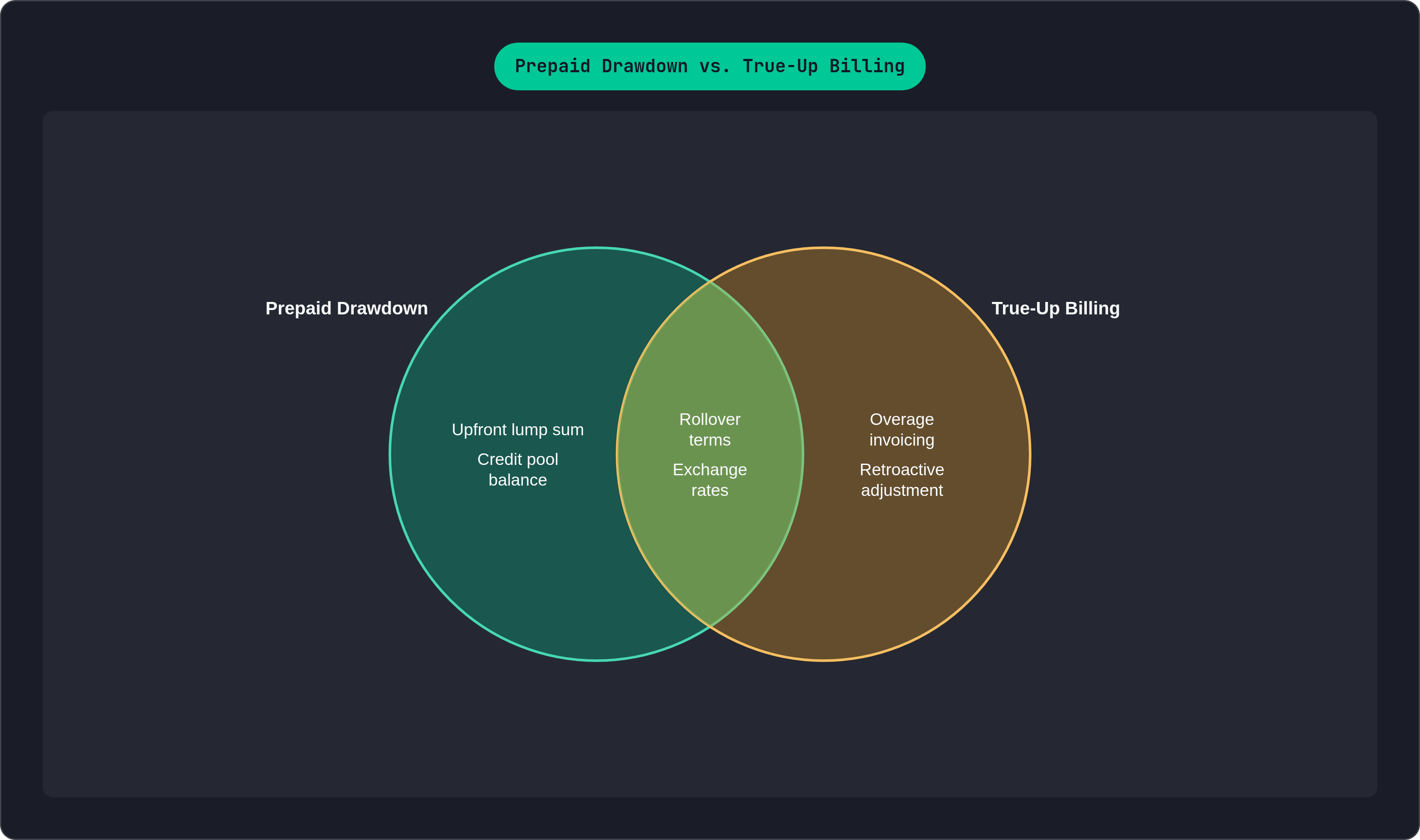
Here's the mechanism. The customer pays a lump sum, or an annual installment, upfront. That payment becomes a credit balance the vendor holds and draws against as usage occurs. It's not a subscription. A subscription buys a fixed entitlement; a drawdown contract buys a pool of spend that gets charged down unit by unit as real consumption happens.
The commit sets a floor for both sides. The vendor gets the revenue no matter how much of the pool actually gets used. The customer gets a locked unit price and guaranteed access, no matter how usage swings during the term.
Sales teams tend to breeze past the terms that matter most here, and that's the mistake I see most often. The commit amount, the term length, the exchange rate that turns five API calls into one credit, whether the customer owes the full commit no matter what or only up to a ceiling, the overage rate, the rollover terms. Get any of these wrong or vague at signing, and it comes back as a billing dispute twelve months later. Every time, without fail.
Rollover, in particular, is rarely generous. Most contracts default to use-it-or-lose-it. Some enterprise deals allow a capped carryover, usually one period only and a small percentage of the unused balance. Vendors also sometimes split the pool by product line, carving out a defined chunk for AI workloads separate from core SaaS features. That tightens the vendor's margin control considerably, and it strips the buyer of the flexibility to move spend where they actually need it that quarter.
How credits are metered and drawn down in real time
Every chargeable event, an API call, a generated token, a compute minute, a processed document, throws off a signal the metering layer has to catch and turn into a credit deduction. That conversion runs through a pricing layer: the exchange rate that translates raw usage into credits pulled from the prepaid pool.
This has to happen in real time. Batch processing, reconciling usage overnight, can't enforce entitlements or warn a customer they're about to run dry. AI inference especially can burn through a credit pool at millisecond speed; a system that only knows the balance at month's end has already failed the customer by the time it finds out.
Event ingestion has to be idempotent, so the same event never decrements the balance twice, even when a retry fires after a network hiccup. The running balance needs to be queryable at any moment, not just at invoice time. Customers need configurable depletion alerts, commonly set at 80% and 95%. And at zero, the system has to gate access or flip to overage billing immediately. It cannot keep serving requests and sort out the bill later.
Adobe's generative AI credits are a decent real-world reference point here. Credits for features like Firefly sit on top of existing subscription tiers, metered at the feature level, so users can experiment without renegotiating the underlying contract. It's a hybrid model, but the metering discipline underneath is the same discipline any drawdown contract demands.
One risk rarely makes it into the contract language, and it should. Call it the opaque multiplier: a vendor reserves the right to change how many credits a service costs, so a feature priced at ten credits today becomes twenty tomorrow. The sticker price never moves. The prepaid pool just burns twice as fast, and the customer only finds out when their credits vanish faster than expected and nobody can explain why. Get this written into the contract, and get it logged visibly in the metering system's audit trail.
The architecture underneath usually follows the same shape: event-driven ingestion, often through an SDK or a direct write to a stream like Kafka, a pricing engine applying the current exchange rate, and a partitioned credit ledger updating atomically. Finance needs to read that ledger live. Reconstructing it from raw logs at month-end isn't a substitute. It's a workaround, and a bad one.
When and why a true-up is triggered
A true-up reconciles what the customer committed to against what they actually used. In a drawdown contract it answers exactly one question: did consumption land over, under, or right at the prepaid commit?
Under-consumption means the leftover credits expire, unless a rollover clause says otherwise. A dead-on match almost never happens and needs no adjustment. Over-consumption means the customer drew past the pool, and the true-up generates an additional invoice for the gap.
Cadence is a real design choice, not a formality. Annual true-ups are standard for enterprise SaaS and seat-based deals. High-variance usage, cloud compute or AI inference especially, often calls for quarterly or even monthly true-ups. Letting overconsumption run unchecked for a full year invites a bill nobody budgeted for.
A true-down, the buyer-friendly mirror image where license counts or costs get reduced at reconciliation, exists in theory. It almost never shows up by default. Somebody has to negotiate it in explicitly, because vendors certainly aren't volunteering it.
Overage pricing is where buyers get burned most. Overages commonly get billed at full list price, undiscounted, well above whatever rate the customer thought they'd locked in. Unlike a renewal conversation, the overage rate isn't up for discussion at true-up time; it was fixed at signing, months earlier, usually before either side had a real sense of what usage would look like.
Microsoft's Enterprise Agreement model is still the reference point most enterprise buyers already understand intuitively. It requires an annual true-up comparing licenses used against licenses purchased at the start of the term, filed through what Microsoft calls an Update Statement. Even a year with zero net additions requires a filing; skip it and that counts as a compliance breach that surfaces later, usually at renewal or audit, the worst possible moment to find out. Microsoft's November 2025 restructuring of its EA tiers added a wrinkle worth flagging: on-premises additions still earn banded pricing at true-up, but online services additions no longer do. A customer running a mixed estate is now running two separate reconciliation calculations instead of one.
How the true-up calculation works in a credit drawdown context
The math is simple in structure, even when the inputs get messy. You need the opening credit balance, total credits consumed during the period straight from the metering ledger, any credits added mid-term through top-ups or amendments, and any credits returned through refunds or dispute resolutions. Closing balance equals opening balance, plus additions, minus consumption, minus returns.
A positive closing balance triggers the rollover policy: expire, carry forward, or apply toward the renewal commit. A negative closing balance is the overage, and its absolute value, multiplied by the contracted overage rate, becomes the true-up invoice.
The exchange rate applied at calculation time has to match whatever rate was actually in effect when the usage occurred. If the vendor changed the credit multiplier mid-term and the audit log doesn't show which rate applied when, the invoice is disputable on its face. That's not a hypothetical. It's the single most common thing that goes wrong here.
Granularity changes the outcome, sometimes substantially. A customer might overconsume in Q2 and Q3, then land under the annual commit once Q4 comes in soft. An annual true-up nets all of that out cleanly. A quarterly true-up would have already fired off two overage invoices before the year balanced itself. Neither approach is wrong on its face, but the cadence decision carries real cash flow consequences for both sides, and it deserves to be negotiated rather than defaulted into.
Most true-up disputes trace back to one of three causes: events double-counted during a retry, test or sandbox environments accidentally drawing from the production credit pool, or a rate change applied retroactively to usage that occurred under the old rate. An end-of-period summary report solves none of these. Finance needs a continuous, auditable ledger showing every deduction, its timestamp, and the rate that applied at that instant. Otherwise the true-up conversation turns into a forensic exercise instead of routine bookkeeping.
Cisco's True Forward as an alternative reconciliation philosophy
Cisco's Enterprise Agreement billing takes a different position on the same problem. Instead of retroactively invoicing a customer for past overconsumption once it's caught, True Forward bills the growth forward from the point of detection onward. A semi-annual True Forward event can also fire on its own if usage crosses 115% of contracted volume during the term, the exceptional growth threshold.
The practical effect: no retroactive bill shock. The customer's commitment steps up from the moment the overage was detected, not from whenever it actually started weeks or months earlier. That changes the tone of the renewal conversation entirely. Instead of arguing about what's owed for the past, it becomes an acknowledgment that the account has grown and needs to commit at a higher tier going forward.
The tradeoff lands on the vendor, who eats the revenue gap between when overconsumption started and when it got caught. Customers give something up too: the chance to negotiate volume pricing before the step-up locks in automatically.
I'd study this closely if I were building a true-up policy for competitive enterprise sales, especially where procurement has already been burned by a retroactive invoice from some other vendor. But adopting the philosophy doesn't make the infrastructure lift any lighter. Catching a 115% threshold crossing and triggering a forward adjustment requires the same real-time, continuous balance visibility a standard true-up demands. There's no version of True Forward that runs on batch data.
What the billing system must do to support this contract type end-to-end
The full lifecycle here, metering through entitlement enforcement through ledger management through invoicing, touches functions that rarely report to the same VP. That's a big part of why it breaks so often.
On the metering side: sub-second event ingestion with idempotency built in, real-time balance computation instead of batch, exchange rates configurable by product, feature, or tier, and an audit log recording every deduction with its timestamp and the rate applied.
On the entitlement side: balance-gated access enforcement down to the API or feature level, configurable alerting for both the customer and internal teams, and graceful overage handling that's contract-configurable. Some customers get metered overage billing, others get a hard cutoff, depending on what got negotiated.
On the contract and ledger side: per-customer credit pools with their own terms, rates, and rollover rules, support for mid-term amendments like top-ups and rate changes, and the ability to track multiple concurrent periods for contracts running quarterly true-ups.
On the finance side: automated true-up invoice generation straight from ledger data, deferred revenue recognition logic that only counts prepaid dollars as revenue once the matching credits get consumed, live dashboards showing balance, burn rate, and projected exhaustion date, and an exportable audit trail that holds up under external audit or a dispute.
Teams that bolt this onto a legacy flat-rate billing platform are stacking custom logic on infrastructure built for fixed monthly charges. The mismatch doesn't announce itself right away. It shows up at true-up time, when the ledger says one number and the invoice says another, and somebody spends a week doing engineering archaeology just to explain the gap.
How finance, product, and engineering each experience this contract type differently — and why that creates problems
Finance reads the contract as a revenue recognition instrument. Prepaid dollars sit as deferred revenue and get recognized as credits are consumed; finance needs a live read on burn rate to know when the next true-up invoice lands or when the renewal conversation needs to start.
Product reads the same credit pool as a usage entitlement. They want to know which features burn credits fastest, whether a handful of power users are skewing the whole pool's burn rate, and whether the exchange rates in place are pushing customers toward the behavior product actually wants to see.
Engineering reads it as an infrastructure problem, full stop. Every chargeable event has to get captured, deduplicated, and attributed correctly to the right customer and product line. The balance has to stay accurate enough to enforce entitlements without accidentally cutting someone off or letting them run past zero silently.
The failure mode shows up when these three views stop lining up. Finance closes the month on an estimated balance. Product has no idea a major customer sat at 95% depletion for two weeks straight. Engineering never got word that a mid-term amendment changed the exchange rate on one product line. Stack those three gaps on top of each other and the true-up invoice comes out wrong, and now someone has to explain the discrepancy to a customer who's already annoyed about it.
This isn't a rare hiccup. A large majority of AI companies that launched with usage-based pricing have already revised their pricing model at least once, and every revision forces finance, product, and engineering to update their understanding of the credit pool at the same time. When that update doesn't happen in sync, the gap surfaces at exactly the worst moment: true-up.
The fix isn't a better dashboard, or at least not only that. It's a shared ledger all three teams can read directly, without routing a request through whichever engineer happens to have query access that week. Flexprice, a metered billing infrastructure platform built for AI and SaaS products that charge by consumption, provides customer-facing usage dashboards and real-time balance visibility as a core part of the billing engine rather than a bolt-on. Billing systems that force ad hoc exports and manual queries create a bottleneck at the exact moments when the answer is most urgent: a customer approaching depletion, a mid-period amendment, a true-up deadline closing in fast.
Negotiating the contract terms that determine true-up outcomes
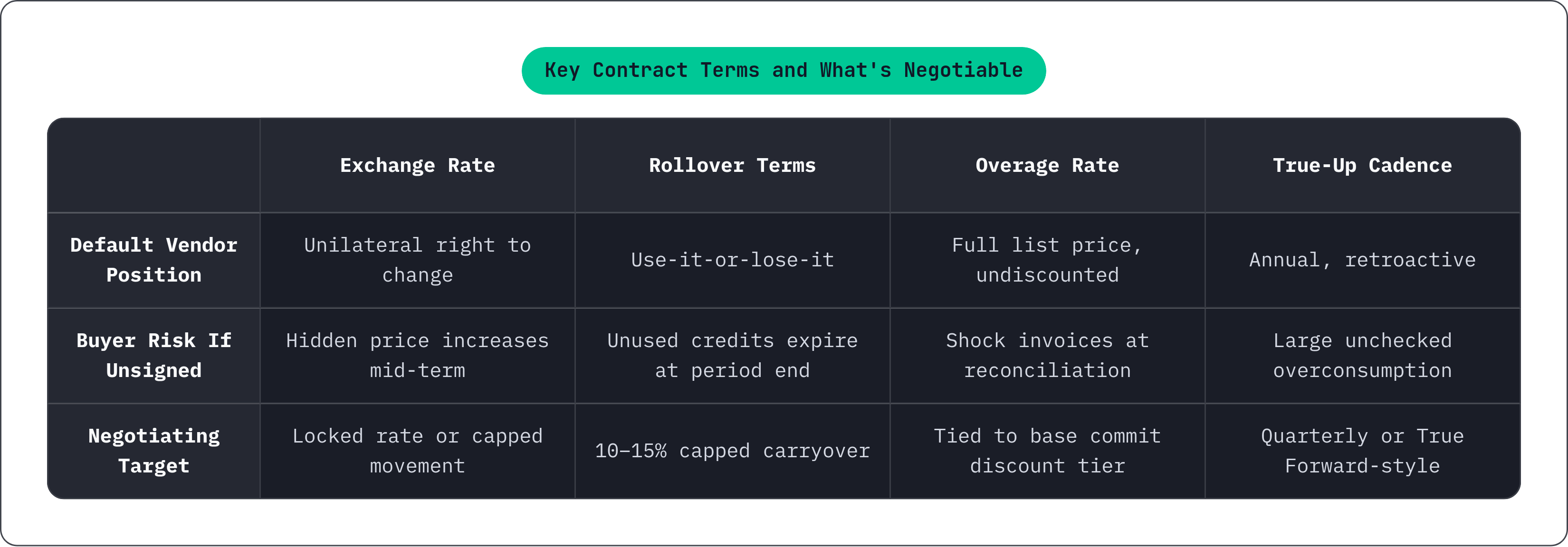
Everything covered above becomes a negotiating lever at the table, and most buyers don't realize how many of these terms are actually movable until they've already signed something worse.
Start with the exchange rate. It deserves far more scrutiny than it usually gets. A vendor that reserves unilateral rights to change credit multipliers has effectively reserved the right to raise prices without ever touching the sticker price. Push for a locked rate for the term, or at minimum a notice period and a cap on how far it can move.
Rollover terms are almost always negotiable, even when the initial draft reads as strict use-it-or-lose-it. A capped carryover, even 10 to 15 percent of the unused balance into the next period, meaningfully softens the penalty for a customer whose usage estimate ran high.
Overage rate matters more than either of those, probably, because it gets set once at signing and never revisited until renewal. Buyers with any leverage should push to tie overage pricing to the same discount tier as the base commit, rather than letting it default to list.
True-up cadence, and the choice between retroactive billing and a Cisco-style forward adjustment, round out the list. If you've been burned by a surprise retroactive invoice before, ask directly whether the vendor offers, or would consider, a True Forward-style mechanism. Not every vendor says yes. But asking the question signals you know what you're doing, and vendors serious about enterprise accounts increasingly treat it as a fair ask rather than an odd one.
None of this is exotic. It's fine print, the kind that decides whether a true-up feels like routine bookkeeping or an ambush. That difference comes down almost entirely to what got negotiated, and written down clearly, months before anyone touched the product.