Billing for Retrieval-Augmented Generation Pipelines
Five independent cost layers reshape RAG billing beyond simple per-query charges.

Most RAG billing systems are counting the wrong thing. They meter queries, but the costs they need to capture move across five independent dimensions, each with its own curve and its own billing primitive. The result is invoices that drift further from actual consumption as a system matures. This piece maps each cost layer to the metering design it demands, then shows what a billing architecture built for that reality looks like.
Why RAG pipelines generate costs that look nothing like subscription usage
The clearest evidence comes from a documented production case. Nothing in the subscription model predicted that gap. The gap showed up only in the five cost lines that subscription billing tools were never built to see.
The non-linearity is the core problem. Re-indexing can spike the bill without any change in user load at all. This is not a scaling problem. It is a structural mismatch between how RAG workloads generate costs and how most billing tools are designed to count them.
The five cost dimensions of a production RAG pipeline and why each one needs its own billing primitive
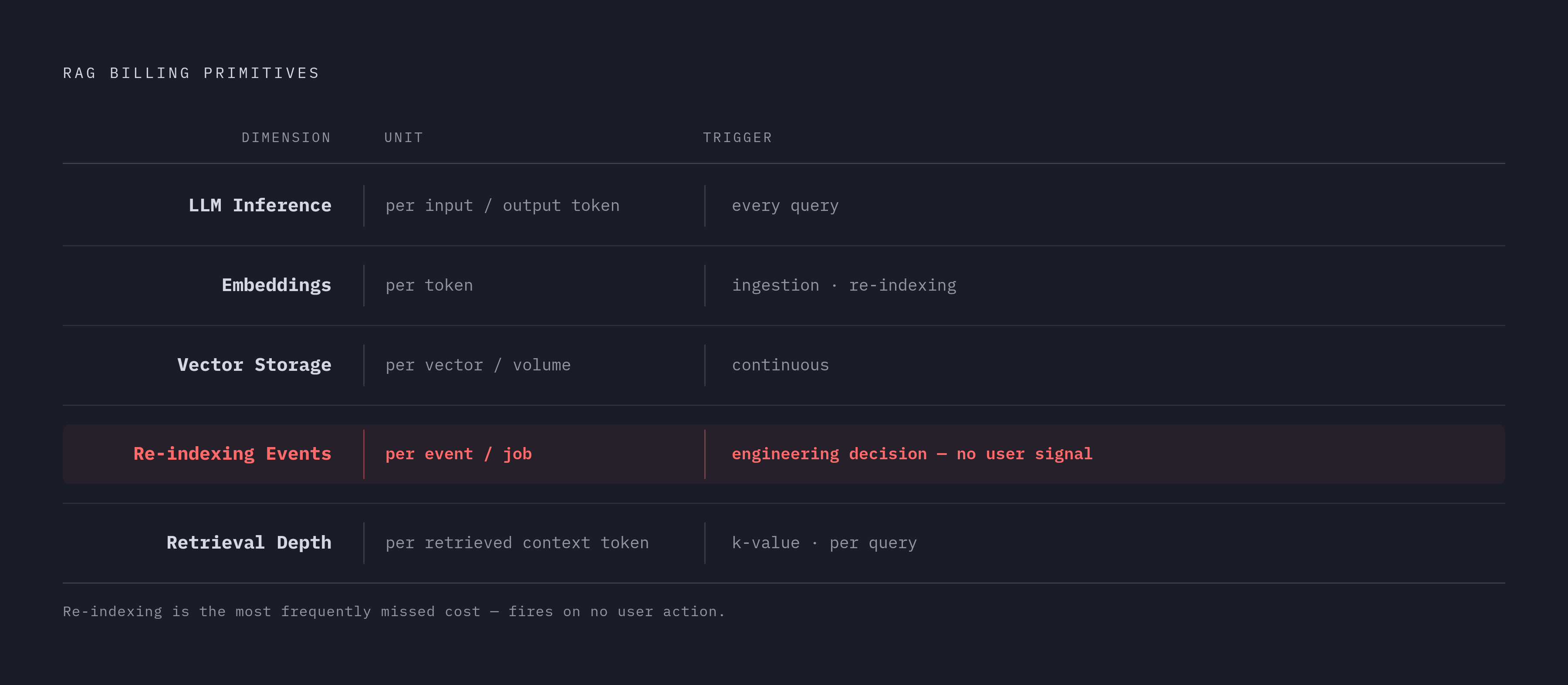
Each cost dimension in a production RAG pipeline has a different unit of measure, a different trigger event, and a different aggregation pattern. That means each requires a distinct billing primitive. The five dimensions sit side by side, and a billing system must hold all five meters at once.
LLM inference is billed per token, with input and output priced separately, and it is the dominant cost in most production deployments. The billing primitive is a token meter on the generation step, with separate rates for input and output tokens and a model identifier attached so model-routing produces accurate per-model attribution. At scale, generation cost is elastic. It grows with query volume, context size, and retry volume, making it the dimension most likely to produce invoice shock if metered on stale or batch-aggregated data.
Embeddings are billed per token at ingestion time. The billing primitive is a token meter scoped to embedding API calls, with event-level attribution so that a re-indexing event is distinguishable from routine query-time embedding. Without that attribution, the embedding meter cannot tell the difference between a steady trickle of daily ingestion and a full re-embedding of millions of documents.
Vector storage is billed by stored vector count or storage volume, often on a tiered schedule that jumps when a corpus crosses a size threshold. Kalvium's analysis identifies a vector DB tier jump around the multi-million-vector range as a recurring sprint-three surprise, a cost invisible in sprint-one estimates because they are written at sub-threshold scale. Storage cost accrues continuously even when no queries run, so a query-driven meter will systematically undercount it.
Re-indexing events are the most frequently missed cost dimension. The billing primitive is an event meter that fires on each re-index job, capturing corpus token volume at the moment the job runs, not averaged over the billing period. A re-indexing reserve line item belongs in any RAG budget where the corpus is likely to grow or evolve in schema.
Retrieval depth is the dimension most likely to make a flat per-query price structurally unworkable. The billing primitive is a per-query context-token meter that captures the actual retrieved token volume, not a fixed chunk-count assumption baked into the rate card at plan design time. Two queries at k=3 and k=8 are not the same billable event.
Why a flat per-query price cannot hold when retrieval depth is variable
Per-query pricing is the natural billing unit for RAG, and it becomes a revenue leak the moment k-value is configurable by the customer or tuned by the engineering team. A query at k=8 passes four thousand. That is nearly three times the inference cost at the same query count.
When the rate card prices on queries, k-value increases are invisible to revenue. The correct design is a two-part billing primitive: a per-query base charge plus a per-retrieved-token charge that captures actual context volume. It is structurally similar to a base subscription plus usage overage, but metered at the token level rather than the query level.
The objection that customers resist per-token pricing because it feels opaque has a specific answer. Usage dashboards showing real-time context consumption make the charge legible in a way a flat per-query price never can. The alternative is a flat per-query price that rises unpredictably at renewal, which produces worse trust outcomes than transparent metering would have.
Re-indexing events as billing events: how to meter a cost that is triggered by engineering decisions
Re-indexing is the dimension most likely to appear on a vendor's infrastructure cost report and never on a customer's invoice. It is triggered by engineering decisions rather than user actions, and billing systems that only fire on user-initiated requests will miss it entirely. None of them produces a user-facing signal that billing infrastructure can hook into by default.
The metering design requires an explicit re-index job event. The job ID is non-negotiable. The billing infrastructure must deduplicate on the stable job ID before aggregating anything.
For SaaS builders with multi-tenant RAG, attribute re-indexing cost to the tenant whose corpus triggered the event, not to all tenants pooled. That requires tenant-scoped event metadata on every re-index emission. Enterprise customers with large corpora will ask for re-indexing cost projections before signing, and if your billing design cannot produce a per-event cost, that conversation cannot happen.
The event ingestion architecture a RAG billing system requires
To bill a RAG pipeline accurately, you need a streaming event ingestion layer that captures billable events at the moment they occur. Batch aggregation on an invoicing schedule produces invoices that are structurally disconnected from actual consumption. Tokens accumulate at millisecond speeds during LLM inference, and a billing system that reads usage from an API at end-of-day or end-of-period has no way to produce real-time spend visibility, enforce budget limits, or prevent credit exhaustion mid-session.
The correct architecture has three layers. A pricing engine applies the rate card to aggregated totals. The architecture is an event pipeline optimized for high throughput, not a polling loop over an API counter.
Every billable event must carry a stable request_id for LLM inference calls or a job_id for re-index events, so that retry storms do not produce duplicate charges. A prepaid credit wallet requires its own financial object with rollover logic, expiry rules, tenant-level pooling, and real-time burn-down tracking, none of which an invoicing counter can model. The practical consequence for build-versus-buy decisions follows directly: building a production-grade metering layer for hybrid pricing, credit wallets, and revenue recognition is a meaningful engineering investment before maintenance even begins.
How semantic caching and model routing reshape the margin between what you pay and what you charge
Semantic caching and model routing are not just cost controls. Kalvium's analysis documents a semantic cache achieving a very high hit rate in a pre-seeded benchmark, with roughly four-fifths of requests routed to lower-cost models. The combination produced dramatic cost reduction at production query volumes.
The billing design implication is direct. That is the usage-based pricing monetization flywheel working correctly. The margin expansion is invisible to the pricing model.
Model routing creates a parallel problem. Pricing experimentation, testing whether tiered model routing or aggressive caching changes conversion or churn, requires a billing infrastructure that can change rate cards without an engineering deployment. A team that must open a ticket to adjust the price of a model tier cannot run pricing experiments at all.
Choosing between per-query, per-token, per-resolution, and hybrid rate cards for RAG products
No single billing unit can price a RAG workload accurately across all usage patterns. The right rate card design depends on which cost dimensions are most variable for a given product, and in most enterprise cases the answer is a committed minimum with usage overage. That requires billing infrastructure that can run both mechanics on the same engine.
Per-seat pricing is predictable and easy to sell, but it overcharges organizations with variable query patterns and provides no signal about actual consumption. The hybrid committed minimum plus usage overage is the dominant enterprise pattern. It requires billing infrastructure that can hold a base plan, a usage meter, and overage rate logic simultaneously, then generate a single coherent invoice that combines them.
For SaaS builders embedding RAG per customer tenant, a flat-bundle-per-tenant model trades margin upside for churn resistance. The structural constraint is that most subscription billing tools were designed for one of these models, not all of them simultaneously. If your product needs a base plan, a per-token overage, a per-tenant credit wallet, and a re-indexing event charge, you cannot model that on a platform built for annual seat renewals.
How prepaid credit wallets sit alongside postpaid invoicing in a RAG billing engine
Enterprise RAG buyers frequently require prepaid token credit wallets and postpaid invoicing on the same account. Billing infrastructure that models these as separate systems will produce reconciliation problems that fall on the finance team every month. The common enterprise pattern is a committed token or credit pool purchased upfront, consumed against LLM inference and embedding events in real time, with overages invoiced postpaid at the end of the billing period.
Credits are financial objects, not line items. The ASC 606 treatment is distinct. When a customer prepays for a pool of credits, the vendor has received cash for a performance obligation not yet satisfied. That is deferred revenue, a contract liability you draw down as credits are consumed against actual metered usage.
If you run the metering system, the credit wallet, and the invoicing engine on separate systems, revenue recognition becomes a reconciliation exercise, not a ledger property. The failure mode is not an accounting error but a systems architecture error. A billing platform that cannot simultaneously hold a prepaid credit balance and a postpaid invoice on the same customer record is not designed for the way AI and enterprise products are actually sold.
What accurate RAG invoices require from the billing infrastructure underneath them
An invoice that accurately reflects a RAG workload must be produced by billing infrastructure that can simultaneously hold five independent meters, apply a hybrid rate card across them, deduplicate retry events, manage credit wallet state, and generate the invoice without manual reconciliation. Most subscription billing platforms cannot do this. The five meters are specific: a per-token generation meter with model-level attribution, a per-token embedding meter scoped to ingestion events, a vector storage meter updated on ingestion rather than on queries, a re-indexing event meter with job-level deduplication, and a per-retrieved-token context meter capturing actual k-value-driven context volume per query.
The rate card must hold a base plan charge, per-unit rates for each of the five meters, a prepaid credit balance with burn-down logic, an overage rate that kicks in when credits are exhausted, and tenant-level attribution for multi-tenant products. Every billable event must carry a stable identifier so that retry storms, common at LLM endpoint timeouts, do not produce duplicate charges. A billing system without deduplication at the event level will systematically overcharge at scale. Real-time spend visibility is not optional. That is three codepaths reconciled manually every month, because none of them share a ledger.
Build vs. buy for RAG billing infrastructure: where the real cost accumulates
Building billing infrastructure for a RAG product looks tractable in sprint one, but by sprint three it becomes a permanent engineering obligation. The reason is the same one that makes the RAG cost model itself surprise teams: non-linear complexity only becomes visible after the first inflection point. The direct build cost is significant engineering time for a production-grade system handling hybrid pricing, credit wallets, and basic revenue recognition, before maintenance, expansion, and compliance overhead begin.
The maintenance burden is structural. The application emits billable events and the platform ingests and processes them. This is not the same as integrating a metering tool with a billing tool, which is two integration projects pretending to be one solution. The evaluation criterion that reveals the most about a billing platform's fitness for RAG workloads is whether its event ingestion API can accept a high-throughput stream of heterogeneous usage events, token counts, re-index jobs, storage updates, in a single call with a stable deduplication key.
Customer-facing spend visibility as a RAG pricing feature, not an afterthought
Real-time spend visibility is the feature that makes usage-based RAG pricing acceptable to enterprise buyers. Enterprise procurement and finance teams will not sign usage-based contracts without real-time dashboards showing token consumption, credit balance, and projected spend against budget. This is not a preference but a procurement requirement in most enterprise contexts. The five-dimension cost structure of RAG makes in-flight visibility especially important. They require real-time metering data flowing to a notification layer, which is only possible if the billing system ingests events as they happen rather than aggregating on a batch schedule.
For SaaS builders with multi-tenant RAG, per-tenant spend dashboards are both a product feature and a retention tool. Customers who can see their own consumption are less likely to dispute invoices and more likely to upgrade when they approach their credit limit naturally. The conclusion the entire argument leads to is this: billing infrastructure for RAG must be designed as a single system that meters events in real time, models multi-dimensional pricing, manages credit wallet state, and surfaces consumption to customers, not as three tools integrated together and reconciled manually at month end.