Hybrid Pricing Strategy for AI and SaaS Product Lines
Hybrid pricing layers usage or outcomes onto subscriptions to survive AI cost volatility.

Hybrid pricing, a subscription floor stacked with a usage or outcome layer, has become the working default for AI and SaaS products in 2026. Per-seat pricing isn't adapting to this shift so much as getting retired by it: companies still running pure per-seat models are pricing against a cost structure that no longer exists. What follows walks through the operational decisions behind a hybrid model that actually holds together: what to meter, how to reconcile prepaid credits with postpaid invoices, and how to keep the whole structure changeable as underlying costs keep moving.
Hybrid pricing as the default model for AI and SaaS products
Per-seat pricing assumes a human is doing the work a seat represents. AI breaks that assumption cleanly. When an agent resolves a support ticket or drafts a contract on its own, no seat gets consumed, yet the vendor still absorbs a real, variable inference cost to produce that outcome. Charge per seat in that world and the price comes loose from the cost structure. Gross margin now floats on a number, compute price, processing capacity, model choice, that the vendor doesn't control and often can't predict month to month.
The volatility isn't theoretical. Token prices fell roughly 80% year over year, and total AI spending grew 320% over the same stretch, a divergence that points to usage exploding faster than efficiency gains can offset it. Falling unit costs and rising aggregate spend at the same time means usage is exploding faster than efficiency gains can offset it. That's exactly the condition hybrid pricing survives and flat per-seat pricing doesn't.
Adoption still lags the need, and this is where most companies get the sequencing backwards. A High Alpha SaaS benchmarks report found 53% of companies still monetize exclusively through subscriptions, with only 42% having moved to usage-based or hybrid models. Companies read that gap as evidence hybrid pricing is optional, a frontier bet rather than table stakes. Read it the other way instead: it's a lagging indicator of how many billing stacks can't yet support what their own cost structure already demands. The gap is a backlog, not a choice, and that backlog produces the practical tension running through everything that follows.
"Hybrid pricing" and the four archetypes companies are choosing from
Hybrid pricing means a subscription floor that gives the vendor predictable recurring revenue, with one or more variable components layered on top that capture consumption or outcome value above that floor. The floor and the variable layer do different jobs. Confusing them is where most pricing redesigns go wrong, usually by asking the floor to absorb variable cost it was never built to carry.
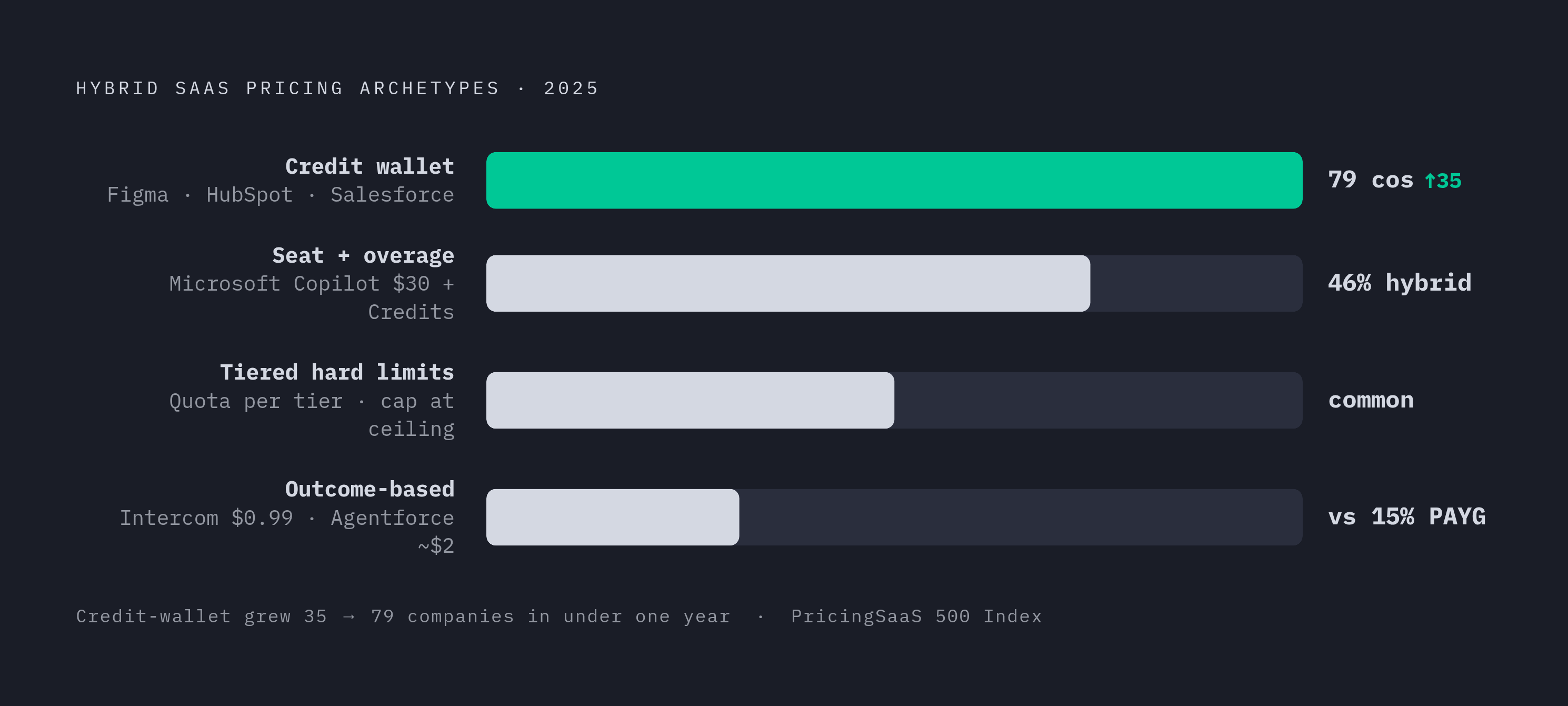
Four archetypes dominate the market, sitting on a spectrum rather than a ranked list. Seat-plus-usage-overage charges a flat per-seat fee and meters consumption above an included allocation: Microsoft Copilot runs this way, with a $30 per-user enterprise add-on alongside separately billed Copilot Credits for agentic workloads. Subscription-plus-credit-wallet sells a bundle of credits, often through the subscription itself, that customers draw down and top up when depleted. 79 of the 500 companies tracked in the PricingSaaS 500 Index now run this model, up from 35 at the end of 2024, and Figma, HubSpot, and Salesforce all adopted some version of it in 2025. Tiered usage with hard limits, the most familiar prosumer structure, sets subscription tiers against fixed usage quotas and either charges overage or caps consumption at the ceiling. Subscription-plus-outcome charges a base access fee plus a per-outcome fee on top: Intercom Fin charges $0.99 per resolution, Salesforce Agentforce roughly $2.
Across the market, 46% of SaaS companies now run some hybrid version of this, bundling usage into seat plans or stacking usage fees on top of them. Only 15% run a purely pay-as-you-go model. Hybrid is already the plurality behavior, not an emerging trend still waiting to prove itself, and treating it as optional is the wrong read of the data.
Pure token pricing deserves a separate mention, because it gets mistaken for a hybrid variant when it isn't one. OpenAI's model, running at roughly $4 per million input tokens and $20 per million output tokens on the current promotional rate, or $5 and $30 for GPT-5.5 at the standard tier, works because for OpenAI the inference is the product. A SaaS company built on top of inference, reselling a workflow rather than raw model access, inherits all the COGS volatility of that pricing without owning the lever that controls it. Copying token pricing because it looks simple means copying OpenAI's mechanism while missing the one thing that makes the mechanism survivable for OpenAI itself.
Choosing what to meter: the dimensions that belong in a hybrid model
Most teams start by asking what they can measure. That's backwards: most teams start by asking what they can measure, when the question that actually matters is what the customer experiences as the unit of value they're paying for. The question that actually matters is what the customer experiences as the unit of value they're paying for, and the two answers frequently diverge, sometimes badly enough to sink adoption.
Candidate dimensions vary by product. Tokens, metered separately for input and output the way OpenAI does it, make sense when inference cost dominates COGS and the customer has direct control over prompt volume. API calls or requests fit developer-tool products where the integration itself is the product being sold. Compute time, GPU-minutes or CPU-seconds, fits batch and training workloads where wall-clock time is the actual cost driver. Outcomes, a resolved ticket, a booked meeting, a qualified lead, fit products that own a workflow end to end and can define success in a way that's objectively countable.
Multi-dimensional metering, charging simultaneously on tokens, API calls, and compute time, is an infrastructure commitment. It's an infrastructure commitment. Each dimension needs its own independent aggregation pipeline, and teams that treat this as a configuration toggle rather than a systems build are the ones whose billing projects quietly balloon six months in.
The dimension that matters is the one that scales with infrastructure cost and stays legible to the buyer at the same time. A dimension that's accurate but opaque to the customer generates support tickets and disputed invoices. A dimension that's legible but doesn't track cost generates margin compression, slowly and invisibly, until someone in finance notices the gross margin line moved without anyone deciding it should.
Outcome-based metering is the frontier, and it's the hardest of the four to instrument correctly. It requires defining "resolved" with no ambiguity, capturing that signal reliably at whatever scale the product runs at, and getting the billing system to attach an arbitrary outcome metric to an invoice line. That third part remains a significant implementation challenge, which is one reason outcome pricing remains harder to implement than other metering approaches.
Structuring the subscription floor to do real work
The floor has two jobs at once: give the vendor revenue predictability and give the buyer something they can actually budget against. A floor that only does one of those jobs eventually gets renegotiated, usually by the party whose job didn't get done.
Good tier design assigns each tier to a specific buyer persona. A Free tier is for the individual kicking the tires. Starter is the small team. Professional is the growing company that suddenly needs SSO and real integrations. Enterprise is the organization that needs security review, compliance documentation, an SLA, and a contract that isn't a click-through.
Pricing benchmarks in the prosumer AI SaaS segment cluster fairly tightly. Starter plans run $15 to $29 a month with a limited quota, Pro plans run $49 to $79 with a more generous one, and Team or Scale plans run $99 to $199, combining higher quota with seat-based pricing on top. Overage, where it exists, tends to price at three to five times the vendor's per-unit infrastructure cost. Bootstrapped AI SaaS tools heading into 2026 show their top quartile settling on $29 to $99 a month as the primary paid tier, a fairly narrow band for what a serious individual or small-team buyer will pay upfront.
What the floor includes matters as much as what it costs, and this is where teams underprice their own design work. A base tier with a meaningful included-usage allocation, rather than a zero-usage floor that pushes everything into pay-as-you-go, converts what feels like an open-ended variable cost into something the buyer experiences as mostly fixed. That single choice reduces sales friction more than almost anything else on the pricing page, and it costs nothing but a bit of margin the vendor was probably going to lose to support tickets anyway.
Prepaid credit wallets alongside postpaid invoices: why this is one problem, not two
Enterprise AI customers frequently need both payment models running at once: a prepaid credit block covering self-serve AI usage, and a postpaid invoice covering committed platform fees and professional services. Treating these as two separate billing tracks that happen to belong to the same customer is a common mistake, and it's the wrong call. They have to reconcile onto one statement, because the customer experiences them as a single relationship, not two vendors sharing a logo.
The customer's actual requirement is simple to state and hard to build: visibility, at any moment, into how many credits remain, what's already been consumed, and what's going to land on the next invoice. Mix a prepaid paradigm with a postpaid one without a unified view sitting on top of both, and billing confusion compounds quickly, making disputed invoices far harder to resolve. Nobody, including the vendor's own support team, can answer "why does this number look like this" without pulling data from two different systems, and that lag is what turns a billing question into a churn risk.
Credit models earn their place for a real reason beyond convenience. They collect cash before usage happens, which helps the vendor's cash position. They create natural moments to upsell, as customers return to replenish their balances. And they give finance a defined liability to work with, but only if the underlying system tracks credit balance in real time rather than reconciling it in a nightly batch job.
The PricingSaaS 500 Index counts 79 companies now running credit-based pricing, and that number gets cited as proof the model has settled. It hasn't settled, since plenty of teams running credits privately treat them as a stopgap, especially where the mapping from credits to actual features consumed stays opaque to the buyer. Plenty of teams running credits privately treat them as a stopgap, especially where the mapping from credits to actual features consumed stays opaque to the buyer. A credit that doesn't map clearly to a unit of value is a promise to pay with extra steps, and buyers eventually notice.
The real-time metering infrastructure that hybrid pricing requires
Hybrid pricing lives or dies on stream processing: metering, aggregation, and rating applied to usage events as they arrive, not batch jobs that run once at the end of a billing period. Real-time dashboards, live spend alerts, and hard-limit enforcement that blocks a request the instant a credit balance hits zero all depend on that architecture existing before the pricing model gets designed, not after. That mistake is caused by designing the pricing model first and the metering pipeline second, and it appears in the first billing cycle, not the tenth.
Every metering system needs to get a small number of things right at the event level. Deduplication requires each event to carry a unique ID, because the same event arriving twice across a retry must not produce two billing records. Each event needs a source timestamp, the moment it actually occurred rather than the moment it arrived at the ingestion layer, since billing period cutoffs depend on that distinction, and clock skew between ingestion nodes can split an aggregation window in a way that quietly underbills a customer. Each event needs correct account mapping too, since a missing resource tag that routes usage to the wrong customer is one of the most common failure modes in production billing systems.
Three failure patterns recur often enough that teams should design against all three explicitly, not just the one that bit them last time. Duplicate ingestion after a retry can produce double billing that runs for hours before anyone notices. A service outage that drops part of the event stream can mean an entire customer-month goes unbilled. And a schema migration on the producer side, some client library updating its event format, can silently drop records and generate disputes weeks later when the invoice doesn't match what the customer expected.
Multi-dimensional metering multiplies all three risks rather than adding to them. Billing simultaneously on tokens, API calls, and compute time means three separate pipelines, each with its own failure surface, its own dedup logic, its own clock handling. That's the argument for purpose-built metering architecture over a general billing tool patched to handle a second or third dimension it was never built for.
Keeping pricing changeable as cost structures shift
a16z has documented commodity-tier LLM inference cost falling roughly 1,000x over three years, even as frontier-model pricing held its premium. That asymmetry means an outcome-based price set today against today's frontier COGS can become structurally mispriced within 12 to 18 months, without anyone at the company doing anything wrong. The market moves under the price, and the vendor may not notice.
At a roughly 10x-per-year inference deflation rate implied by that trajectory, a fixed AI price is a depreciating asset the moment it's set. Pricing in this environment has to be a lever that product and finance can pull without filing an engineering ticket, and companies that hardcode rate cards into application logic are the ones that find themselves quoting 2024 costs to 2026 customers.
Building for that requires a few specific things. Rate cards need to live outside the codebase, so changing a per-token price or an overage rate is a configuration change rather than a deployment. Plan versioning needs to support multiple concurrent rate structures, so existing customers can stay grandfathered at their old rate while new customers land on updated pricing, without forcing a mass migration event. Commitments and credit models need to be centralized enough that a monetization change doesn't require re-collecting payment details or migrating every subscriber on the same day.
None of this is purely a systems problem. The shift toward usage and outcome pricing forces a rethink of customer communication, sales compensation, and internal reporting at the same time it forces a rethink of the billing stack itself. When one changes, the others move too, planned or not.
Build vs. buy decisions for hybrid billing infrastructure
The build-versus-buy calculus turns on how many of the pieces above a team is prepared to own, permanently, not just for the initial launch. Real-time stream processing, multi-dimensional aggregation, credit-and-invoice reconciliation, and decoupled rate cards are each nontrivial on their own. Committing to build all of them in-house means committing an engineering team to billing infrastructure as a permanent product line, not a one-time project, and most teams underestimate that commitment by an order of magnitude.
Building it all makes sense for a company whose pricing model sits at the center of its competitive position and is unusual enough that no off-the-shelf system fits it well. It makes much less sense for a team that needs to ship a credit wallet and an outcome-based invoice line by next quarter and would rather spend engineering time on the product itself. That second team building from scratch is the more common mistake, because the work looks simple until a second metering dimension appears and an unplanned schema migration takes down a billing cycle. A range of billing platforms exist specifically to handle metering, credit balances, and rate-card versioning without a custom build, and the right call depends less on ideology than on how much of that infrastructure work is actually differentiated for the business doing it. For most teams, it isn't, and the honest move is admitting that before the second dimension appears in the cost structure rather than after.
Treating pricing as static once it launches is the one option that isn't defensible anymore, whichever path a team takes. The infrastructure supporting the pricing model has to support change as a routine operation, because the cost curves setting today's price will not look the same twelve months from now.