Deferred Revenue Accounting in Usage-Based SaaS
Usage-based SaaS demands metering infrastructure that subscription accounting never required.
Deferred revenue accounting was built for a world where payment arrives before service, and where service unfolds on a fixed calendar. Usage-based billing breaks that premise entirely: the amount a vendor is owed to recognize depends on what a customer does after the contract is signed. This piece traces that break from the accounting mechanics through to the metering infrastructure required to fix it, using real pricing changes at named companies as evidence along the way.
Deferred Revenue, Subscriptions, and Usage-Based Billing
A fixed annual subscription gives you one of the cleanest accounting problems in finance. A customer pays upfront, so the vendor books the full amount as a liability called deferred revenue, and each month a fixed slice of it converts into recognized revenue as service is delivered. There is no estimation involved because the delivery schedule is known the day the contract is signed: twelve months of service, twelve equal releases, a balance that declines in a straight line to zero. The accounting standard behind this, ASC 606 in the US and IFRS 15 internationally, requires that revenue be recognized as services are delivered, and under a subscription, delivery maps directly onto elapsed calendar time.
Usage-based billing removes that mapping. Where a subscription asks how much time has passed, consumption pricing asks how much was actually used, and that answer does not exist until after the fact. One developer discovered this the hard way when a single intense coding session generated a $7,225 invoice overnight, a number nobody, including the vendor, could have forecast at contract signing. That example captures the structural shift in miniature. A subscription's deferred revenue balance is just a passive schedule waiting to unwind. A consumption contract's deferred revenue balance is an active liability, and you can't know its release amount or its release timing until actual usage data arrives. So finance teams accustomed to subscription accounting inherit a system that assumes certainty where none exists anymore.
What ASC 606 requires when billing is variable
ASC 606 addresses variable pricing, but its rules on variable consideration are specific enough that teams carrying over subscription-era habits tend to misapply them. The standard's five-step framework still applies in full: identify the contract, identify the performance obligations within it, determine the transaction price, allocate that price across the obligations, and recognize revenue as each obligation is satisfied. Step three is where usage-based contracts diverge sharply from subscriptions. The transaction price is no longer a fixed number sitting in a contract line item. It includes variable consideration, whether that's token consumption, API calls, or compute minutes, and the standard requires that this variable amount be estimated and then constrained against the risk that a significant portion of it could later reverse.
The practical handling splits along one line: when usage is billed in arrears, revenue is recognized in the month the usage actually happens, and no estimation is needed, though the books cannot close until actual consumption data for the period is captured. When usage is billed through a prepaid credit pool or estimated overage, the constraint kicks in directly: a vendor can only recognize the portion of that prepayment that is highly probable not to reverse once real usage is measured. A vendor sitting on a prepaid credit deposit can't just drop the full amount into deferred revenue and release it on a preset schedule. Release timing is gated by actual consumption events, and that gating requires live metering data flowing into the accounting system before the close can happen. A metering platform built to track usage across prepaid credit pools in real time, the kind Flexprice was built to do, becomes necessary infrastructure once variable consideration enters the picture, because without that data feed, the constraint can't be applied with any confidence.
The standard adds a second complication for contracts that blend fixed and variable elements, and this is where most SaaS sub-ledger designs show a structural weakness. ASC 606 requires each performance obligation inside a multi-element contract to be tracked separately, and a single blended deferred revenue account does not satisfy that requirement. When a blended account is all a finance team has, and an auditor asks for a sub-schedule tying the balance to individual obligations, reconstructing that schedule after the fact is the kind of gap that triggers a restatement.
Pricing Changes and Accounting Consequences at Named Companies
Finance teams do not face the accounting complexity described above only someday. It has already landed on several companies that changed their pricing models in ways that quietly reshaped their balance sheets.
Windsurf retired its credit billing system entirely in March 2026, citing a flat credit rate that, in the company's own words, "charged the same rate for both simple and complex requests". In its place, Windsurf introduced quota-based plans with daily and weekly usage allowances that refresh automatically, and any overage is billed at API pricing. That shift from a prepaid credit model to a consumption model is not a cosmetic pricing update. It changes the liability structure on the balance sheet outright: a prepaid credit balance sitting in deferred revenue behaves differently from a usage allowance that resets weekly and bills overages separately, and Windsurf's finance team had to absorb that change in how the obligation is measured and released.
The pattern across cases like this is consistent: a decision that looks, from the outside, like a product or pricing team's call is simultaneously an accounting event. Pricing teams rarely loop in sub-ledger design when they redefine what a credit means or change the unit a customer is billed on, and the consequence lands on finance only after the new pricing is already live. The deeper problem lies in cadence. AI pricing models now redefine the billing unit itself, a token, a credit, an action, a resolution, every few months, and that pace is fundamentally incompatible with a deferred revenue schedule that was set up once, at contract inception, and never meant to be rebuilt mid-stream.
Sub-Ledger Design and Consumption Pricing
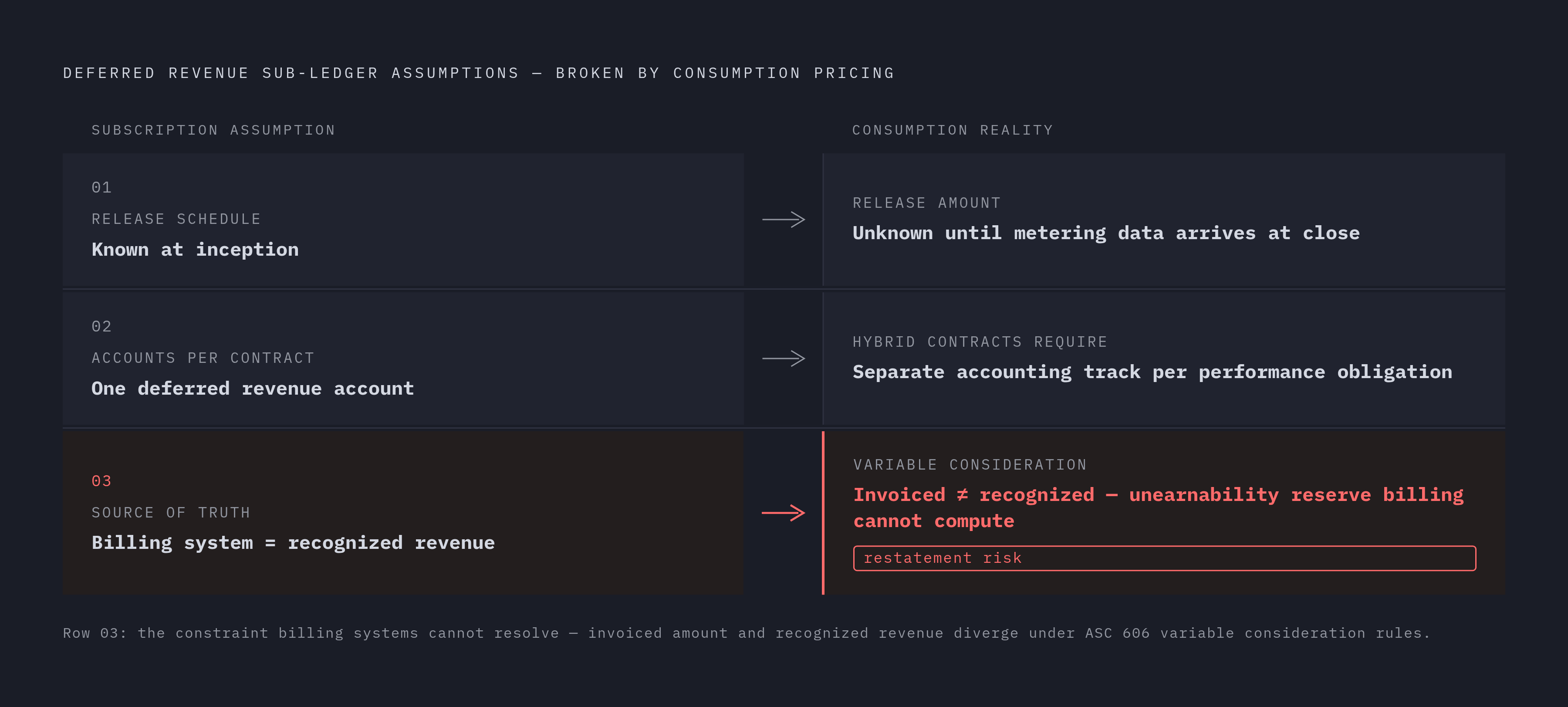
The deferred revenue sub-ledger that most SaaS finance teams run today was built around fixed schedules, and consumption pricing breaks three of its core assumptions at once.
The first assumption is that the release schedule is known at inception. A subscription sub-ledger pre-computes a monthly release amount the day the contract is signed. But under consumption pricing, you don't know the release amount for any given period until metering data arrives at close, so the sub-ledger simply cannot be populated in advance.
The second assumption is that one deferred revenue account per contract is enough. That holds for a pure subscription, where a single blended line captures everything that matters. But it does not hold for a hybrid seat-plus-usage contract, where each performance obligation needs its own accounting track, and a sub-ledger designed for ratable subscription release cannot produce that without manual patchwork.
The third assumption is that the billing system is the source of truth for how much to recognize. In subscription billing, the invoice amount and the period's recognized revenue are the same number. In consumption billing, they can differ, because variable consideration constraints may not yet have been lifted on part of the invoiced amount, and the sub-ledger needs to hold an unearnability reserve that the billing system has no way to compute on its own.
The audit exposure that follows is concrete. When auditors request a sub-schedule tying the deferred revenue balance to individual performance obligations, a finance team running a single blended account has to reconstruct that schedule retroactively, and booking annual prepayments upfront instead of recognizing revenue ratably is the single most common trigger for revenue restatements in SaaS. Teams that have patched around this with spreadsheet overlays sitting on top of the sub-ledger carry the same exposure: the overlay isn't something an auditor can independently verify, it doesn't reproduce the same result twice reliably, and it falls apart the moment the pricing model changes again.
All three broken assumptions produce the same structural fact: recognizing usage-contingent deferred revenue correctly requires the metering system and the accounting system to operate on the same event-level data, and most billing stacks were never wired that way. When metering and billing live in separate products connected by a data pipeline, any lag or error in that pipeline flows straight into the deferred revenue balance, and from there into the income statement. Finance teams running three separate billing codepaths, one for subscriptions, one for usage, one for prepaid credits, hit a reconciliation problem at month-end that isn't a process failure so much as the predictable result of running fragmented infrastructure. Usage-based billing forces finance teams to depend on engineering and product systems that can track actual consumption with precision, a dependency that exposes how many usage-based companies still lack a metering foundation wired directly into the accounting close.
What accurate recognition requires from the metering layer
If you want to release deferred revenue accurately under consumption pricing, your metering layer needs to hand the accounting system auditable, idempotent, real-time event data before the books close. Each API call, each token consumed, each compute minute used generates a discrete event, and that event is the atomic unit behind both the customer's invoice and the recognition calculation. Miscount it once, and both numbers are wrong together.
When you bill usage in arrears, recognition happens in the month the usage occurs, so the close cycle can't start until metering data for the full period is confirmed complete and accurate. The volume involved is substantial: production-grade metering has to handle millions of events per second at sub-second latency, and a widely used API product can generate traffic at exactly that scale, which puts real pressure on the ingestion layer.
Idempotency is not optional at this scale. If a network error causes a usage event to be sent twice, the system has to count it once, because over-billing inflates revenue and under-billing understates it, and either direction creates exposure to a later restatement. Stripe's own implementation guidance draws a useful line here, distinguishing billing meter event summaries, which exist for invoicing, from internal records, which exist for debugging, auditing, and showing customers their usage in real time. That distinction matters because the accounting system needs the finalized, aggregated consumption record to release deferred revenue correctly.
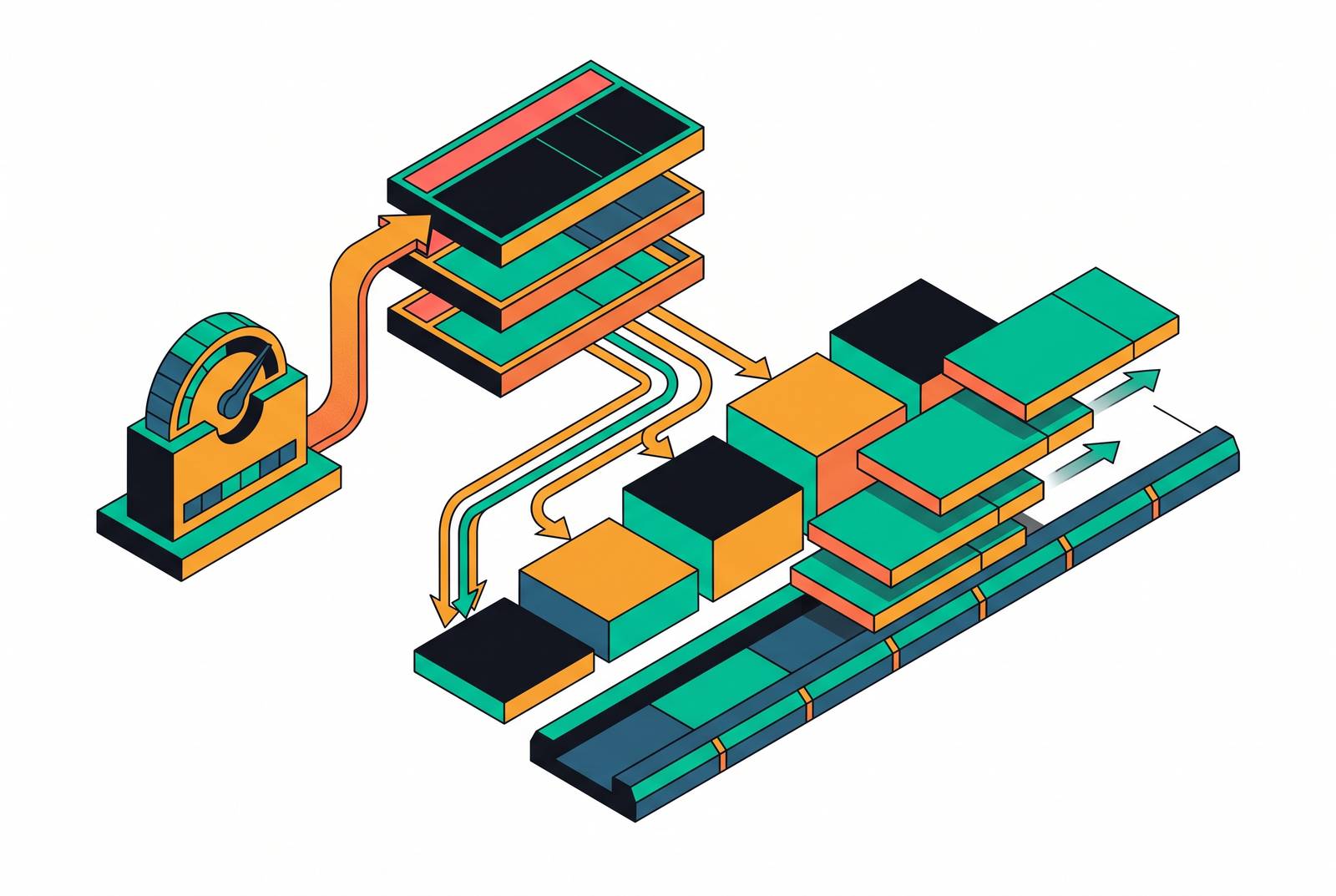
The architecture that supports this separates a hot path from a billing path. Events flow into a streaming transport, a stream processor updates a real-time store that feeds customer-facing dashboards and budget alerts, and the same events get forwarded to an ingestion API where the platform aggregates them for invoicing and for the accounting sub-ledger. That split exists for a specific reason tied directly to deferred revenue: releasing a liability against a real-time estimate that later gets trued up creates period-over-period adjustments that auditors notice and flag. The accounting system has to work from the finalized aggregate.
Mature Multi-Meter Accounting in Practice, at Companies Built Around Consumption Pricing
Companies that built consumption billing into their core model from the outset, rather than bolting it onto a subscription architecture built for something else, show that multi-dimensional usage pricing does not have to produce accounting chaos.
Datadog bills across three distinct usage vectors: its core monitoring product per host, log management per gigabyte ingested, and APM per host, and each of those vectors requires its own recognition treatment rather than a single blended calculation. Datadog posted strong revenue growth in 2025, with multiple usage dimensions expanding wallet share inside existing accounts, which is direct evidence that complexity, managed properly at the infrastructure level, produces durable revenue growth rather than the reconciliation nightmares that plague less disciplined setups. Snowflake runs a comparable model: it bills storage by the terabyte and compute separately, another case where distinct usage meters feed into one coherent set of books instead of a single estimated number.
What both companies demonstrate is that the number of usage dimensions is not itself the obstacle. The obstacle is whether the metering layer and the sub-ledger are designed together, from the start, to handle variable consideration the way ASC 606 requires, which prescribes recognition as services are delivered. Companies that get that pairing right can turn multi-meter pricing into a growth driver. Companies that don't inherit a subscription-era sub-ledger stretched past its design limits, and the audit consequences described throughout this piece are what fill that gap.