Credit Expiry Policies and Their Effect on Customer Retention
How you let credits expire determines whether customers feel trusted or cheated.

Every credit system contains a decision that gets treated as boilerplate but functions as a live retention lever: what happens to a credit when it goes unused. Get that decision wrong, and the same credit that made a customer feel like they were getting a deal becomes the exact thing that pushes them to cancel. Kyle Poyar's State of B2B Monetization Report 2025 found hybrid pricing, a base subscription paired with a usage meter, climbing from 27% to 41% of surveyed companies in a single year. Figma, HubSpot, and Salesforce all adopted credit models during that stretch, which means expiry policy is no longer a niche billing detail tucked into the terms of service. It sits at the center of how a growing share of software gets sold, and most companies are still designing it like an afterthought.
Nobel laureate Richard Thaler's work on mental accounting explains why credits work as well as they do in the first place. People don't treat money as one fungible pool. They sort it into separate mental buckets, and spending from a bucket labeled "already paid for" feels different, and easier, than spending from a bucket labeled "cash in hand." Credits exploit this directly. They abstract the moment of payment away from the moment of consumption, so using a credit doesn't feel like spending money, even though it is.
That same mechanism cuts the other way the moment a credit expires unused. The bucket that made the credit feel like a gift is the same bucket that makes its expiration feel like theft. A customer who never notices $40 of unused software capability disappearing from a line item will absolutely notice 400 credits vanishing at the end of a billing cycle, because the credit was mentally earmarked as theirs, not the vendor's.
Most companies still get the underlying signal backward: a short, hard expiry is a margin decision dressed up as a product decision, and customers read it correctly almost every time. It tells them the value of what they bought is contingent on how fast they use it, whether the vendor intends that message or not. Rollover with a cap says something gentler, that usage runs uneven and the vendor is willing to extend some trust within limits. No expiry at all is closer to a wager, one where the vendor bets on genuine engagement over manufactured urgency, and it reads to the customer as generosity, even as it quietly removes some of the pressure that drives habitual use.
Industry data shows 78% of IT leaders reported surprise AI-related charges in the past year, and expiry rules, alongside overage policy, are the two most common culprits behind that surprise. Design expiry purely as a margin-protection tool, ignore the fairness test the customer is running underneath it, and churn follows on a predictable delay. That tradeoff isn't symmetrical. Vendors who treat expiry as a pure finance decision are the ones who get blindsided by the cancellation numbers three months later.
The four expiry policy designs and the customer behavior each one produces
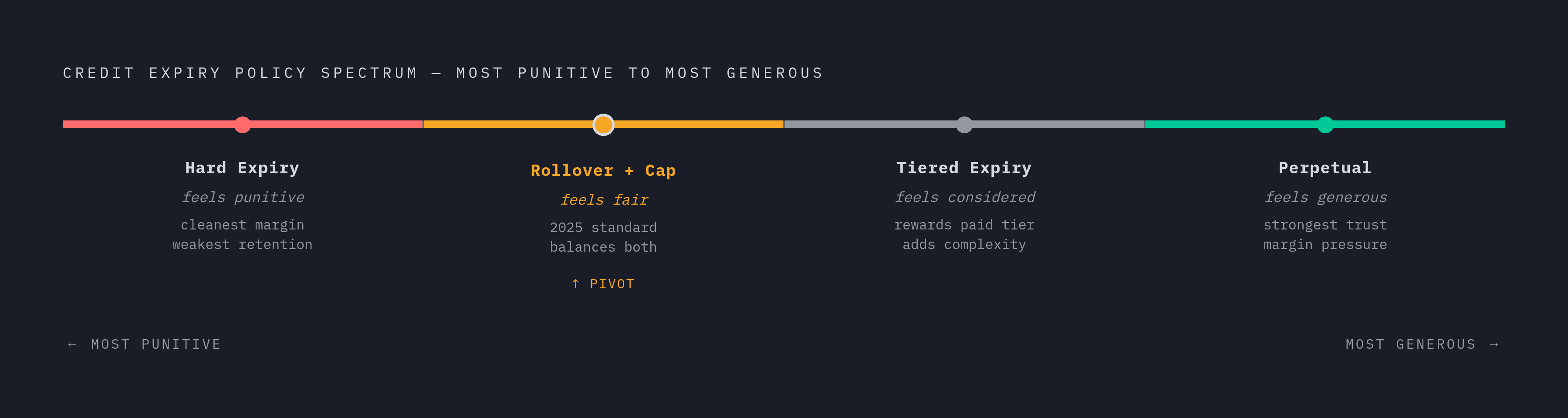
Hard expiry, the classic use-it-or-lose-it model on a monthly or annual clock, gives vendors the cleanest revenue recognition and the most predictable margin. It's also the weakest of the four designs, and not by a small margin. It reliably produces a spike in usage right before the deadline, followed by a drop in engagement the moment the deadline passes and the incentive disappears. Customers with genuinely variable workloads, which describes a large share of the customers AI products are built to serve, experience this model as punitive rather than fair. There's no version of hard expiry that reads as fair to a customer whose usage is naturally lumpy, because the model was never built with that customer in mind.
HubSpot's approach shows the same trap from the other direction. Cross the credit limit and the platform automatically upgrades the account to the next capacity tier for the remainder of the contract. That's not expiry in the traditional sense, but it's the identical failure in reverse: an automatic penalty triggered by usage patterns the customer didn't fully control. Set against the finding that 60% of vendors deliberately obscure rising prices by bundling AI features into existing plans, hard expiry starts to look less like a neutral billing mechanic and more like one tool in a broader opacity strategy.
Rollover with a cap has become the dominant middle-ground design in 2025, and it deserves that position. Gamma set its rollover cap at 2 times plan size, a design choice aimed at reducing customer anxiety about wasted credits. Lovable, at $200 million in ARR, added rollover credits in August as one of several pricing adjustments made alongside its broader monetization changes. The size of the cap does real work here: a 1.5x cap signals a company still keeping a tight hand on the wheel, while a 2x cap signals room to breathe. Rollover absorbs the volatility in how customers actually use AI products without erasing the incentive to upgrade, since credits still accumulate toward a ceiling rather than an endless pool.
Perpetual or non-expiring credits send the strongest trust signal of the four, mostly because they remove expiry as a churn trigger entirely. The tradeoff is real: without scarcity pressure, the behavioral nudge that drives habitual product use can go slack. This model works best where engagement is already driven by something other than a ticking clock, and it shows up far more often in prepaid top-up arrangements or enterprise committed-spend deals than in ordinary monthly plans.
Tiered expiry solves a different problem entirely. It lets a vendor use expiry as an upgrade signal without punishing the customers already paying for the privilege of staying. Free or trial credits expire fast, paid-plan credits roll over, and committed-spend credits carry no expiry at all. The tradeoff is complexity: customers on different tiers experience the product on genuinely different terms, and if that isn't communicated clearly, it generates confusion and support tickets in roughly equal measure. Consumption-based pricing from token-metered AI labs shows the enterprise version of this pattern well. List pricing runs per token, but enterprise buyers routinely negotiate committed-use deals with entirely different expiry logic attached. Tiered expiry is the enterprise norm, even when nobody calls it that on the pricing page, and of the four designs, it's the only one built to do more than one job at once. That's exactly why it becomes the default once a company reaches scale.
Why the retention math makes expiry policy worth engineering carefully
A 5% improvement in customer retention can lift profits by somewhere between 25% and 95%, according to widely cited retention research. That means even a modest fix to expiry policy sits on top of a genuinely outsized lever. Treating it as a minor operational detail is a mistake of scale, not just of judgment.
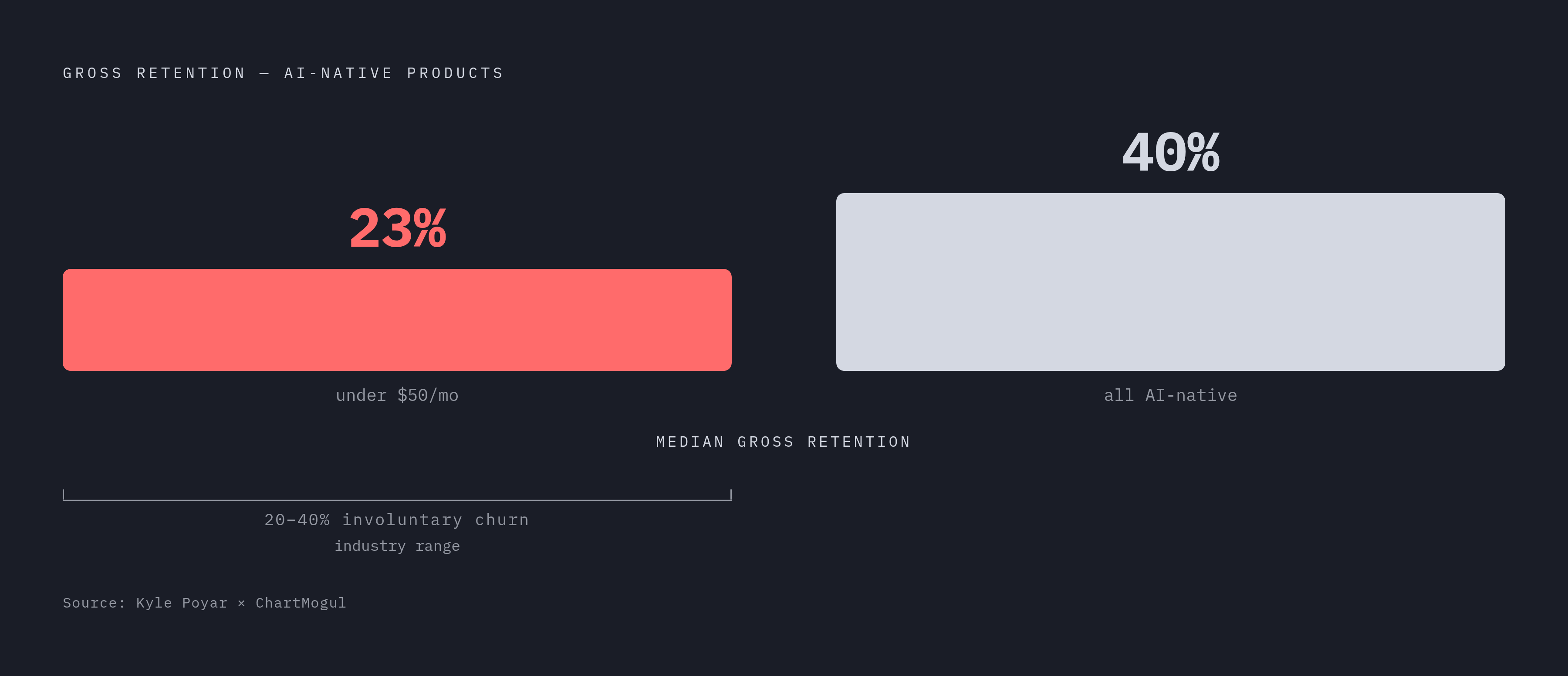
The number that should stop anyone building a credit system in their tracks comes from AI-native companies specifically. Median gross retention across AI-native companies sits at 40%, and for products priced under $50 a month, that figure drops to 23%, according to Kyle Poyar's analysis with ChartMogul. Cassie Young, General Partner at Primary Venture Partners, has called this the "gross retention apocalypse," and where gross retention is increasingly seen as the more revealing early signal of product-market fit. At 23% gross retention, expiry-triggered churn is a negligible factor. It's the main character in that number, eating most of the cohort before any other churn cause gets a turn.
Some of that loss gets miscategorized before anyone can even diagnose it. Involuntary churn, driven by failed payments, expired cards, or internal org changes on the customer's side, accounts for somewhere between 20% and 40% of total losses industry-wide. That figure doesn't capture the customer who cancels on purpose because they watched their credits evaporate and felt cheated. That churn gets filed under "voluntary" or "dissatisfaction" in most reporting, so the real cost of bad expiry design is almost certainly understated in the numbers companies use to evaluate their own pricing.
Bessemer's framing of the "renewal cliff" adds urgency here: deals signed in 2025 under first-wave AI enthusiasm are now coming up for renewal against actual usage data, not projected value. Every clause in that contract, expiry terms included, has to justify itself against what the customer actually got, not what they hoped they'd get when they signed.
The operational variables that expiry policy decisions depend on
Where a credit sits on the value chain changes how forgiving customers are about losing it. Credits tied to raw infrastructure inputs, tokens or GPU-minutes, feel fungible and abstract, and customers tend to tolerate their expiry with a shrug. Credits tied closer to a finished outcome, contacts nurtured, tickets resolved, feel concrete, and losing them reads as losing actual business value rather than losing compute nobody would have missed anyway.
Usage variability compounds this. AI workloads run spiky by nature: a customer might do nothing for three weeks and then fire off a large batch job in a single afternoon. A hard monthly expiry punishes precisely that rhythm, which happens to be the native rhythm of how people actually use AI tools. Vendors already know this about their own operations, since 73% of SaaS companies running usage-based models actively forecast variable revenue internally. The business already assumes lumpy consumption on its own books. Expiry policy that refuses to extend the same assumption to the customer's side of the ledger is simply inconsistent with what the vendor already knows to be true.
Billing mechanics set the stakes. Prepaid credit wallets turn expiry into the forfeiture of cash the customer already handed over, the highest-stakes version of this problem and the one most likely to generate real anger if the policy runs punitive. Postpaid or pay-as-you-go arrangements make expiry mostly irrelevant, since overage and cap design carry the real weight instead. Hybrid models, subscription plus credits, add a wrinkle where expiry interacts with renewal cadence: an annual-plan customer has a very different tolerance for monthly credit expiry than someone paying month to month.
Who actually owns this decision inside the company matters more than most teams admit. Per Verdantix's analysis, decisions about free credits, overage policy, and usage communication routinely get made by different teams pulling in different directions. Finance wants clean revenue recognition. Product wants engagement. Customer success wants renewals. An expiry policy designed by any one of those teams in isolation ends up optimized for that team's metric and nobody else's, and the customer absorbs the mismatch.
Metering sophistication sets the ceiling on all of it. A policy is only as good as the system enforcing it, and rolling over the wrong credit type, miscounting usage against the wrong bucket, or firing alerts off stale state are metering failures, not policy failures, even though customers experience them identically. AI agents generating thousands of events a minute can outrun a metering pipeline entirely. Enforcement ends up reading data that's already out of date, and a customer blows past a limit before the system even registers it happened.
A framework for choosing expiry policy based on product stage and customer segment
Three variables do most of the work in choosing the right policy. The first is usage predictability. Customers with regular, frequent usage patterns can handle hard or monthly-rollover expiry without much friction, since they're unlikely to get surprised by it. Customers with spiky, project-based, or exploratory usage need rollover with a generous cap, 2x plan size or more, as a floor, not a ceiling. Hard expiry systematically punishes exactly the usage pattern that's native to how AI tools get adopted, which is why it should be the exception on this segment, never the default.
The second variable is how close the credit sits to money the customer already paid. Prepaid wallets call for the most generous rollover terms available, since the customer has already transferred real cash and will feel its forfeiture as a direct financial loss, not an abstract inconvenience. Credits bundled into a subscription plan can tolerate a more moderate rollover policy, because they were perceived as a benefit layered on top of a purchase rather than a purchase in themselves. Free or trial credits are the one place where a short, hard expiry is not just acceptable but expected: the entire point of that credit is to create urgency toward an upgrade decision.
The third variable is product stage, and this is where most companies default to the wrong instinct. Early-stage, pre-product-market-fit companies should lean generous, not tight, because credit-based pricing is widely understood as a bridge model rather than a permanent architecture. Punitive expiry during the discovery phase of a customer relationship accelerates exactly the retention collapse the gross retention data describes, at the moment a company can least afford it. Growth-stage companies can start introducing rollover caps as a natural constraint, using expiry design to open upgrade conversations rather than trigger resentment. Enterprise and committed-spend accounts should treat expiry as a contract variable up for negotiation; generous rollover terms are a common negotiating point at that tier, a legitimate retention mechanism rather than a concession a vendor grudgingly grants.
The rollover cap itself is the single most useful tuning dial in the whole framework. Gamma's move from 1.5x to 2x is a concrete example of what recalibration looks like in practice: too low a cap and customers feel boxed in, too high and the cap stops functioning as an upgrade signal at all. The safer sequencing starts generous and tightens based on observed behavior, rather than starting tight and loosening only after the backlash arrives. Companies that do it in the opposite order are, in effect, asking customers to forgive a mistake instead of never making one in the first place.
Tiered expiry, finally, lets a single company run all of these approaches at once without contradiction. Free credits stay hard and short to create urgency. Paid-plan credits roll over with a moderate cap as a loyalty reward. Committed or enterprise credits carry perpetual or annual rollover as a retention anchor. Expiry does a different job at each stage of the customer lifecycle, and no single policy has to carry all three jobs at once.
The communication layer that determines whether good policy actually retains customers
None of the framework above matters if customers don't understand it. The recurring failure pattern in 2025 wasn't bad policy design so much as bad explanation. Companies rolled out credit systems, changed caps, or adjusted expiry terms without walking customers through the benefit, and the backlash that followed had less to do with the mechanics than with the silence around them. A generous policy explained poorly loses to a mediocre policy explained well, more often than pricing teams want to admit.
Cost previews close part of that gap. Showing a customer the credit cost of an action before they take it removes the surprise from the consumption side of the equation entirely, turning a system that feels opaque into one that feels predictable. Rollover and expiry alerts close the other part: a proactive warning sent before credits expire gives the customer time to actually use them, converting what would have been a silent loss into one more reason to open the product.
The policy and the communication around it aren't separate problems. They're the same problem, wearing two different departments' names. A company that gets the framework right but never tells its customers about it will lose the retention gains anyway, and it will never quite figure out why.