Preventing Credit Overdraft in High-Throughput AI APIs
Real-time enforcement blocks overdraft at request time, not after consumption happens.
Kyle Poyar's 2025 analysis found the number of companies using credit-based pricing in the PricingSaaS 500 Index jumped from 35 to 79 year-over-year, a 126% increase. That growth outran the enforcement infrastructure meant to support it, and most of that infrastructure fails quietly, in a specific and fixable way: it checks balances after the money's already spent. Zylo's research found 66.5% of IT leaders reported unexpected charges tied to consumption-based or AI pricing models. That number isn't the disease, it's a symptom, and the cure isn't better reconciliation. The cure is refusing to let batch metering anywhere near a credit limit in the first place.
An AI agent workflow can fire off thousands of events a minute. The metering pipeline lags by a few seconds, the enforcement layer reads a stale balance, and the customer blows past their limit before anyone, human or system, notices. By the time reconciliation catches it, the compute's already spent, and the only conversation left is who eats the cost. Systems that detect overdraft after the fact, through batch reconciliation or end-of-cycle invoice review, are not doing the same job as systems that block it at the moment a request comes in. They just look similar on a feature list. Any vendor selling the first kind as protection is selling detection with better branding, and the distinction is worth drawing sharply because the two get pitched interchangeably.
This gap matters more for AI workloads than it ever did for traditional SaaS, because token consumption isn't linear and agent workflows amplify themselves step by step. A single multi-step job can drain a wallet in seconds. The distance between when an event happens and when the system decides whether to allow it is where overdraft lives, and closing it takes four specific controls: real-time balance checks, pre-request validation, burst guards, and wallet-aware enforcement. Each handles a different slice of the timing problem, and none of them work alone.
How AI consumption patterns make overdraft structurally likely under batch metering
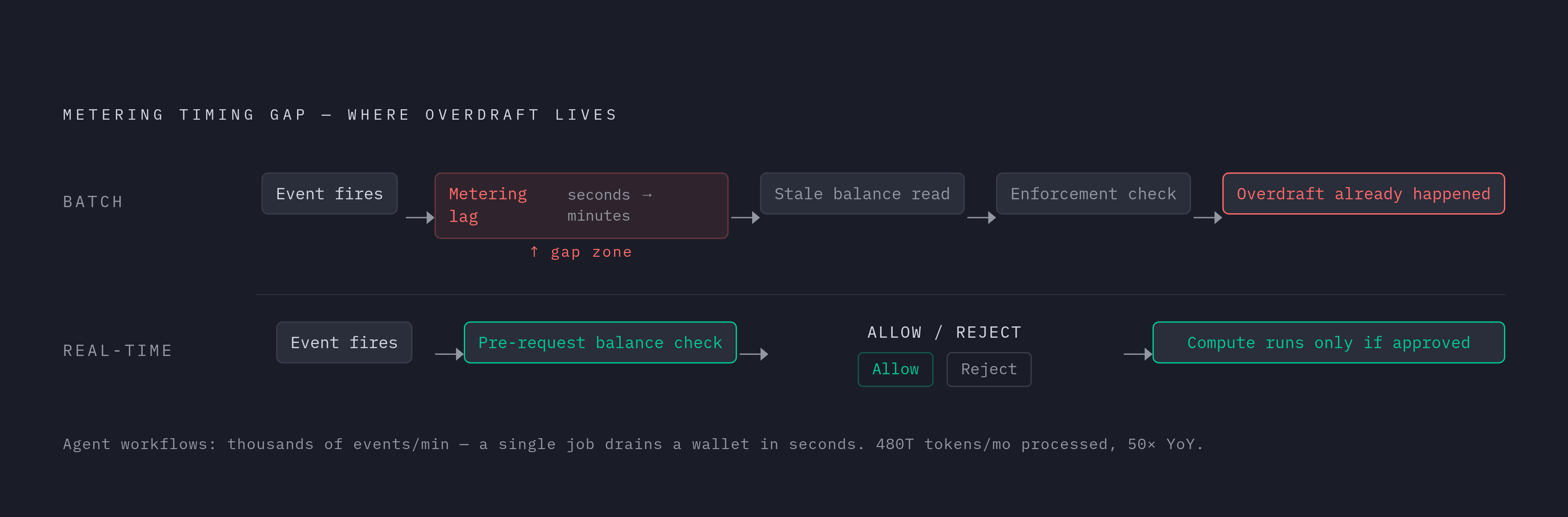
Google reported processing over 480 trillion tokens monthly as of I/O 2025, a fifty-fold jump from the year before. At that scale, a lag between event and enforcement that used to be tolerable for human-paced SaaS usage turns into a real structural exposure, not a rounding error.
The mechanism is straightforward once you name it. Batch or periodic metering reads usage from a store that's always some interval behind real time, by design. At high event rates, even a short polling window, seconds rather than minutes, opens enough space for consumption to blow past the limit before the check even fires. Multi-step agent workflows make it worse: each step can trigger downstream calls, so one user action multiplies into hundreds or thousands of billable events before any single one of them shows up in the enforced balance.
There's a related, more subtle failure worth naming directly: stale state. Enforcement logic that reads from a replica or a cache with write-behind delay isn't reading the customer's actual balance. It's reading the balance as it existed some number of milliseconds ago, and in high-throughput inference, that gap is exactly where overdraft happens. Nobody designed it to fail this way, it fails this way because replication lag was an acceptable trade-off for a slower system, and nobody revisited the trade-off once the system got faster.
Agentic workloads compound this in a way API-only workloads never did. A human-initiated API call has roughly human-paced retry behavior: a person waits, checks a result, tries again. An autonomous agent retries at machine speed, forks parallel sub-tasks without hesitation, and has no built-in pause between steps. Capgemini's research found 82% of organizations plan to integrate AI agents within one to three years, so agent-scale consumption isn't a future edge case anyone gets to plan around later. It's arriving now, on infrastructure mostly built for something slower.
None of this is purely a financial problem, either. It's a trust problem. The 66.5% of IT leaders already reporting unexpected charges are describing the exact pattern batch enforcement produces: an overdraft invoice that shows up weeks after the usage happened, with no chance for the customer to have stopped it, and no way to tell whether the charge is a bug or a business model.
Real-time balance checks: enforcing credit limits at the speed of the request
The design principle is simple to state and hard to build: the balance check has to resolve before the request proceeds, not after it completes. Enforcement that happens post-completion isn't enforcement, it's detection, and detection doesn't save anyone money.
Getting "real-time" to actually mean real-time takes specific infrastructure choices. Entitlement state needs to live in a low-latency read store, not the transactional billing database and not a read replica carrying replication lag. The check itself should resolve in-process or against a local cache, so upstream database latency doesn't get tacked onto every request. And the cache invalidation, whether write-through or write-around, has to guarantee that a deduction made by one node becomes visible to another node's enforcement layer within a bounded, known time window.
At the gate, the decision is binary: does the customer have enough balance to cover the estimated cost of this request? If not, reject it or queue it before any compute gets spent. That part's conceptually easy. The estimating is the hard part.
For token-based models, input tokens are known the moment the request comes in, but output tokens aren't knowable until generation finishes. Enforcement has to work off a worst-case or average estimate, built from historical patterns for that model and that customer. Underestimate, and soft overdraft creeps back in through the side door. Overestimate, and legitimate requests get rejected for no real reason, which frustrates paying customers just as much as an overdraft frustrates finance teams. Most systems land on a reservation pattern instead: pre-authorize an estimated amount, deduct the actual cost on completion, release the difference back to the wallet. It solves overdraft and over-rejection with the same mechanism, which is why it's become the default rather than one option among several.
One more piece matters here, and it gets skipped often: the check itself can't become a bottleneck. A configurable timeout with a defined fallback policy, whether that's fail open with logging, fail closed, or fall back to last known balance, keeps upstream latency from cascading into the whole application. This is the baseline layer. Pre-request validation and burst guards build on top of it, not around it.
Pre-request validation: blocking consumption before compute costs are incurred
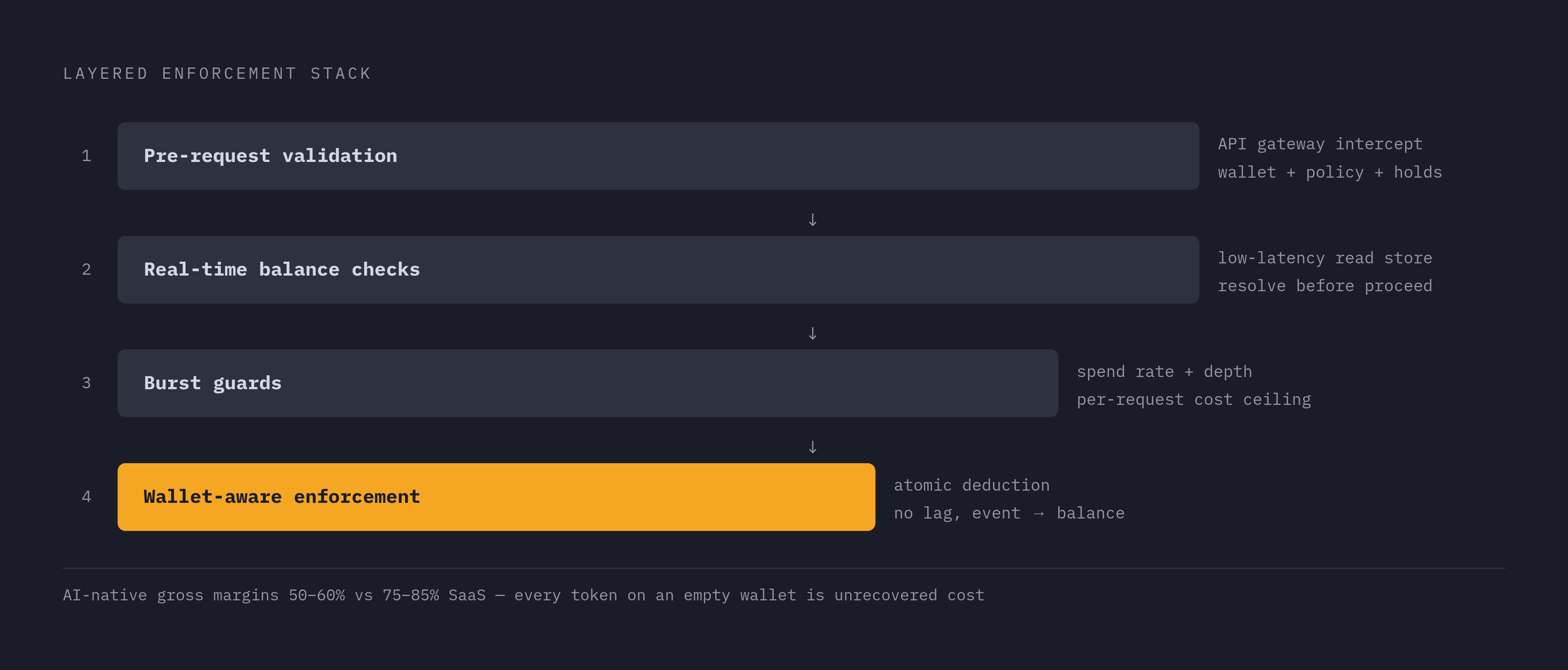
AI-native companies typically run gross margins of 50 to 60%, well below the 75 to 85% traditional SaaS companies see. Every token processed against an already-exhausted wallet is a direct cost with zero revenue attached to it. That margin gap is exactly why pre-request validation matters more here than it ever did in subscription software, where an extra API call barely moved the cost line.
Pre-request validation sits at the API gateway or middleware layer, ahead of model inference. It intercepts the request before any GPU cycle gets spent on something that can't be billed. The validator checks three things at once: the current wallet balance against the estimated cost, whether an overage policy is active (hard cap, soft cap, auto-top-up) and which rule applies, and whether other concurrent requests from the same customer already have holds in place that shrink the available balance further.
Two implementation patterns dominate, and they trade off directly against each other. A synchronous check inline at the gateway adds latency but gives the strongest guarantee. A cached entitlement token, issued at session start and refreshed on a fixed TTL, cuts per-request latency but opens a bounded overdraft window equal to that TTL. A 30-second TTL on a human-paced chat interface is a minor risk. That same 30-second TTL on a workflow firing thousands of calls a minute is a completely different exposure. Treating the two identically is the mistake most teams make when they copy a pattern from one product surface to another without checking the event rate first.
Google Workspace's admin controls are a useful reference point here. Admins decide whether users can exceed the monthly per-user credit limit at all, and if they enable it, overages accrue up to a cap the admin sets. That's pre-request policy, not after-the-fact reconciliation, a fairly clean example of opt-in overage handled at the policy layer instead of discovered on an invoice.
The failure response matters too. A structured error that states the remaining balance and offers a clear path forward, top up, upgrade, wait for the next reset, turns a hard stop into something a customer can act on, rather than a confusing dead end that reads like a bug.
Burst guards: handling the spike patterns specific to agent and batch workloads
Checking balance alone isn't enough, and this is the part most teams underbuild. A customer sitting on 100,000 credits can still overdraft if an agent workflow burns through 150,000 credits in 90 seconds, because the balance check passed at the start, when the balance was sufficient. Nothing constrained the rate of consumption, only the starting point, and a starting-point check tells you almost nothing about what happens ninety seconds later.
A proper burst guard controls three things: the rate of credit consumption per unit of time, not just the instantaneous balance; the depth of concurrent in-flight requests a single customer can hold at once, each carrying its own cost reservation; and a ceiling on the cost of any single request, so one abnormally large call can't eat a disproportionate share of remaining balance without triggering a separate review.
Token bucket and leaky bucket rate limiting, familiar from traditional API rate limiting, apply here too, but the unit changes. Standard rate limiting counts requests. Credit-aware rate limiting counts the cost of requests, and that distinction matters because a single large-context completion can cost as much as dozens of small ones combined. The bucket replenishes at a defined credit-spend rate, and requests that would overflow it get queued or rejected rather than waved through.
Idempotency deserves a mention because it's an easy thing to get wrong under pressure. At high throughput, retried requests from transient network failures can look identical to genuine bursts. Deduplicating events by a stable event ID keeps retry storms from triggering burst guards falsely, or from double-counting credit deductions that should have only happened once.
Scale dictates what's actually required at each stage, and skipping ahead doesn't help. At tens of millions of events a month, streaming pipelines with idempotent writes become necessary. At one hundred million events, dead-letter queues, replay capability, and tracing stop being optional. At one million transactions per second, the infrastructure starts to resemble what large-scale billing platforms run in production today. Burst guard design has to match the event rate a system will actually see, not the rate it saw at launch, because the rate at launch is never the rate six months later.
Wallet-aware enforcement: why credit wallets and usage billing cannot be separate systems
Separating the wallet from the metering system is the single most common architectural mistake in this space, and it's usually made for a reasonable-sounding reason: the teams that build metering and the teams that build billing rarely start as the same team. When the wallet and the metering system are separate, metering records events, the wallet tracks balances, and the two get reconciled on some periodic schedule. During that interval, the wallet has no idea what's actually been consumed, and the enforcement layer reads a number that doesn't reflect recent activity. That gap is a design flaw, not a bug, and no amount of tuning the reconciliation frequency fixes it, because the gap is structural to having two systems instead of one.
Wallet-aware enforcement closes it by requiring every metered event to write a deduction to the wallet atomically, so there's no lag between recording an event and the balance reflecting it. Prepaid and postpaid mechanics need to run through the same balance engine too. A customer holding a prepaid credit wallet alongside a postpaid overage policy needs the enforcement layer to know both the wallet balance and the overage headroom at the same instant, not as two separate lookups reconciled later.
Concurrency is the hard part, and it's where most naive implementations quietly break. Parallel requests from the same customer can't each independently check "sufficient balance," pass, and proceed, only to jointly exceed the limit because neither one accounted for the other. Two approaches handle this. Optimistic concurrency checks a balance version on read, writes with that expected version, and retries if it's changed, which is safe but adds round-trips under heavy parallelism. A reservation model instead has each request immediately reserve its estimated cost, reducing the available balance right away, so parallel requests see the reduced number and can't double-spend the same credits. For agent workloads firing dozens of parallel sub-tasks, the reservation model is the only one that scales without adding latency exactly where you can least afford it, and teams that default to optimistic concurrency here are usually solving for the wrong load profile.
Hybrid billing adds another layer worth naming. An AI product selling prepaid credit bundles alongside a standard subscription invoice, on the same engine, needs enforcement logic that understands both: which credits apply first, what the overage rate is once the wallet's empty, and when the system should stop deducting wallet credits and start accruing an invoice line item instead.
All of this needs to land in an immutable audit log: every deduction, every reservation, every release, written to a record that can't be altered after the fact. That log is the foundation for resolving billing disputes and for answering questions about unit economics with an actual record, not a reconstruction built from memory and best guesses after something's already gone wrong.
What breaks when enforcement is added to a platform not designed for it
A 2025 survey found 92% of AI companies using usage-based billing had changed their pricing model at least once since launch. Pricing changes happen constantly in this market, and an enforcement layer hard-coded to a specific pricing configuration breaks every single time that configuration shifts. Bolting enforcement onto a system that wasn't built to expect that churn isn't a shortcut. It's a recurring bill that comes due with every product decision.
The common failure pattern is easy to spot in retrospect: one tool records events, a separate tool generates invoices, and the two get stitched together as a custom pipeline someone on the team maintains until they leave and someone else inherits it. Enforcement in that setup requires the metering tool to query the billing tool's balance across a network boundary, and that adds both latency and consistency risk at precisely the layer that needs to be tightest.
A few specific failure modes show up again and again in retrofit architectures. The billing tool updates its balance at invoice generation time, not at event ingestion time, so enforcement reads a number that's days or weeks stale. The metering tool often has no concept of a wallet or a prepaid credit at all, it just counts events, which pushes enforcement decisions onto a third component that has to stay in sync with both systems by hand. And plan migrations force someone to update the enforcement layer manually; during that transition window, the system enforces old rules against new pricing, which produces overdraft, false rejections, or both at once for different customers on the same plan.
This pattern plays out repeatedly as AI products scale, with invoice errors eroding customer trust along the way. That's the real operational cost of enforcement bolted onto a platform that wasn't built for it, and it never shows up as one clean line item on a budget. It shows up as headcount, as support tickets, as churn nobody can quite trace back to its actual root cause.
The engineering cost compounds too, it doesn't stay flat. Carta's H1 2025 data put the average engineering hire at a startup at $189,000 base salary, with a fully loaded multiplier between 1.25x and 1.40x. Every pricing change, every new product line, every custom customer contract adds another round of manual updates to a retrofit system, and delays from building or fixing this kind of infrastructure in-house can push deployment back six to nine months.
The billing infrastructure properties that make these controls possible to run in production
None of the controls described above work unless the underlying metering layer can ingest events fast enough to keep the enforced balance close to the true balance at all times. A pipeline that falls behind under load isn't a minor performance issue, it's the exact overdraft window this entire piece has been describing, just relocated one layer down the stack.
Wallet deductions need to be atomic at ingestion time, full stop, not at rating time and not at invoice generation. Anything less, and the balance the enforcement layer reads is always a version of the past dressed up as the present, no matter how fast the rest of the system runs.
Pricing configurability without an engineering deploy in the loop matters just as much, and it's the property most retrofit systems lack entirely. With 92% of AI companies changing their pricing model at least once post-launch, a system where every pricing change requires a code deployment to update enforcement rules is a system that spends real time enforcing the wrong rules. That window, between when a pricing decision gets made and when enforcement actually reflects it, is a window where the numbers are simply wrong, and no amount of downstream reconciliation fixes what already happened while it was open.