Grandfathering Free Credits in Developer Onboarding Programs
Billing systems, not pricing memos, determine how credit grandfathering actually works.

Grandfathering free credits looks like a customer-relations problem, the kind a support rep settles in an afternoon with a canned email. It's actually an infrastructure decision wearing a policy costume, and most teams have that backwards. Every time a platform changes its onboarding credit terms, it creates two live populations running on two different rule sets at once, and what separates a clean split from a billing dispute is how the transition is executed. It's whether the system underneath can hold both cohorts without losing track of which user belongs to which era. The companies that get this backwards find out during a billing dispute nobody budgeted time to fix.
Free credits aren't one thing, either. Signup credits land automatically at account creation, no purchase needed. Promotional credits tie to a campaign or launch window and expire on a clock. Program credits, the kind handed out through startup programs, hackathons, or referral deals, run much larger and sometimes carry contractual terms attached. Grandfather one type and the other two don't automatically follow: each carries its own expiry logic, its own eligibility rules, its own exposure on the balance sheet. Nearly every monetization change a company makes will leave behind a cohort that needs to be grandfathered, migrated, or quietly wound down, and which of those three outcomes actually happens gets decided by what the billing system can hold, not by what the pricing memo says should happen.
How real platforms have already changed their credit terms, and what each change left behind
OpenAI phased out its historical $5 trial credit for most new signups in mid-2025. Accounts created after that point get zero automatic free credit. The stated reasoning was straightforward: cut down on abuse and filter for users with actual intent to build something. What's left runs through eligibility-gated paths instead of automatic grants. OpenAI for Startups offers $2,500 through a VC partner referral. OpenAI Grove offers $50,000 in API credit to a five-week cohort, bookended by in-person weeks in San Francisco with an asynchronous stretch in between. The Codex Open Source Fund offers up to $25,000 to qualifying maintainers, and Founder Stack via Ramp adds up to $2,500 more. None of that changes the fact that accounts opened before mid-2025 may still be sitting on legacy trial balances that don't exist for anyone who signed up after. The billing system has to know, for every account, which era it was born into.
Anthropic made a similar move on June 15, 2026, replacing flat-rate API evaluation access with a console credit pool and a one-time trial credit for new developers. Its Startup Program layers on eligibility rules of its own: institutional equity funding, a company founded within the last four years, no prior Anthropic startup credit already claimed. The credits only work on the first-party Claude API through Claude Console, not on AWS Bedrock, not on Google Vertex AI. That's a platform boundary, not just a dollar limit, and it means the billing system has to enforce where a credit can be spent, not only how much of it is left.
AWS took a third approach. Accounts opened after July 15, 2025 get up to $200 in promotional credit, but only $100 lands automatically at signup. The other $100 unlocks in $20 increments across five guided onboarding tasks, and the whole pool expires after 12 months. That's a wallet tracking two states at once: money already available and money earned but still pending completion of a task.
Three companies, three mechanisms, one shared pattern. Each change reads clean in the press release and creates a genuine operational question for the accounts that predate it, and the policy memo doesn't answer that question. Whatever the billing engine can actually do answers it, correctly or not. Tightening terms for new users while grandfathering the old ones at generous rates only works as a strategy if the infrastructure can contain the liability instead of letting it compound quietly in the background. Most companies write the press release before confirming the system can hold both cohorts at once, and that ordering is backwards.
The three grandfathering structures and what each one demands from a billing system
Three basic shapes cover most real-world approaches, and each asks something different of the system running underneath it.
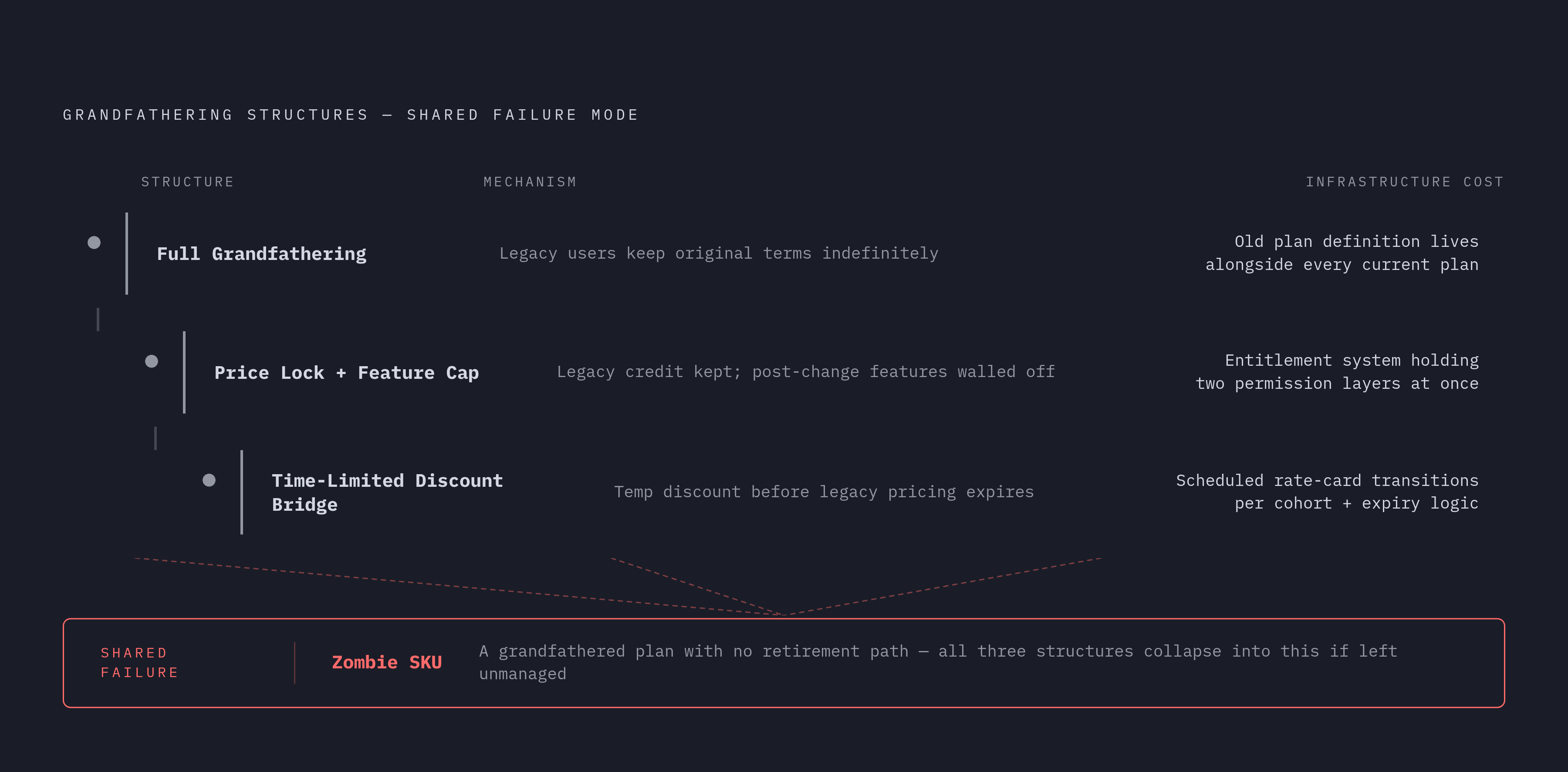
Full grandfathering keeps legacy users on their exact original terms indefinitely. It's the strongest trust signal available: nobody who joined early feels punished for it. It's also the structure most teams reach for by default, and that default is usually a mistake dressed up as generosity. The old plan definition has to live on forever alongside every current plan, and every future pricing change has to explicitly carve out the grandfathered cohort or risk overwriting it by accident. The revenue drag isn't static, either. It widens every time the current plan improves, since the gap between what legacy users pay and what the product is actually worth keeps growing.
Price lock with feature capping preserves the legacy credit terms but walls off anything released after the change behind a current plan. That creates a natural pull toward upgrading without forcing the issue, and it's a sharper tool than full grandfathering precisely because it doesn't try to freeze time indefinitely. It demands an entitlement system that can hold two permission layers at once: one that says "included in the legacy plan," one that says "available only on current." Get that logic wrong and legacy users either lose access they were promised or get features they were never sold.
A time-limited discount bridge moves users onto the new terms immediately but softens the landing with a temporary discount, six or twelve months, before the legacy pricing disappears for good. It's the cleanest route to actually retiring old SKUs, but it needs scheduled rate-card transitions per cohort, expiry logic on the discount itself, and a trigger that fires communications when the discount runs out.
All three share the same failure mode if left unmanaged: the zombie SKU. A grandfathered plan that never gets a retirement path clutters the quote flow, confuses support, and sits there as technical debt years after anyone remembers why it exists. The plan definition needs to separate from the selling window, so a legacy entitlement keeps working without the old plan ever showing up as something a new customer could purchase. And the choice among these three structures isn't purely strategic, whatever the pricing deck implies. A team whose system can't isolate cohorts by signup date or plan version doesn't choose full grandfathering. It defaults into it, because that's the only option the infrastructure can actually execute, and calling that a choice gives the team too much credit.
What plan versioning, wallet mechanics, and entitlement isolation actually require under the hood
Plan versioning means holding multiple versions of the same plan alive at once, each with its own rate card, its own credit amounts, its own expiry rules, its own set of attached features. Without that, a pricing change just propagates across every account on the plan, legacy or not, because nothing holds anyone in place. Versioning has to go deeper than plan tiers, too. It needs to isolate by signup-date cohort, since two users on the same nominal tier might be running on entirely different terms depending on when they joined.
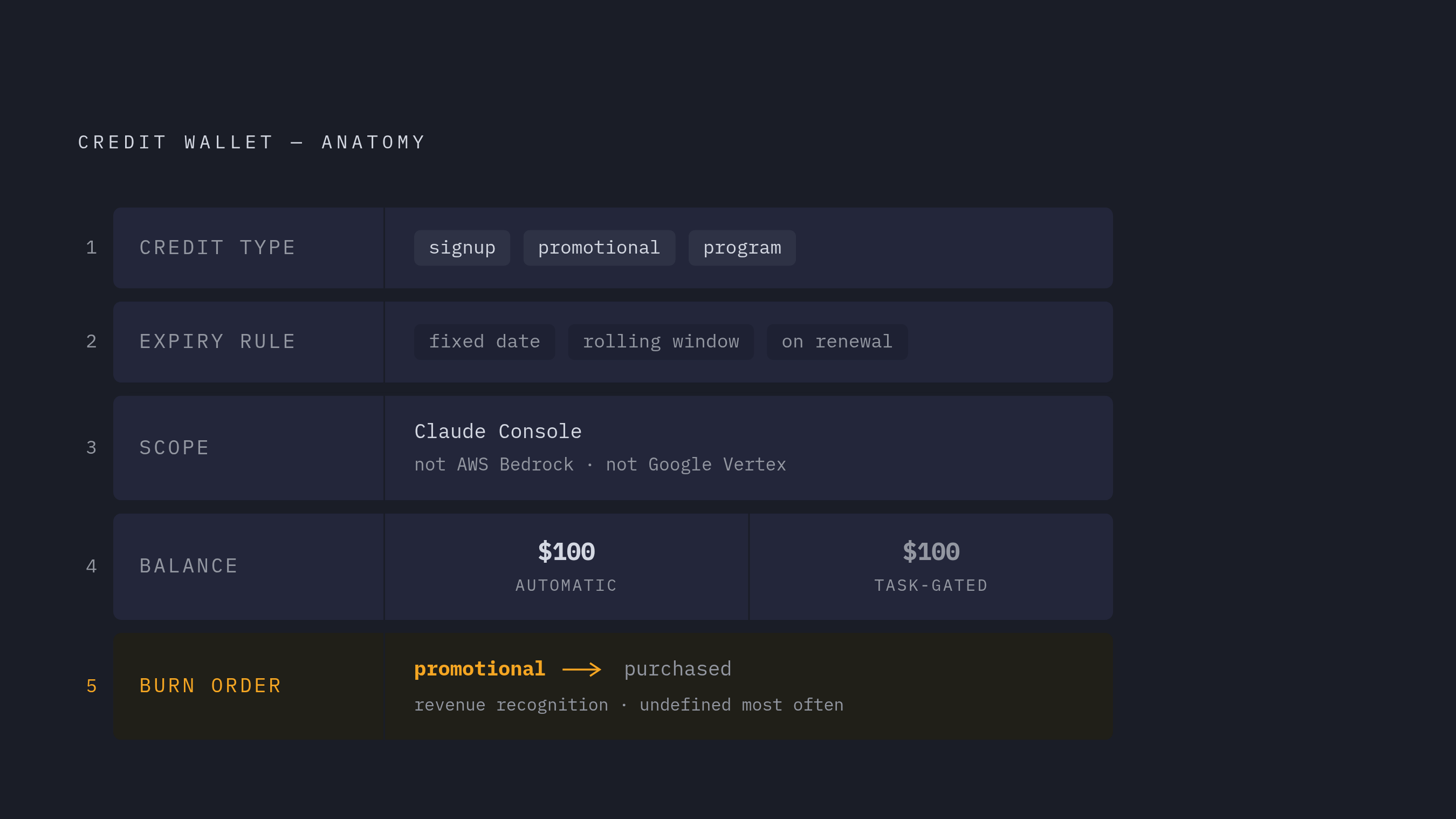
The credit wallet itself has to carry more than a single number. It needs a credit type field, signup, promotional, program, since grandfathering rules depend on which kind of credit is sitting in the balance. It needs an expiry rule, because some credits expire on a fixed calendar date, some on a rolling window from issuance, some on renewal. It needs a consumption scope, and the Anthropic case makes this concrete: credit valid on Claude Console and worthless on Bedrock or Vertex. It needs to separate earned balance from pending balance, the way AWS splits its $200 into $100 automatic and $100 task-gated. And it needs a defined burn order: when a user holds both leftover promotional credit and freshly purchased credit, the system has to know which drains first, because that ordering affects what the user experiences and how the company recognizes revenue.
Entitlement isolation decides what a user can actually touch, and it has to run independently of the rate card. A user on a grandfathered grant might have a different feature set than someone on the identical plan name who joined after the change, which means entitlement checks read plan version, not plan label.
Two more requirements sit underneath all of this, and skipping either one is where most homegrown systems quietly break. Idempotency: usage events tied to a grandfathered credit pool have to be deduplicated, because a retried network call counted twice against a finite legacy balance isn't a minor bug, it's an irreversible loss for the user. And mid-cycle handling: when a pricing change lands mid-billing-cycle, the system needs a clear answer for whether grandfathered credit applies retroactively to usage already logged that cycle or only going forward. That's not a call for a product manager to make on the fly. It's a decision baked into the data model, and a metering pipeline that just applies whatever the current rate card says to every past event will bill grandfathered users wrong, every single time.
How AI agent workloads stress-test grandfathering infrastructure beyond what subscription-era systems were designed for
Subscription billing was built for monthly cycles and predictable seat counts. AI agents don't behave that way, and pretending the old architecture scales down to agent workloads is where a lot of this breaks. A single multi-step agent workflow can throw off thousands of usage events a minute, and the metering pipeline has to attribute each one to the right credit pool as it happens, not in a batch job run at the end of the month.
That speed creates a specific failure mode: stale enforcement state. If aggregation lags behind ingestion even slightly, the system reads a grandfathered credit balance as healthy when it's already exhausted. The agent keeps running, the overage keeps piling up, and the correction only shows up after the damage is done. Hybrid pricing, a base subscription stacked with usage-based overages and promotional credit grants on the same account, makes this worse rather than better. When a grandfathered pool is just one of several active balances competing for burn priority, the ordering logic stops being a nice-to-have and becomes the difference between a correct invoice and a disputed one.
Outcome-based pricing adds a separate complication. A credit grant built around "outcomes delivered" doesn't map cleanly onto a wallet designed to count tokens. Legacy credit issued under a token-based system can't just get renamed into outcome units without an explicit migration step defining that conversion. Multi-dimensional pricing, tokens plus GPU-minutes plus audio minutes plus megapixels plus hardware tier, multiplies the problem further: a single legacy grant might cover some of those dimensions and not others, and the entitlement layer has to know exactly which.
None of this stays invisible to the user, either. Dashboards showing live credit balances have to match what the billing engine will actually charge, because a mismatch between the number on screen and the number on the invoice generates support tickets and bill shock in roughly equal measure. The fast, approximate aggregation running the dashboard and the slow, exact aggregation running the invoice have to stay in sync, even under the event volume an agent workload produces.
Migration tactics for moving legacy credit cohorts toward current pricing without triggering churn
A price increase past roughly 15 to 20% is usually the point where grandfathering or a phased migration stops being optional and starts being necessary to avoid shock-driven cancellations. Below that line, a time-limited discount is often enough.
Sequencing matters more than most teams expect, and most teams sequence it backwards. Migrate the smallest, lowest-risk cohorts first, not the biggest accounts. Early movers surface the confusing parts of the new billing model, the UX gaps, the edge cases, before any of it reaches a high-value customer who's already frustrated. Pair that with a voluntary opt-in phase ahead of any mandatory switch, offering bonus credits, a temporary rate cut, or early access to new features as the incentive, and let engaged users self-select into the new system first. Their friction points become the fix list before the rollout goes wide.
Annual subscribers deserve a harder rule: honor their existing pricing through the renewal date. It's a trust practice, and in B2B contracts it's frequently a contractual obligation, so any mandatory change needs a check against required notice periods before it ships. High-impact accounts are worth a transitional credit covering a cycle or two of the step-change in cost, framed as recognition of loyalty rather than a concession wrung out under pressure.
Two confirmed examples show how this plays out without a hard cutover. Zoom held grandfathered pricing in place until a customer actually needed more seats or new features, letting ordinary product growth start the upgrade conversation instead of forcing it. Adobe Creative Cloud offered legacy license holders incentives to move to a subscription model rather than forcing an abrupt cutover. Both let the system carry the ambiguity so the customer never had to feel it.
None of these tactics work without a system that can hold multiple plan states on the same account at once and trigger transitions off real events, such as a renewal date, a feature request, or a manual opt-in. A system that supports only one active plan version per account can't execute any of this cleanly, no matter how well the policy is written. Migration off legacy credit terms is an ongoing process without an end date. It's the start of an ongoing pricing motion that keeps demanding the same flexibility from the infrastructure, indefinitely.
What to look for in billing infrastructure that can hold grandfathered credit grants without collapsing as pricing evolves
Most legacy subscription billing tools share one disqualifying trait: they were built to hold a single plan state per account. Grandfathering breaks that assumption immediately, since it requires several plan versions active at once, each with an independent rate card, its own entitlement set, and its own wallet configuration.
Building this in-house is usually the wrong call. An in-house build eats months of engineering time and then sits there as permanent maintenance debt, and grandfathering is exactly the kind of complexity that turns a homegrown billing system into a long-term liability instead of a shortcut. Teams that underestimate it usually find out during the second or third pricing change, not the first, because the first change is the easy one. It's the one where only a single cohort split exists and the system hasn't yet been asked to hold three or four generations of plan terms at once.
A handful of capabilities separate infrastructure that can actually handle this from infrastructure that can't. Plan versioning with cohort isolation matters most: can a legacy plan stay active for one specific group of users without ever appearing as something a new customer could buy? A typed credit wallet comes next, one that separates signup, promotional, and program credit, each with its own expiry, scope, and burn order. An entitlement layer decoupled from the rate card has to govern feature access by plan version independently of the price applied to usage. Real-time ingestion with idempotency guarantees needs to land usage events against the correct versioned rate card the moment they happen, not after a batch job catches up. Enforcement has to read current balance state rather than a stale aggregate, since that gap is exactly where AI agent workloads run up overages before anyone notices.
Two more things round it out. Prepaid and postpaid billing need to run on the same engine, so a grandfathered credit grant can sit next to a conventional invoice on one account without a separate codepath bolted on. And rate cards and entitlements need to be adjustable by product and finance teams without an engineering ticket every time, because a system that requires code changes for every pricing tweak will always fall behind the pace at which pricing itself is now changing.