ACV vs. ARR for Usage-Based SaaS Contracts
Usage-based pricing breaks traditional metrics, so SaaS teams need different tools to track revenue.
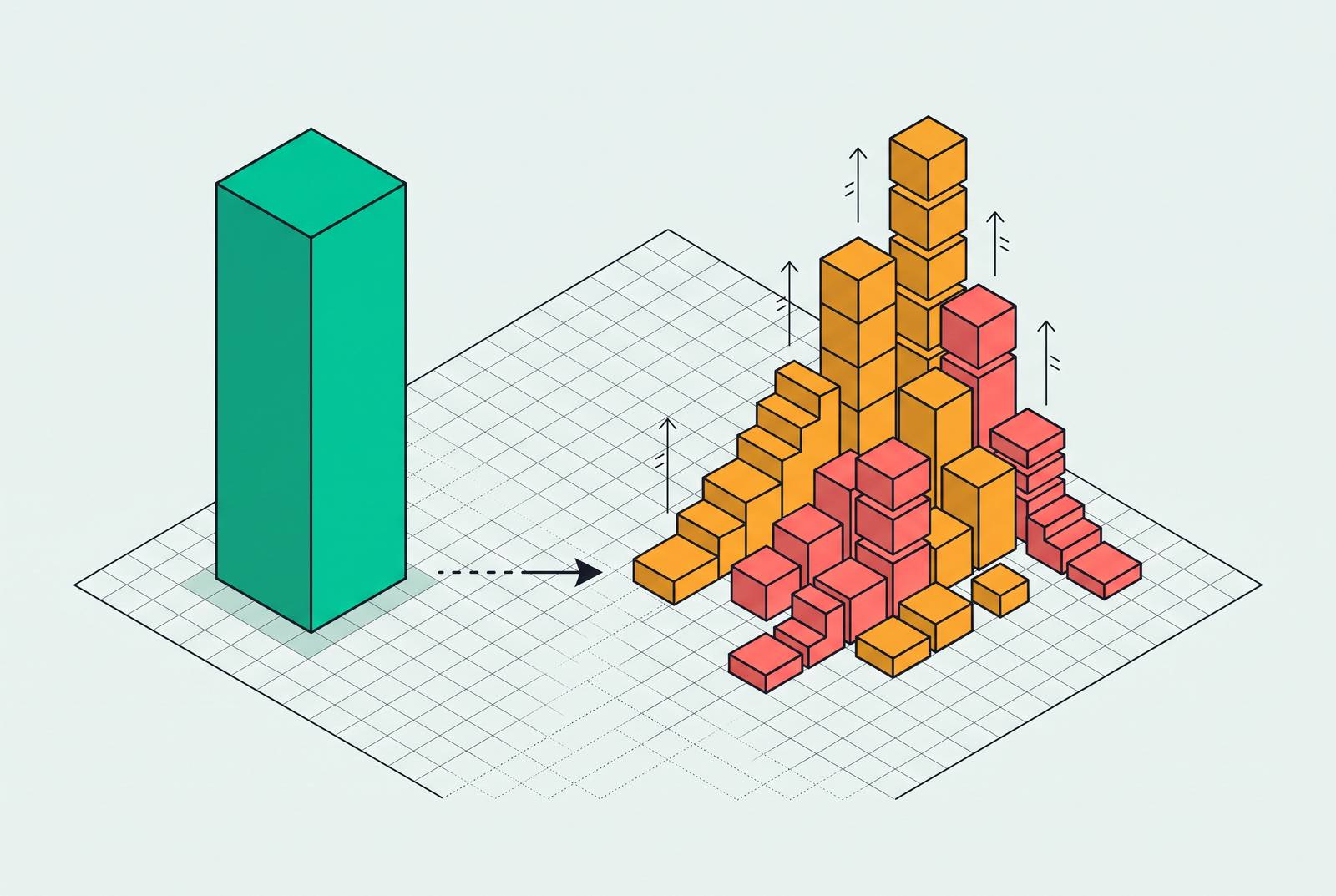
Usage-based pricing means revenue now expands or contracts with customer consumption, which is what ACV and ARR were not designed to handle. This piece walks through what each metric actually measures, where consumption-based billing snaps them, and what to track instead.
ACV and ARR: definitions and sources
Annual Contract Value is calculated by taking the total contract value, stripping out one-time fees, and dividing by the number of years in the contract. Setup charges, implementation costs, and one-off professional services don't belong in that number.
ARR works at a different altitude. It's the total recurring revenue a company expects from every active subscription across a twelve-month window, a company-wide run-rate rather than a per-deal figure.
The distinction matters more than most teams treat it. ACV zooms into individual contracts; ARR zooms out to the whole business, and they answer different questions and should never be used interchangeably. A company with a base of small-contract customers might show an ACV of just $2,400 per customer while its ARR is $12 million, and neither number alone tells you whether the business is healthy withorb.com. The most common failures here aren't exotic. Teams conflate TCV with ACV, treat gross ACV as if it were net, or let one-time fees creep into either metric, and inconsistent definitions across departments are a leading cause of the arguments that break out over board decks. ACV is the annualized recurring revenue of a single contract, normalized so a one-year deal and a five-year deal sit on equal footing. Key exclusions from ACV include setup fees, implementation charges, and one-time professional services, which belong in TCV, not ACV. ACV is closely tied to retention and churn, a rising ARR signals the recurring revenue engine is working, while flat or falling ARR signals contraction is dragging it down.
Use of Each Metric by Sales, Finance, and Investors
Sales teams treat ACV as the pulse check on deal quality. A pipeline that's growing in volume but showing declining ACV usually means reps are discounting harder or the customer mix is sliding downmarket. ACV also justifies spend: a business closing high-ACV deals can afford to invest more in sales headcount, onboarding, and customer success without worrying the unit economics won't hold. Benchmarks shift by segment, unsurprisingly. SMB-focused SaaS runs lower, mid-market higher, enterprise higher still, and median ACV for private B2B SaaS companies climbed to $26,265 in 2024 from $22,357 the year before, with the gain concentrated in mid-market and enterprise accounts nxcode.io getlago.com SaaS Capital.
Finance and investors read ARR as the headline. It anchors valuation multiples, informs hiring plans, and tells a board whether the business is compounding or stalling. What drives that trajectory is retention: research cited in Martal Group's guide found that moving Net Revenue Retention from the 90 to 100 percent range up into 100 to 110 percent improves median growth rates by 5 percentage points SaaS Capital. The two metrics earn their keep together. Rising ACV with steady ARR says contract sizes are growing while customer count holds flat. Rapid ARR growth against a stagnant ACV says volume is up but deal quality isn't improving, and reading the two side by side catches what either one hides on its own. Finance also has to separate gross ACV, which counts every new and expanded contract, from net ACV, which subtracts churn and downgrades. Bookings activity looks impressive on a gross basis and misleading on a net one, and it's the net figure that reflects actual recurring revenue growth.
Why usage-based pricing became the dominant model
The shift didn't happen because usage-based pricing sounded fairer. It happened because AI reintroduced real variable costs into software, inference, compute, tokens, GPU-minutes, that a flat per-seat subscription simply can't recover. Charge for the seat instead of the consumption, and the vendor eats every cost overrun quietly, on its own margin.
Six pricing models now dominate the AI software landscape: hybrid tiers, pure usage-based, credit pools, outcome-based, seat-based with add-ons, and freemium. Hybrid tiered pricing layered with usage or credit elements has become the most common approach going into 2026. Credit-based models in particular surged, growing 126% year-over-year in 2025, with 79 companies in the PricingSaaS 500 Index offering them by year's end compared with 35 the year before tropicapp.io nxcode.io getlago.com. Even so, credits are widely understood inside the industry as a stopgap rather than a durable architecture, a way to buy time while teams figure out what billing unit actually maps to value tropicapp.io nxcode.io getlago.com.
The structural consequence outweighs any single pricing trend. Revenue used to lock in at the moment of signature. Now it expands or contracts with how much a customer actually consumes, month over month, and that's precisely the behavior ACV and ARR were never built to track. Hybrid models, subscription plus usage, post a 21% median growth rate, the highest of any pricing architecture measured, which explains why so few companies run a pure model anymore medium.com.
How usage-based billing breaks ACV at the deal level
ACV captures a promise made at signing. Usage-based pricing makes that promise conditional on behavior that hasn't happened yet, so the contracted ACV and the revenue a contract actually generates in a given year can pull apart substantially. That gap represents a substantial and deliberate divergence, not a trivial discrepancy. It's the entire point of usage-based pricing, and it means the number sales reported to finance on close day may bear only a loose resemblance to the figure that appears on the income statement eleven months later.
Compensation plans feel this first. Traditional ACV-based commission structures reward revenue recognized at signing, but usage-based revenue accrues gradually, through consumption, so reps end up closing deals that look small on paper but might triple in value over the contract term. Rationally, a rep paid on booked ACV will always prefer the safer subscription deal. Multi-year prepaid contracts create a mirror-image distortion: they inflate the ACV reported in the signing year, which makes year-over-year comparisons misleading unless someone normalizes for it.
The Cursor incident from July 2025 shows how far this can go nxcode.io digitalapplied.com. A single developer ran up a $7,225 invoice in one day after a teammate burned through 500 requests on an annually-billed plan, and a post describing the incident pulled in 797,000 views within a week nxcode.io digitalapplied.com. Nobody's billing system malfunctioned. The pricing architecture simply produced a deal-level outcome that no ACV figure calculated at signing could have anticipated. ACV still holds up cleanly in one case: enterprise deals with a committed minimum spend keep a guaranteed floor regardless of consumption, and it's only in the absence of that floor that usage-based billing actually breaks the metric. For usage-based contracts, teams need to track both contracted ACV and consumed ACV (the contracted minimum or baseline ACV and the actual annualized consumption trajectory), since treating them as the same number produces a false picture of deal economics.
How usage-based billing strains ARR at the portfolio level
ARR's entire premise rests on the "R," the assumption that recurring revenue is both predictable and repeatable. Usage-based billing chips away at that assumption every time consumption varies by customer, by month, and by which feature someone happened to use. For usage-based contracts, one unusually heavy or unusually light month can throw off the annualized number for the other eleven.
Churn gets murkier too. In a subscription business, a canceled account is a clean subtraction from ARR. In a usage-based business, a customer who simply stops consuming, without formally canceling anything, sits in a gray zone that nobody's dashboard resolves cleanly: is that churn, contraction, or just a slow quarter? The industry has largely admitted defeat on solving this with ARR alone. 73% of SaaS companies running usage-based models already run a separate forecasting layer for variable revenue, on top of whatever ARR figure they report, because they've accepted that ARR by itself isn't predictive enough to plan around medium.com.
The specific edge cases that expose both metrics simultaneously
Hybrid contracts, a base subscription plus a usage tier, are the most common case and the messiest one. Part of the revenue feeds ARR cleanly, and part of it is genuinely variable, and getting the split right requires two parallel accounting treatments that most finance teams handle inconsistently from customer to customer.
Prepaid credit wallets add another layer. A customer buys a block of credits upfront, which sits as deferred revenue rather than ARR, and draws it down over the following months. When that pool runs dry mid-year and the account flips to postpaid billing, the revenue recognition pattern changes mid-contract with no corresponding deal event to trigger an ACV update anywhere in the system. Windsurf's experience with credit billing is instructive here. The company retired its flat-rate credit system in March 2026, citing the fact that a flat rate charged the same amount for a simple request and a complex one, and moved to quota-based billing instead. That's a problem with the pricing unit itself, not with the metrics. No refinement to ACV or ARR reporting would have caught it, because the flaw sat upstream, in the pricing unit itself.
Multi-dimensional pricing compounds the confusion further. A product billing simultaneously across tokens, GPU-minutes, audio minutes, and hardware tiers produces a consumed-revenue figure that depends entirely on which features a given customer leaned on and in what mix. A single ACV number flattens all of that into one line and hides which dimensions are actually driving value. Even the most carefully structured enterprise deals aren't immune. Committed-spend contracts with true-up mechanisms preserve a contracted ACV floor, but the true-up revenue generated above that floor recurs in practice and falls into an accounting gray zone where ARR reporting doesn't quite know what to do with it.
Metrics Finance and Sales Teams Need to Track Instead (or Alongside)
None of this means throwing ACV and ARR out. It means redefining what each term refers to and building companion metrics around them. Keeping both visible turns the gap between commitment and consumption into something a customer success team can act on before renewal, rather than a surprise that appears in the numbers three months too late.
ARR needs a similar split. Separate contracted ARR, the sum of guaranteed minimums across every active contract, from run-rate ARR, the annualized figure based on actual consumption. The spread between contracted ARR and run-rate ARR is itself a useful number: it's a measure of consumption risk or upside. Expansion ARR deserves its own line too, distinct from new ARR, because in a usage-based business, expansion from existing accounts is usually the primary growth engine, and folding it into a single total ARR figure hides the mechanism doing most of the work. It also helps to report ARR against a trailing three-month consumption average instead of a single month's run-rate, since a single month is unrepresentative and volatile.
None of these adaptations work in isolation, though. Usage-based businesses need a handful of metrics alongside ACV and ARR, not instead of them. Net Revenue Retention remains the single most important companion figure, since it captures expansion, contraction, and churn all in one number; SaaS Capital research cited in sources found that improving NRR from the 90-100% band into the 100-110% band improves median growth rates by 5 percentage points. Usage penetration rate, the share of a customer's contracted capacity or purchased credits they're actually burning through, works as an early warning system for churn risk and expansion potential well before either appears in an ARR report. Time-to-consumption, how quickly a new customer starts generating usage events, correlates with onboarding quality and predicts whether the contracted ACV will ever be realized in practice. And compensation has to change alongside the metrics. Reps paid purely on ACV-at-signing will rationally steer customers toward subscription deals and resist usage-based contracts that take months to mature into real commission, so comp plans need to reward consumption ramp directly. Contracted ACV is the guaranteed minimum annual value at signing (what the deal is worth regardless of consumption). Consumed ACV is the annualized value of actual usage to date, tracking whether the customer is on a trajectory to hit, exceed, or fall short of the contracted figure.
What the billing infrastructure underneath these metrics must do
If the usage data underneath these adapted metrics is wrong, the metrics themselves produce false readings. Metering errors account for an estimated 3 to 7% of annual billing leakage across usage-based SaaS businesses, and a team comparing consumed ACV against contracted ACV is working from a corrupted baseline the moment its event pipeline starts losing or duplicating events getlago.com. That's not a rounding concern, and it's the foundation the whole reporting structure sits on.
Real-time metering infrastructure has a specific job to do: ingest usage events as they happen, normalize them into one canonical billing format regardless of which product surface generated them, deduplicate within a 24 to 48 hour window, and route each event to the correct billing meter getlago.com. Get any one of those steps wrong and every downstream number, contracted ACV, consumed ACV, run-rate ARR, NRR, inherits the error. The metrics conversation depends on the plumbing underneath it being trustworthy. SOURCE PAGES (what the pages behind the outline's links say).