Idempotency Guarantees in Usage Event Processing
Duplicate events are inevitable in distributed systems and must be caught before they inflate bills.
Duplicate usage events aren't an edge case in metering pipelines. They're the guaranteed outcome of how distributed systems deliver messages. At-least-once delivery is the default contract for nearly every message broker running in production today, so any metering pipeline built on top of one will, sooner or later, see the same event twice. Skip deduplication at the start and you get inflated usage totals, corrupted balances, and invoices charging customers for consumption that never happened.
Network failures make producers retry sends they can't confirm went through. Broker redeliveries fire when a consumer crashes mid-processing, before it acks receipt. Both look identical from the outside, an event showing up twice, sometimes more, and there's no clean way to tell the two failure modes apart after the fact. People talk about exactly-once delivery so often that they assume it's solved end to end, but the reality is narrower: systems marketing exactly-once semantics deliver it only inside tight transactional boundaries, usually a single broker partition or a single database transaction. Cross a service boundary, hit a webhook, add a network hop, and the guarantee disappears.
Brokers are just one source, and not even the sneakiest one. Webhook handlers, cron jobs, and the glue code wiring a product to a billing system throw off duplicates just as reliably, often more quietly. A bug in a webhook handler can double-emit for weeks before anyone notices. A cron job firing twice under specific load conditions builds a structured, repeatable stream of duplicates that looks a lot like real usage growth on a dashboard. Two data sources tracking the same metric and feeding the same pipeline is a classic, almost boring way to double-count without a single line of buggy code involved. Microservices make it worse: order, payment, and inventory services might each receive the same logical event on their own, and each one has to catch the duplicate independently. Catching it in one service does nothing for the other two.
Duplicates show up, reliably and often. Deduplication has to be a first-class design requirement from day one, not a patch applied after finance flags a bad invoice.
What idempotency means in a metering pipeline specifically
Idempotency, in the general computing sense, means an operation produces the same result whether you run it once or ten times. In a metering pipeline that turns into something concrete: ingesting the same usage event ten times should move a customer's usage total by exactly one event's worth, not ten.
That's a different guarantee than the API-level idempotency most engineers already know, the kind Stripe enforces with an Idempotency-Key header on POST requests so a retried charge doesn't bill a card twice. That protects one request-response cycle. Metering idempotency lives one layer up, at event aggregation, where the question isn't whether an API call fired twice but whether the same usage record got counted more than once on its way through ingestion, into a stream, and finally into a billing total.
The mechanism is the idempotency key: a stable, unique identifier the producer attaches to every event, generated once and never changed across retries. UUIDv4 is the standard pick because it gives strong collision resistance without needing coordination between clients. Where producers can't freely generate a UUID, embedded devices, legacy systems, some mobile SDKs, a composite key does the job instead: device ID plus timestamp plus record type, or account plus meter plus timestamp. What matters is stability. The same logical event, sent once or sent ten times by accident because a connection kept dropping, has to produce the same key every time.
On the backend, the billing system keeps a log of every idempotency key it has already processed. Any inbound event carrying a key already in that log gets dropped before it touches the aggregation logic. Idempotency is the property that makes this work; the key is just the mechanism a deduplication strategy uses to enforce it. People mix the two up constantly, and it's worth keeping them separate in your head.
What goes wrong when idempotency is absent
Double counting is the first, most direct failure. A customer's usage total for the period balloons by however many duplicate events slipped through, and nobody notices until the number looks wrong somewhere downstream.
Credit-based pricing makes the failure worse, not just louder. Duplicates chew through a purchased credit balance faster than real consumption ever could, and a customer can hit their limit mid-cycle for usage they never actually generated. If a balance check triggers a hard stop, or kicks off overage billing on a balance already corrupted by duplication, the customer either pays for phantom activity or gets cut off from a product they're still well within their real limits on.
Invoice errors are usually the first thing anyone sees, and that's the rough part: by the time they show up, the damage is done. Customers spot the wrong line item before an engineer spots the pipeline bug. Even a duplicate rate of 0.1% matters here, because at real production volume that's not rounding error. It's thousands of extra events, each carrying a real dollar amount.
AI products sharpen this problem considerably. Token consumption events fire at high frequency and small granularity, so a systematic duplicate rate compounds fast inside a single billing cycle. One agent workflow can trigger dozens of individual LLM calls, and each call is a discrete billable event, meaning each one is its own chance to get double-counted. At that volume, even a short gap in deduplication produces a distortion in the bill a customer sees that's hard to miss. Homegrown integration layers between product and billing system are especially prone to this, and the failure is structural: the bug sits there quietly until someone notices the invoice looks wrong, not when the bug actually started.
Where deduplication must happen in the pipeline stack
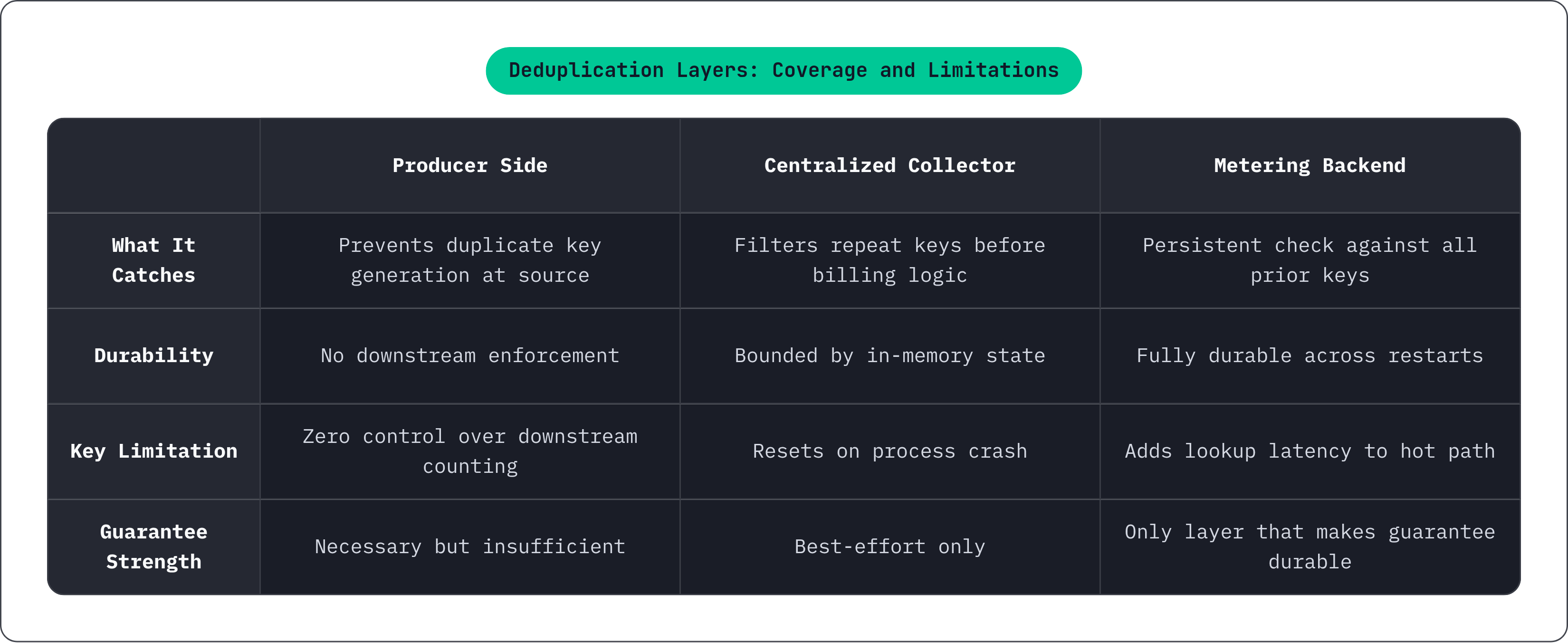
Three layers can apply deduplication: the producer, a centralized collector sitting between producer and backend, and the metering backend itself. Each one covers different ground, offers a different durability guarantee, and fails in its own particular way.
Producer-side deduplication starts with the event source attaching a stable key before it emits anything. Necessary, but not enough on its own: the producer controls how the key gets generated, but it has zero control over whether anything downstream actually checks that key before counting the event. Mobile and offline clients need particular care here, since they often need monotonic sequence numbers or composite keys to build stable IDs without talking to a server first.
A centralized collector sitting in front of the metering backend can catch duplicates in the stream before they reach billing logic. Stream processors consuming off a message topic can track occurrences by idempotency key and forward only the first-seen instance downstream. Yet if that collector is stateless, its memory of what it's already seen is bounded by whatever's held in RAM since the last restart. Call it best-effort deduplication: useful, limited, and a mistake to treat as a guarantee.
The metering backend is the only layer that can make the guarantee durable. It holds a persistent log of every key it has processed, and anything matching a prior key gets dropped, full stop. Some analytics storage engines, ClickHouse with a ReplacingMergeTree being a common example, handle duplicate rows during background merge operations. Genuinely useful for analytical queries, but the merges happen asynchronously, not instantaneously, so leaning on them alone for billing correctness leaves a gap. The real complement to ingestion-time deduplication is atomic aggregation per billing period: even if a duplicate slips past ingestion somehow, a transactional aggregation step stops it from ever inflating the number a customer gets billed on.
Architectures that hold up under real load treat ingestion-time deduplication and aggregation-time correctness as two separate checkpoints, each catching what the other might miss.
Deduplication windows and why their boundaries matter
A deduplication window is the stretch of time during which the system recognizes a repeated key and suppresses it. Outside that window, the same key looks brand new and gets counted again. This sounds like a small implementation detail, but it isn't.
The window has to cover the actual retry horizon in the real world, not the tidy one from the design doc. Network failures retry within seconds, mobile clients syncing offline usage can retry hours later, and backfill jobs reprocessing historical data can resurface an event days after it first happened. I've seen teams size their window off a demo environment where retries happen in under a minute, then watch it fall apart the first time a field tech's phone syncs three days of cached usage after coming back online.
Some purpose-built billing engines use a 35-day window because it covers a full monthly cycle end to end, plus whatever grace-period retries show up near the edges. A duplicate landing inside that window gets caught automatically, no custom retry-suppression logic required on the client side.
A handful of operational questions separate a real implementation from a fragile one. What's the key lookup latency at peak load, and does checking for a duplicate add meaningful lag to ingestion itself? Does the key log survive a restart or an infrastructure failure, or does a crash quietly reset the window and let everything back in? And if a retry lands after the window has already closed, does the system flag it, log it for review, or just wave it through as brand new?
Short or volatile windows are, by a wide margin, the most common failure in real implementations. They pass every test in staging, where retry patterns behave themselves, and then buckle under the messy retry distribution that shows up in production.
Handling late-arriving and out-of-order events without corrupting billing periods
Late events aren't duplicates, and treating them like duplicates is its own separate mistake. A late event is genuinely new usage; it just shows up after the billing period it belongs to has nominally already closed. Mobile clients syncing offline usage, batch jobs backfilling records, plain network delay skewing arrival order against actual event timestamps: these are the usual culprits.
The fix is easy to say and easy to get wrong in practice: attribution has to run off the event's own timestamp, never the time it happened to land on the server. Metering by arrival time misattributes usage to whatever period happens to be open when the event shows up, which is a different bug wearing the same clothes as duplication.
A finalization window handles this. Define a cutoff after the period boundary, commonly 24 or 48 hours, during which late events still get accepted and attributed to the period they actually belong to. After that cutoff, the invoice closes. Anything arriving beyond it gets pushed into the next period as an explicit adjustment or credit note instead of reopening a closed invoice. Write this policy down and enforce it the same way every cycle. Leaving it ambiguous lets invoice behavior shift unpredictably from month to month, which erodes trust just as fast as an outright billing error.
Out-of-order arrival inside a period that's still open is a separate problem, and it belongs to aggregation, not deduplication. The system just keeps accumulating events as they land, regardless of order, until the period closes. When an error surfaces after a period has already finalized, the right move is a correction event that adjusts the total and references the original record; rewriting historical aggregates directly destroys the audit trail and makes reconciliation nearly impossible down the line. One detail people miss constantly: a correction has to be metered under the pricing rules in effect when the original event happened, not whatever pricing is live today. Get that wrong and the correction introduces a second error while trying to fix the first.
Why AI and credit-based billing raise the implementation bar
Traditional SaaS billing grew up around low-frequency events: one renewal per customer per month, one API call mapped cleanly to one request-response pair. The whole model assumed events were rare enough to reason about one at a time.
AI workloads blow that assumption apart. A single user action, something as plain as "summarize this document," can spawn dozens or hundreds of LLM calls, tool invocations, and retrieval steps underneath it, and every one of those is a separate billable event carrying its own duplicate risk. Token variability and multi-step agent loops mean event volume can spike within minutes, and at that frequency a deduplication gap that would've been a rounding error in a traditional billing model shows up on an invoice almost immediately.
Credit-based pricing compounds this rather than merely amplifying it. Duplicate events don't only inflate an invoice a customer sees at month's end; they drain a pre-purchased credit balance in real time. A customer who bought a credit bundle and hits zero mid-cycle because duplicates quietly ate through it has a far worse experience than one who spots an inflated number next month and gets it fixed. The balance check and the credit deduction at consumption time have to happen atomically, or the enforcement mechanism itself becomes a second source of billing error stacked on top of the deduplication problem.
This isn't a fringe concern anymore. Usage-based pricing has become the default model for a large share of SaaS companies, and it's close to universal among AI-agent companies specifically. The pipeline problem this piece describes is the dominant architecture for a fast-growing category of software, not a handful of unusual billing setups. And the stakes reach past correctness: unpredictable pricing shows up again and again in surveys as one of the top reasons IT leaders hesitate to adopt generative AI tools at all. Billing errors from deduplication failures feed straight into that hesitation. Idempotency, here, has a direct line to adoption and trust, well beyond plumbing.
What correct idempotency implementation looks like end to end
On the producer side, every event needs a UUIDv4 idempotency key generated at the source, fixed across every retry of that event. Offline or constrained clients need a deterministic composite key instead, built from something like device ID, timestamp, and record type. The single most common mistake at this layer is a producer generating a new key on retry, which kills the whole mechanism before the event even leaves the client.
At ingestion, the key store has to be persistent. It needs to survive a restart, not just live in memory until the process dies. The window needs to be wide enough for realistic retry horizons and offline sync delays, and the lookup itself can't add meaningful latency to the hot path. Sub-50ms lookups are achievable with decent indexing, and there's not much excuse for slower than that at this point.
Aggregation needs to run atomically per billing period, so any duplicate that somehow slips past ingestion still can't inflate what a customer gets billed. The aggregation type matters too: COUNT, SUM, unique count, and MAX each serve different billing metrics, and a UNIQUE COUNT keyed on the idempotency field gives you a second deduplication backstop stacked on the first.
Late events and corrections need an explicit, written policy: attribution runs on the event's own timestamp, never arrival time, and the finalization window gets enforced the same way every time rather than handled case by case. Events arriving after the cutoff generate adjustment records rather than triggering a rewrite of history.
None of this counts for much without observability. Every dropped duplicate should get logged with its key, timestamp, and a reference back to the original event; silently discarding it just trades one blind spot for another. Duplicate rate itself should get tracked as an ongoing pipeline health metric, because a climbing rate is usually the first sign of a producer regression or a broken integration somewhere upstream. A metering backend built for this should be running duplicate rates low enough that they barely register against total volume, the kind of number you only find because you went looking, not because a customer complained first.
Building this yourself versus using infrastructure that already enforces it
None of the above is something you knock out over a long weekend. A durable key store, sub-50ms lookups at volume, a 35-day retention window, atomic per-period aggregation, an explicit late-event and correction policy, duplicate-rate observability: each one needs real design work, real testing against production-grade retry patterns, and upkeep as volume grows.
Homegrown deduplication layers are a well-documented source of exactly the billing errors this piece opened with. The silent webhook bug, the cron job that fires twice, the two data sources quietly double-reporting the same metric: these show up disproportionately in custom, in-house pipelines, far more than in metering systems built from the ground up to treat idempotency as a first-class guarantee instead of an afterthought bolted on after the first bad invoice goes out. Teams deciding whether to build this internally should weigh that track record honestly. The cost of getting it wrong doesn't show up as engineering time lost. It shows up on a customer's invoice, months later, as a number nobody in the room can fully explain. Metered billing infrastructure like Flexprice, a consumption-based billing and metering platform for AI and SaaS products that tracks tokens, credits, and API calls and enforces idempotency as a first-class guarantee, exists precisely to absorb that complexity rather than leave it to each team to rebuild.