Local Development and Staging Environment Setup for Billing Integrations
Test metered billing end-to-end before production goes live.
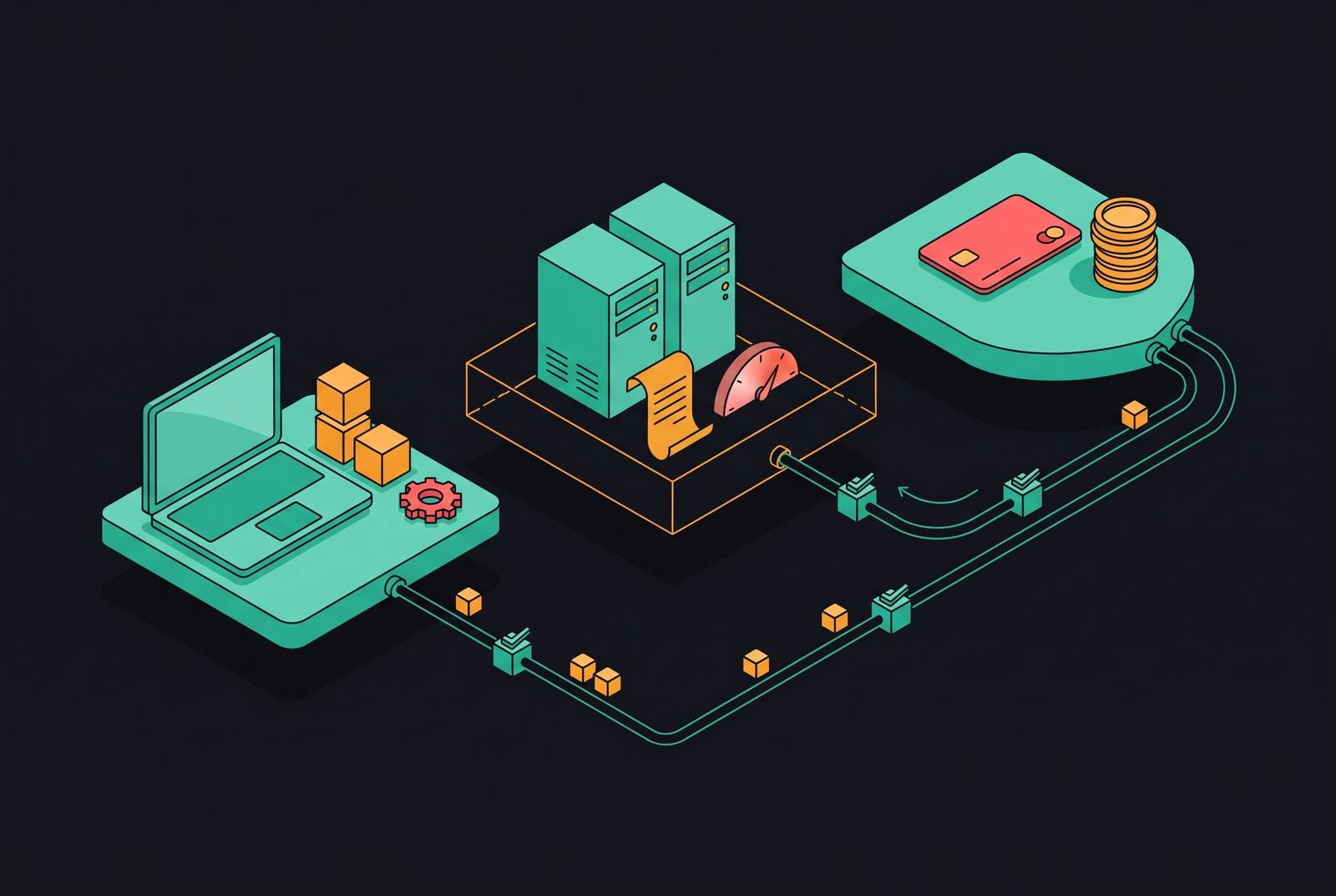
Local development and staging for billing integrations must test how usage becomes an invoice. For metered and hybrid pricing, reliable environments require isolated secrets, deliberate event instrumentation, realistic synthetic usage, and rehearsed failure paths.
Why billing integrations break in ways that generic environment guides do not anticipate
A duplicated usage event can inflate a customer's bill, while a dropped event can erase revenue without producing a visible test failure. Both can pass an ordinary integration smoke test. Generic environment guides often frame billing setup as a credential swap, with staging pointed at a sandbox key. That framing may serve flat subscriptions, but consumption-based charges require more than successful authentication.
Usage-based billing has three distinct layers, which are event ingestion, aggregation, and a pricing engine. Each must be exercised before release because an accepted event does not prove that the correct customer total or rate will appear on an invoice. Hybrid pricing adds a subscription path, such as a base seat fee, that must work with metered overages without interference. AI products add call-site token capture to this chain, so application instrumentation must be in place for the environment to be ready.
The three-environment model and where billing integration work belongs in it
Development tests whether a change works on its own. Local event emitters and stubbed metering endpoints are appropriate here because the immediate goal is to prove instrumentation logic. The environment is disposable and uses synthetic data. Staging tests whether the release works safely with real dependency versions, using the billing vendor's sandbox in place of a mock. Its remit extends through ingestion, aggregation, pricing, and invoice generation.
Production serves real users with real credentials and money. It requires monitoring, alerting, access restrictions, and rollback procedures, and must never receive testing traffic. Staging can use less compute, but its schema, configuration structure, and dependency versions must be the same as those in production.
Per-pull-request preview environments provide another place to review billing changes before shared staging. Each has its own namespace, URL, and database isolation. Their lifecycle also needs explicit cleanup. Namespace expiry and automated pruning must account for sandbox sessions, test subscriptions, and webhook registrations so that closed pull requests do not leave billing resources behind.
Credential and secret isolation across environments — and why billing makes it higher stakes
A staging deployment with a production billing key can trigger a real charge and send an invoice email to a customer. It can also consume live-account rate limits and potentially violate the vendor's terms of service. This is not merely contaminated test data. Development, staging, and production must therefore each have their own credential sets and never share them.
In practice, credentials belong in environment variables. Separate named secret stores or vaults should be scoped to each environment tier, with CI/CD automatically injecting the appropriate set for the deployment target. Webhook signing secrets need the same separation. A staging receiver using its own signing secret will reject a production-signed payload, exposing the mismatch. For on-premises or sovereign-cloud billing deployments, isolation must also extend to separate network segments for staging and production endpoints.
Pointing staging at sandbox and test modes — and where that abstraction stops protecting you
Staging billing traffic must go only to the vendor's sandbox or test-mode endpoint and must never reach the live account. Sandbox modes typically support test customers, subscriptions, and invoices without real charges. They also allow simulated payment and subscription webhooks, declined cards, delivery failures, and retries. Those capabilities establish a safe integration target. They do not establish that production metering behavior has been tested.
Sandbox rate limits are often lower than production limits, so representative throughput testing needs a controlled production-like target. Successful event acceptance also does not necessarily exercise late-data aggregation or prove that the intended rate card was applied. Deduplication remains untested unless staging deliberately replays duplicate events.
Instrumenting usage events correctly so staging actually exercises the metering path
The application must emit structured events where billable usage occurs, whether that usage is a token generated, a tool call, an agent action, or a retrieval. Each event needs a customer identifier, feature or model identifier, event type, and timestamp. These fields make downstream totals reconcilable. Missing customer or feature tags can put usage into the wrong aggregation bucket even when the deployment otherwise mirrors production.
For AI products, many model responses have counts of input and output tokens. Cache-read and cache-write token fields vary by provider and model and are not returned on every call. Available usage metadata must be extracted from the response at the call site and forwarded. Staging must route it through the production pipeline's architectural equivalent, including a dedicated event bus.
The aggregation layer must also run in staging. Checking only that events arrived leaves the financial interpretation untested. Duplicate and late-arriving events must pass through that layer so that tests examine customer totals.
Simulating realistic usage in staging without copying production data
A handful of hand-crafted payloads cannot exercise the variety that metered pricing depends on. Synthetic customers should have small-, mid-, and high-volume usage so that tests reach tier thresholds and check how overage rules work. AI simulations should use different token counts across models and feature flags, including the cached-token variants that are supported. Uniform payloads leave pricing branches untouched. Tests must also cover zero-usage periods, bursts that cross a tier threshold, and events that arrive after a synthetic period closes.
Hybrid credit mechanics require a connected scenario. A test customer should use up prepaid credits until the wallet is empty, then move into the postpaid overage path in the same run. Testing those paths separately would miss failures at the handoff. The simulation must exercise both mechanics on the same engine.
Staging data must be synthetic, seeded, masked, or anonymized rather than copied raw without an approved privacy and security process. Database choices affect that discipline. A separate database per preview provides isolation, while schema isolation is faster and cheaper but requires correctly scoped migrations. Production snapshot clones offer realistic aggregation volumes only after customer records have been scrubbed of personally identifiable information.
Webhook delivery, event ordering, and the integration failure modes staging must deliberately provoke
Retries make duplicate delivery a normal condition to test. Staging should submit identical event payloads twice and establish that deduplication by event ID prevents the aggregated total from doubling. Concurrent events should also be submitted out of order, with the resulting total checked against the intended usage. Arrival order must not distort the bill.
Late data needs an explicit financial outcome. An event belonging to an already invoiced period must be handled deterministically, whether by crediting the next period or reopening the invoice, and staging must exercise the chosen behavior. Failed webhook deliveries should provoke retries without duplicate processing. Partial usage records from interrupted calls must be rejected or flagged to prevent their aggregation as complete counts.
Each development, staging, and preview environment must register its own webhook destination so that its events cannot trigger handlers in another environment. Shared receivers undermine otherwise separate credentials and data. An SDK that supports duplicate and delayed event injection reduces custom test scaffolding, while an API without those facilities leaves that engineering cost with the team.
Infrastructure and schema parity between staging and production — where gaps become billing bugs
Database engine versions, schemas, event-pipeline routing, and configuration structure must match the production equivalents. The usage events table, aggregation materialized views, and invoice line item schema need particular attention. Tests can miss a missing column until a live invoice fails to render. Billing migrations must therefore run in staging before production and be validated through aggregation and invoice generation.
Worker topology is part of that parity. If production uses a dedicated ingestion worker separate from the application server, staging needs the equivalent process. TLS configuration, ingress rules, and health check endpoints should also match so that deployment itself is rehearsed. Rollback testing must cover how to reverse the migration that would be reversed during a production pricing-engine rollback. Finally, staging needs a realistic rate card with sanitized customer references, because a single-tier placeholder cannot show where billing fails at production tier boundaries or when pricing dimensions are combined.
Pricing configuration as a versioned, environment-promoted artifact
Rate cards, tier definitions, usage grant rules, and credit wallet rules belong in version-controlled configuration. A configuration error applied to real usage can generate incorrect invoices that are expensive to correct. Promotion should follow the same controlled path as application code. Staging must run the exact configuration intended for the next production release, including any mid-cycle customer migration that could create partial or inconsistent invoices.
Feature flags allow new pricing tiers or models to be activated for a subset of staging customers before gradual production enablement. Staging must use the same flag system so that these gated paths receive meaningful tests. Every configuration change also needs a tested rollback. For multidimensional rate cards, reversal must be atomic because a partial rollback can leave incompatible pricing rules in place.
This discipline need not make every rate change an engineering ticket. A platform can let finance and product teams change pricing while still requiring it to be tested in staging before it reaches customers.
What a pre-production billing validation checklist should actually cover
A team can adapt the following validation categories to its billing integration rather than treat deployment success as release approval. Isolation checks should establish that staging contains only staging-scoped credentials and sandbox endpoints, with no production keys. Registered webhooks must point to the staging receiver. Preview cleanup should account for billing sessions, test subscriptions, and sandbox registrations belonging to closed pull requests.
Tests of metering should include a synthetic run through every pricing dimension that is configured, including model types and supported token variants for AI products. Submitting duplicates must leave totals the same, while out-of-order and late-arriving events must give the expected aggregation result. Zero usage and bursts must exercise tier boundaries. Failed webhook retries and partial payloads should also reach their intended handling paths.
Pricing validation should check that the applied rate card matches the next release's configuration and review whether sandbox invoice line items have the expected charges. The review must include prepaid drawdown and the postpaid overage split where applicable, plus mid-period pricing changes that could fragment invoices. Infrastructure validation should establish that staging migrations support the billing aggregation queries and that workers and pipeline components match production equivalents. Rollback must be rehearsed, including atomic pricing reversal and the applicable migration reversal. Approval depends on financial results.
Where the billing platform itself determines how much of this complexity you own
Deduplication, late-data handling, multidimensional pricing, and atomic rollback are either platform responsibilities or continuing engineering obligations. API quality therefore matters when choosing a platform as well as when planning the integration. With environment-scoped credentials and failure-injection helpers, much of staging setup can be done by configuring it and checking that it works. Their absence requires the team to build and maintain those abstractions.
Building billing internally is defensible when billing is itself the product or regulatory constraints forbid hosted infrastructure. Otherwise, the aggregation and reconciliation behavior exercised in staging remains an ongoing maintenance liability that competes with product development. Deployment constraints do not disappear with a purchase. Where usage events cannot legally transit a shared vendor cloud, the platform must support the customer's own environment, and the same staging discipline must work there.
A purpose-built usage billing platform can own multidimensional ingestion, real-time aggregation, and prepaid and postpaid mechanics on one engine. Support for on-premises deployment can extend those capabilities to residency-constrained environments. The team's remaining responsibility is to validate its instrumentation, configuration, and financial outcomes. Staging work is unavoidable, but how much underlying billing machinery the team must build and maintain is a platform choice.