Pro Rata Billing Calculations for Mid-Cycle Plan Changes in SaaS
Avoid overcharges and revenue recognition errors by mastering five core proration scenarios.

Pro rata billing sounds like a solved problem: charge for what the customer actually used, credit them for what they didn't. What isn't solved is how upgrades, downgrades, seat additions, and mixed usage-plus-subscription events each produce different calculation paths, credit treatments, and revenue recognition consequences that SaaS billing systems must handle correctly. Pro Rata Billing Calculations for Mid-Cycle Plan Changes in SaaS.
What pro rata billing is and the proportional logic behind every mid-cycle adjustment
The standard formula for pro rata billing is: Daily Rate = Total Plan Cost ÷ Days in Cycle; Prorated Amount = Daily Rate × Days Remaining.
Run the numbers on an actual example. The same formula applies to three canonical scenarios (a mid-cycle new customer start, a mid-cycle upgrade, and a mid-cycle downgrade), each producing a different financial direction: charge, net charge, or credit.
It helps to be precise about what pro rata billing is not. It isn't a refund, which reverses a transaction that already completed, and it isn't automatically a credit note, which reverses an invoice that's already been issued. Confusing those instruments is where ledgers start to get messy. Get that denominator wrong and every subsequent calculation, however correctly executed, is answering the wrong question. It matters because subscription changes almost never land neatly on a renewal date, and a system that can't prorate correctly either overcharges or undercharges customers on a regular basis, which is exactly the kind of small, recurring friction that erodes trust in a billing relationship over time. As one worked example from the sources illustrates, a $60/month plan is upgraded with 10 days left in a 30-day cycle. The old plan's daily rate is $2/day, yielding a credit for unused time of $20. The new plan, priced at $90/month, carries a daily rate of $3/day, producing a charge for the remaining 10 days of $30 (Medium). The net charge to the customer is $10. For non-standard periods, billing cycles measured in weeks or quarters, such as 90-day billing, use the same proportional logic but must align the denominator to the actual cycle length rather than assuming 30 days.
How upgrades, downgrades, seat additions, and cancellations each produce different calculation paths
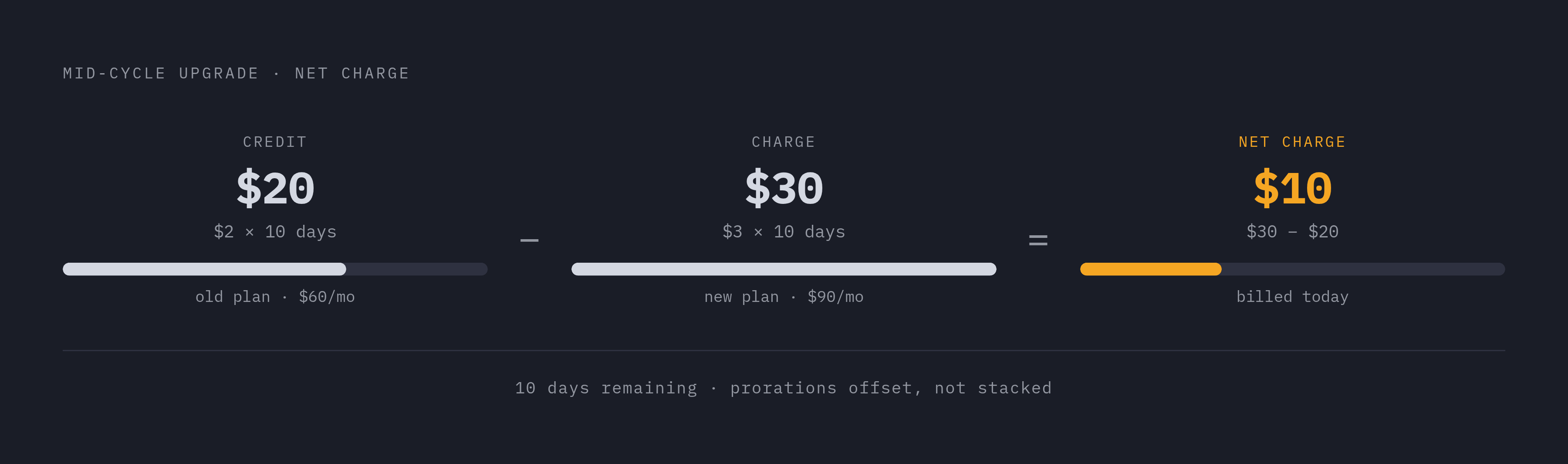
An upgrade mid-cycle charges the customer the difference between the new plan's prorated cost and the unused value remaining on the old one, typically billed immediately at the moment of change. Usage has to rate against whatever price was in effect when it actually happened, meaning days before the upgrade bill at the old rate and days after bill at the new one. A system that rates the entire period at a single price, old or new, will produce an invoice that looks clean but is arithmetically wrong.
A downgrade runs the same logic in reverse. The difference produces a credit note balance of $27.43, which the company either applies to the customer's next invoice or refunds outright, depending on policy. A downgrade that only takes effect at renewal, rather than immediately, may not represent a current-period modification at all. Timing of effectiveness is its own variable, separate from the proration math.
Seat additions follow a parallel but distinct path, prorating each added seat from its addition date through the next billing date. Slack's publicly documented model illustrates the inverse case, a seat removal: a Pro subscription billed at $8.75 per user per month, where a member goes inactive 15 days into the cycle, generates a credit of ($8.75 ÷ 30) × 15, or $4.38. Seat changes carry an accounting wrinkle that plenty of billing systems miss entirely: under ASC 606, an added seat can represent a wholly separate contract if the added service is distinct and priced at its standalone selling price, rather than simply a modification of the existing one. That distinction affects how revenue gets recognized, not just how the invoice gets calculated.
Cancellation is its own animal, and its calculation depends entirely on the refund policy in force, whether that's a partial refund for unused days, a credit carried forward, or no refund at all. It has to be kept conceptually separate from a downgrade: cancellation ends the obligation outright, while a downgrade only modifies it. Google Workspace's flexible plan model charges based on the daily number of user accounts during the preceding month, then bills at the start of the following month. In a Zoho Billing example drawn from the sources, a downgrade from a $100/month Premium plan to a $50/month Basic plan occurs on day 14 of a 31-day cycle. The new plan prorated amount is calculated as ($50/31) × 17 = $27.41. The unused premium amount is calculated as ($100/31) × 17 = $54.84.
Credit notes vs. prorated invoice adjustments, why using the wrong instrument corrupts the ledger
The functional line between these two instruments is simple to state and easy to blur in practice. Proration adjusts an invoice before it finalizes, and that makes it the right tool for routine mid-cycle changes. A credit note, by contrast, reverses value on an invoice that's already gone out, which makes it the right tool after finalization, or when there's an actual dispute to resolve.
Using a credit note for a routine downgrade, rather than a proper prorated adjustment, clutters the ledger with reversal documents that were never actually dispute driven. It also makes revenue recognition harder, since the reversal now has to be traced back to the original obligation it was meant to offset. Auditors increasingly expect point-in-time clarity on the logic that governed a revenue split the moment it happened, and a ledger full of stacked credit notes obscures exactly that kind of clarity. There's a related question companies have to answer explicitly rather than let default: when a downgrade generates excess credit, does it carry forward with or without an expiry date, apply automatically to the next invoice, or trigger a cash refund? Each of those choices changes the deferred revenue balance sitting on the books.
Coupon and discount proration sits in the same family of edge cases. A flat discount coupon has to be prorated in step with everything else, or it risks fully nullifying a prorated invoice it was never meant to wipe out entirely, a behavior Zoho Billing documents explicitly in its own proration mechanics. Same-day plan switches, timezone boundary cases, and leap year periods all stress this same distinction between proration and reversal. A credit note issued the same day as an upgrade can read, in the ledger, exactly like a dispute, even when nothing about the change was contested at all.
Why mixed usage-plus-subscription invoices are where billing systems break
Flat-plan proration is arithmetic any competent system handles without drama. The genuinely hard case occurs when a mid-cycle upgrade lands on a plan that also meters usage.
Usage that happened before the upgrade date has to rate at the old price, and usage after the upgrade date has to rate at the new one: a single billing period now needs two separate rate schedules living on one invoice. Plenty of billing tools treat usage as a simple add-on bolted to a plan object, and those tools tend to rate the entire period at a single price, producing an invoice that's arithmetically wrong even while the subscription-only portion of the proration looks entirely correct. Without a preview step before the invoice finalizes, these mixed-invoice errors become visible only after the invoice has already gone out, at which point a credit note, the wrong instrument for a routine correction, becomes the only remedy left on the table.
Hybrid pricing makes the problem worse rather than better. Once a prepaid credit wallet sits alongside metered usage and a prorated subscription base fee, three separate value streams have to settle on one document, each carrying its own timing rules. Atlassian's pricing model, as described by Zylo, bundles a Standard plan that includes 25 Rovo AI credits per user per month with products like Virtual Service Agency that charge $0.30 per conversation once usage exceeds the included limits. Enterprise customers on structures like that now hit exactly this mixed invoice problem routinely, both at renewal and mid-cycle, not as some rare exception the billing team can safely ignore Zylo.
What ASC 606 requires when a plan change mid-cycle is treated as a contract modification
Proration and revenue recognition answer two different questions. Proration determines what gets invoiced. ASC 606 determines when that consideration becomes revenue. They share the same dates and the same dollar amounts, but they serve entirely separate purposes, and conflating them is a common source of downstream error.
A mid-cycle change that alters a customer's enforceable rights and obligations generally counts as a contract modification under ASC 606-10-25. Finance has to document the analysis for each change rather than apply one blanket rule to every plan change that comes through Zylo. The standard lays out four possible treatments: when the change adds distinct services priced at standalone selling price, it's treated as a wholly separate contract. When the remaining services are distinct but not priced at standalone selling price, the existing contract terminates and a new one takes its place. When the remaining services aren't distinct from the obligation already being satisfied, the company records a cumulative catch-up adjustment. And when a modification mixes distinct and non-distinct elements, the treatment combines prospective accounting with a catch-up adjustment.
A $12,000 annual plan gets upgraded to $18,000 halfway through the term, with the modification accounted for prospectively. At that midpoint, $6,000 has already been recognized from the original contract, leaving $6,000 unrecognized. Adding the $3,000 upgrade invoice brings the remaining consideration to a total of $9,000, recognized over the final six months at $1,500 a month. Notice what's happening here: the billing system invoices the $3,000 immediately, in full, at the moment of the upgrade, while the revenue schedule runs on its own separate, slower calculation. Usage that occurred before the upgrade date must rate at the old price and usage after the upgrade date at the new price, producing two rate schedules on one invoice, and a system that conflates them will misstate revenue even while the invoice itself is perfectly correct.
The downgrade version runs the same logic with the arithmetic reversed. An $18,000 annual plan drops to a $12,000 annualized rate with three months left on the term. Original consideration remaining at that point is $4,500, against a new rate of $3,000 for those three months. The company issues a $1,500 credit, reduces deferred revenue accordingly, and recognizes $1,000 a month for the remaining term. When a billing frequency change leaves total consideration, contract term, and promised services all unchanged, finance generally shouldn't reset the revenue schedule at all, a misconfiguration common enough that PwC's 2025 guidance for software and SaaS companies calls out contract modifications and transaction price allocation as persistent areas of judgment under ASC 606 Zylo. KPMG's 2025 Software and SaaS Handbook makes a related point: multi-element contracts require allocation based on standalone selling price, and sales teams selling bundled packages that include mid-term upgrades and usage fees make that allocation especially difficult to get right Zylo. Usage-based charges often get recognized as the usage occurs, when the billable amount tracks value delivered in that period, but minimum commitments, prepaid credits, and tiered rates all demand separate analysis, because billing under those structures doesn't necessarily track recognition in lockstep.
How hybrid pricing structures (subscriptions layered with usage and credits) change the proration and recognition calculus simultaneously
Credit-based pricing is no longer a niche feature. The PricingSaaS 500 Index counted 79 companies offering credit models as of the most recent reporting date, up from 35 at the end of 2024, a 126% year over year jump that means credit wallet balances now have to be accounted for right alongside prorated subscription lines and metered usage lines, not treated as an occasional exception NXCode.
Atlassian's structure again offers a concrete illustration of what this looks like in practice. Standard plans include 25 Rovo AI credits per user per month, and Virtual Service Agency adds charges of $0.30 per conversation once usage runs past the included limits Zylo. A mid-cycle seat addition against that structure triggers proration of the subscription, partial proration of the credit entitlement, and a separate question about whether overages to date must be settled at the change point Zylo. That's not one calculation.
For ASC 606 and its international counterpart IFRS 15, allocating transaction price across performance obligations on a pure subscription is a relatively contained problem. A hybrid model, subscription plus usage plus credits plus a committed spend floor, turns that into a genuine allocation problem, one that a billing system not purpose-built for it will end up pushing into spreadsheets maintained outside the system of record. There's a further complication in the credit wallet itself: three core scenarios (mid-cycle new customer start, mid-cycle upgrade, and mid-cycle downgrade) each produce a different financial direction, charge, net charge, or credit. Ibbaka's 2026 prediction holds that credit wallets are becoming standard infrastructure. Proration logic for credit balances becomes a first-class billing requirement, not an afterthought.
The operational failure modes: what breaks in practice when billing systems handle mid-cycle changes incorrectly
Three failure modes recur across companies handling this badly.
The first is rating an entire billing period at a single price when two rates should actually apply (usage before the upgrade date at the old price and usage after at the new price, producing two rate schedules on one invoice). It produces invoices that are systematically wrong in a way that often isn't visible until month-end reconciliation, well after the customer has already been billed and, in many cases, already paid. The second is reaching for a credit note to handle a routine downgrade instead of a proper prorated adjustment, which clutters the ledger, invites audit questions that didn't need asking, and makes the underlying revenue schedule difficult to trace back to its source. The third is settling the subscription portion of a mid-cycle change correctly while letting metered usage keep accumulating unchecked in the background, a pattern that quietly builds toward bill shock at the next renewal.
That bill shock deserves treatment as a design failure, not merely a billing failure. Digital Applied's 2026 decision matrix documents a case from 2025 in which a single user triggered a $7,225 invoice in one day Zylo Digital Applied / Mean CEO. Even perfectly correct proration cannot compensate for a pricing structure that exposes customers to uncapped consumption without giving them real-time visibility into what they're accruing Zylo Digital Applied / Mean CEO. Auditors, for their part, no longer accept a month-end spreadsheet as sufficient evidence. They expect visibility into the exact logic that governed a given revenue split at the moment it happened, and inconsistent modification treatment across different plan changes tends to raise questions about every other revenue figure a company reports, not just the one under direct scrutiny.
An organizational gap causes as many of these failures as any technical shortcoming does. When billing data lives inside a system that engineering configures but finance can't directly interrogate, modification treatment ends up applied inconsistently across plan types, simply because no single team owns the logic from end to end. Add to that the companies that have built entirely separate billing codepaths for subscriptions, for usage, and for credits, each maintained by a different team with a different mental model, and the fragmentation compounds. Proration was never the hard part. Making sure every codepath agrees on what happened, and when, is.