Budget Alert Architecture for Metered AI APIs
Enforce AI spending limits at the request boundary, not after the charge posts.

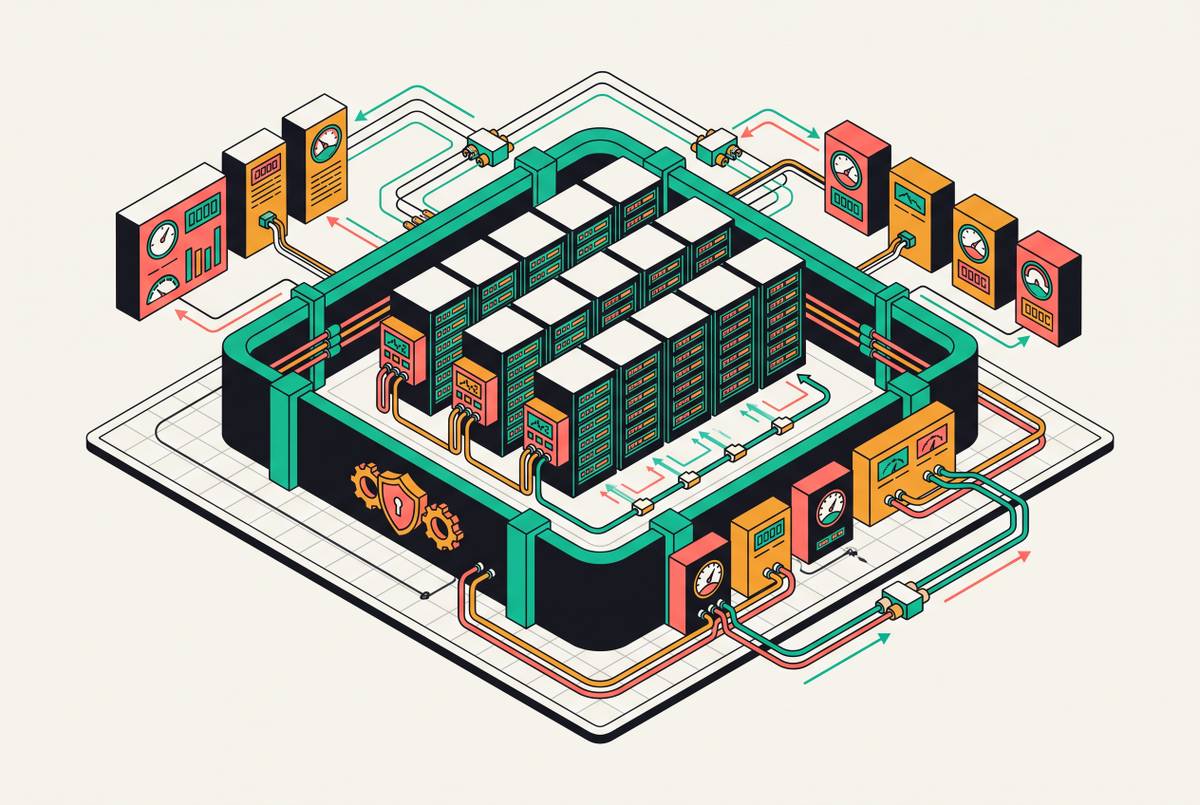
Budget alert architecture for metered AI APIs must stop spend as well as report it. Effective control requires enforcement in the request path, supported by real-time metering and layered alerts, throttles, hard caps, and rate limits. The same architecture should give end customers control over their consumption, so that internal cost protection and customer billing operate from the same usage record.
Why post-hoc alerts fail as a cost-control strategy for metered AI APIs
A tight agent loop making requests at fractions of a dollar each can clear a daily cost ceiling before the next validation fires. Parallel requests compound that exposure because spending continues across concurrent calls. Agentic AI built on continuous inference can send token usage into the millions per month. The workload does not pause while someone reads a Slack notification, so an alert can arrive while the liability it describes is still growing.
Google's GCP Budgets documentation states the limitation explicitly. “Setting a budget does not automatically cap Google Cloud or Google Maps Platform usage or spending”. A notification therefore marks a threshold without necessarily changing what the system permits. The gap lies between seeing the spend and stopping the next billable call. Any architecture that leaves that gap open relies on a person to stop a failure that runs at machine speed.
The architectural distinction between a soft alert and a hard cap, and why only the cap changes who carries the risk
A soft alert is a monitoring signal, whereas a hard cap is an enforcement boundary. A real-time budget guardrail evaluates a spend or rate threshold before forwarding the next provider call. It then takes a defined action, which can be to warn, throttle, or reject. Its defining feature is not the dashboard or notification channel but the decision made in the request path, in milliseconds. Only rejection at the boundary prevents the next call from adding to the bill.
That distinction changes who carries the risk of failure. An alert leaves the customer exposed until someone acts, while a cap bounds exposure only to the extent that enforcement is timely. Google's terms place responsibility for overages incurred during the enforcement-delay window on the user. For a software vendor selling AI capabilities, this also affects the customers it sells to. Choosing how to control infrastructure costs also means choosing how much uncontrolled consumption customers can incur.
How the four enforcement mechanisms layer into a working guardrail system
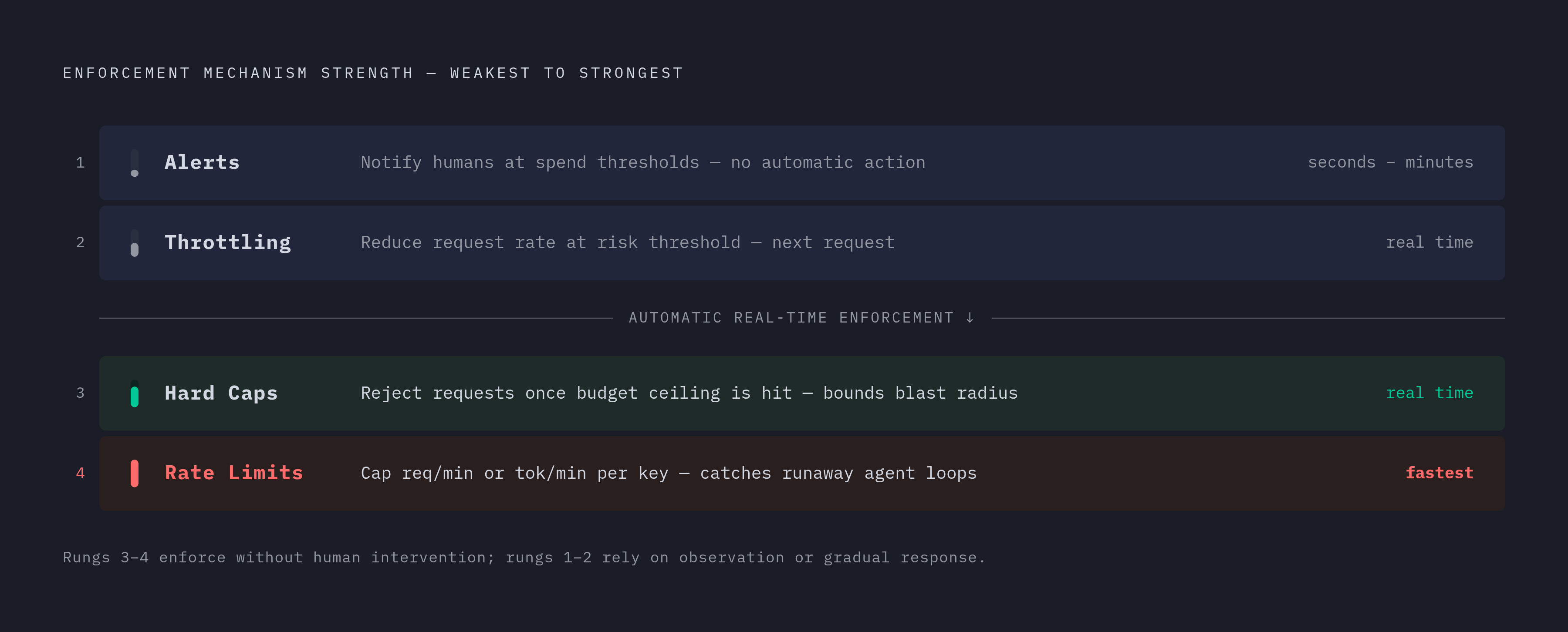
The four mechanisms serve different roles rather than offering interchangeable ways to express a budget. Alerts notify humans at escalating spend thresholds, with latency measured in seconds to minutes. They catch trend deviations while correction is still cheap, including drift that would not trigger a sudden stop. Throttling then reduces the request rate automatically when a risk threshold is crossed. Because it acts on the next request in real time, it buys time without hard-stopping the workload.
Hard caps serve a different purpose by rejecting requests once a budget or quota ceiling is reached. They are the mechanism that bounds the worst-case blast radius. Rate limits cap the requests-per-minute or tokens-per-minute for each key, agent, or workspace. Their real-time boundary makes them the fastest mechanism for catching agent loops that can exceed a budget in seconds.
Most production teams need all four because the failure classes differ. A system running only hard caps can miss drift until service stops. A system running only alerts has no automatic enforcement at all. Escalating thresholds connect early warning to stronger controls as spending approaches its ceiling.
Where the circuit breaker must live — and why placement determines whether it works
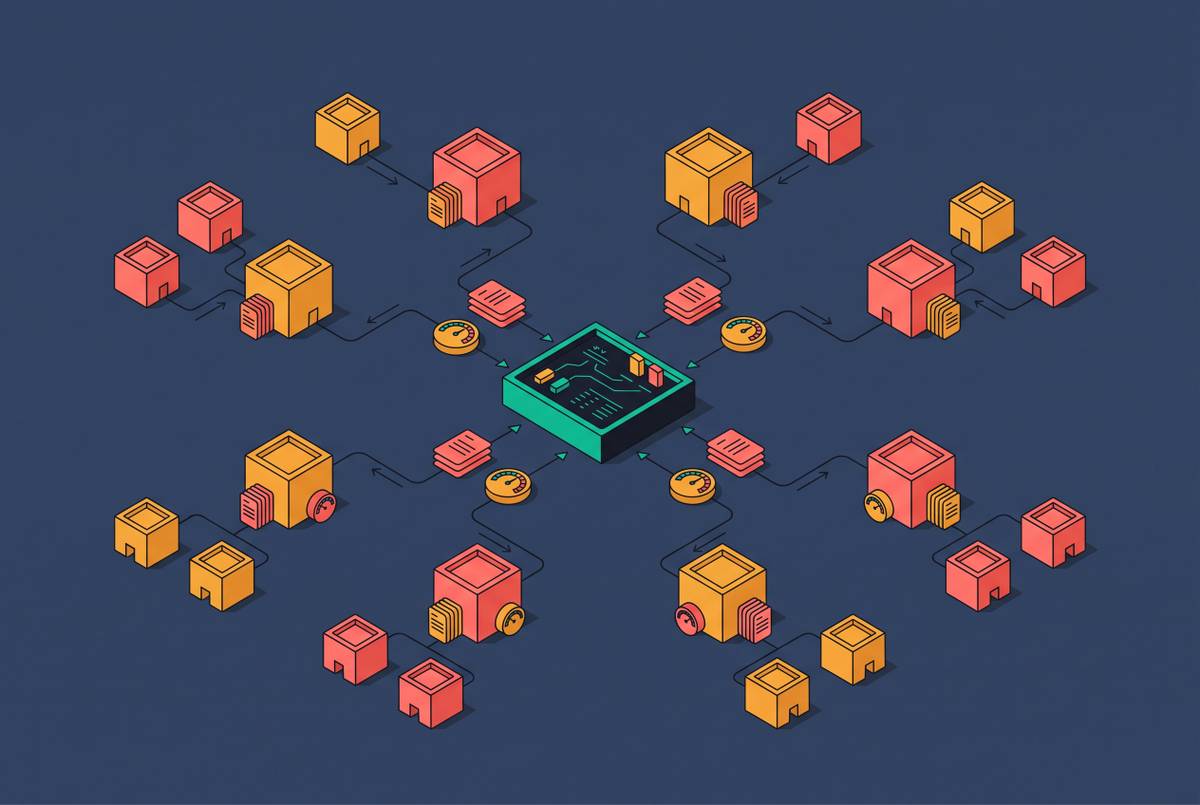
The circuit breaker belongs at the API proxy or gateway layer, before the request reaches the vendor. Application-layer checks can be bypassed by runaway loops or misconfigured retry logic. When more than one application instance is running, concurrent requests can also slip through a limit unless a distributed lock, using Redis or a similar system, keeps them in step. A gateway places the decision at the common forwarding boundary. Blocking there prevents the request from reaching the vendor's servers and incurring the charge.
Placement alone does not settle enforcement timing. A pull model checks the balance before each request and is reliable, but it adds latency. A push model that uses webhooks has a built-in delay, including the 5–30 second gap between spend and the arrival of a notification described for OpenAI and Anthropic. Webhooks therefore cannot be the sole enforcement mechanism and should be paired with pre-request balance checks. For per-user budgets, allowances can be cached at application startup or refreshed periodically, since querying a cost database on every inference request can become the bottleneck before the LLM does.
For publicly traded companies, SOX requires internal controls that are documented and can be audited for systems within the ICFR scope, including AI agents that touch financial reporting processes. That requirement does not apply to operational spend controls broadly. Within that scope, a proxy-layer circuit breaker with rejection logs identifying the feature, user, and model provides an auditable technical control. Manual dashboard monitoring is not a substitute for that enforcement record.
What the major AI API vendors actually enforce today, and where the gaps remain
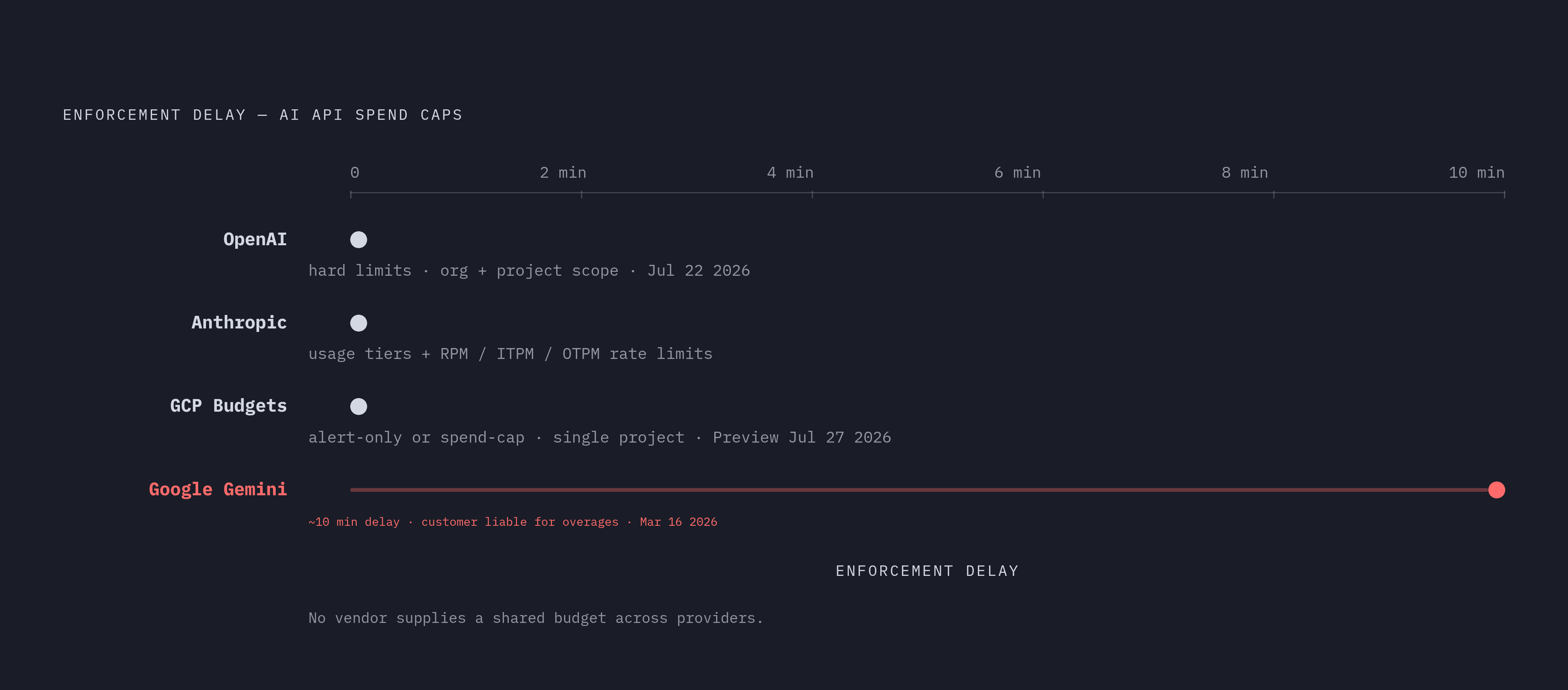
On July 22, 2026, OpenAI shipped hard limits on how much organizations and projects can spend each month. Its Usage and Costs dashboards gained API-key filtering and grouping on August 4, 2026. Keys are a reporting dimension, with no documented per-key hard cap. Projects and the organization remain the boundaries at which those limits apply.
Anthropic enforces spend ceilings through usage tiers assigned automatically based on usage history and account standing. It also offers RPM/ITPM/OTPM rate limits, giving spend and throughput controls distinct roles. Google Gemini API shipped a spend cap on March 16, 2026, but it carries approximately a 10-minute enforcement delay during which the customer is liable for overages. Broader GCP introduced a console-level Spend Cap in Public Preview on July 27, 2026, covering eligible services including Cloud Run, Cloud Run Functions, and Maps. GCP Budgets consequently offer both alert-only and spend-cap-enforcement types, with each cap scoped to a single project and single eligible service per budget.
These controls are valuable within their stated boundaries, but none supplies a shared budget across providers. A team using OpenAI, Anthropic, Gemini, and AWS Bedrock still faces separate controls in separate dashboards. The gaps in shared budgets and documented per-key enforcement explain the need for a shared proxy layer and billing system. Native caps protect spend with each provider, while the shared layers track total spend and who is responsible for it at the customer level.
Real-time metering as the prerequisite that makes enforcement possible
A request-path decision is only as reliable as the usage data beneath it. AI metering must capture each billable event when it happens, including a token generated, a tool call, an agent action, or a retrieval. It must then aggregate that usage per customer over the billing period and apply a rate card. The work divides into ingestion, aggregation, and a pricing engine. At AI volumes, this is a streaming problem.
At scale, the ingestion layer needs a dedicated event bus with guaranteed delivery. Missing events mean missing revenue and missing enforcement signals. Each event record needs a unit and quantity that state what was measured and how much. Those measurements must stay atomic unless pricing treats them identically. Otherwise, the event contract cannot preserve the distinctions the rate card needs.
A correlation ID supplies the other essential connection by tying usage to the originating request, session, or agent run. That connection makes an invoice line item traceable to application logs and supports the audit requirement for systems within scope. Attribution must also show usage for each user, feature, model, and region. A total-monthly-spend figure can show that a budget is under pressure without revealing which feature or user cohort caused it. Granular metering therefore supports both the enforcement decision and the explanation of that decision.
Extending guardrails to end customers — spending visibility as a product feature
The same visibility must reach the customers consuming the product. Customers who cannot see usage as it happens face bill shock, which leads to churn and more work for support as well as a confusing invoice. Developers building on metered AI APIs expect to read a pricing page and calculate their cost in under two minutes. A live cost estimator that updates as configuration changes can substantially reduce billing support tickets.
Controls for customers follow the internal model, with soft alerts at usage thresholds, throttles that keep service running, hard caps that customers set, and rate limits per agent or application key. The credit wallet gives those controls a unit customers can understand. Rather than asking customers to reason in tokens, the product can translate metered token cost into a unit tied to delivered value. Tiered allowances and per-unit overage rates then express how that value is sold. This links a customer's budget to the outcomes being purchased without discarding the underlying usage record.
GitHub Copilot AI Credits, ChatGPT Workspace Agents, and Fable 5 usage credits all shipped between June 1 and July 20, 2026. These launches illustrate the move toward credits as the customer-facing abstraction over raw token metering. AI and enterprise products routinely need prepaid credit wallets and postpaid invoicing on the same engine simultaneously. A platform that supports only one forces customers to manage two billing systems, adding complexity precisely where the product promises clarity.
Why this architecture is a build-vs-buy decision with a clear threshold
The threshold arrives when a product layers credits on usage, usage on a subscription, or enterprise commits on either. At that point, the team is building a billing system whether or not it calls the work billing. Making hybrid pricing, credit wallets, and basic revenue recognition work in production takes a great deal of engineering work. Launch is only the start because maintenance, expansion, and changes to pricing models remain ongoing responsibilities. The decision is therefore about owning a durable financial system.
Pricing across tokens, GPU-minutes, audio minutes, megapixels, and hardware tiers makes that responsibility more demanding. Those dimensions tie the way events are designed to pricing, enforcement signals, and invoices. Separate metering and billing tools can split up the work, but the links between them still need upkeep. Purpose-built infrastructure becomes justified when it handles those responsibilities as one system. Its value rests on a shared usage foundation.
The resulting division of responsibility is clear. Provider caps form the outer envelope, an inline gateway acts as the operational control plane, and a billing platform serves as the finance system of record. That platform must support metering, enforcement signals, credit wallets, and postpaid invoices without manual reconciliation between their calculations. Finance teams should not spend the first week of every month correcting billing errors against provider dashboards. Invoices should generate automatically and reflect the same usage and enforcement logic as the guardrails.
Where a system can be deployed also helps set that threshold and must be part of the buying decision. Organizations operating under GDPR, CMMC, or HIPAA may require billing infrastructure, including usage event records, to remain within specific geographic or sovereign boundaries. Where those requirements apply, the absence of on-premises or sovereign-cloud deployment can eliminate a platform from consideration. The purpose-built answer must therefore meet both the runtime architecture and the financial and deployment requirements. Buying is justified when one system can carry that full responsibility, while the gateway stops spend before it becomes a reconciliation problem.