Freemium to Paid Tier Conversion for API Products
Usage limits determine freemium conversion, not marketing or pricing page copy.

For API products, the conversion rate a team eventually observes is set long before the first signup. It's set when someone decides what the free tier allows, where that tier stops, and what, specifically, triggers the request to upgrade. Teams that miss their conversion targets tend to look downstream for the fix, tightening onboarding emails or rewriting the pricing page copy, when the actual fault sits upstream in how the tiers were built. A free tier that lets developers build around its limits indefinitely will underconvert no matter how good the marketing is, and a free tier with a sharp, well-placed usage cap will convert well even with a plain pricing page. The rest of this piece works through each of the decisions that go into that tier structure, in the order a team actually has to make them.
The Free Tier's Usage Limit as the Primary Conversion Mechanism
A free tier's usage cap does more than keep infrastructure costs in check. For an API product, it is the thing that decides whether a developer ever reaches a clear moment of choice or just keeps building on free forever. Feature-limited freemium, where the free tier is missing some capability rather than capped on volume, lets a developer work around the gap indefinitely: they build a workaround, ship it, and never have a reason to reconsider the plan they're on. Usage-limited freemium doesn't allow that kind of drift. A hard number on API calls, tokens, or compute forces a decision at a specific, trackable point: the cap.
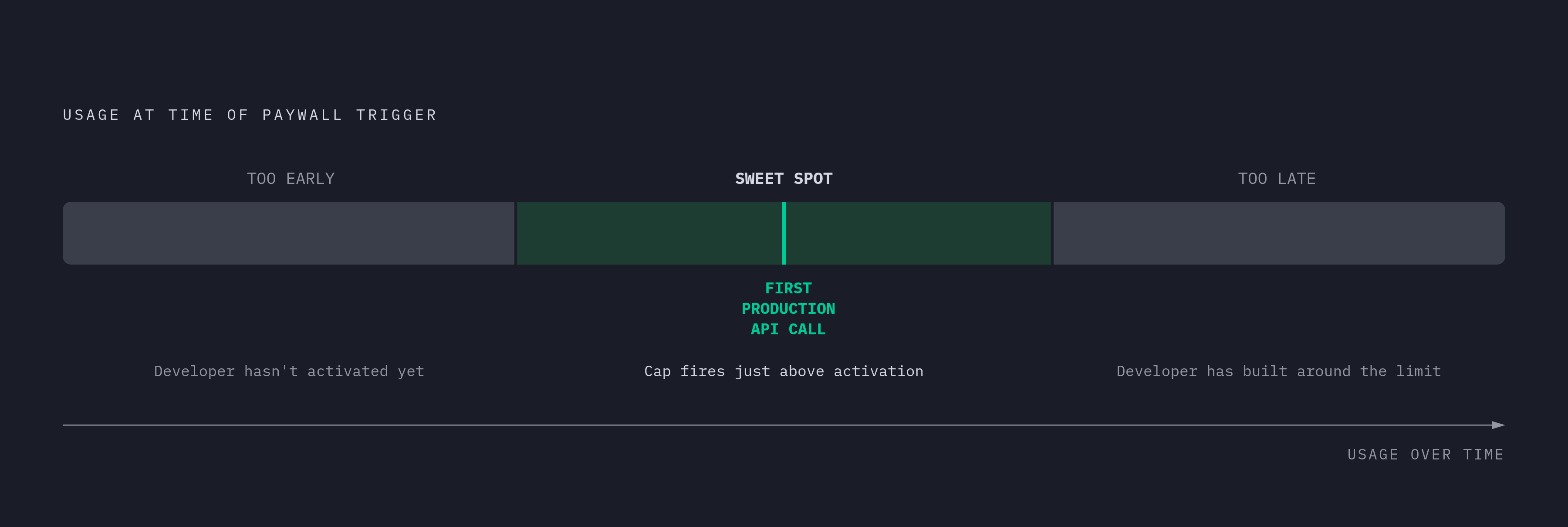
That decision converts best when it lands at what's worth calling a happy moment. A developer who has just made a first successful call against production, crossed some meaningful usage threshold, or shipped something that actually works is, at that instant, experiencing the product's value directly. That's the moment they're most open to paying for more of it. GrowthSpree's 2026 benchmarks name the first successful API call from a production environment as the activation event that matters most for API-first developer tools, and conversion logic should be built around that event rather than around some arbitrary number of days since signup.
The cap has one job: let a developer get far enough to activate before it closes the door. A limit that fires before a developer has done anything real with the API teaches them that the product can't do what they need, not that they need to pay for more of it. Those are very different lessons, and only one of them leads to a credit card.
Calibrating the Usage Limit: Decisions That Determine Whether the Cap Converts or Repels
Setting the cap correctly comes down to three separate questions, and teams that treat it as one number usually get it wrong. The first is what unit of usage to measure. The second is where that limit should sit relative to how developers actually behave on their way to activation. The third is whether the limit resets on a schedule or stands as a hard lifetime ceiling.
Raw API call counts are the easiest thing for a developer to reason about. A developer can look at a counter and know exactly where they stand relative to the wall. Token counts, compute-minutes, and credit systems map more closely to what the product actually costs to run, which matters a great deal for AI products where a single call can vary enormously in cost depending on context length or model tier. The tradeoff is that these units ask the developer to understand the pricing model before they can predict when they'll hit the cap, and that extra cognitive step can slow activation down. Credit systems exist largely to paper over this problem: by absorbing the variance between a cheap, short request and an expensive, long one into a single spendable unit, they let a developer track one number instead of several cost dimensions at once. That smoothing effect is a large part of why credit-based free tiers show up so often in AI API products specifically.
Where the cap sits relative to activation shapes when the pressure to upgrade begins, so it matters more than the unit choice. The cap needs to sit above the point at which a developer has done something real, so that the pressure to upgrade only begins after the product has already proven its worth. Usage data from a product's existing free users is the most reliable guide here: look at where developers who go on to convert typically land their usage before they upgrade, and set the cap near that level rather than picking a round number because it looks clean on a pricing page.
The third factor is reset cadence. Monthly resets build in recurring pressure for any developer whose usage keeps growing month over month, and they're one of several cadences used across free and production API tiers, alongside per-minute, per-day, and rolling-window resets. A hard lifetime cap moves the pressure to upgrade earlier in a developer's relationship with the product, which can work well for products with a short evaluation window but risks pushing out developers who are still deciding whether the product fits their needs.
How tier structure above the free tier determines whether developers upgrade or churn
The gap between what the free tier allows and what the first paid tier includes matters just as much as where the free cap sits. A gap that feels punishing, where a developer who's outgrown the free tier suddenly needs far more than they actually use just to get back to parity, pushes people toward churn. The jump needs to feel proportional: the first paid tier should cover the next natural increment of usage for a developer who's validated the API and is starting to build something real, not some enterprise-scale allotment built for a company ten times their size.
Stacking several paid tiers above the free one, rather than jumping straight from free to one large plan, lets revenue grow in step with a developer's actual usage instead of forcing one big commitment the moment they hit the cap. This is the same logic behind usage-based overage charges and credit top-ups: they let the relationship scale continuously.
A hybrid structure, a modest flat base that includes a defined usage allotment, with overage billed on top of it once that allotment is used, does the most work here. It turns "upgrade or churn" from a binary decision made under pressure into an ongoing relationship that simply grows as the developer's product grows. This matters because developers who spend long enough on the free tier tend to settle into habits and build around its limits, becoming harder to convert the longer they stay, a pattern sometimes called the freemium trap. Tier structure above the free tier needs to actively create reasons to expand rather than waiting for a developer to notice on their own that they should be paying more.
Billing Infrastructure at the Upgrade Moment
Everything described so far is a plan until the moment a developer actually hits the cap. At that instant, the billing system has to measure usage accurately in real time, enforce the limit without error, show the developer a clear path to upgrade, and activate the new tier without making them wait. If any one of those steps fails, the tier design built upstream doesn't matter.
Real-time metering isn't a nice-to-have for API products. If usage data only updates in batches overnight, the system can't tell a developer how close they actually are to their limit, can't show live consumption on a dashboard, and can't fire the upgrade prompt at the moment it would land best. For AI products specifically, where inference cost accumulates in milliseconds, a billing system that can't ingest usage events as they happen will undercount what's actually being consumed, quietly over-serve free users past the intended cap, and erode the economics the free tier was built on.
The upgrade trigger only works if the system tracking it knows, instantly, where a developer actually stands. Metering built specifically for API products can instrument that cap moment with precision, so a developer sees their real usage as it happens rather than discovering a billing surprise weeks later.
Billing also has to support more than one payment model at once. A developer on a credit-based free tier needs to be able to buy more credits or switch to a monthly invoice without the product having to build and maintain two separate systems to handle it. For token or credit-based caps specifically, getting the level right depends on whether the billing engine can model several pricing dimensions at the same time, different costs for different model tiers, for longer context windows, for more complex requests, without asking the developer to untangle all of that themselves. Billing infrastructure built for AI and API pricing can carry that complexity on one platform, which makes it possible to set a cap that reflects real cost without handing the developer an opaque pricing puzzle.
Traditional subscription billing tools weren't built to carry any of this. A platform that only knows how to count fixed subscription quantities has no way to meter individual API calls, token consumption, or GPU-minutes at the speed those events actually happen. And a setup that bolts a separate metering tool onto a separate billing tool introduces its own failure mode: the two systems disagree, and the first week of every month turns into a reconciliation exercise.
Flexprice was built specifically for this architecture. It ingests usage events at under 60ms P99 latency, models usage-based and credit-based pricing on the same engine rather than as separate systems, supports prepaid wallets alongside postpaid invoicing, and surfaces real-time consumption data back to the developer. That combination is what lets the upgrade trigger a tier design specifies actually fire correctly once the product is live, rather than failing quietly at the one moment it was supposed to work.
Pricing Page Clarity and Upgrade Prompt Design
A well-built tier structure can still fail to convert if it's explained poorly. The pricing page is the translation layer between the design decisions made upstream and whether a developer actually understands what they'd be paying for.
Pages that show, directly, what a developer gets on the free tier and what changes the moment they hit the cap convert noticeably better than pages that describe tiers in vague, feature-list language. A direct comparison removes the hesitation of not knowing what upgrading actually buys. acceleroi's benchmarks rank pricing page clarity as the second most significant lever on PLG conversion, behind only usage-limit gating itself, and pages that show a direct visual comparison between free and paid limits produce a typical lift of one to three percentage points over pages that don't.
The in-app upgrade prompt carries the same logic forward. It needs to fire at the moment a developer actually hits the usage limit, not on a weekly email cadence or at some arbitrary point in a session chosen because it was easy to build. The prompt works best at the same happy moment described earlier: right after a successful API call, right after an integration is finished, right when the developer has just felt the product deliver value. That timing matters because the cost of upgrading feels proportional to the value just received. Pairing that prompt with a first-month discount or a free initial billing cycle adds further lift, because it lowers the perceived risk of committing at the exact moment the developer is deciding.
The billing layer underneath makes all of this work. A prompt can only fire at the right instant if the billing system actually knows, in real time, where the developer sits against their cap.
How to run tier experiments without engineering cycles
Tier design isn't a decision a team makes once and leaves alone. The correct cap, the right overage pricing, and the best-shaped paid tier are empirical questions, answerable only by testing against how real users actually behave, and teams that treat their first version as permanent will underconvert indefinitely relative to a team willing to keep adjusting.
The obstacle most teams run into is that most billing platforms turn a tier change, a cap adjustment, or a new usage metric into an engineering sprint, so experiments happen rarely, if at all, no matter how much a team wants to run them. Pricing gets discussed often and changed rarely, and that gap is almost always a function of what the infrastructure allows, not a sign that the team lacks the will to test.
What a team actually needs is the ability to change tier definitions, adjust rates, and add or remove usage metrics without waiting on a code deploy, so that pricing experiments can run on the same cadence as any other product experiment. Flexprice offers this as a direct, specific capability: tier changes, rate adjustments, and new usage metrics can be configured without engineering involvement. The loop between testing a tier change and seeing its effect on conversion can then run continuously.
The teams that can iterate quickly on tier design will eventually land on a cap level, a pricing page, and a prompt configuration that actually matches how their market behaves. The teams that can't will spend their effort optimizing everything downstream of tier design while the one variable that decides the outcome stays frozen at whatever it was set to on day one.