Pricing Experiment Rollout Without Engineering Tickets
Moving pricing experiments out of the engineering queue requires infrastructure, not just strategy.

Usage-based pricing stopped being a novelty for early-adopter startups a while ago. Revenera's 2025 Monetization Monitor found that 59% of software companies expect usage-based approaches to grow as a share of revenue this year. That is a majority expectation across the industry, and no billing team gets to sit this one out.
A blend of pure subscription and pure usage is now replacing both. Hybrid pricing, subscription plus usage, saw adoption jump sharply in the space of a single year, while pure seat-based and flat-fee models lost ground. Salesforce layers Einstein AI credits on top of its per-seat CRM pricing; Slack charges usage-based fees for AI features stacked on top of its per-user base. Block capacity, minimum commitment with true-up, prepaid credits that draw down over time: each structure runs on its own pricing logic, and none of them are interchangeable at the code level.
AI products make this worse, because the billable unit itself keeps moving. Credit-based and token-based consumption means the thing being measured and charged for changes as the underlying models change, and inference costs have fallen fast enough that AI companies are re-pricing on a cycle no traditional SaaS team ever had to keep up with. Outcome-based pricing, where charges tie to a measurable business result rather than a unit of consumption, is already in pilot at a meaningful share of companies. The pricing logic behind these models has no business living inside an application's source code, and most teams find this out mid-quarter, after the second or third pricing change gets stuck behind a sprint.
This is fundamentally an infrastructure problem wearing a strategy costume. Every new hybrid variant, every AI-specific billing unit, becomes a code change if pricing rules sit inside the application. The faster these models evolve, the more often engineering gets pulled into a queue it never should have owned in the first place.
What pricing experimentation actually requires to work
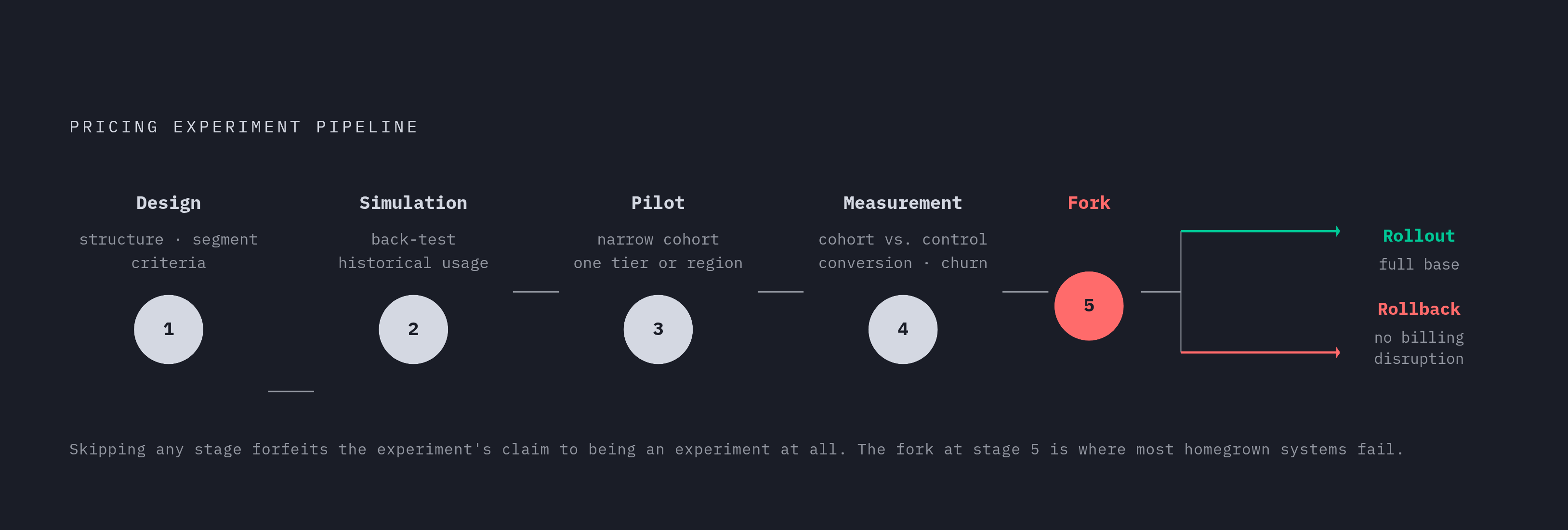
Changing a price is not the same thing as running an experiment. A real pricing experiment has a hypothesis, a test cohort, a control group, a defined set of outcome metrics, and a way to back out cleanly if the results go bad. Updating a number in a database skips all of that; it's a guess with an invoice attached, dressed up afterward to look like analysis.
A properly run experiment moves through five stages. Design defines the new structure, the target segment, and what success looks like before anything touches a live account. Simulation back-tests the proposed model against historical usage data to estimate revenue impact ahead of time. Pilot rolls the plan out to a narrow cohort: new signups, one customer tier, a single region. Measurement tracks that cohort against a control group on conversion, expansion, and churn. Rollout or rollback either promotes the winning model to the full base or reverts it without disrupting anyone's bill.
Skip a stage and the result forfeits its claim to being an experiment at all. Each stage puts a specific demand on the billing infrastructure underneath it: a sandbox that mirrors production pricing logic exactly, plan configuration that doesn't require a deploy, cohort targeting with grandfathering rules for customers on existing contracts, scheduled rollouts so nobody is pushing changes at midnight, and an audit trail so finance can reconstruct exactly what pricing applied to which account and when.
Most billing systems can generate an invoice just fine. Very few can simulate, stage, or selectively apply a new pricing model without a developer stepping into the process at every stage, which is the gap Flexprice, a usage-based billing and metering platform, is built around. That gap, more than any shortage of pricing ideas, is why pricing experimentation stalls before it starts.
The four pricing levers product and growth teams should be able to pull directly
Four levers determine whether a team can actually run pricing experiments on its own, or whether it is still filing tickets and calling it self-serve. Leave one lever behind a developer's queue and the self-serve claim collapses, no matter what the pricing page says.
Plan and tier configuration comes first: creating a new plan, duplicating an existing one, changing a price point, adjusting an included usage threshold. A product manager should do this through a UI or an API call, not wait for a sprint to open up.
Feature entitlements and access gates come second. Enabling or disabling a feature by plan, setting a usage cap per tier, flipping on beta access for a specific cohort: these are entitlement changes, and none of them should require redeploying application logic to take effect.
Credit and overage rules make up the third lever. Setting the credit grant on upgrade or renewal, configuring an overage rate, turning automatic top-ups on or off. For AI products specifically, this extends to deciding which actions consume credits and at what rate, without anyone touching the code that serves the model itself.
Cohort targeting and rollout scheduling round out the list: assigning a new plan to a defined segment, setting a launch date, spelling out grandfathering terms for customers still on legacy plans. The team needs to state plainly that new pricing applies to signups after a given date, while existing customers keep their current terms until they choose to upgrade.
The test is simple, and it doesn't bend for exceptions. If pulling any one of these four levers requires filing a ticket, the billing system is the bottleneck, full stop. The frequency at which these levers get pulled also carries real economic weight: monetization work, done at this pace, drives revenue growth more efficiently than pouring the same effort into acquisition or retention.
What billing infrastructure has to look like underneath to make this possible
The four levers work only when pricing logic sits in a configuration layer instead of application code. That means a rating engine that reads pricing rules from a catalog at the moment of use, rather than rules compiled into service logic at deploy time. Plan definitions need to exist as structured data that an authorized non-engineer can edit, with the change taking effect without anyone touching a build pipeline.
Real-time metering is a prerequisite, not a nice-to-have. Usage-based experiments only produce trustworthy results if the metering layer reports consumption accurately and promptly; run a simulation or a cohort comparison against stale data, and the conclusions are worthless before the analysis even starts. AI workloads raise the stakes further, since the metering pipeline has to keep pace with high event throughput without falling behind. Enforcement built on stale state produces unreliable experiment signals every time. The common architectural answer splits the work: a fast, approximate aggregation path for real-time dashboards and enforcement, and a slower, exact aggregation path for the final invoice. Both paths need to be accurate enough that nobody double-checks them by hand.
Entitlement enforcement has to live apart from feature code, too. Features should check a centralized entitlement service at runtime rather than consulting a hardcoded plan map buried in the application, so changing what a plan includes doesn't mean touching the feature itself.
Idempotency matters more than it sounds like it should. Duplicate events, caused by retries or a dropped network connection, cannot be allowed to double-count usage inside an experiment cohort. Skip this and the experiment's measurements are corrupted before anyone runs a single query.
Finally, an audit trail. Finance needs to reconstruct exactly what pricing applied to a given account at a given moment, which matters enormously for any experiment that runs mid-billing-cycle. Immutable event logs paired with versioned plan configurations are what make that reconstruction possible after the fact.
How teams should structure a pricing experiment from first hypothesis to full rollout
Start with a back-test, ahead of any live pilot. Run the proposed model against historical usage data pulled from the existing customer base, and use that to estimate revenue impact, flag which segments benefit and which get hurt, and surface churn risk before a single customer ever sees the new pricing.
From there, configure the experiment as a plan in the billing system, built alongside the existing plans rather than replacing them. Set entitlements, credit grants, overage rules, and price points through configuration, keeping the process clear of a code review queue.
Define the cohort next, and be explicit about grandfathering. Target new signups, one tier, or an opt-in group, never the full base on day one. State plainly what happens to everyone else: current customers keep their existing terms until they upgrade voluntarily, or they roll onto the new pricing at their next renewal, whichever the business decides in advance.
Then schedule the rollout and let the pilot run. Set a go-live date so the launch doesn't turn into a deployment-night handoff with engineering, and track the cohort against control on the metrics agreed on up front: conversion, expansion MRR, support ticket volume, early churn signals.
Last comes the decision: promote or roll back. A successful experiment gets promoted to the full customer base by updating the default plan assignment, again through configuration, while a failed one gets reverted for the cohort, with no disruption to anyone's billing. This structure eliminates the two-to-three-month delay that shows up whenever every stage of an experiment needs engineering not just to review the plan, but to build it from scratch. A 2025 Maxio/Benchmarkit survey found that 44% of SaaS companies now charge separately for AI-powered features. Each of those pricing decisions was itself an experiment that had to be designed, piloted, and rolled out before it ever became a line item.
Where build-vs-buy decisions determine whether self-serve pricing is achievable at all
Most companies build first and ask whether it scales later, when the honest order of operations runs the other way. Building is the wrong default for nearly everyone reading this, and the reasoning holds up under scrutiny. Homegrown billing systems are almost always built to fit the pricing model that existed the day they were written: flat-rate, or an early version of usage-based. Extending a system like that to support plan simulation, cohort targeting, or configurable entitlements amounts to a re-architecture, not a feature request. Engineering teams that maintain a homegrown billing stack tend to spend a large share of their time keeping it running rather than building new capability into it, which means pricing agility ends up competing with the product roadmap for the same small set of engineers.
A purpose-built billing platform changes that arrangement. Plan configuration, entitlement management, and rollout scheduling become available to product and finance directly, without a developer in the loop. Real-time metering infrastructure built to handle high-throughput AI workloads, idempotency, fast-path enforcement, audit logging: this comes as part of the platform rather than as a separate project. Hybrid models, credits, tiers, commitments with true-ups, overages, get supported natively instead of requiring custom development for every new variant a growth team dreams up.
The decision comes down to what pricing actually is for the business. Building makes sense when billing logic is a genuine product differentiator, or when a regulatory requirement falls outside what any vendor already covers. Otherwise, buy, and treat any other answer as a rationalization for sunk cost. The configuration layer inside a bought platform is precisely the thing that makes non-engineering pricing changes possible, and rebuilding that layer from scratch is the multi-month engineering project that created the ticket bottleneck in the first place. That same Maxio/Benchmarkit survey found a 21% median growth rate among companies running hybrid pricing models, a number only reachable if the team can actually iterate on hybrid pricing, which in turn requires infrastructure that doesn't route every change through an engineering queue.
Keeping finance in sync when pricing experiments run at product speed
Speed without visibility is its own kind of risk. Once product can change pricing without filing a ticket, finance loses the ground it is standing on, unless the billing system updates revenue recognition logic in step with every experiment rather than after the fact.
Accurate reporting during an active experiment depends on tying each customer account to the correct plan version at each point in time, which is exactly what versioned plan configurations exist for. Revenue has to be recognized against the terms that actually applied to an account, rather than a snapshot taken at the start of the month before the experiment even launched. Cohort performance, experiment against control, needs to show up inside the same revenue dashboard finance already uses, not a separate spreadsheet somebody reconciles by hand every Friday.
Invoice accuracy underpins all of it. When a customer can look at their usage events and match each one to a line item on the bill, disputes over unexpected charges drop off, and that matters most precisely when pricing is in flux and trust is what is actually being tested alongside the price itself.