Grace Period and Account Suspension Logic After Payment Failure
Separate billing from access, and anchor the grace deadline to the first failure.
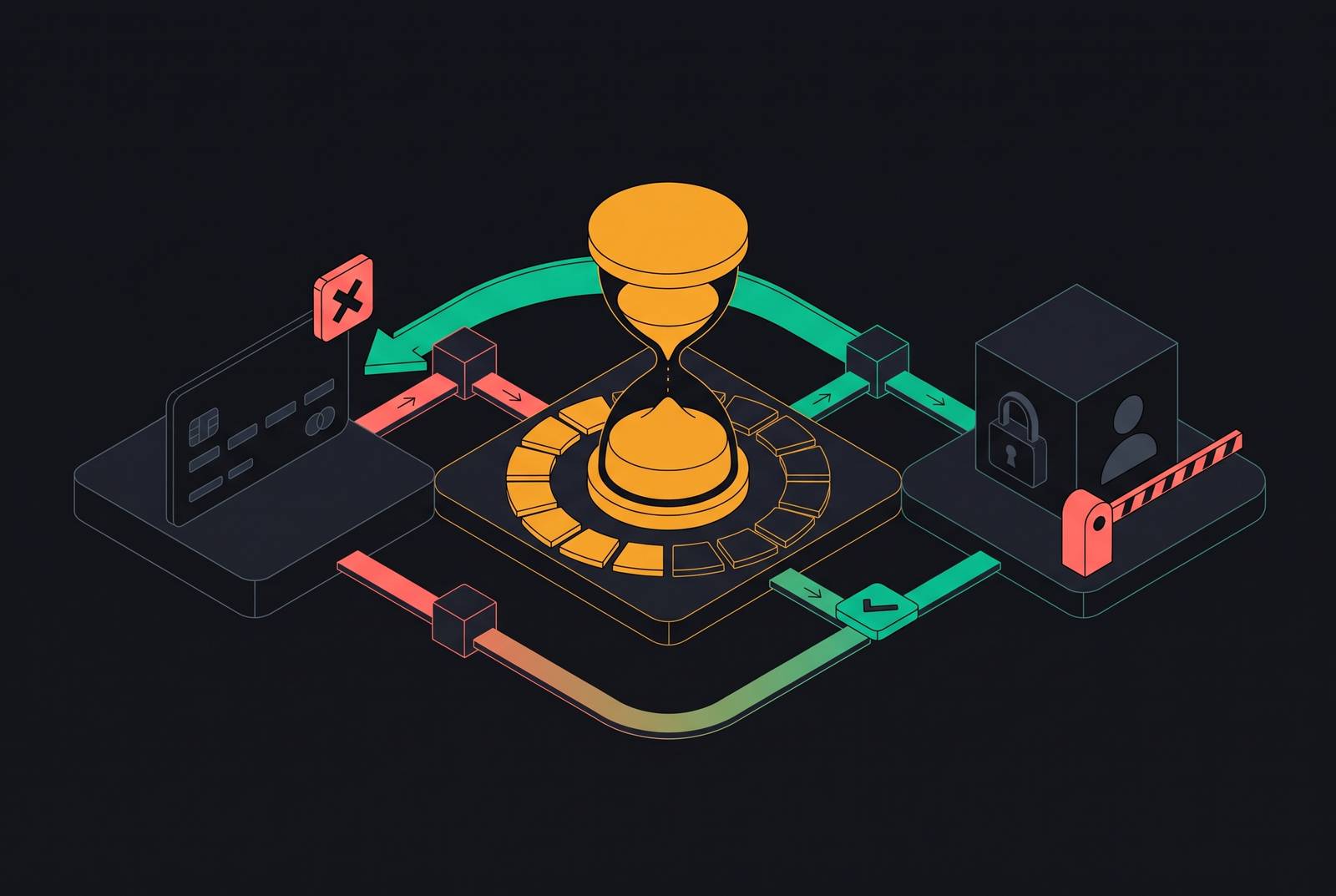
Grace period and account suspension logic after payment failure is a layered system. Reliable recovery depends on separating collection from access, fixing the grace deadline, and coordinating retries, restrictions, and restoration. Billing platform defaults often optimize for the platform rather than the business, so these rules must be deliberate business decisions.
Why payment failure opens a lifecycle, not a single event
A customer loves the product, uses it every week, and is about to lose access because a card expired. Nothing about that failure signals an intention to leave. Yet a system that responds by immediately withdrawing access can turn an administrative problem into involuntary churn.
Payment failure therefore opens a collection lifecycle that runs in parallel with the product’s access lifecycle. Collection may remain unresolved while the subscription is commercially valid and the customer retains some access. Collapsing those conditions into one overloaded status creates accounts stranded between states or allowed to continue indefinitely. Most failures are soft declines, so treating every failure as final also discards recoverable revenue. For usage-based and AI products, this lifecycle extends beyond recurring subscriptions to failed metered invoices and credit balances exhausted before invoice time.
The two dimensions every grace-period system must track separately
Billing collection state records what the payment provider reports, including past_due, unpaid, and canceled. Product access state records what the product permits, including full access, degraded access, suspension, and termination. These dimensions need independent updates and distinct ownership. The provider manages collection, while the subscription or entitlement module manages access.
The product should record and act on provider status without rebuilding the recurring payment retries that the provider already handles. Its access model should not expose provider-specific status strings as business rules, because terminology can change and providers can be replaced. Billing can then progress from past due to unpaid while the access layer keeps the customer within a valid grace period. A successful payment can settle collection while an abuse hold or an administrator’s restriction stays in place.
How failure type determines the right first response
The first decision after failure is classification. Hard declines, including a closed account, stolen card, or invalid card number, require a new payment method. The system should notify the customer immediately. Soft declines, including insufficient funds, temporary bank holds, issuer timeouts, and do-not-honor responses, can justify spaced retries.
The first failure’s decline code should be logged and used to choose how to recover the payment. An insufficient-funds response calls for timing aligned with common payroll deposits. An issuer timeout presents a different recovery window. Classification gates the actions that follow, even though the first observed failure still supplies the grace-period timestamp.
ACH requires separate handling within that classification. Nacha rules cap retries for NSF returns with R01 codes at two, while exceeding the unauthorized return rate threshold can suspend ACH origination entirely. That consequence reaches every customer using ACH.
Anchoring the grace period to the first failure, not the last retry
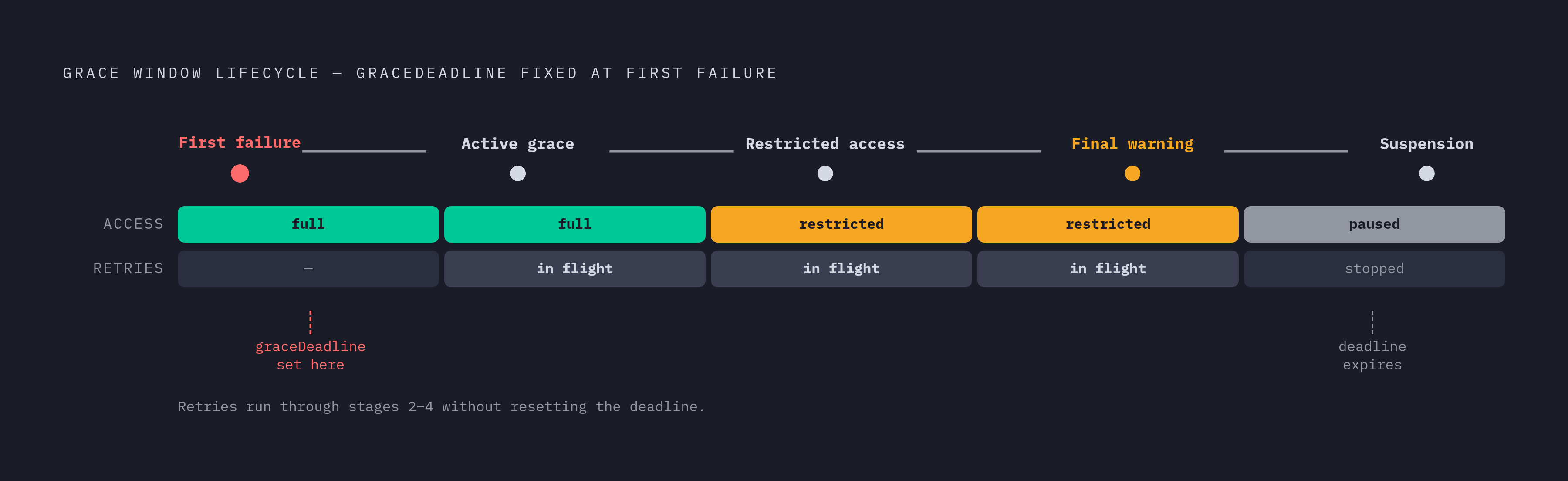
The system should store firstFailedAt when the first failure event arrives and calculate graceDeadline from it. Later failures can update collection status and attempt count, but must leave that deadline unchanged. A seven-day grace period means seven days from the first observed failure.
Using lastFailedAt to set the deadline instead gives the customer more time with access after every retry. The billing team may think it has allowed seven days while the system lets access last much longer. The Grasp subscription module lesson explicitly distinguishes the first failure’s deadline from subsequent retry updates. A background sweep can compare graceDeadline with the current timestamp and transition expired accounts to suspension, independently of a retry in flight. This decouples enforcement from collection timing, so neither process has to wait for the other to complete.
Designing the retry sequence to maximize recovery within the grace window
A retry schedule should cover plausible recovery windows. Same-day issuer timeouts, short-cycle funding problems, and longer card-update delays call for different spacing. Trying again every day can trigger issuer fraud detection and turn a soft decline that could have been recovered into a hard block. More attempts are not necessarily better recovery.
Timing also depends on when funds become available. Midweek retries, Tuesday through Thursday, generally outperform weekend attempts, but regional payday cycles can change the best opportunity. AI-powered dunning tools can adjust timing using decline codes and behavioral patterns, while well-spaced static schedules remain preferable to aggressive, poorly timed retries.
Attempt limits constrain either approach. More than four to six retries risks diminishing returns and issuer scrutiny, while Visa allows up to 20 and Mastercard up to 10 retries per period before network penalties apply. The retry schedule and grace window run on their own, so access ends on time even if an attempt is pending or retries are still allowed.
Graduating access degradation across the grace window rather than cutting off at the end
Graduated degradation moves from full access to restricted access and then suspension. An illustrative first stage covers days 1 through roughly 7, with collection attempts and low-urgency notification while access continues. A second stage, where the window permits it, restricts new actions while preserving access to existing data. Suspension follows only after the deadline passes without recovery.
Blocking expensive actions earlier protects an AI product from unrecovered spending on tokens, GPU-minutes, or inference calls, while early restrictions offer little financial benefit for a low-cost dashboard or document tool. The agri-saas case shows a different policy choice: full entitlements stay in place during grace, after which the account drops to a free tier. These variations preserve the underlying principle without imposing one universal access rule. Each transition also supplies a concrete reason to explain what changed and what the customer can do next.
Segmenting grace-period length and degradation policy by customer type
A uniform grace period substitutes platform convenience for business policy. Self-serve monthly subscriptions commonly use two or three retries, with recovery speed taking priority because recovery rates drop sharply after the first couple of weeks. Annual contracts can warrant longer grace, up to thirty days, and more cautious restrictions. The account value and reactivation effort are higher, while the failure may be administrative.
Enterprise invoicing requires a different starting point. Suspension must not precede the contractual payment window, including net-30 or net-60 terms, and ACH or wire timing can vary. At this tier, an account manager gets in touch in place of automated dunning emails. High-compute products still need earlier restrictions on expensive actions regardless of customer segment, even when read access remains generous. These choices should be written down and version-controlled so that a clear policy governs how customers are treated, rather than whatever defaults were left in place at launch.
Suspension state design — what it means to pause rather than cancel
Suspension should keep the data, configuration, billing history, and subscription record in place. Cancellation may trigger deletion workflows that make restoration impossible without starting over. The distinction is operational as well as commercial. A recoverable pause can preserve the relationship within a win-back window, allowing reactivation to be treated as recovery.
The product must therefore represent suspension independently of the provider’s terminal billing state. It may retain a suspended account after the provider has canceled its subscription, but billing must not be the only recorded reason for restricted access. Abuse, administrator action, and nonpayment can coexist. Resolving one reason must leave the others intact.
IRIS open-source platform PR (#638) shows how recovering a payment can accidentally restore an account that is still under an abuse hold. The race arises when the handler reads the suspension actor outside the advisory lock. The fix is to acquire the lock before reading that actor and remove only the billing-originated suspension row. For a customer who is eligible for reactivation, updating payment details and confirming should still take a single action, with this internal work kept out of view.
Customer communication across each state transition
Dunning messages should explain changes in state instead of going out on an email schedule with no reason behind its timing. The first failure should trigger an informational message within an hour, with a direct link to the payment update form. “Your payment didn’t go through” frames the problem as something to resolve.
When restrictions begin, the message should name the affected features and the deadline before suspension. A final warning in the last day or two should state the suspension date explicitly. The suspension message then confirms that access is paused, data is preserved, and a specific payment update step can restore access. Urgency follows the consequence.
After suspension, three contacts over thirty days can support win-back. The first reiterates the data-safe restoration path, the second on day seven explains what the customer is missing, and the final message on day thirty states the data-retention deadline. A small annual-plan discount can be appropriate for high-value accounts. Email remains primary, supported by in-app banners, with SMS reserved for high-value accounts that have given prior consent.
Recovery logic when payment succeeds after partial grace-period degradation
Recovery should undo all billing-originated degradation while keeping unrelated holds in place. During the first stage, that means closing the billing cycle, clearing the past-due flag, and logging recovery. During restricted access, it means restoring the specific entitlements that were reduced.
After suspension, recovery also requires reactivating the subscription or creating a new one if the provider canceled it, followed by confirmation of restored access. Audit events such as billing.grace_start, billing.suspend, and billing.restore let support and finance reconstruct the account’s timeline. For usage-based products, recovery must also settle usage accrued during grace and accurately reflect periods when expensive actions were blocked.
Finance reporting after the grace period closes without recovery
Suspending access does not close the financial record. If retries, dunning, and grace end without payment, leaving the failed invoice open inflates accounts receivable while cash remains unchanged. The unrecovered balance should move from AR to bad debt expense. The subscription record can remain available for win-back without keeping that invoice open in AR.
Under ASC 606, revenue recognized in the current period may also need reversal if collection is no longer probable. Grace-period exhaustion should therefore trigger a finance workflow alongside an access change. Finance teams should have direct visibility into grace-period stages and AR aging, so that the write-off decision is timely rather than a discrepancy discovered during monthly close.
What billing platforms get wrong by default and what to look for instead
A platform evaluation should test whether each policy is controllable and observable. A distinct, queryable firstFailedAt field shows whether the grace deadline can remain independent of retries. Separate collection events and access provisioning show whether entitlement policy belongs to the business. Intermediate access states and actor-tagged suspension records establish whether the system can degrade service safely and restore only the restrictions that payment resolves.
Retry automation needs equally clear boundaries. Decline-code branching, attempt controls, and ACH handling should be clear to see, rather than hidden behind one schedule used for every case. For metered and credit-based products, real-time consumption and credit balances are also essential during grace. Reconciliation only at invoice time cannot provide that visibility.
Infrastructure built for usage billing is better placed to offer these controls through APIs because consumption-based products need billing events and entitlement states that can change on their own. That architectural fit still needs evaluation against the actual policy. Building the system internally is tractable, but the scope includes concurrent suspension actors, ACH compliance, write-off triggers, and real-time usage visibility, with maintenance growing as pricing models expand. The buying or building decision should turn on control over those mechanisms.