Smart Retries and Card Updater Services in Subscription Billing
Fixing involuntary churn means refreshing cards, retrying wisely, and respecting network rules.
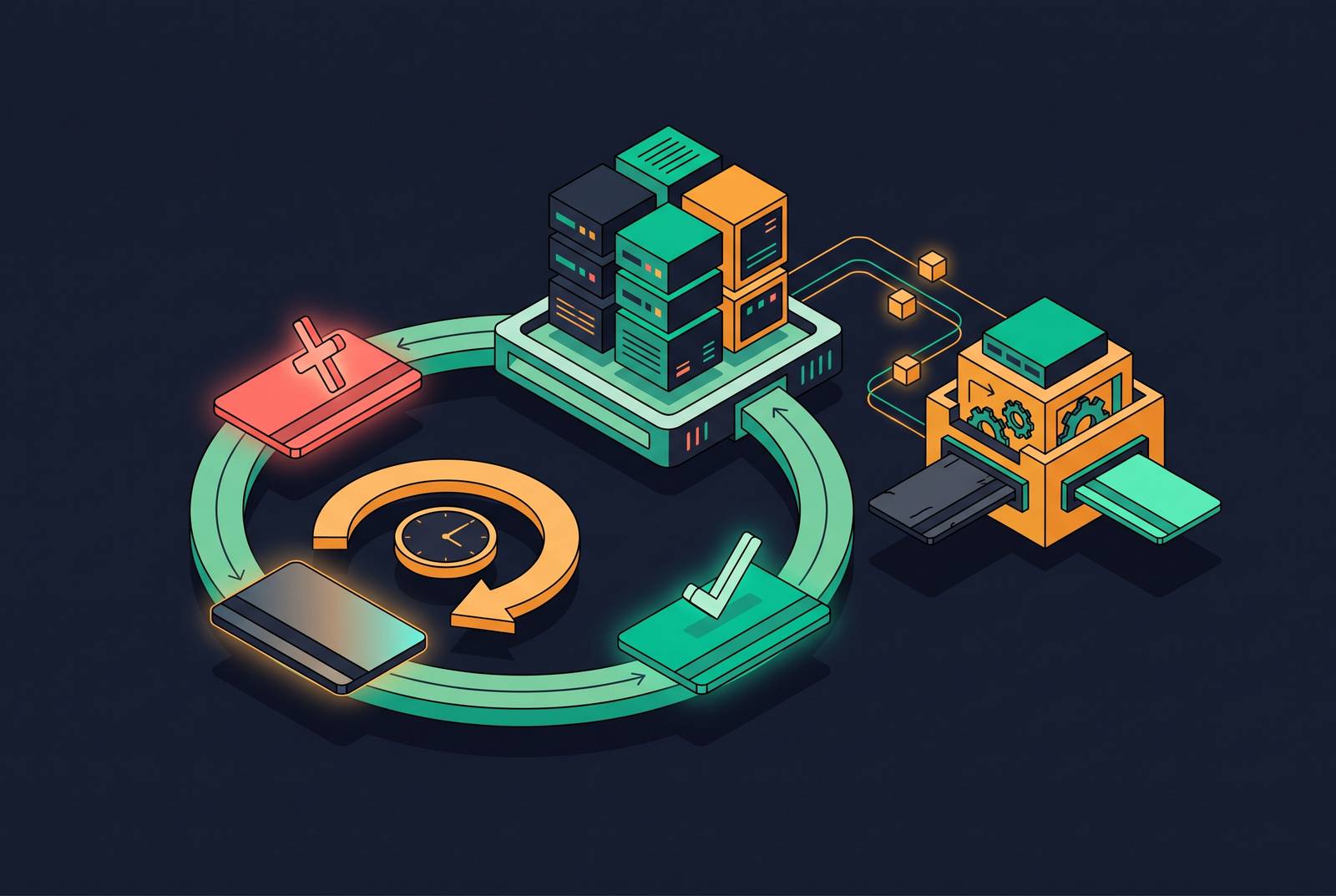
Smart retries and card updater services address involuntary churn as a billing infrastructure failure. Involuntary churn accounts for a substantial share of subscription cancellations. Recovery calls for refreshing credentials before charging, retrying recoverable failures according to issuer signals, and contacting customers only when their action is needed. The order of these steps can decide whether a subscriber who wants to stay keeps or loses access.
Involuntary churn is a billing infrastructure failure, not a customer behavior problem
A subscriber can be entirely happy with a product and still have their account cancelled because a renewal payment failed. No cancellation decision took place. Yet a single churn metric can count that subscriber alongside someone who chose to leave, leading product, finance, and retention teams to misread what went wrong. At meaningful MRR scale, such losses can leak a seven-figure annual sum from customers who would renew if the payment cleared.
Win-back campaigns and cancellation-flow offers address deliberate departures. They cannot repair a network timeout at 2 AM. When payment failures disappear into a general churn rate, billing defects look like dissatisfaction with the product. Tracking those losses separately makes it clear what payment infrastructure needs to fix, mostly without asking customers to do anything.
Why payments fail and require four distinct responses
An expired or reissued card requires different treatment from a temporary lack of funds. The credential itself needs to change. Fraud-prevention reissues, EMV chip upgrades, and contactless replacements can leave subscriptions attached to details the customer has forgotten to update. Card updater services can update those details before the bill is charged. Where they cannot, a targeted email with a one-click update link gives the customer a specific remedy.
With soft declines, the same card may still work. They can happen because of insufficient funds, velocity limits, network timeouts, and temporary issuer-side risk rules. Roughly 80–90% of declines fall into this category. Recovery depends on another attempt at the right moment. Immediate outreach introduces friction into failures that retries can often resolve silently.
For hard declines, a stolen card, closed account, or permanently invalid credential will not work after a wait, so retries should stop right away and the customer should be asked for a new payment method. Geographic or fraud-mismatch blocks call for a different message to the customer. The card may be valid and funded, but the bank is withholding authorization. The customer needs to authorize the charge with their bank or use another payment method.
How smart retry logic works and what separates a genuine retry engine from a rescheduled attempt
A genuine retry engine decides whether to try again, when to try, what to change, and when to stop trying to recover the payment. A fixed schedule answers those questions identically for every failure. The distinction begins with classification, because an incorrect soft-or-hard decision either abandons recoverable revenue or spends attempts on a payment that cannot clear. Timing alone is not enough to make retries intelligent.
Some responses resist a simple classification. A “do not honor” code can indicate a soft or hard decline depending on accompanying network advice. Where those signals leave the response ambiguous, treating it as soft with a longer retry window allows recovery before escalation to customer outreach. Explicit issuer instructions take precedence over that fallback. Mastercard Merchant Advice Codes (MACs) 24–30 specify waits ranging from an hour to 10 days, while MAC 03, “Do Not Try Again,” requires an immediate stop.
Within those instructions, timing depends on the failure and its context. Network timeouts can justify earlier attempts, while insufficient funds call for more time. Card type, issuing bank, geography, payday cadence, time of day, and historical approval patterns help distinguish those cases. Routing adds another dimension to the decision. An alternate gateway can recover failures the original processor would decline again, but this requires multiple payment providers or an orchestration layer.
The network rules that constrain every retry strategy
Network rules make retry design a compliance problem as well as a recovery problem. Visa raised its standard retry cap in May 2025 to 20 attempts per card within a rolling 30-day window. That allowance does not apply to every decline. Visa Category 1 responses, including lost card, stolen card, closed account, and stop payment, permit zero retries. Mastercard also applies a per-attempt fee when merchants retry after MAC 03.
Visa’s Acquirer Monitoring Program (VAMP) tightened its Excessive threshold to 1.5%, with over a thousand events per month, in Asia Pacific, Canada, the EU, and the US as of April 1, 2026. That threshold is lower than when enforcement began on October 1, 2025. The change allows less room for disputes and gives no separate retry allowance. Merchants exceeding it face per-dispute fees and fraud report charges, with loss of Visa acceptance as the ultimate penalty.
Mastercard’s Excessive Authorization Rules, updated January 2025, target repeated attempts involving the same declined card, merchant, and amount. Rapid “woodpecker” retries can also trigger customer-account fraud flags. Stale credentials introduce another cost through its Acquirer Credential Continuity fee on outdated recurring credential charges for merchants without network tokens or card updaters. More attempts are therefore not a sound objective. Effective engines conserve the available attempts for recoverable failures and stop when network signals require it.
How card account updater services resolve credential failures before a charge is attempted
Card account updater (CAU) services work upstream of retries. They refresh credentials before the billing cycle runs, so a charge can use the correct card details on its first attempt. This addresses a failure that timing cannot fix. An old card number stays out of date no matter how long the wait, even when the customer’s underlying account is still active.
Mastercard’s Automatic Billing Updater uses a push model in which issuers send credential changes to the network. Visa’s Account Updater works with both push and pull models. For merchants, CAU is primarily a batch process. Enrolled vaulted cards are submitted on a recurring cycle, participating issuers supply updates through the network, and the gateway applies them to the vault before scheduled charges.
A card reissued close to billing may not update in time, issuer participation varies by bank and region, and cardholders can opt out through their bank. CAU also cannot resolve insufficient funds, exceeded limits, or fraud blocks. Subscription status remains a separate control. Updated credentials applied to an already-cancelled subscription can produce an unexpected charge and a dispute, so cancellation processing and grace periods belong in the same operational picture.
Network tokenization as a structural complement to card updaters
Network tokenization replaces the card number, or PAN, with a token issued by the card network. The token remains linked to the underlying account when the physical card expires or is reissued. No batch submission is required to update that mapping. Each tokenized charge also includes a one-time cryptogram that authenticates the payment source. Visa’s published data indicates materially lower card-not-present fraud, which can support authorization by reducing issuer concerns about risk.
Tokenization and CAU therefore overlap without being interchangeable. Network tokenization covers approximately 80–90% of major issuers automatically, while CAU supports legacy card files and issuers outside the token network. Using both gives better authorization rates than using either on its own. Their separate lifecycles can create integration gaps or duplicate updates if poorly coordinated. Modern payment orchestration and billing infrastructure providers generally handle that coordination in a single layer, leaving more of the integration burden with teams building payment infrastructure themselves.
The correct sequence of smart retries, card updaters, and dunning
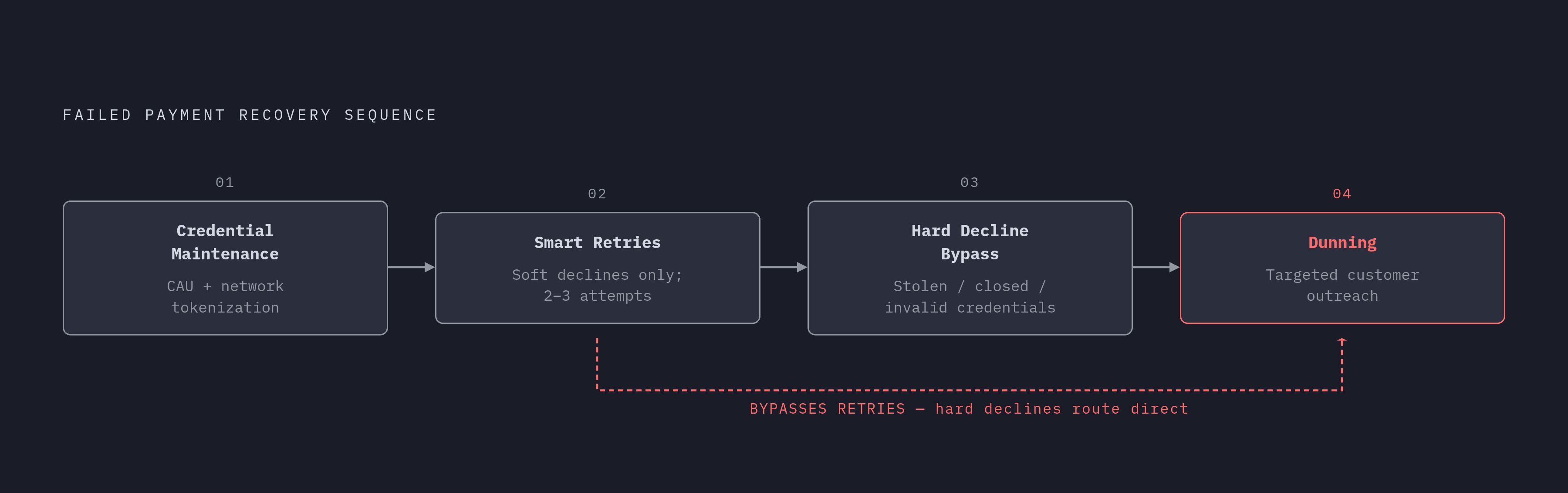
Credential maintenance comes before any charge attempt. CAU runs before billing, while tokenization keeps the account mapping up to date without a batch refresh. Together, they prevent a share of failures without spending retry attempts or asking the customer to intervene.
Smart retries follow when a charge still fails for a recoverable reason. Even with correct credentials, a payment can fail because of insufficient funds, timeouts, or temporary limits. Most recoverable soft declines resolve within the first two to three attempts, so classification and timing determine how effectively that window is used. Hard declines bypass this stage entirely. They require immediate, targeted outreach rather than an obligatory passage through the retry schedule.
Dunning reaches out to customers when automation cannot fix a failure. Soft declines reach it when retries run out, while permanently invalid cards and bank authorization blocks need the customer to act sooner. The message must explain the actual remedy, whether that is replacing an expired card, addressing insufficient funds, or asking a bank to authorize a charge. This sequence assumes card payments unless explicitly extended. PayPal failures can involve expired billing agreements, cancelled mandates, or missing tokens, and some billing systems do not retry them at all.
What the sequenced approach looks like on a real usage-based billing stack
MEGOGO reduced subscription churn by 5% and improved payment conversion after integrating Solidgate’s orchestration, network tokenization, and Account Updater in a single stack. The case grounds the approach in an operating subscription business. It demonstrates the combined outcome of credential maintenance and orchestration, rather than assigning the improvement to one isolated feature.
Variable usage invoices add a complication to that model. For AI and usage-based products, the amount can change each billing cycle, affecting dunning thresholds, urgency, and the explanation sent to the customer. Fixed-charge retry logic therefore needs re-examination before reuse. The recovery message must make sense for the current invoice.
Hybrid pricing extends that requirement across a base subscription and its usage components. Metering and billing on the same engine make it possible to distinguish those components in a failed invoice and communicate the appropriate recovery message. Prepaid credit wallets add another access risk. Wallet depletion can interrupt service much like a conventional payment failure. Billing infrastructure must handle that distinction rather than treating every interruption as a declined card.
What to audit in your billing stack before the next billing cycle runs
Auditing the handoffs between these mechanisms is the practical next step. Fragmented stacks can separate card updates from retries, retry exhaustion from dunning, and payment-method updates from subscription resumption. Recovery can stall at any handoff even when each tool works on its own. A separate metering system adds reconciliation work when invoices contain variable usage. Finance teams that reconcile records across disconnected systems may also struggle to see how much is lost to involuntary churn.
Purpose-built infrastructure can close those gaps by handling metering, pricing, invoicing, and payment recovery in one system. Building the equivalent internally involves more than retry scheduling. It also requires CAU integration, email sequencing, payment-method update flows, and continuing maintenance as network rules change. The audit should establish whether the stack supports hybrid invoices and prepaid wallets without losing the recovery sequence, and whether PayPal failures receive any automated recovery at all.
Before the next cycle, establish whether CAU is enabled and whether the recovery plan accounts for batch latency, opt-outs, and non-participating issuers. Then examine the retry decisions themselves. Check the engine’s distinction between hard and soft declines, compliance with issuer instructions, and adherence to Visa’s 20-attempt-per-30-days cap, while monitoring exposure under the 1.5% VAMP Excessive threshold. Finally, inspect the customer messages to check whether each asks for the action that can resolve that failure or every failed payment still triggers the same generic email.