Failed Payment Retry Sequencing in SaaS Billing Platforms
Sorting declines by cause shows when to retry, wait, or ask.

Effective failed payment retry sequencing in SaaS billing platforms prevents temporary payment problems from becoming lost revenue. Recovery is primarily a routing and sequencing problem. Effective systems classify the failure, retry when conditions favor success, respect issuer instructions, and involve the customer only when automated recovery cannot resolve the issue.
Why failed payments become permanent losses without sequencing intelligence
A payment fails, the default retry fires three times on the same schedule, and the account lapses. The customer never knew there was a problem. Nothing in that sequence establishes that the customer wanted to leave or that the payment could not have cleared. It establishes only that the configured attempts failed. The loss begins with a payment error but becomes permanent through a recovery process that never adapts.
A fixed retry schedule plus automated emails wrongly treats different failures as though the same fix will work for all of them. A temporary bank-side timeout needs another attempt, but a deactivated card needs the customer to act. Applying the same sequence to both wastes attempts on one and can delay recovery on the other. The design failure is not a lack of retry capability but a lack of decisions about which failures belong in the queue.
That distinction separates involuntary churn from a deliberate cancellation. A customer who wants to keep paying can lose access without choosing to stop, so better billing operations can prevent this loss. More communication alone does not correct the routing error. The recovery system first needs to establish what can change before the next attempt and whether that change requires the customer.
How decline codes sort every failed payment into one of three fundamentally different recovery paths
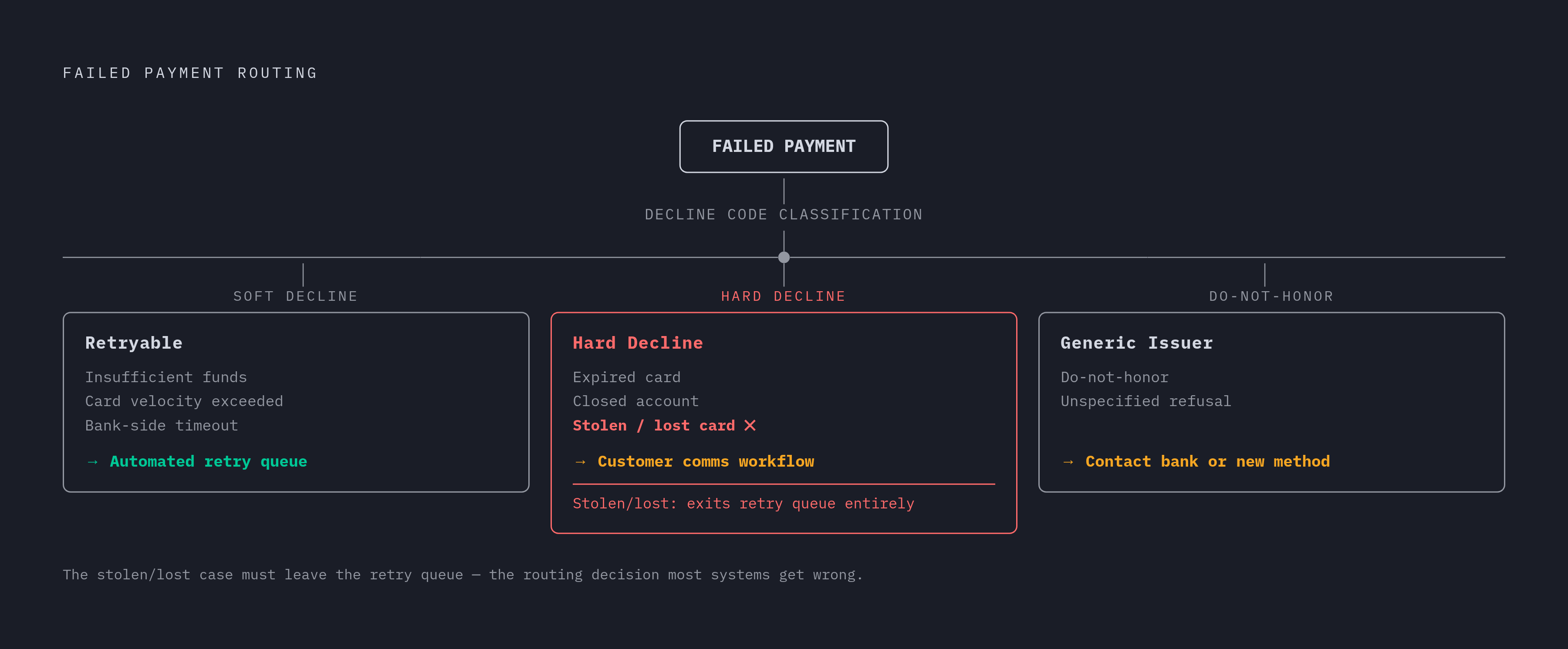
Decline-code triage is the first decision gate. Retryable soft declines include insufficient funds, card velocity exceeded, and bank-side timeouts. These failures describe temporary conditions affecting a usable payment method. Their recovery path is automated retrying, because the payment can clear without customer involvement once the blocking condition changes.
Hard declines require a different route entirely. Expired card, stolen or lost card, and closed account indicate that retrying the same payment method will not succeed. The communication workflow should therefore start immediately, while the retry queue still has pending attempts. A stolen or lost card should leave that queue altogether, because the card is deactivated and further attempts only delay the viable recovery path.
Do-not-honor and generic issuer declines belong to a third, more conservative path. Their ambiguity is itself a useful signal. The failure may hide a fraud flag, and more attempts can make the issuer more suspicious without making recovery more likely. These cases usually require the customer to contact the bank or provide a different payment method.
A soft-declined subscriber who could have recovered silently may instead receive unnecessary dunning messages. That introduces friction and voluntary cancellation risk into what began as an operational failure. Classification therefore determines both what the system does and when it leaves the customer undisturbed.
Why retry timing within each path is determined by issuer batch cycles and payroll calendars, not arbitrary intervals
Within the retryable path, the next decision is when the blocking condition is likely to change. Card networks and bank processors run batch processing at specific times, so an attempt made at the wrong point can fail even when funds are available. Card velocity exceeded has a different clock. Daily limits usually reset within 24 hours, but weekly, monthly, and credit-cycle limits take longer to reset. Network or processing errors, by contrast, can clear on the next retry within hours.
Payroll calendars provide another timing signal for B2C and SMB cards. Recovery windows tend to fall around the dates when deposits arrive, including the 1st and 7th in India. Corporate purchase cards behave differently. For B2B accounts, switching to ACH, increasing card limits, or using another card is more likely to resolve some failures than waiting for another scheduled attempt.
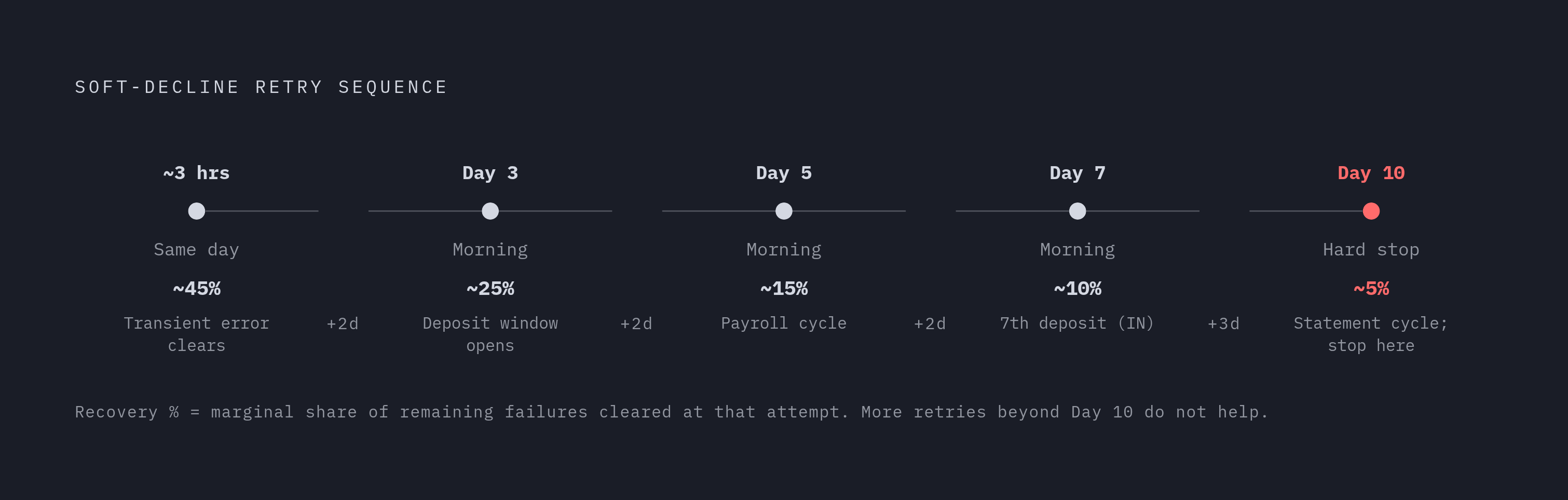
An illustrative sequence starts within a few hours, then moves to Day 3 morning in the customer’s timezone, Day 5, Day 7, and optionally Day 10. Early attempts can clear transient errors and temporary holds, while later ones leave time for deposits and statement cycles. Each successive attempt recovers a smaller marginal share, so the sequence needs a stopping point rather than an assumption that more retries always help.
A well-instrumented system records successful retry times and days of the month by decline code and card type. That history supports timing choices grounded in actual recovery patterns. Those choices must still fit within the rules governing whether another attempt is permissible.
How Merchant Advice Codes and card network retry rules create a hard compliance ceiling on retry sequences
Card network rules constrain even a well-timed retry. Visa caps retries at 20 attempts per card per 30 days. Mastercard caps retries on soft declines and expanded its Transaction Processing Excellence (TPE) Excessive Authorization Attempts program. Its fees apply after thresholds of declined attempts within a short window or across a 30-day period, with subscription and SaaS businesses among those affected. Penalties can exceed the revenue being pursued.
Merchant Advice Codes (MACs) provide more specific instructions. They tell the billing system not merely that an attempt failed but what should happen next. Ignoring the MAC meaning “Do Not Try Again” incurs a per-attempt penalty. Continuing to retry after MAC 21 (Stop Recurring Payment) is a compliance violation, while other codes prescribe waits ranging from a short interval to several days.
These signals belong inside the sequencing logic. A system that ignores them spends retry budget on prohibited attempts and accumulates penalty exposure across the billing cycle. Geography also constrains the sequence, because a schedule designed for US cards can violate SEPA rules when applied unchanged to European customers. SaaS businesses that serve customers in different countries need rules for each geography in place of a single global schedule.
Automation must stop when the permitted attempts are exhausted or an issuer instruction rules out another charge. At that boundary, recovery moves from retry execution to a deliberate decision about customer outreach.
How the retry-to-dunning handoff works, and what makes it fail
Dunning is an escalation path. It should begin when automated recovery is exhausted or when the failure makes automation futile. Hard declines need an immediate handoff because only the customer can take the steps needed for recovery. Stop-retry MAC signals also force that transition, as do ambiguous do-not-honor declines where further attempts risk reinforcing a fraud flag.
For soft declines, the handoff follows the permitted recovery window. It must preserve the context of what happened. Decline-code history, the number of attempts, and the customer’s payment history allow communication to reflect the actual failure. Without that context, dunning loses the distinction between a temporary problem that persisted and a payment method that was unusable from the outset.
Communication should then match the account’s stage of recovery. An initial notice can assume a temporary glitch, later reminders can increase urgency as the unresolved sequence advances, and the final notice should specify the exact cancellation date.
Pausing preserves history and configuration, allowing reactivation without re-onboarding, which is especially consequential when enterprise re-signing takes months. Cancellation is appropriate for low-value accounts or confirmed non-payment after multiple attempts. Static rules cannot make that judgment dynamically from account value, payment history, and the dunning attempts already completed.
How account tier and billing model change every parameter of the retry sequence
Enterprise accounts warrant more retries over a longer permitted window, immediate customer success manager notification, an extended grace period, and an option to switch to invoice billing. Mid-market accounts warrant a tighter window and a later CSM alert, while self-serve accounts can follow fully automated sequences once the failure type and route are established.
Some accounts should bypass automated outreach altogether. The automated dunning flow should leave out VIPs, manual-billing enterprise accounts, internal users, and customers who are in active hardship negotiations. Annual billing also changes the stakes because one failed payment can represent a year of contracted revenue. Proactive card-expiration outreach should begin well before the charge date, and grace periods should be substantially longer than for monthly billing.
Usage-based and hybrid models introduce a separate moving-total problem. The amount owed closes at the end of the billing period, while consumption can continue during recovery. The retry system must reconcile that live consumption with the invoice and charge the correct final amount.
For AI-native and agent-based products, access restrictions also affect live workflows. An immediate cutoff can break work already underway. A graduated response instead begins with a soft lockout on new high-cost actions, preserves essential functions through a degraded mode, and reserves a hard cutoff for the close of the dunning window. Retry count, grace period, escalation, communication, and service access thus depend on the account and billing model as well as the failure.
What billing infrastructure needs to get right underneath the retry logic
Idempotency prevents a recovery attempt from becoming a duplicate charge. Any operation that creates a charge or modifies a subscription needs an idempotency key derived from the business operation itself. A randomly generated key at request time does not provide that protection when a repeated request receives a different key. Network errors, deployment failures, and race conditions can all force request retries, so the system needs this safeguard beneath the sequencing logic.
Amounts must use integers in the smallest currency unit or fixed-precision decimals, because floating-point arithmetic introduces rounding errors across retries and reconciliation. The outbox pattern makes the database write and the recording of its event atomic, preventing a retry from firing without an accurate record of whether the previous attempt succeeded.
The webhook event log holds the history the system needs to make those decisions. It must record failures, retries, successes, decline codes, card types, invoice amounts, customer IDs, previous payment history, and timestamps with full metadata. The system needs that history to count attempts correctly, enforce limits, and calculate recovery rates.
Usage-based and AI billing add a real-time metering requirement. When credits are consumed at millisecond speeds, usage ingestion must keep pace so that invoice totals remain accurate during the retry window. Maintaining these primitives is ongoing engineering work, which changes the economics of building the recovery system internally.
Why building retry sequencing in-house costs more than the initial sprint suggests
Basic retry scheduling is a tractable initial integration. A senior engineer can wire it up in a few weeks, but that sprint does not cover the system’s continuing obligations. Improving retry timing takes training data, rules need to keep up with issuer behavior, and changes to network policy need checks for compliance. Payroll calendars and regulations add inputs that can change unpredictably after the scheduler is deployed.
The available data also limits an internal system. It optimizes against the organization’s own payment history, while a purpose-built platform can draw on transactions across merchants, gateways, payment methods, and markets. That difference becomes more consequential for new geographies, payment methods, and billing models. Multi-gateway routing adds another capability burden, because automatically trying an alternative provider can recover failures the primary provider would leave unresolved without waiting for engineering intervention.
Buying infrastructure is not always an available option. Healthtech and fintech businesses with strict rules on data residency sometimes cannot use cloud-hosted billing platforms at all. Their decision is therefore not purely economic. Where external infrastructure is permissible, however, the comparison needs to include ongoing maintenance and recovery capabilities rather than only the cost of the first scheduling implementation.
For usage-based, hybrid, and AI-native pricing, that comparison extends beneath payment recovery. The engine must ingest usage at speed, model multiple pricing dimensions, and support prepaid credit wallets and postpaid invoicing together. Purpose-built billing infrastructure offers another way to handle this instead of adding retry intelligence on its own to a subscription engine. It treats sequencing and billing accuracy as one problem, because recovering a charge is useful only when the charge is correct.