Root Causes of Revenue Leakage in Usage-Based Billing
Events get lost silently in usage-based billing pipelines, erasing revenue without a trace.
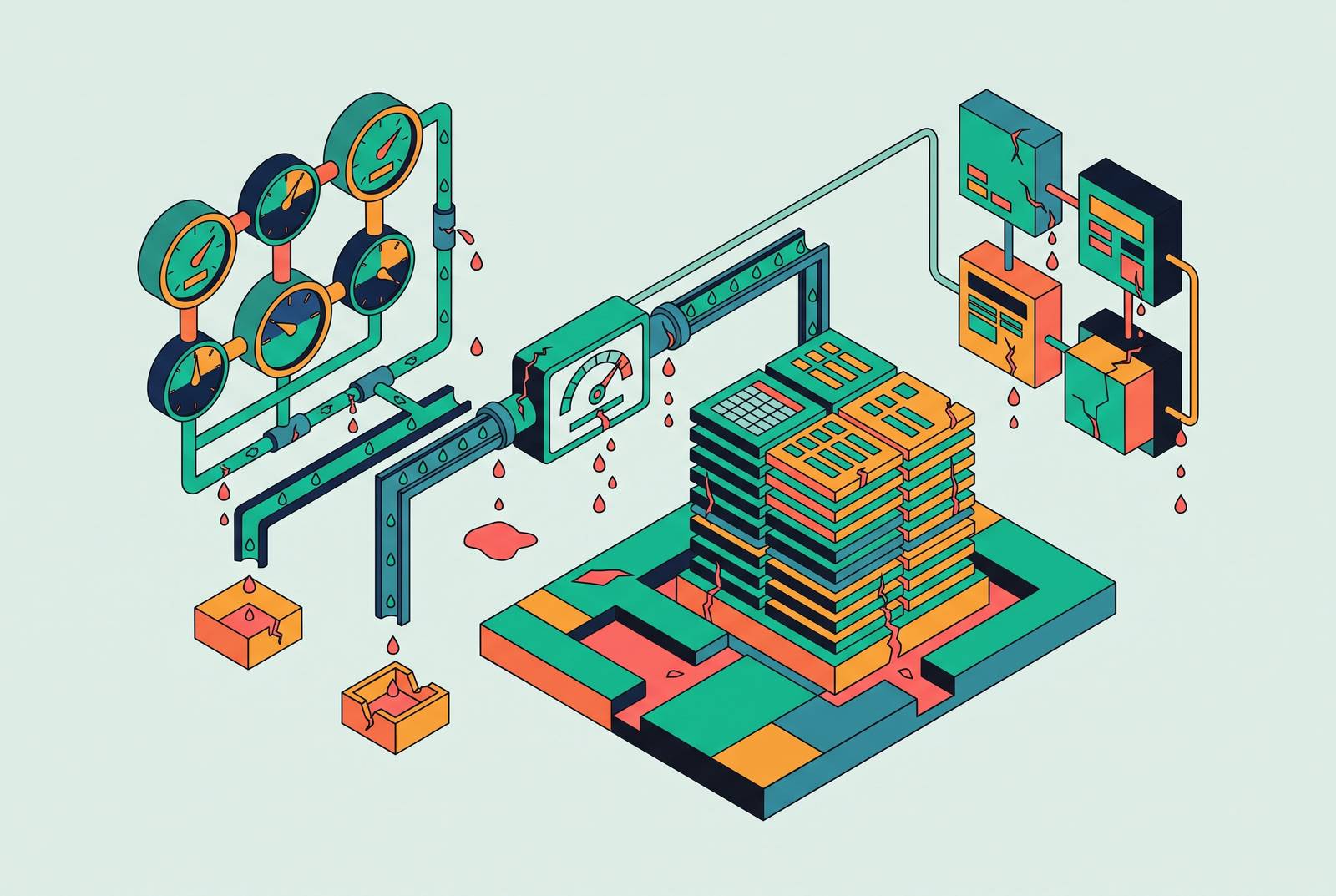
Revenue leakage in usage-based billing does not announce itself. No alarm fires, no discrepancy flags itself for review, and the invoice that goes out at the end of the month looks exactly as correct as the invoice that went out the month before. That is the first thing to understand about this problem: it is a detection failure before it is anything else. In flat-rate SaaS, the invoice amount gets fixed the day the contract is signed, and an error there appears as a wrong price or a wrong renewal date, something a human can spot on a spreadsheet. Usage-based billing works differently. Every invoice gets computed fresh from raw event data, so every step between the event firing and the invoice printing is a new place for something to go quietly wrong. A 2026 analysis of SaaS billing leakage found that dropped events leave no error log behind, and the system just bills for less than was consumed, month after month, without any signal that anything has gone wrong. Generic billing hygiene advice, the kind built for subscription errors, does not reach this problem, because there is nothing visibly broken to catch.
Event loss during ingestion: leakage that leaves no evidence
The first and most basic failure point in usage-based billing sits before any pricing logic even runs. Events simply fail to arrive at the billing pipeline, and once that happens, no downstream system can recover what it never received. Three mechanisms cause most of this loss: network timeouts between the event source and the billing platform, buffer overflow when traffic spikes, and integration failures between application instrumentation and the ingestion endpoint. None of these require a bug in the traditional sense. They are ordinary properties of distributed systems operating at volume, and all three produce the same outcome: usage that happened but was never counted.
Platforms built specifically for consumption-based billing, like Flexprice, a metered billing infrastructure for AI companies and SaaS products that tracks API calls, tokens, and credits on the same engine as invoice generation, address this by coupling event acknowledgment to the ingestion layer itself. What makes this failure mode dangerous is its invisibility. BillingPlatform's 2026 analysis states the problem directly: there is no error log that says events were lost today, because the pipeline processes whatever it receives and produces a result that looks entirely correct. A finance team reviewing that month's invoices sees clean numbers. Nothing in the output distinguishes a complete count from a partial one, and the company simply under-bills for consumption that already happened.
To close this gap, you need a mediation layer built around persistent event buffering and delivery confirmation: every event source gets an acknowledgment for every batch it sends, and if that acknowledgment never arrives, the source retries the send. For AI products, the exposure runs higher than for most software categories. Every token generated or agent step taken is a billable event, inference happens at millisecond speed, and burst traffic during peak load is a normal operating condition rather than an exception. Event loss is a predictable outcome of how the traffic behaves, and a billing pipeline that cannot absorb bursts will lose revenue on a schedule, not by accident.
Duplicate events and aggregation misconfiguration: leakage in opposite directions simultaneously
Event loss causes revenue to disappear through absence. Two other failure modes, duplication and aggregation misconfiguration, cause leakage through a different mechanism, and they can push revenue in opposite directions at the same time within the same billing cycle.
Duplicate events come from network instability, application retry logic, and integration bugs: the same billable action gets recorded more than once in the event stream. If you don't enforce idempotency, both copies get treated as legitimate usage, and the customer is billed twice for a single action. The fix is conceptually simple. Every event carries a unique identifier, and the ingestion layer rejects any event whose identifier it has already processed. Building that check is not the hard part. Most teams fall short when they try to apply it consistently across every event source a company runs, including ones added after the original system was designed.
Aggregation misconfiguration is a contract compliance failure wearing a technical disguise. A contract might specify billing at the monthly peak, but the billing system underneath is actually calculating a rolling 30-day average. For a customer with spiky usage, those two numbers are not close. The same 2026 analysis frames this precisely: every aggregation function, whether sum, count, peak, average, or percentile, needs to be mapped to the specific language of the contract at setup time, not adjusted later as though it were a configuration preference someone could change on a whim. Get that mapping wrong and the billing system is violating the terms the customer agreed to.
The Cursor incident from June 2025 shows what this looks like when it reaches a customer directly: a single developer received an invoice for $7,225. The root cause was not a payment failure. It was a metering architecture that let usage accumulate without spend caps or real-time visibility into consumption as it happened. Real-time spend visibility, usage dashboards, alert thresholds, and budget caps are not customer-experience polish layered on top of a billing system. They are engineering requirements of the billing layer itself, because without them, usage mechanics can run well past what any customer expects to see on an invoice.
Late-arriving events and mid-period contract changes: misaligned consumption and billing
A third category of failure has nothing to do with bad data. The data is correct. The billing system cannot correctly assign the data to the period or the rate it belongs to.
Late-arriving events are a normal property of distributed systems, not a malfunction. Network delays and queue backlogs mean an event that happened on the last day of a billing period can arrive days after that period has already closed. A rating engine that closes the books at midnight on schedule has two bad options: drop that event entirely, or apply it to the wrong billing period. At low transaction volumes, this barely registers. At scale, it does not stay small. High-frequency API calls, IoT sensor streams, and AI inference events can all generate late arrivals that add up to a meaningful share of total usage in a period, and BillingPlatform singles this out as especially significant for telecom call-detail-record processing, IoT sensor data, and high-frequency SaaS usage metrics.
The capability that closes this gap is a configurable grace period paired with retroactive rating, a defined window after period close during which late events still get accepted, rated as though they had arrived on time, and applied to the correct period. Not every billing engine supports this, which makes it a specific question to raise directly with any vendor during evaluation rather than an assumption to make. Supporting it well requires two timestamps on every event, not one: event_time, recording when the usage actually happened, and ingestion_time, recording when the billing pipeline received it. Without both, the rating engine has no way to tell a late event belonging to last period from a normal event belonging to this one.
Mid-period contract changes compound the same underlying problem. A customer renegotiates a rate in the middle of the month, and a billing system that lacks split-period rating applies the new rate retroactively across the entire billing cycle. That either hands the customer a discount on usage that should have been billed at the old rate, or it generates a retroactive overcharge the customer will dispute the moment they see it. Mid-cycle modifications are also where ASC 606 revenue recognition most often breaks down in practice: the revenue recognition engine needs the modification's effective date, the new schedule going forward, and a correction applied to revenue already recognized under the old terms, and if the billing data and the contract amendment do not tie out with each other, the journal entry will not tie out either. Any enterprise SaaS relationship with a dynamic contract will eventually produce a mid-period change, and the billing system either handles it or generates a dispute.
The widening gap between application code and billing configuration
A different kind of leakage comes from organizational structure, not pipeline mechanics. Tier enforcement and access logic typically live in application code, and that ships weekly or faster. Billing configuration usually changes on a slower, more deliberate cycle, often quarterly. The two systems move at different speeds, and they diverge continuously, with no automated check in place to catch the growing distance between them.
The practical consequence is a mismatch nobody owns. A customer may be using a feature the product itself allows, while the billing system never picks it up as a chargeable event. The product team calls this a billing problem. The billing team calls it a product configuration problem. Without one shared source of truth connecting what the product enforces to what billing charges for, that argument has no natural end, and the gap just keeps widening with every deploy that touches entitlement logic, feature gating, or usage calculation.
MGI Research's December 2025 findings define revenue leakage across the entire monetization chain, not just the billing step: pricing, contracts, fulfillment, usage, billing, revenue recognition, and cash collection all belong to the same chain, and the research explicitly warns against treating leakage as only a billing or collections problem. The code-vs-billing gap is a direct illustration of why that warning matters. It originates in engineering decisions made before billing configuration is ever touched.
The Simplismart case shows what it costs to live with this gap rather than close it. Running billing on top of an open-source platform, the team spent between one and a half and two months building a billing engine on top of it, and still needed manual intervention at month-end reconciliation afterward. That is a recurring tax paid every reconciliation cycle, because patching a structural gap with engineering hours does not make the gap disappear. It just moves the cost from the billing invoice to the engineering roadmap.
Separating metering from billing: the conditions for all five failure modes at once
Each of the four failure modes described above looks, on its own, like a distinct technical problem with a distinct technical fix. They share a common root.
When metering and billing sit in separate systems, event counts live in one place and invoice generation happens in another. Correctness at the component level says nothing about correctness at the system level.
Laid out directly, each of the five failure modes traces back to a specific gap, one that a single unified layer would close. Event loss gets caught by delivery confirmation built into ingestion. Duplicates get rejected by idempotency enforcement applied at the same point. Late events get rated retroactively inside the same engine that produced the original invoice, so you don't need a separate reconciliation pass. Mid-period amendments get handled through split-period rating inside the system that already holds the contract rate, instead of being reconstructed after the fact. The code-vs-billing gap narrows when the billing system itself acts as the authoritative source of pricing logic, rather than sitting downstream as a passive consumer of decisions made elsewhere in the codebase.
Connecting a metering tool to a billing tool through integration does not eliminate these gaps. It relocates them to the integration layer itself, which then has to be maintained indefinitely and tends to be the first thing that breaks when the company scales or the product changes shape. Effort was not the deciding factor: three weeks of in-house engineering on credit-based pricing produced nothing shipped, while moving onto a purpose-built platform got the same pricing model live in three days. Effort was not the difference. It was whether the underlying system treated metering and billing as one problem or two.
The 2026 BillingPlatform analysis offers a direct diagnostic question for any company trying to find out where it stands: does the billing system track event delivery confirmation, meaning not just that an event was received, but that it was acknowledged and stored. Without that confirmation, there is no way to know whether events are being dropped before anyone ever notices the revenue is gone. A system that cannot answer that question is, functionally, a metering tool and a billing tool pretending to be one solution.