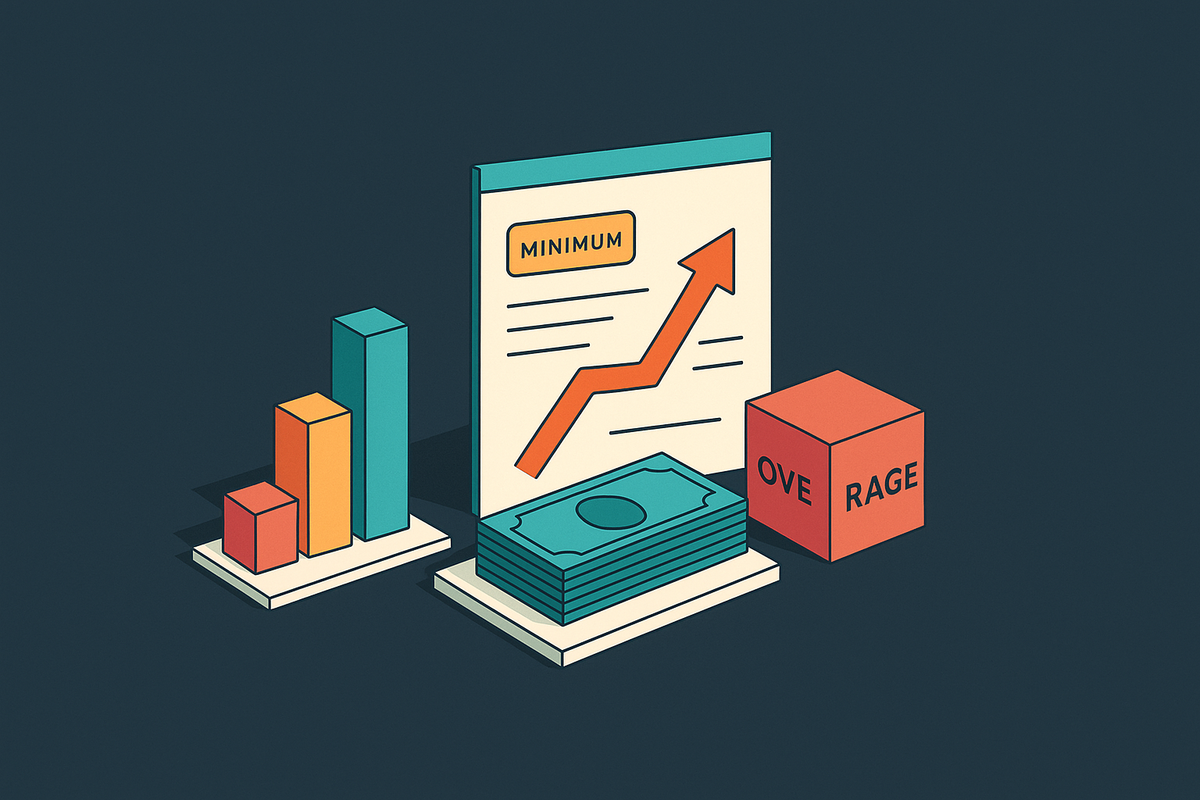
Real-Time Rating vs. End-of-Period Batch Rating
Real-time rating lets you enforce credits instantly, not hours later when revenue is already gone.
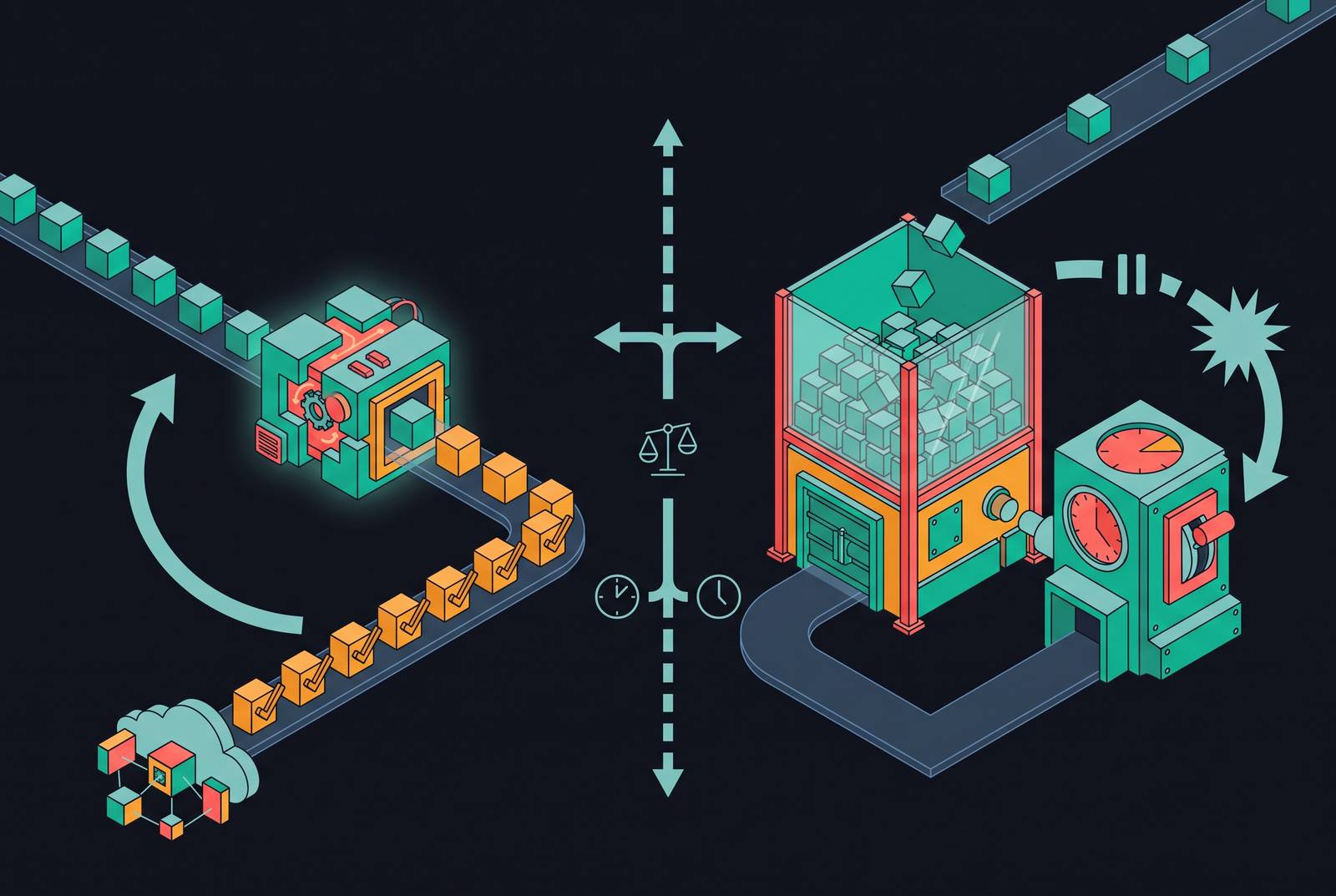
Rating is the step where pricing rules get applied to usage events to produce a charge. Metering just captures the events, and invoicing shows the customer the final number; rating sits between the two, and it's where the math actually happens. Whether that math runs in real time or on a batch schedule is an architectural decision, and it has direct consequences for credit enforcement, billing accuracy, and whether a customer trusts the number on their dashboard. That decision is separate from how often an invoice goes out; a monthly bill works fine on top of real-time rating underneath it. The split is about timing, and that timing question matters more now than it did ten years ago, because modern products throw off usage events all day long, not in tidy monthly chunks.
Why batch rating dominated for so long and what it still does well
Before distributed systems were the norm, overnight batch windows were the only realistic way to chew through large volumes of usage data without knocking over production systems. Telecom billing ran this way for decades: call detail records piled up all day, and a batch job worked through them at 2 a.m., when compute was cheap and nothing else needed the machine. Scheduling was predictable, hardware cost less off-peak, and subscribers had no expectation of watching a balance move in real time anyway. Monthly billing cycles meant nobody was checking a dashboard at noon.
Batch still earns its keep in plenty of places. Flat monthly seat charges with no usage variable don't need millisecond rating, since there's no event to react to between billing periods. Enterprise contracts reconciled against files delivered on a schedule fit naturally into a batch job, and plenty of small SaaS shops with a modest customer base don't generate the volume or urgency to justify what real-time rating costs to run. There's a real operational upside too: batch jobs can be retried, audited, and replayed against a known, stable snapshot of pricing rules, so failure recovery is simple when you can just rerun last night's job.
The trouble starts the moment a product adds consumption-based pricing, credit enforcement, or an AI feature that meters tokens. That's when batch's deferred math stops being a quiet convenience and starts creating real problems.
The specific failure modes batch rating introduces in consumption-based products
The clearest failure is the credit enforcement gap. If a balance only updates overnight, nothing stops consumption the moment that balance hits zero at 2 p.m. The system either keeps letting the customer use the product, so the vendor eats the overage, or it chases the customer after the fact with an invoice nobody expected.
Then there's the queue itself. Events waiting for the next batch run can get lost, duplicated on retry, or rated against a pricing rule that changed between the moment the event happened and the moment the batch job finally touches it, and any one of those puts a number on the invoice that doesn't match what the customer actually did.
AI products make this worse, because the pricing math is rarely one-dimensional. A single request often needs a formula: input tokens times one rate, plus output tokens times a different rate, sometimes with a model-tier multiplier stacked on top. Apply that after the fact across millions of events in a nightly batch, and reconciliation gets harder exactly as fast as volume grows. Inference costs, meanwhile, have been falling hard: the Stanford HAI 2025 AI Index Report found the cost of running a GPT-3.5-level system dropped more than 280-fold between late 2022 and late 2024. A company locked into batch-rated pricing can't reprice mid-period without someone manually stepping in, so stale rate tables sit there quietly overcharging or undercharging customers while the market moves on underneath.
None of this is cosmetic for a customer treating API cost as something to check daily. When a billing dashboard lags actual spend by hours, overage enforcement turns reactive instead of preventive, and customers get a surprise invoice while trust takes the hit.
What real-time rating requires architecturally
Real-time rating runs on three stages, and all three have to move with almost no lag. Ingestion takes in raw usage events, whether that's API calls, tokens, or agent actions, and checks and cleans them up before anything downstream touches them. Metering rolls that stream up into billable metrics: gigabytes per month, tokens per request, credits burned per action. Rating then applies pricing rules to those metrics as they land, handling tiered pricing, volume discounts, credit deductions, and overage fees on the spot.
Atlassian's Forge Billing system runs this way in production. Services publish events over HTTP/REST; a layer called StreamHub checks each event against a JSON schema before it ever gets written to Kafka. From there, a Usage Tracking Service pulls from multiple producers, dedupes, orders, and enriches the events, so usage doesn't get lost or double-counted downstream.
An architecture like this has real advantages. Services scale independently, so the rating engine doesn't buckle during a traffic spike, and one component failing doesn't take the whole pipeline down with it. But it also creates problems batch never had to solve: guaranteeing event order, delivering exactly once instead of zero or twice, keeping the balance store consistent with the event log, and managing faults across a pipeline with far more moving parts than a single nightly job.
AI billing adds another wrinkle. Pricing engines increasingly need to adjust credit redemption rates or per-token charges the moment an upstream model provider changes its own pricing, and a static rate table loaded once at batch time can't do that. Enterprise buyers, for their part, increasingly want metering that's tamper-proof, cryptographically signed, and append-only, especially when the vendor controls both the AI agent doing the work and the meter billing for it.
None of this comes free. Real-time rating means more moving parts and more surface area to watch, patch, and debug, and if the product's usage pattern doesn't demand it, that overhead is cost with no offsetting benefit.
How the scale of AI and SaaS usage events exposes the choice
A single LLM API call throws off at least two billable events: one for input tokens, one for output. A platform handling 100,000 API calls an hour is generating over 200,000 billing events in that same hour, a volume most legacy billing systems were never built to rate in real time, since they were built for monthly cycles with a handful of line items per customer.
At that density, batch rating's lag stops being a minor inconvenience and becomes structural. Balances and dashboards sit stale during every active usage window, not just at the edges, and consumption-based pricing isn't a fringe strategy anymore: a large majority of the largest software companies now build it into their revenue model. So the rating architecture decision doesn't get made once at launch and forgotten. It gets revisited every time a new usage-based or AI feature ships, and a foundation built for batch racks up compounding retrofit cost each time that happens.
Credit-based pricing as the case where real-time rating is non-negotiable
Credit models work like this: a customer prepays a balance, each action deducts from it, and the system has to check that balance before allowing the next action, not after. That "before" is the whole point, and it's exactly what batch rating can't deliver. Get this wrong and there is no middle ground, only two bad outcomes.
Check a balance against a stale ledger and one of two things happens. Either the system blocks a customer too early because it hasn't caught up with a recent top-up, a bad experience that generates support tickets; or it lets consumption run well past zero, which is revenue leakage and a billing dispute waiting to happen. Real-time credit enforcement needs sub-second balance reads and writes, and the rating result has to update that balance atomically with the charge itself, not on some later pass.
There's a psychological piece here too. Customers hold back from using AI features when they're worried about unpredictable cost, and real-time visibility, meaning a live balance, a cost preview before an action runs, a warning before credits run dry, is what turns a hesitant user into a confident one. A handful of real implementations show the pattern: OpenAI's per-seat subscriptions come with shared credit pools that extend usage caps, Vercel and Bolt.new tie credits directly to developer activity, and Miro attaches AI credits to subscriptions with add-on packs for heavier users. Credits are supposed to hide the vendor's internal cost structure, so that structure can shift without touching the customer's billing agreement. That only holds up if the balance shown to the customer is accurate right now, and a stale number defeats the entire point of the model, full stop.
Where batch rating remains a defensible engineering choice
Seat-based or flat-rate pricing with no usage variable doesn't need anything more than batch. Rating happens once at the start of a period or when a seat count changes, and that cadence already matches how rarely the underlying event occurs.
Coarse-grained billable units work the same way. If customers get billed per project or per document created each month, event volume stays low enough that a nightly batch run creates no meaningful gap between what happened and what gets billed. Large enterprise deals billed against committed minimums, with true-up adjustments at contract milestones, fit a structured batch reconciliation process naturally too; there's no mid-session balance to protect.
Early-stage products, before product-market fit even settles, are usually better off skipping real-time infrastructure entirely, since building it before anyone understands the actual usage pattern is spend on a problem that doesn't exist yet. A simple batch approach buys time to learn what the product actually needs. Plenty of mature systems run a hybrid: real-time rating for the credit-sensitive, AI-driven parts of the product, batch reconciliation for contract true-ups and final invoice numbers. The two sit inside the same platform without much friction.
The real question is whether the product's usage profile actually needs balance enforcement or live visibility during an active session, not whether real-time rating sounds like the more serious engineering choice. If the answer is no, batch is the cheaper, correct choice for that product, full stop. Most teams reach for real-time rating because it sounds impressive, rather than checking whether their usage pattern calls for it, and that instinct deserves resistance, not applause. A batch job nobody needs to babysit beats a real-time pipeline nobody has the headcount to run.
The build-vs-buy dimension of rating infrastructure
Building real-time rating in-house means standing up a high-throughput event ingestion layer, a balance store that handles atomic reads and writes under concurrent load, a rule engine that runs multi-variable formulas in milliseconds, dedupe logic to keep events from getting counted twice, and operational tooling to monitor and replay anything that fails along the way. Each one of those is a serious engineering problem on its own; together, they add up to months of foundational work before a single pricing rule ships to a customer. Flexprice, for instance, is a metering and billing infrastructure platform built specifically so teams can skip that construction phase entirely.
And the work doesn't stop once it ships. Pricing changes, new AI model tiers, schema changes in the event stream: all of it demands ongoing engineering attention, and this sits on the maintenance budget permanently, not as a one-time cost. Revenera's 2025 Monetization Monitor found that 59% of software companies expect usage-based pricing to grow as a share of revenue, up 18 points from 2023, and every one of them is staring down this same infrastructure decision soon.
Buying billing infrastructure instead of building it turns that cost into configuration and integration work, since the rating engine, balance store, and event pipeline are already running at scale somewhere else. For most teams without a dedicated billing engineering group, buying is the right call. Teams that build anyway are often solving an ego problem more than a business one; building in-house only makes sense once usage-based revenue is large enough to justify a permanent team defending it, and most teams overestimate how soon they'll hit that point. Whatever route a team takes, check a few things closely before signing anything: ingestion latency under actual peak load, not the average case; support for formula-based rating across multiple variables, not just single-dimension pricing; atomic credit balance updates with real enforcement hooks; on-premises deployment for enterprise buyers who need it; and SOC 2 Type II compliance, since procurement will ask.
Mapping the decision to your product's actual usage profile
The diagnostic question underneath all of this is simple to state, even if the answer takes work to find: does value get delivered in the product at a granularity and frequency where a stale balance or a lagging dashboard actually causes harm?
A few signals point toward real-time rating. Credit or token balances need to gate access before consumption happens, not after, and customers or internal teams want live visibility into spend while a session runs. Pricing formulas reference several variables per event, like model version, inference type, or customer tier. Upstream costs shift, and pricing has to follow without waiting for a billing period boundary, while AI features or agent workloads throw off a high volume of events per user session.
Other signals point toward batch, or a hybrid with batch handling reconciliation. The billable unit is coarse and doesn't change often, and pricing is flat or seat-based with nothing to enforce mid-period. Invoice finalization, not mid-session balance accuracy, is the only moment where correctness actually matters.
Plenty of mature products run both at once: real-time rating for enforcement and credit deduction, batch reconciliation at period end for finalizing invoices and settling contract true-ups. That's a standard production pattern, and treating it as an either-or choice is where most of these decisions go wrong from the start.
The rating model isn't a footnote in the billing stack. It decides whether credit enforcement happens before an overage or after one, whether customer trust gets built through a number the customer can check or eroded by an invoice they never saw coming, and whether engineering time goes toward the product or toward keeping a billing pipeline from falling over.