Shared Credit Pools for Team and Organization Accounts
AI-driven usage skews how SaaS teams should bill for collaborative tools.

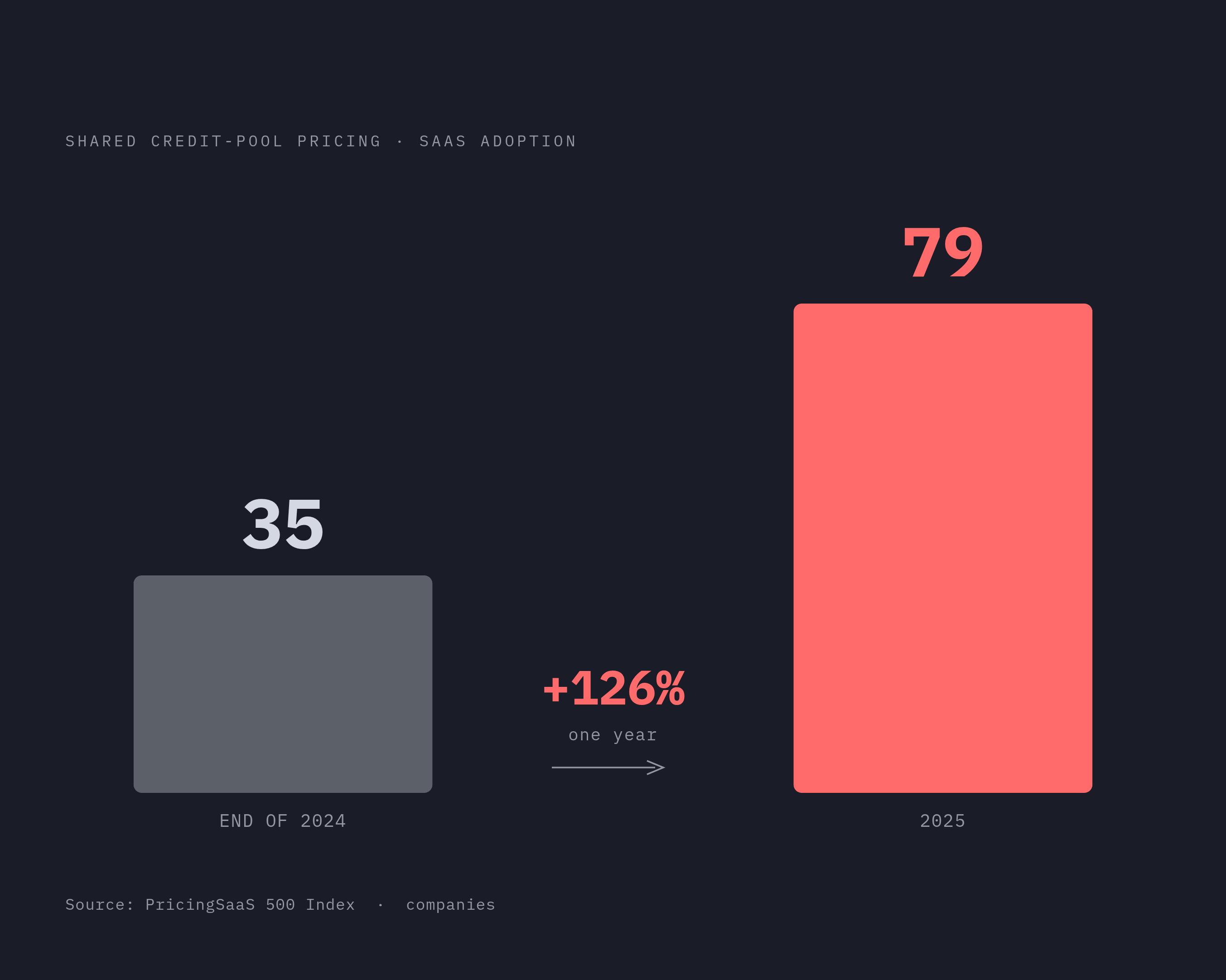
Seat-based SaaS pricing rests on one quiet assumption: a user is a user, and roughly the same value flows to each one. AI features break that assumption completely, because usage inside a single account can be wildly skewed, with a handful of people running dozens of generations a day while the rest of the seats sit mostly idle. Shared credit pools are the industry's answer, and the PricingSaaS 500 Index counted 79 companies offering credit models in 2025, up from 35 at the end of 2024. That's growth of 126% in a single year, and the wrong lesson to take from it is that pooling is simply the more generous option. It isn't generosity. It's a bet that unpredictability is easier to manage in aggregate than in isolation, and the bet only pays off if the billing infrastructure underneath can hold the line, which most of it currently can't.
What a shared credit pool actually is and how consumption flows through it
A shared pool aggregates credits at the account or workspace level. Every user draws from the same balance instead of a private stash only they can spend. That's the entire mechanical difference from the two alternatives it usually gets compared against: individual seat credits, where each person owns a fixed allocation and can't borrow from a teammate's, and usage add-ons, where credits get sold separately from the seat and bolted onto the plan rather than built into it.
A concrete version makes this clearer. A team buys 10 seats at $10 each, and each seat contributes 100 AI credits a month. Instead of 10 separate 100-credit buckets, the team gets one pool of 1,000 credits, and any user can draw against it. Every AI action deducts from that shared balance at a predefined rate, and the balance is visible in real time across the account, not something one admin has to reconstruct from an invoice at the end of the month.
What sits inside the pool varies by product. Consumption-mapped credits tie one credit to a fixed unit (tokens, compute seconds, API calls), and the burn rate stays roughly linear until workloads get heavy enough to bend that curve. Feature-scoped credits split the pool into separate buckets for distinct capabilities: image generation, fine-tuning, analytics, each metered on its own, so the pool is partitioned rather than fully fungible. Either way, the pool functions as a budget rather than a forecast. Nobody has to predict which of the ten users will be the heavy one this month; it just absorbs whatever mix shows up, which is exactly the property that makes it useful for collaborative tools where usage shifts by role and by project phase.
The four structural patterns for building a shared pool
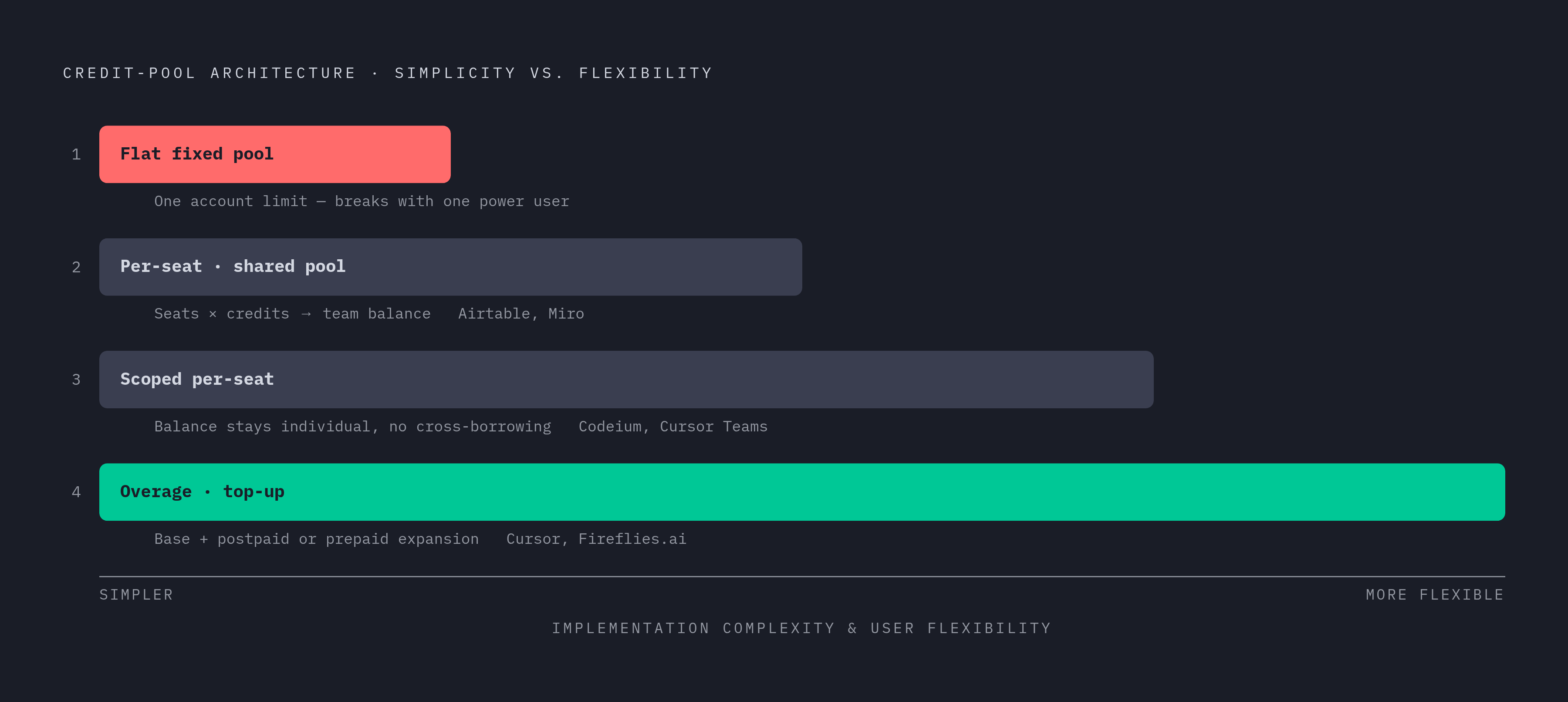
Four patterns cover most of what's actually shipping today, and they trade simplicity for fairness in fairly predictable ways. Teams that skip straight to the simplest one usually regret it within a quarter, and that's the pattern worth naming as the wrong default.
The flat seat rate with a fixed credit pool is that default: the account gets a set number of credits no matter how many seats it has. It's the easiest thing to launch, and it's also the one most likely to blow up in practice, because it breaks the moment one power user starts eating the whole allocation while everyone else waits their turn.
Per-seat credits aggregated into a shared pool scale the total with headcount instead: each new seat adds its allotment to the team balance. Airtable and Miro both use this. Airtable originally sold AI usage as separate credit packs, then moved to pooled credits bundled straight into the core subscription, so a Business plan with 10 seats at 20,000 credits each yields a 200,000-credit monthly pool. Any user in the account can draw down any share of it. Miro works similarly, with add-on credits available once the shared pool runs dry. The hard part of this pattern isn't the steady state, it's the edges: what happens to the pool when a customer adds three seats on day 12 of the billing cycle, or removes two on day 20. Proration logic needs a decision made in advance, or support tickets pile up fast.
Scoped-seat credits go the other direction and keep the balance tied to the individual. Codeium works this way, and so does Cursor's Teams plan, though Cursor's Enterprise tier switches to a pooled model instead. Scoped credits guarantee one user can't drain a teammate's allocation, a real fairness win, but the pattern sacrifices the flexibility that makes pooling attractive in the first place. Admins managing these accounts often want more control over redistribution than scoping allows, and that gap is where the pattern shows its age fastest.
Overage or top-up layered on scoped or pooled credits is the fourth pattern, and the most demanding one to run. Teams share or scope a base allocation, and once it's exhausted, an overage charge or a prepaid top-up kicks in rather than a hard stop. Cursor and Fireflies.ai have both adopted variations of this. It asks the most of the billing system underneath, because the engine now has to track prepaid balance and postpaid charges at the same time without losing the thread. Box AI offers a useful hybrid: 20 monthly credits per user as a baseline, plus a 2,000-credit org-level pool for power users, with more available to purchase, which cleanly separates the predictable baseline from the unpredictable surge.
None of these choices are permanent, and treating one as permanent is its own mistake. The pace of change is clear: the industry norm is to revisit pricing structures repeatedly as usage patterns become clearer. Whatever pattern a team picks at launch, the architecture underneath needs to survive being rebuilt, probably more than once.
Design decisions teams must make before launching a shared pool
Before any of the four patterns get built, a handful of decisions have to be made explicitly. Leaving them implicit is how billing disputes start, and by the time they start, the fix costs a lot more than the upfront design work would have.
What does one credit actually buy? Answer that before anything else gets designed. Some products fix it to a unit: 1 credit equals 100 tokens. Others tie it to an action type: 1 credit per document summary. Others let the rate float with model tier or task complexity, which is more flexible but risks confusing customers who can't tell why the same-looking action cost different credits last week than it does today. Whichever route gets picked, it has to be communicated clearly, or support ends up fielding the same question on repeat.
Expiry policy comes next, and it's a genuine tradeoff, not a formality. Credits that roll over reduce the urgency to use them. Credits that never expire sit on the balance sheet as a growing liability. Credits that expire at period end drive engagement but can generate real resentment if customers feel like they're losing money they already paid for. Figma's approach when it launched AI credits in late 2025 is the right model to copy here, and most teams do this backwards. Figma didn't enforce any limits for roughly three months. It just let usage run and collected the data, and what it found was that a large majority of high-value customers were using AI weekly, with consumption concentrated among a much smaller subset. That kind of observed usage data is what should inform tier boundaries. Observe before you constrain. Most companies do the reverse, guess at a tier structure on day one, and spend the next two quarters walking it back.
Per-user caps inside the pool matter too, because without them, one aggressive user can burn through the account's entire month by the second week. Options range from hard daily or monthly caps per user, to soft alerts once someone crosses a threshold, to admin-controlled allocation across sub-groups. Caps take more engineering work to build, but skipping them turns a shared pool into a race to consume first, which defeats the point of pooling at all.
Then there's the question of what happens when the pool hits zero. A hard stop blocks all usage until renewal or a top-up. A soft stop with automatic top-up refills a prepaid wallet once it crosses a low threshold. Postpaid overage lets usage continue and bills the excess at period end. Which one makes sense depends on context: a hard stop is tolerable for a nice-to-have feature, but it's a serious problem if it interrupts someone mid-workflow on something business-critical.
Mid-cycle seat changes need their own explicit policy: prorated credit additions when seats get added, and a clear stance on clawback or freeze when seats get removed, written into the contract rather than improvised when a customer asks. Larger organizations often want nested structure too, a parent org pool with sub-pools by department or cost center, which requires the billing layer to support parent-child account relationships natively rather than as a workaround. Done right, this lets a company run internal chargebacks and departmental budgets without breaking the shared pool at the top level.
What finance and admin teams need to govern consumption across the organization
Shared pools create a specific governance headache: the money is committed upfront, but the rate at which it drains is unpredictable across dozens or hundreds of users. Finance teams inherit that unpredictability whether they asked for it or not.
Real-time balance visibility isn't a nice extra here, it's load-bearing. Admins need to see remaining credits at the account level, the sub-group level, and the individual user level, without filing a request to engineering and waiting for a report back. Alert thresholds need to fire automatically as the pool crosses defined percentages remaining, so finance finds out about depletion from the system, not from a user complaining that the AI feature stopped working mid-task.
Usage attribution still matters even in a fully shared pool. Finance generally needs to know which team or which user actually consumed what, both for internal chargebacks and for the renewal conversation that happens later. The invoice has to match what the customer sees in the product dashboard, full stop. Any mismatch between those two numbers erodes trust fast and generates support volume that didn't need to exist.
For enterprise accounts, especially in regulated industries, every credit deduction needs an audit trail: which action, which timestamp, which user. That's not a nicety, it's a compliance requirement, and it has to get built into the metering layer from the start rather than patched on later. Billing systems that can't track consumption in real time tend to produce a familiar failure mode: finance spending the first week of every month reconciling errors by hand. Shared pools make that worse, not better, when the underlying metering isn't accurate at the event level.
There's an upside buried in all this reconciliation work, though. Clean consumption data across the life of the pool is exactly the evidence finance needs going into a renewal: which teams are pushing against their limits, which are barely touching their allocation, and what the next tier should actually look like.
What the billing infrastructure must support to make shared pools reliable at scale
None of the design decisions above matter if the infrastructure underneath can't execute them. Real-time event ingestion is the foundation: every AI action has to register as a usage event the moment it happens. Batched or delayed metering creates a gap between what the customer sees and what actually happened, and once that gap opens, neither the vendor nor the customer trusts the number on the screen again.
Deduction has to be atomic. When two users on the same team trigger actions simultaneously against the same pool, the system can't double-count or lose track of which deduction landed first. That's a database consistency problem as much as a billing one, and it's easy to underestimate until an account has fifty concurrent users hammering the same balance at once.
The pool itself should be treated as a ledger, not a counter sitting in a spreadsheet somewhere. It needs to support deposits (top-ups, renewals), withdrawals (consumption), expiry events, and rollover logic, and all of it needs to stay queryable and auditable after the fact. Org-level pools with departmental sub-pools require the billing layer to model that parent-child hierarchy natively. Bolting nested accounts onto a system built for flat, single-tier billing just accumulates reconciliation debt that somebody has to pay down later, usually at the worst possible moment.
Pricing dimensionality adds another layer of difficulty: a single pool may need to deduct credits at different rates depending on which feature got used, which model tier ran, or which compute type the request hit. The billing engine has to support multi-rate deduction from one balance, not force a workaround where every rate variant needs its own separate pool. Many enterprise accounts also want prepaid and postpaid running in parallel, a prepaid pool for baseline usage and postpaid overage billing for anything beyond it, and both need to run on the same engine without triggering a separate reconciliation process.
Pricing itself changes constantly, and the system has to keep up without an engineering ticket every time someone wants to move a tier boundary. PricingSaaS tracked more than 1,800 pricing and packaging changes across 500 SaaS companies in 2025 alone. Credit rates, tier boundaries, and overage rules need to be adjustable by product or finance teams directly, not locked behind a code deploy. And for enterprise buyers in regulated sectors, the entire billing and metering stack sometimes has to run inside their own infrastructure. A cloud-only billing vendor gets disqualified before the evaluation even starts, no matter how good the product otherwise is.
The common market pattern, a separate metering tool bolted onto a separate billing tool, quietly shifts the reconciliation burden onto the buyer, and that's the setup worth avoiding on principle. Platforms built specifically for this, such as Flexprice, a metered billing infrastructure for AI and SaaS products that tracks credit consumption, token usage, and hybrid prepaid-plus-overage models in a single engine, exist precisely to close that gap. Shared-pool mechanics need metering and billing treated as one problem from the start, not stitched together after the fact and hoped into alignment.
How to think about credit pricing and tier design for team accounts
Most teams reach for cost-plus pricing by default: calculate the infrastructure cost of an action, add a margin, set the credit rate. It's fast, and it's also the wrong starting point, because cost tells you nothing about what the action is actually worth to the customer.
Figma's data-first approach is the useful counter-model, already described above: watch real consumption first, without enforcing caps, and let the actual distribution of usage inform where the tier boundaries should sit, rather than guessing at launch and correcting later under customer pressure.
Adobe's pricing history shows the fuller arc of how this tends to mature. AI started embedded for free, with a modest overage fee of $5 per additional 100 credits once a customer went past the free allotment. Over time, Adobe shifted toward treating AI as its own product line entirely, with capacity-capped tiers running from low double digits to $200 for 2,000 to 50,000 generative credits, after an initial free allowance of several hundred credits. That repositioning worked: Adobe exited Q1 2025 with $125 million in revenue from stand-alone AI products. The lesson isn't that every company should spin AI into a separate SKU. It's that the pricing model most companies launch with is rarely the one they keep, and treating the launch price as final is the actual mistake.
Credits-per-seat is a growth lever as much as a cost calculation. Set it too low, and users hit the ceiling before they've built the feature into their workflow, which kills adoption before it starts. Set it too high, and the pool stops functioning as a monetization mechanism at all, since nobody ever needs to pay for more. Overage behavior is itself a useful diagnostic: if customers are buying overage constantly, the base allocation is probably too stingy. If overage purchases are rare but renewal rates are also weak, the base might be generous enough that customers never feel the product's value clearly enough to upgrade.
Fungible pools are easier to sell and easier for a customer to budget against, since there's one number to track. Feature-scoped pools let a company price high-cost capabilities differently, but they ask more of the customer's attention, since now there are multiple balances to watch instead of one. Credit design keeps evolving well past launch, too: Lovable, which reached $200 million in ARR, added rollover credits specifically as a retention mechanism in August 2025, a company well past its early pricing decisions still actively reworking them. Given that 92% of AI companies that started with usage-based pricing have since revised the model at least once, credit pool design deserves treatment as an ongoing experiment, not a setting configured once at launch and left alone.
Communicating shared pools to customers so billing feels fair, not opaque
A shared pool should feel like a team budget the customer can see into, not a meter running somewhere behind the scenes. The test is simple: can an admin answer "how much do we have left and who's using it" without opening a support ticket? If not, the pool will generate distrust no matter how fair the underlying math actually is.
That means remaining balance, current consumption rate, and a projected depletion date belong inside the product itself, not buried in a billing portal a customer opens once a month if that. Individual users benefit from seeing their own draw against the pool too, even when the pool is fully shared, because visibility into personal contribution is what keeps a "someone else will use it up" dynamic from taking hold across the team.
Admins should be able to set their own alert thresholds rather than relying on whatever cadence the vendor picked by default. Handing that control to the customer is itself a signal of trust. Small, but it registers.
The moment the pool nears zero is the highest-risk moment in the entire relationship. Without a clear, pre-communicated path forward (a top-up option, an automatic refill, a short grace period), the experience is a workflow that stops without warning, exactly the kind of thing that turns into a churn conversation. Handled well, and communicated in advance, it barely registers as friction at all.