Accrued Revenue vs Accounts Receivable Classification
How earned-but-unbilled usage becomes receivables, and why metering accuracy decides it.
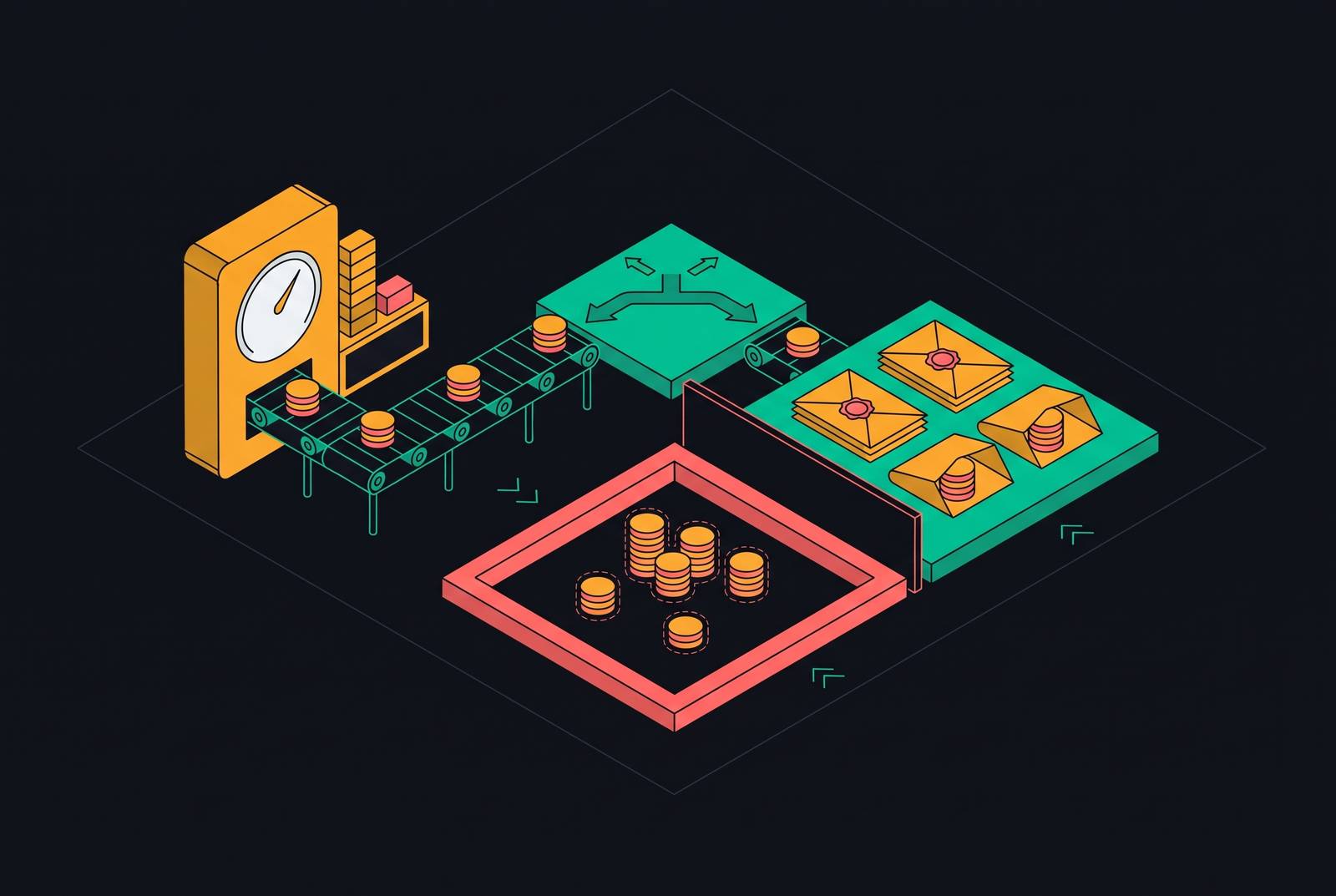
Accrued revenue and accounts receivable are sequential stages in the same revenue lifecycle. The distinction turns on when earned value becomes billed value. For usage-billed products, keeping that transition explicit prevents duplicate assets, preserves cash forecasting, and connects month-end close to the consumption data that will support the invoice.
What accrued revenue and accounts receivable actually are, and why they are not the same thing
Accrued revenue is revenue earned by delivering a good or service but not yet invoiced or collected. It is recorded as a current asset because the business has a right to payment for work already performed. Common labels include unbilled revenue, accrued receivables, and accrued income, although formal reporting requires a more precise distinction between types of unbilled assets.
Accounts receivable is an amount already invoiced but not yet collected. The customer owes a documented sum, and collections can begin. Both balances are current assets, but each is at a different stage of billing. In the basic billing workflow, invoice issuance separates them. Once the invoice exists, the main risk moves from a delay in billing to collection and bad debt.
Deferred revenue provides the contrast with both assets. It represents cash received before the related service has been delivered, so it is a liability. The three positions are therefore earned but not invoiced, invoiced but not collected, and received but not earned. A SaaS business can hold accrued revenue from usage billed in arrears while also holding deferred revenue from prepaid annual subscriptions.
The three-step lifecycle that connects earned revenue to cash on the balance sheet
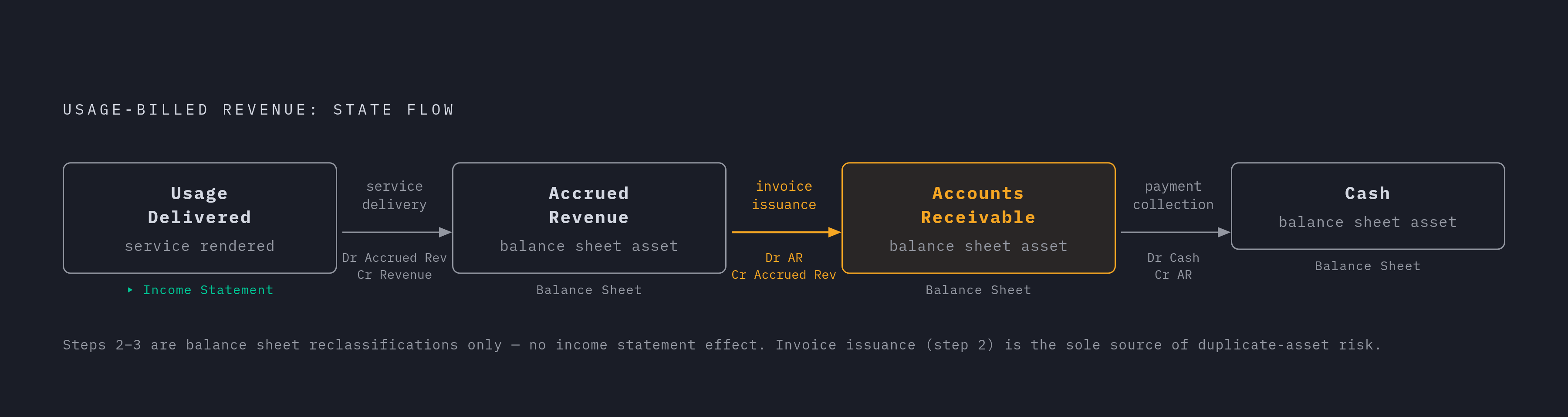
For usage billed in arrears, the operational flow is Usage → Accrued Revenue → AR → Cash. Each step records a different event: the service is delivered, the invoice is issued, and payment is collected. These events need not occur in the same accounting period. Their separation explains why recognizing revenue does not require either an invoice or a cash receipt.
At the first stage, the entry is debit accrued revenue, credit revenue. This increases an asset on the balance sheet and revenue on the income statement. No customer-facing document is required at this point. For example, a cloud infrastructure company can accrue earned usage revenue each week of the month before sending a single month-end invoice.
When that invoice is issued, the entry is debit accounts receivable, credit accrued revenue. The full invoiced balance is reclassified from accrued revenue to AR. The income statement does not change because the company already recognized the revenue as usage occurred. For the invoiced amount, accrued revenue should now be zero.
When payment is collected, the final entry is debit cash, credit accounts receivable. The customer’s payment clears AR and converts the earned value into cash. If invoicing creates AR without clearing the corresponding accrual, the same earned amount remains recorded twice as an asset. If the invoice is also booked as fresh revenue, revenue is duplicated as well.
How ASC 606 adds precision to what "accrued revenue" actually means on a GAAP balance sheet
ASC 606 distinguishes contract assets from unbilled receivables by examining the conditions attached to payment. An invoice is not the decisive accounting test. A contract asset exists when the right to payment depends on something other than the passage of time. In a multi-phase implementation, for example, Phase 1 may be complete while payment remains conditional on delivery of Phase 2. The recognized value of Phase 1 is then a contract asset.
An unbilled receivable has no remaining condition beyond time. For API calls consumed in January and invoiced February 1, that is the relevant distinction if only invoicing and payment terms remain. The absence of an invoice does not make the right conditional. Consequently, the operational label “accrued revenue” can include amounts that already qualify as receivables for financial statement presentation, even though billing systems have not yet moved them into billed AR.
ASC 606 requires contract assets and receivables to remain distinguishable through separate line items or disclosure in the notes. ASC 326 subjects both to credit-loss testing. That testing starts even before there is an invoice. IFRS 15 uses the term “contract asset,” while accrued income is also common terminology in IFRS and UK reporting. Those labels do not remove the need to examine the payment conditions.
The right-to-invoice practical expedient adds a link between recognition and billing. Where applicable, it anchors revenue recognition to the amount the business has a right to invoice for delivered service. For usage billing, that amount comes from rated consumption. The expedient therefore connects the accounting calculation to actual consumption rather than a forecast, but it cannot compensate for usage data that is unavailable at close.
Why usage-based and metered pricing create persistent accrual balances where flat-rate SaaS creates none
A flat-rate subscription normally bills at the start of the service period or on renewal. Billing precedes or coincides with delivery, so deferred revenue may arise while accrued revenue typically does not. Usage billing reverses that operational order. Customers consume throughout the period, and the business invoices after the period closes. Because consumption comes before invoicing, an accrual balance arises each period rather than only when an occasional adjustment is needed.
Pure pay-as-you-go revenue follows consumption as it occurs. Its full-period accrual clears when the post-period invoice is issued. Hybrid seat-plus-usage contracts combine two different timing patterns. A seat fee invoiced in advance can create deferred revenue while usage overage accrues in arrears. The same contract can therefore require separate treatment for its fixed and variable components.
Consider a customer with a $10,000/month minimum and overage charged at a fixed per-call rate. The minimum is recognized over the commitment period. Overage earned in March but invoiced in April remains accrued revenue at the March 31 close. The minimum may already be invoiced and sitting in AR, but that does not change the unbilled status of the overage.
Prepaid credits and token packs follow the opposite pattern. Cash received creates deferred revenue, which releases to recognized revenue as the customer consumes credits. Breakage requires its own estimation policy. These arrangements do not create the same consumption-before-billing gap as usage billed in arrears. Where prepaid and arrears-billed components coexist, their deferred and accrued balances must remain separate.
Why metering accuracy is a prerequisite for a trustworthy accrued revenue balance
Subscription revenue at close can be a known amount drawn from a contract. Usage revenue must instead be calculated from consumption events, which may be incomplete, delayed, or inconsistent across codepaths. Dropped events understate consumption, duplicated events overstate it, and events assigned to the wrong period distort the cutoff. The accrual can therefore be wrong before finance begins its calculation.
When metering is unfinished, finance may use trailing averages, contracted minimums as a floor, or partial-period extrapolation. Each approach introduces estimation error that must be trued up when the actual invoice is generated. There is no invoice yet to test against. Over-accrual can stay hidden until billing shows how much is actually owed, so close relies on a later reconciliation.
High-volume AI products make historical estimates especially vulnerable. Token or compute consumption can spike unpredictably, weakening trailing averages precisely when the accrual balance is largest. Multiple billing codepaths compound the problem. Different product lines may rate events differently, reconcile on different schedules, and aggregate usage in separate systems. Finance then has to consolidate billing data before it can determine the accounting balance.
Rated, period-attributed usage data changes the basis of that work. It allows an applicable right-to-invoice calculation to use consumption available at close. Real-time metering that produces rated usage before close is therefore an accounting control. Infrastructure that uses those figures to generate the invoice connects the accrual to its eventual billing evidence.
What misclassification between accrued revenue and accounts receivable actually breaks in practice
For collections to work, billed amounts must reach the AR aging schedule. If an invoiced amount remains only in accrued revenue, the collections team lacks visibility into it through aging. The invoice exists, but its accounting classification lags. Conversely, creating AR without reversing the accrual leaves duplicate assets in the books. The resulting mismatch undermines reconciliation between outstanding billed balances and total recorded customer assets.
Cash forecasting has a different dependency on classification. An unbilled accrual has no invoice-based payment clock running, while billed AR has payment terms attached. Treating both as equally close to cash ignores the remaining billing step. That can distort days-sales-outstanding calculations and cash runway forecasts. A model that treats uninvoiced consumption as already billed expects payment sooner than the billing stage supports.
Usage revenue accrued during a period is not interchangeable with committed subscription revenue. Combining variable usage with subscription ARR can overstate predictable recurring revenue. MRR and ARR reporting can misrepresent variable consumption as a continuing commitment.
Auditors face a reporting problem when the underlying distinctions disappear. A conditional contract asset presented as a receivable obscures the remaining payment condition, while an unreversed accrual duplicates an asset after billing. Neither is merely a naming inconsistency in the ledger. If those errors reach financial reporting, they may lead to a correction or a restatement. The evidence must show why revenue was recognized and why the asset it created belongs in the category where it was reported.
How to keep the reclassification clean at month-end close for usage-billed products
The close process begins with rated usage data for the full period, avoiding partial-period estimates where possible. The second step records delivered but uninvoiced amounts through debit accrued revenue, credit revenue, in the period consumption occurred. Invoice issuance then triggers debit AR, credit accrued revenue. When the customer pays, the final entry is debit cash, credit AR. Each entry follows its own operational event.
After invoicing, the accrued balance for that amount should be zero. A residual balance signals a missed reversal or a mismatch between the accrual and invoice. If the accrual used an estimate, the reconciliation also identifies how much estimated usage exceeded or fell short of actual usage. The invoice must not become a second recognition of revenue already recorded.
For minimum-commitment contracts, the floor and overage must stay on separate line items at close. The floor may already be in AR while overage awaits a post-period invoice. Hybrid contracts need the same component-level discipline. Subscription and usage components close on separate schedules because they may reclassify to AR on different dates. Their differences in timing and their asset and liability balances must stay visible when netting would hide them.
The audit trail should connect each accrual to the rated usage events that generated it. The reclassification entry should reference the invoice that triggered the transfer to AR. Accounting period locks protect that trail against retroactive changes. Reports that go straight to finance also let it check whether the usage behind the accrual matches the invoice without having to go through engineering during close.
The underlying control is a shared source of truth. When metering and billing run on the same engine, rated, period-attributed usage can drive both the accrual and the invoice, removing the estimate-then-true-up loop. Invoice issuance can then trigger the accrual reversal and AR creation as a single event. With separate systems, the accrued balance and invoice amount must be matched by hand. The system feeding the accrual and the system generating the invoice should therefore be the same one.