Minimum Commitments and Overage Charges in Hybrid Rate Cards
How to structure minimum commitments and overages without leaking revenue or angering customers.
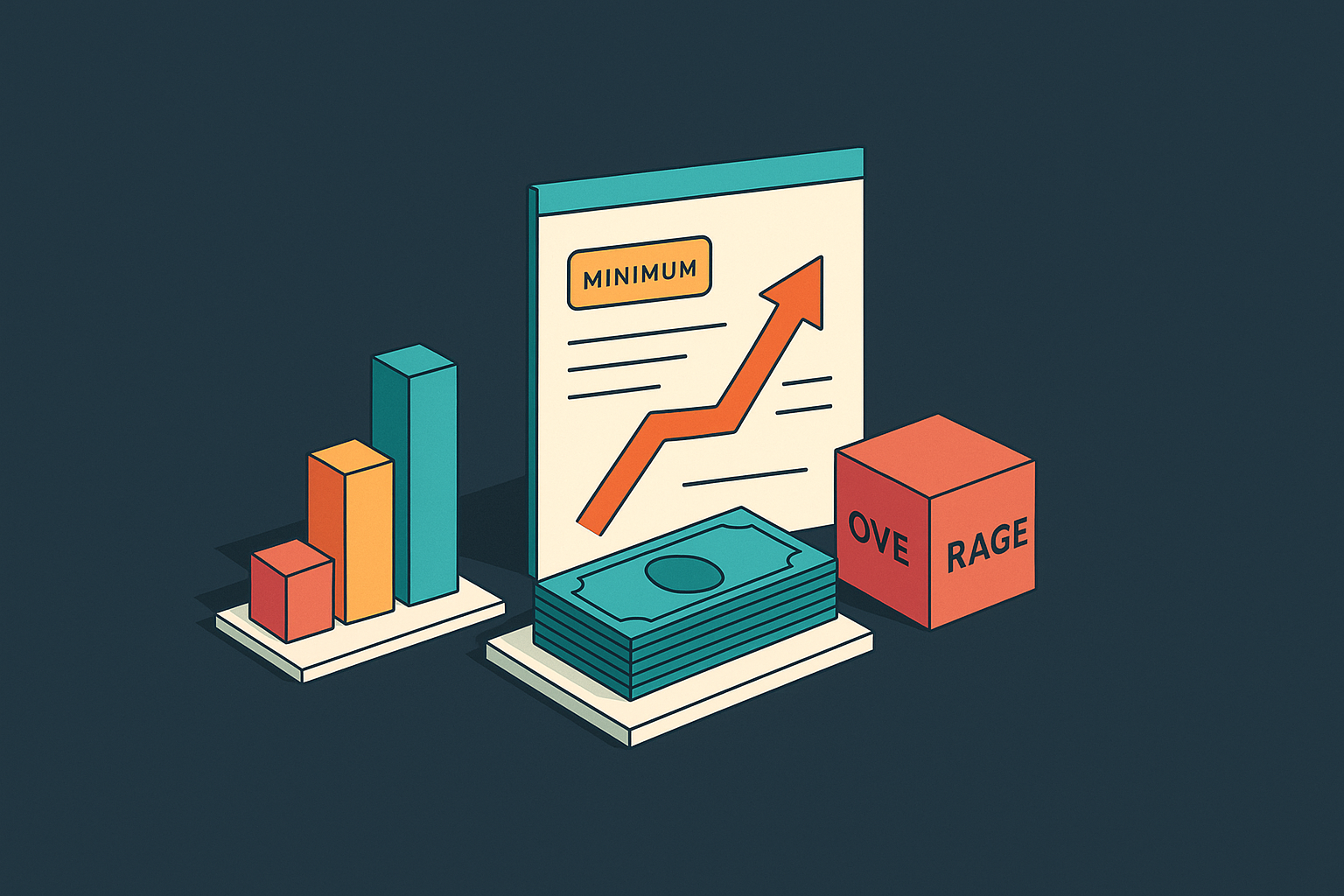
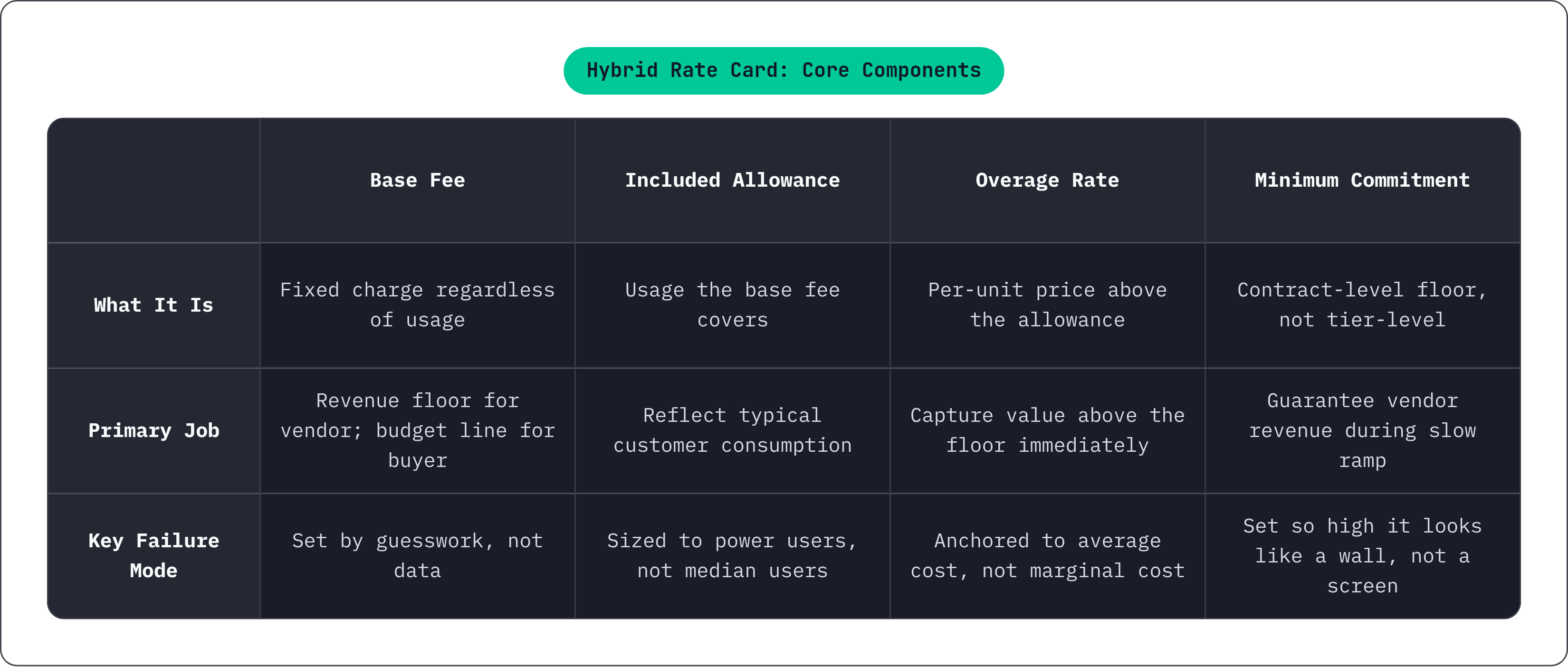
Four pieces make up a hybrid rate card, and skimping on any one of them produces a model that either leaks revenue or punishes the wrong customers. I've watched teams spend months on the overage rate and ten minutes on rollover rules, then wonder why renewal conversations turn hostile.
The base fee is the fixed charge a customer pays no matter what. It gives the vendor a revenue floor and gives the buyer a number to put in a budget line, and it can't do both jobs well if it's set by guesswork. The included allowance is the usage that base fee covers, and it should reflect what a typical customer actually burns through in a billing cycle, not what someone hoped they'd burn through when they built the pricing deck two quarters before launch. The overage rate is the per-unit price once a customer blows past that allowance. Rollover rules, whether unused allowance carries forward, expires, or converts into something else, get discussed least of the four, and yet they shape how fair the whole arrangement feels to a customer watching their balance tick down toward zero.
Then there's the minimum commitment, which people conflate with the base fee constantly, and shouldn't. A base fee attaches to a feature tier. A minimum commitment attaches to a contract term or a volume pledge, and it exists to guarantee the vendor a floor whether or not the customer's usage ever climbs high enough to justify it on its own. Move any one of these variables and the math on the other four shifts underneath you. This is the design, and every downstream decision in a rate card traces back to it.
How minimum commitments function as a structural floor, not just a discount mechanism
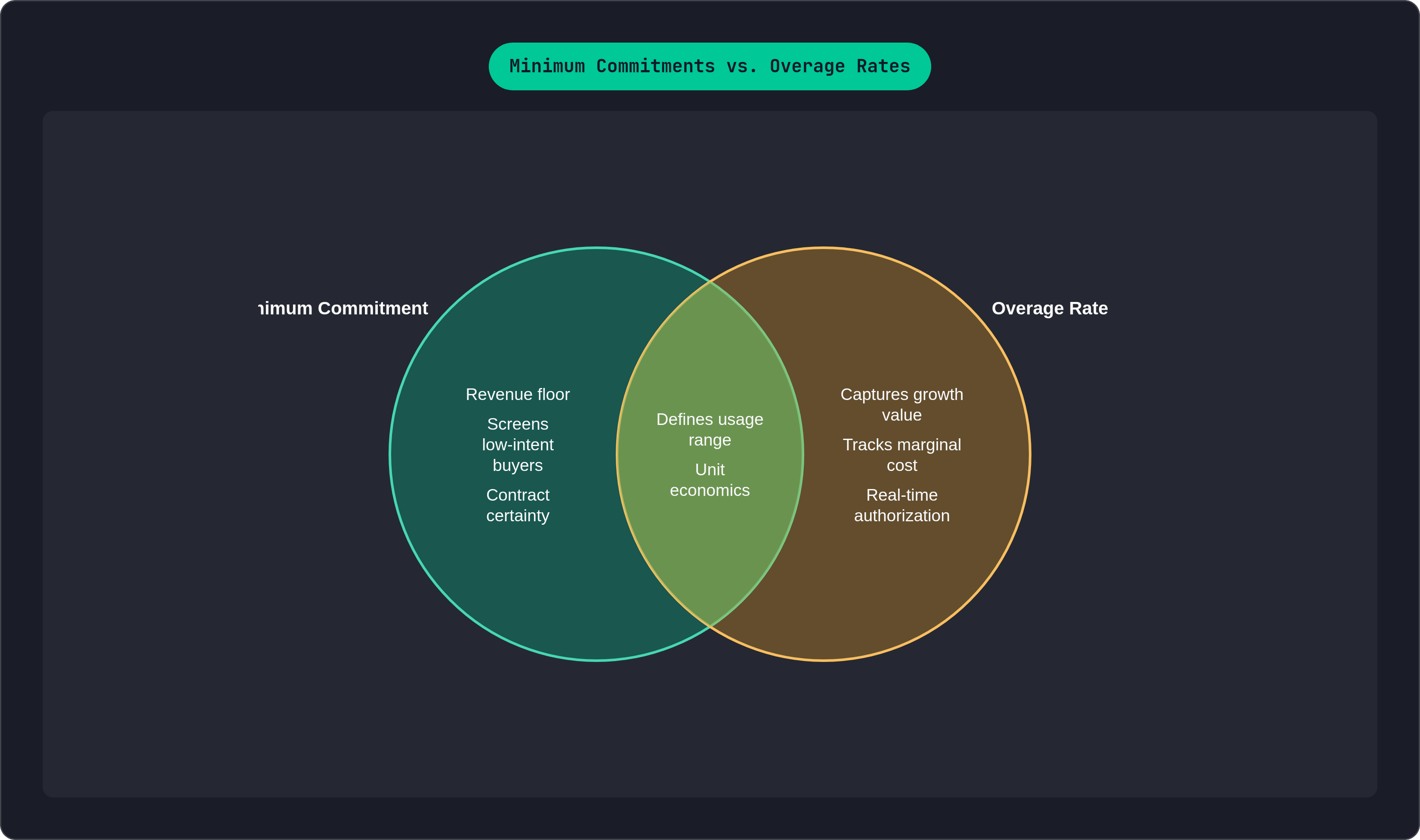
Sales decks pitch minimum commitments as a volume discount: commit to more, pay less per unit. That framing captures part of the story but misses the harder job the commitment is doing: protecting the vendor's revenue floor while filtering out buyers who were never going to generate real usage anyway.
Usage in the first few months of a contract almost always runs below steady-state. Onboarding friction, a slow ramp to adoption, whatever the cause, pure usage billing would report that stretch as thin revenue during exactly the window when the vendor is spending the most on customer success to get the account live. The commitment absorbs that dip and keeps the vendor from bleeding out during the ramp.
For the buyer, the commitment turns an unpredictable number into a financeable one. Finance teams approve numbers. They do not approve "we'll see what it costs," and I've sat in enough of those budget conversations to know that sentence kills deals on the spot. The commitment is the price a buyer pays for certainty, and plenty of them will pay a real premium for exactly that.
There's a screening function too, underappreciated because it's invisible when it works. A meaningful minimum weeds out low-intent buyers who'd never generate enough usage to justify the cost of selling to them in the first place. Enterprise buyers have leaned harder into multi-year committed contracts lately, driven partly by the discount but mostly by a desire to lock in pricing before it moves, particularly on anything with an AI layer where nobody is confident the vendor's cost structure looks the same eighteen months out. Longer terms do raise total contract value, which slows the sales cycle, invites harder discount negotiation, and drags legal into the process longer than anyone wants. Set the minimum too high relative to what a buyer will realistically consume, and it stops screening for seriousness and starts looking like a wall. The right number sits at a level a successful customer reaches through ordinary use, not through padding numbers to justify a contract they already regret.
How overages turn the minimum commitment from a ceiling into a growth mechanism
Pull the overage rate out of a hybrid rate card and the minimum commitment becomes a fixed price wearing a usage costume. Nothing about it responds to how the customer behaves. The overage rate is what gives the model a pulse.
When usage outgrows what anyone forecast at signing, the overage rate captures that value immediately, no renegotiation, no upgrade call someone on customer success has to remember to schedule. The minimum commitment protects the floor; the overage rate harvests the ceiling. Together they define a range, not a point. A seat-based subscription struggles here: a customer who doubles their usage under a seat model pays exactly what they paid before, and the vendor has handed away a growth signal for nothing. Pure usage billing fails the opposite way. A slow month from a large account produces almost no revenue, and the minimum commitment is precisely the thing stopping that from happening.
There's a behavioral effect underneath all this that's easy to miss. A customer who knows there's a floor already paid for tends to use the product more freely early on, and that freedom speeds up the habit formation that actually drives retention later. Twilio is the case I keep coming back to, mostly because it ran the sequence backward from most hybrid adopters: it started usage-first and only later added committed-use contracts with volume discounts, essentially retrofitting a floor onto a model that never had one, because pure usage billing left too much revenue unpredictable to plan around. Atlassian shows the pairing from the other direction: a per-user included credit allowance functions as the floor, and charges that kick in once a user exceeds it function as the overage layer sitting on top.
Sizing the included allowance and the overage rate so unit economics hold at every usage tier
The most common mistake in this exercise is sizing the allowance to cover a power user instead of a median one. It feels generous when you're building the pricing page. In practice it's a subsidy, and someone pays for it: the customers who use the product the most, through margin compression that nobody notices until finance runs the numbers.
Start with real usage distribution data, not the aspirational figure someone wrote into a slide deck before launch. Set the allowance to what a typical customer consumes in a normal cycle. If most customers regularly trip the overage threshold, the allowance was undersized from day one, and every overage notification chips away at trust that took months to build and takes one bad invoice to crack.
The overage rate needs a different anchor entirely. Not the median, but the heavy end of the distribution, because that's where unit economics actually get tested. Price overage against median cost, and you'll eventually discover, usually in a finance review rather than a customer complaint, that your highest-usage accounts run at zero or negative contribution margin. Wildfire Labs' analysis of AI query costs makes this concrete: contribution margin can hit zero at just a few thousand queries a month under typical compute rates. This is a routine outcome, not a rare edge case.
AI products diverge sharply from traditional SaaS here. A customer who exceeds their allowance meaningfully on an AI product can generate an overage bill many multiples larger than the equivalent overage on a legacy plan, because every token and every inference call carries real GPU cost behind it. Get the overage rate wrong on this and it becomes a margin event, not a rounding error. The rate should track marginal cost, meaning the cost of the ninetieth-percentile user's next query, not the average smeared across the whole base. Credit-based models give vendors a cleaner lever here: instead of setting a per-unit price directly, they set how many credits a given action burns, and they can adjust that burn rate later without reopening a single contract.
Prepaid credits versus postpaid overages as two different approaches to the same structural problem
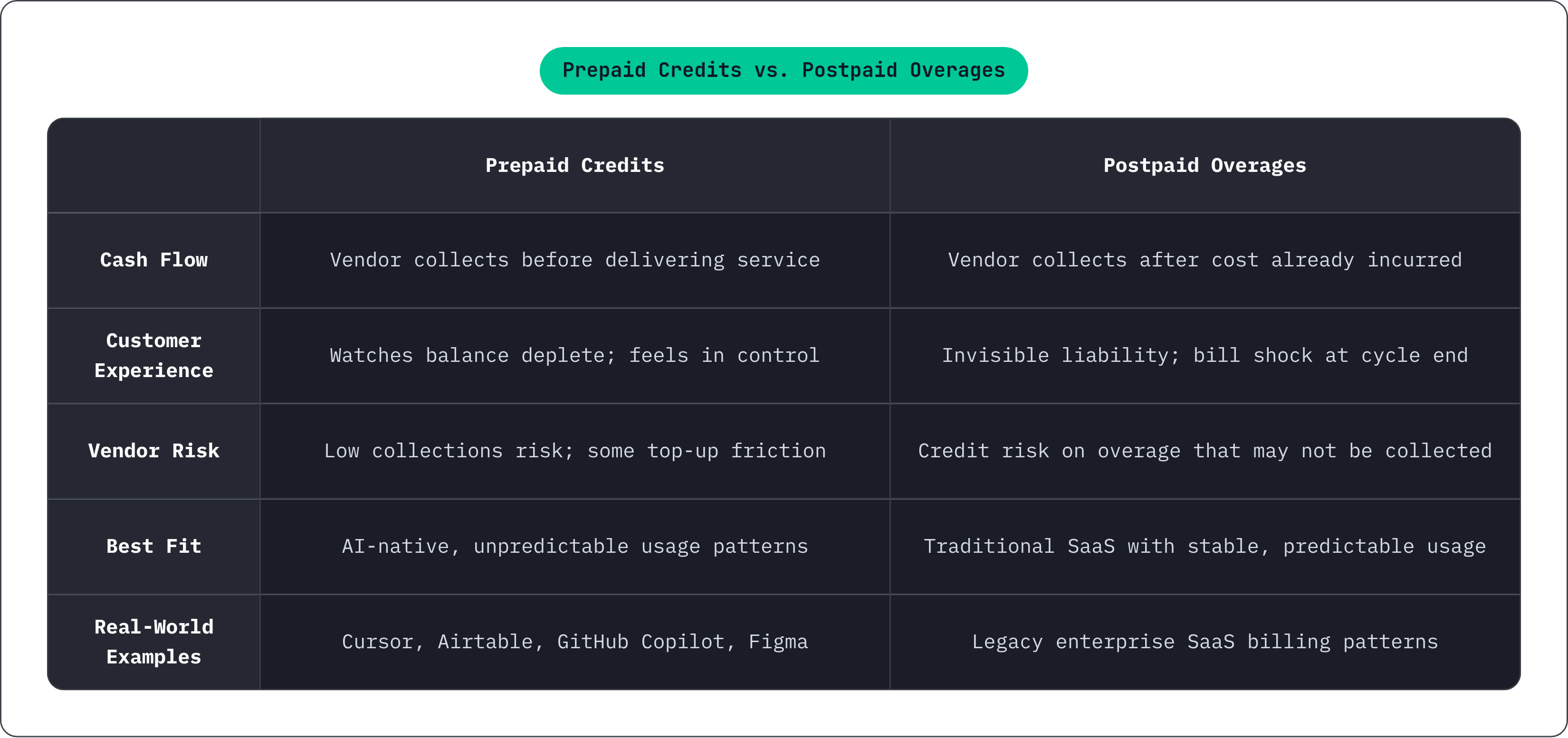
Both models solve for the same thing, capturing value above the floor, but they split risk and cash flow in opposite directions.
Postpaid overages are the familiar pattern: usage piles up during the cycle, and a line item shows up on the invoice at close. Easy to explain, easy to build, and it invites bill shock while delaying cash collection until well after the cost was already incurred. Prepaid credits flip the arrangement. The customer buys a balance up front, consumption draws it down as it happens, and the vendor has cash in hand before delivering a single unit of service. The customer watches a balance tick down instead of a liability quietly piling up somewhere out of view.
Worth saying plainly: the credit model doesn't eliminate the overage concept, it repackages it. Buying more credits is, structurally, the same event as triggering an overage. What changes is the psychology: one feels like something the customer chose to do, the other feels like something that happened to them. AI-native products lean hard into prepaid credits for exactly this reason, and because usage is less predictable than in traditional SaaS; a single agentic session can burn through what used to represent a month of ordinary consumption.
Credit adoption has more than doubled among major SaaS companies over roughly the past year. Figma, HubSpot, and Salesforce are among the names that have shifted toward credit structures, and a large share of companies with meaningful recurring revenue say they plan to introduce AI credits soon if they haven't already. A handful of structural variants keep showing up in practice. Credits with postpaid overage let a customer exceed their balance and settle up later, the pattern Cursor and Anthropic use, which avoids interrupting production work but leaves the vendor exposed on collections. Credits with top-ups, the approach at Airtable, Monday.com, and GitHub Copilot, ask the customer to pre-purchase more as needed, predictable for the vendor but demanding a purchase flow smooth enough that nobody abandons it mid-task. A flat seat rate paired with a fixed credit pool, ElevenLabs' approach, ships easily but raises fairness questions fast the moment one heavy user drains the shared pool dry. Per-seat credits feeding a shared pool, seen at Airtable and Miro, scale cleanly until seats change mid-cycle and the math gets messy.
None of these is purely a technical decision. Each one is a statement about how much spend uncertainty the vendor is willing to carry itself, versus how much gets handed to the customer to manage on their own.
Hard caps, soft caps, and why the overage decision is an authorization problem, not a reporting one
The part of a hybrid rate card that gets the least attention is what happens exactly at the threshold, and that neglect is a mistake. The moment of overage functions as an authorization decision, made in real time, and treating it as a mere billing event is where a lot of otherwise well-designed rate cards come apart.
A hard cap stops usage cold once the allowance or credit balance runs dry. It protects the vendor from chasing uncollectable overage, but it risks halting a customer's workflow at the worst possible moment, often mid-task, mid-deploy, mid-whatever-actually-mattered. A soft cap lets usage continue past the threshold under defined conditions, notifications and escalation built into the flow. It preserves the customer's experience, but now the vendor is carrying credit risk on overage that might never get collected.
Snowflake, AWS, and Cloudflare have each landed on the same pattern independently, which is a strong signal it's the right one: notify at a meaningful percentage of the limit, suspend gracefully once the limit hits so work already in flight can finish, and escalate from there rather than cutting the cord immediately. A staged response works better than a binary switch.
Timing is the whole thing. If a billing system only aggregates usage events and totals them at cycle end, the cost has already been incurred before anyone, vendor or customer, ever sees it coming. The only architecture that actually holds up checks the balance before each inference call or action executes, not after the fact in a nightly batch job somewhere. AI raises the stakes considerably here: a single agentic workflow can generate in a few minutes what a traditional software integration might generate over an entire month, so reconciling usage at cycle end is both outdated and actively dangerous for margin. A soft cap policy written into a rate card means nothing unless the metering infrastructure underneath can check entitlements at sub-second latency before every chargeable event. Design the rate card and the billing infrastructure separately, and you've written a contract nobody can enforce.
Common failure modes when minimum commitments and overages are designed in isolation
Most failures here trace back to one root cause: someone designed the minimum commitment and the overage rate as separate exercises, on separate timelines, without checking whether the two numbers actually cohere once customers start using the product for real.
The decoupled allowance shows up when included usage gets sized without reference to real data, either too generous, which quietly cannibalizes what should have been overage revenue, or too stingy, which generates constant low-grade friction that wears down trust one notification at a time. The margin cliff happens when the overage rate gets set to match the base plan's blended per-unit price instead of the marginal cost of serving a heavy user, and the customers driving the most value end up served at zero or negative margin. That's a strange way to reward growth.
The punitive overage treats every overage charge as a penalty rather than a signal of expansion. A customer who gets blindsided by a surprise bill starts shopping for alternatives right when they should be the account most worth keeping. The hidden commitment buries the minimum floor in contract language instead of surfacing it in the rate card itself, so the customer doesn't realize they're locked in until they try to scale down and discover they can't. That discovery usually lands at renewal, and it usually ends in churn.
The reporting-only cap exists on paper but isn't enforced by the billing system until invoice time, so by the time anyone runs the report, the cost is already incurred and the customer is already annoyed about it. And the static rate card assumes the model designed at launch stays correct forever, when AI inference costs shift constantly, and a rate card that was profitable on day one can be underwater within a year if adjusting it means reopening every customer contract one by one.
Credit burn rate flexibility is the fix for that last one. Abstract price into credits, and a vendor can change the effective overage rate by adjusting how many credits an action consumes, a far smaller surface to touch than renegotiating contracts across an entire base. Salesforce's path with Agentforce shows this adjustment cycle out in the open: it launched with a per-conversation charge, added Flex Credits at a different level of granularity, then layered per-user licenses on top. Each move was a correction, a response to the gap between the rate card as written and how customers were actually using the thing.
What to get right operationally before a hybrid rate card goes live
A hybrid rate card is only as real as the metering infrastructure standing behind it. Design the pricing model without building or buying the systems to run it, and what results is a contract rather than a functioning pricing system, and the difference shows up fast once real usage hits.
Real-time metering isn't optional. Every usage event needs capture, attribution to the right customer and plan, and a check against that customer's current entitlement before the chargeable action even finishes executing, not batched and reconciled overnight while the cost has already walked out the door. Entitlement enforcement has to answer, at any given instant, whether a customer still has allowance left, is sitting inside the soft cap zone, or has already hit the wall, and it has to answer fast enough to act before the cost locks in.
Get the rate card right and skip this part anyway, and the result is a promise rather than a working pricing model. Flexprice, a metered billing and usage-rating platform built for AI and SaaS products that charge by token, credit, or API call, is one infrastructure option designed specifically to close that gap between rate card design and what the system can actually enforce in real time. The first customer who finds the gap between what the contract says and what the system actually does will be the one who tells everyone else about it, and in this market, word travels fast.