Air-Gapped Billing Infrastructure for Defense and Intelligence Sector SaaS
How to keep metering, enforcement, and invoicing inside the perimeter.
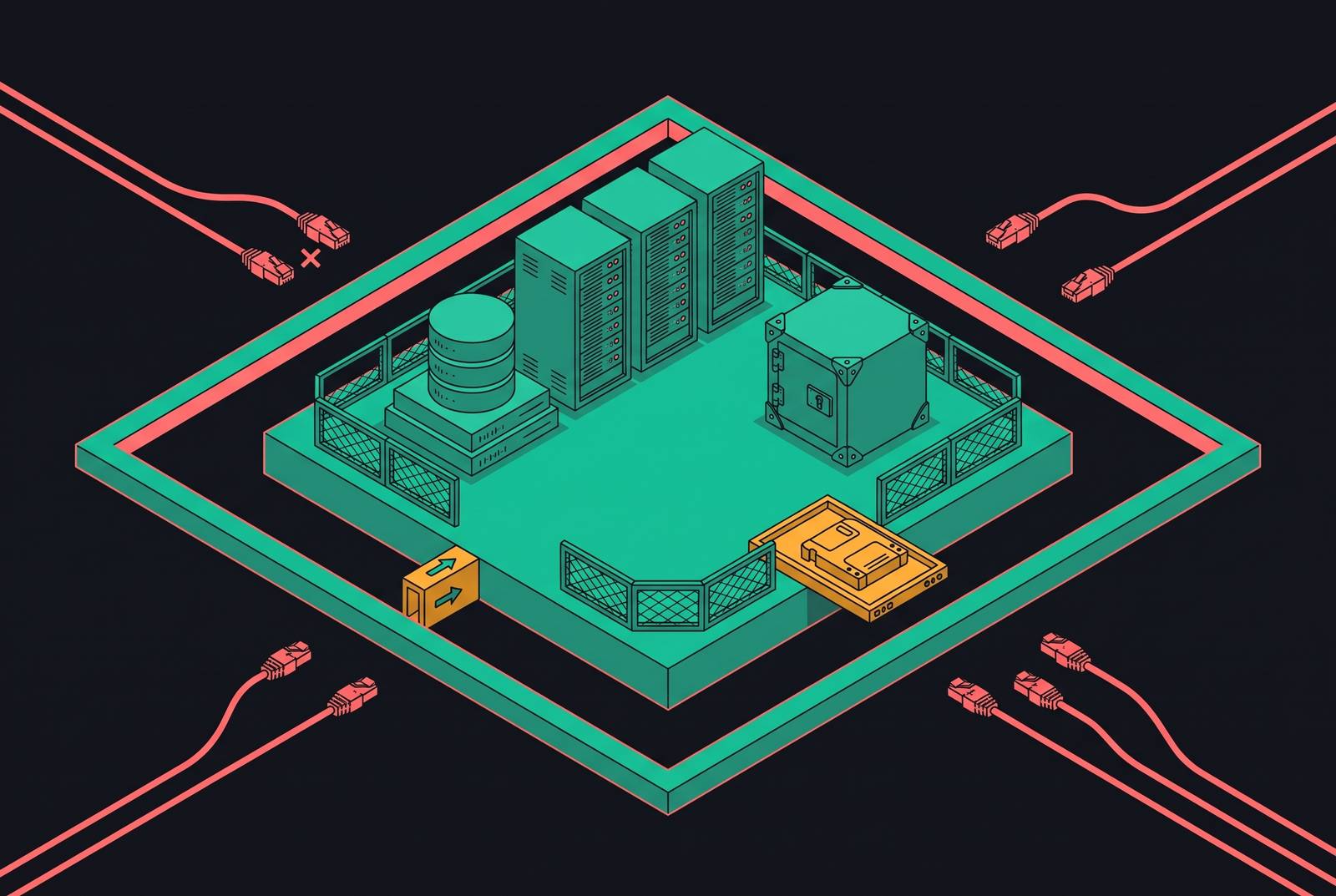
Air-gapped billing infrastructure for defense and intelligence SaaS must operate entirely inside the customer’s perimeter. No cloud callback, external license check, or phone-home metering can remain in the runtime path. This is an architectural requirement. Meeting it means bringing every stage of billing to the data, from event ingestion and entitlement enforcement to usage visibility, invoice generation, and finance reconciliation.
Why defense and intelligence SaaS vendors face a billing architecture problem, not a compliance problem
The wall is a matter of physics. TrueFoundry describes an air-gapped deployment with no NAT gateway, no DNS that resolves external hostnames, and no certificate authority chain that trusts anything outside the enclave. An outbound request has no route to its destination. Billing software that depends on that route therefore needs a different architecture.
Usage flows to hosted aggregation, authorization is checked against a remote server, and invoices return from a cloud service. In defense environments, DoD IL6 and some IL5 workloads bring physical isolation into the deployment requirements. FedRAMP High and CMMC Level 2 and 3 belong in the compliance context, although CMMC treats air-gapping as a recommendation.
The costly mismatch appears when a SaaS vendor wins a contract before examining those dependencies. The application may fit inside the required perimeter while its commercial controls stay outside. Billing then becomes a deployment blocker after award. A compliant application cannot compensate for a billing system that needs an unavailable network.
What the DoD's 2026 AI investment actually creates for SaaS billing vendors
The January 9, 2026 DoD AI Strategy, publicly launched January 12 through Secretary Hegseth’s speech and press release, frames AI as the proving ground for an “AI-first” acquisition model operating at wartime speed. This is a procurement posture. It creates a need for commercial products whose metering and commercial controls work inside isolated networks.
By May 2026, eight commercial AI vendors had been cleared to deploy models inside IL6 and IL7 networks. They were SpaceX, OpenAI, Google, NVIDIA, Microsoft, Amazon Web Services, Reflection, and Oracle. None of them runs the physical infrastructure on which those deployments rely. Both the model layer and the billing layer must therefore run on infrastructure outside the vendor’s control. Meanwhile, a traditional FedRAMP High authorization can take years before the DoD overlay begins, leaving little room for a quick architectural retrofit.
The Army Enterprise LLM Workspace’s multi-year IDIQ contract with Ask Sage launched in May 2025, and adoption grew rapidly in the first weeks. The Army CIO publicly identified token and compute cost as the constraint on which use cases could scale. Local enforcement, local ledger management, and contractually grounded caps let the billing architecture support the agreement by preventing uncapped consumption.
How a standard billing stack fails when the network connection disappears
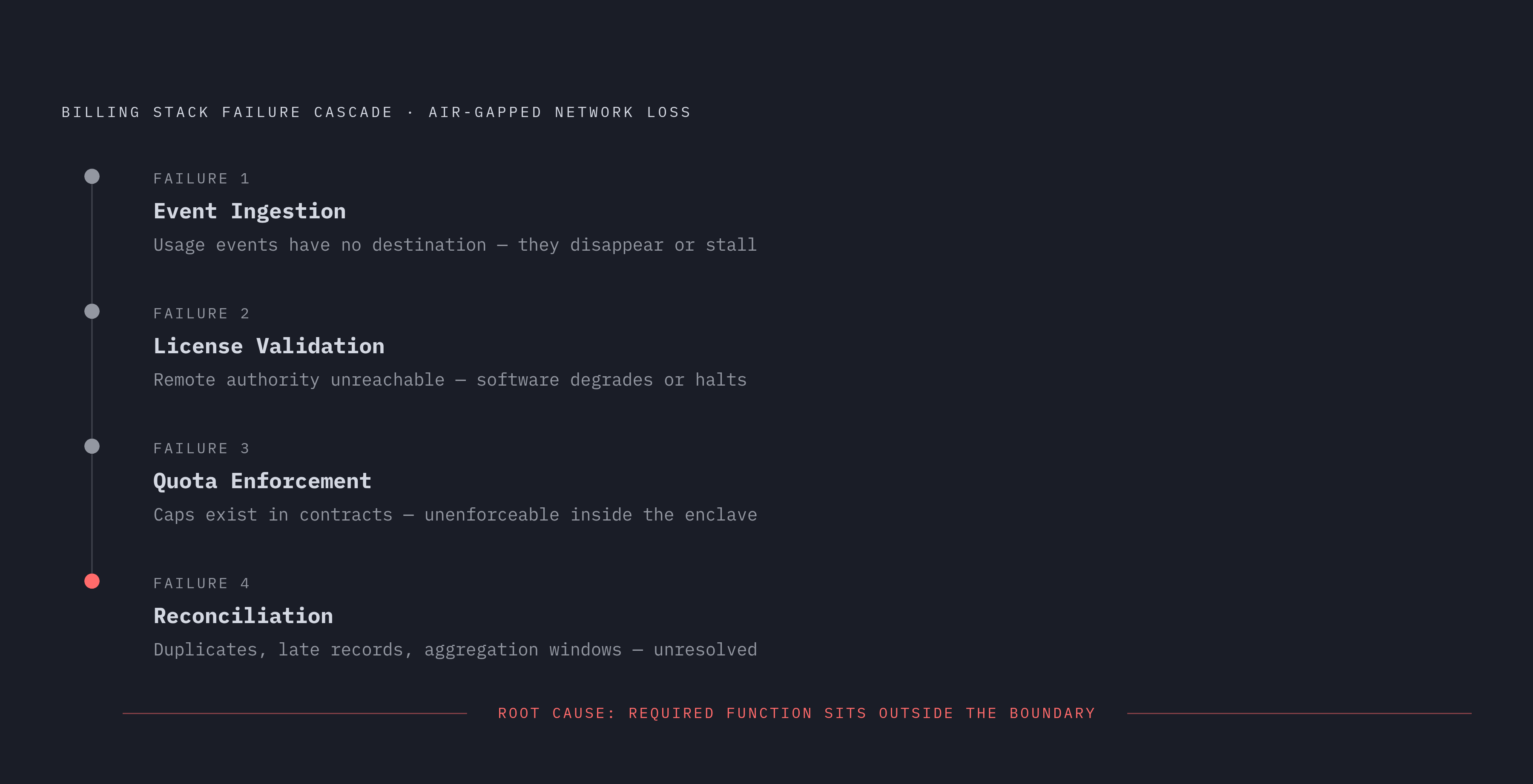
When security data cannot leave a facility, a remote SIEM cannot process it. Billing depends on data leaving the facility in the same way. Four failures follow when that movement becomes impossible.
First, event ingestion loses its destination. Usage events addressed to a vendor-hosted API either disappear or accumulate without a processing path. Waiting for connectivity is not a recovery strategy when the deployment may remain disconnected indefinitely.
Second, license validation cannot reach its authority. Software that periodically contacts a remote license server may degrade or halt when validation fails. Neither outcome is acceptable inside a classified deployment. The unavailable service is part of the authorization path.
Third, externally managed quotas become advisory. A cap can exist in a contract and a cloud dashboard without being enforceable by the application inside the enclave. The application has no way to check remote state or use remote enforcement logic.
Fourth, reconciliation loses the service that resolves duplicates, late records, and aggregation windows. Without a local replacement, errors can persist across a billing cycle before audit exposes them. Changing connection settings cannot repair these four failures. Each happens because a function the system needs sits outside the boundary where it must work.
What the air-gap constraint actually demands from event ingestion and metering
A working ingest layer is a self-contained local pipeline. Event receipt, deduplication, and aggregation must complete without any vendor-hosted component. Durability begins with the individual event because a lost usage record can become lost revenue. With periodic reconciliation, it takes longer to spot that loss. In a classified deployment, audit may not expose it until months later.
Retries, internal network errors, and redelivery must not cause the same consumption to be charged twice. Idempotency therefore has to be enforced inside the enclave. Late-arrival windowing belongs there too, so that the decision to close an aggregation window does not depend on an unreachable endpoint.
The same boundary applies to runtime dependencies. Everything the pipeline needs must be inside the enclave before it runs, brought in on signed physical media so that nothing needs to be fetched while it runs. This extends beyond the event receiver itself. A locally deployed receiver is incomplete if a later processing stage still depends on a hosted service.
AI workloads make this pipeline particularly demanding. Token consumption, GPU-minutes, and inference calls produce usage that the local system must absorb without shedding events under load. The requirement is sustained local processing. Otherwise, the first visible sign of an ingestion gap may be an incorrect invoice.
Entitlement enforcement when there is no license server to call
Counting consumption locally establishes what has been used. Enforcing a contract requires the application to act on that count while usage occurs. A negotiated government cap is a contractual obligation. Its enforcement cannot wait for an external service or a later finance review.
The credit ledger, quota state, and enforcement logic run on customer-controlled infrastructure, with the application consulting a local service. This removes the remote license server from the decision path. It also avoids the choice between blocking an authorized deployment and bypassing validation because a server cannot be reached.
Credit-based pricing fits this architecture because a pool bought in advance gives local enforcement a balance set by the contract to draw down. Consumption reduces the local ledger, and the application enforces the limit without an outbound call. The pricing model and the enforcement mechanism are directly connected. Credits do not solve isolation by themselves unless the ledger and the decisions also remain local.
Without phone-home checks, there is no way to check compliance remotely at all times. An immutable, locally retained audit log replaces that check with a record of consumption events, enforcement decisions, and policy applications. That record lets later commercial and compliance reviews check how the system was controlled.
Audit logs, usage observability, and the seven-year retention problem
The billing system must preserve, query, and produce its records throughout the seven-year retention period without relying on an external archive. The customer needs control over the record inside the same boundary that governs the application.
For classified AI, the record extends beyond a usage total. Per-request observability captures caller identity, workload tag, the model resolved, policy decisions, guardrail verdicts, and a trace ID. These details serve both billing and security review. Finance teams and auditors need access to the relevant record without moving its processing outside the enclave.
Local dashboards must give operators a current view of credit consumption, remaining quota, and cost by workload. The Ask Sage case showed why teams need to see consumption as part of how they control the budget. An operator who sees only the final bill has no opportunity to adjust use during the cycle.
Government procurement makes that delay especially costly. Executive Order 14402 established fixed-price contracts as the preferred default for federal procurement, reinforcing the need to manage consumption against agreed budgets. Local spend visibility supports those decisions before an overrun occurs. It also reduces the support burden and renewal surprises associated with a product whose users cannot see what they are consuming.
Invoice generation and finance reconciliation inside the perimeter
Once usage has been counted and governed, pricing must be applied where that usage resides. The rate card, pricing logic, proration rules, and invoice template all execute locally. The document produced locally is available for export through approved channels. The customer does not wait for an external billing service to send it back.
This reverses the usual commercial data flow. Instead of sending usage to the pricing engine, the deployment brings the pricing engine to the data. Locally aggregated records become the basis for invoice generation. A cloud dependency at this final stage would invalidate the independence achieved by the preceding layers.
Finance integration must respect the same boundary. Cloud-hosted ERP synchronization, external accounting connections, and vendor-hosted payment webhooks are unavailable where they require egress. Reconciliation uses the ways to transfer data that the customer has approved. Signed, transferable bundles can support a scheduled cadence without live API calls, provided each cycle produces a complete, auditable record.
That completeness has a direct revenue consequence. Periodic reconciliation allows undetected errors to persist through an entire billing cycle before audit catches them. Accurate invoices generated automatically from local aggregates reduce that exposure. Manual reconciliation or partial automation increases the risk of leakage even when the application itself runs correctly.
What a billing platform designed for air-gapped deployment actually looks like
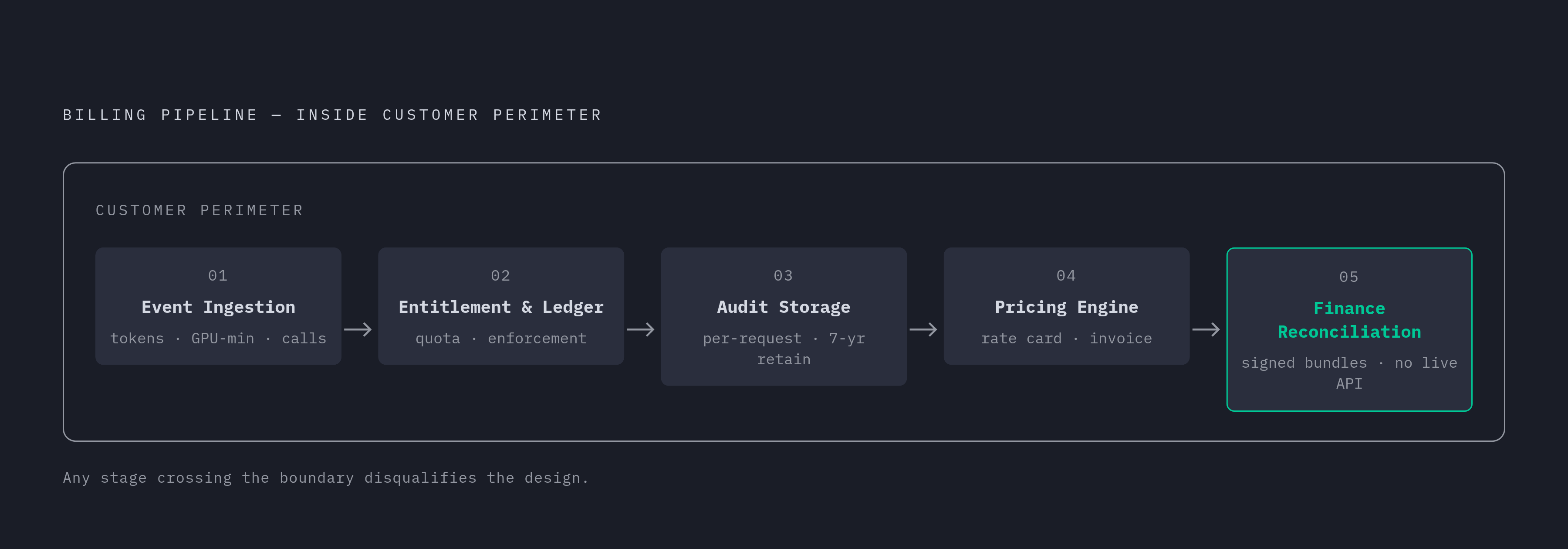
A coherent platform treats disconnected, on-premises, and sovereign deployment as primary design targets. Its durable, idempotent event pipeline feeds a local entitlement engine and credit ledger. Local observability and audit storage preserve the record under configurable long-term retention. A local pricing engine turns the aggregates into invoices. No required runtime stage crosses the perimeter.
Metering and billing must function as one system. An integration seam that phones home disqualifies the design, while separate systems maintained indefinitely inside the enclave increase the burden on the cleared team. The architectural goal is continuity from consumption to invoice. Merely installing two products on premises does not establish that continuity.
ibl.ai demonstrates a related model of ownership inside the perimeter. The customer receives the complete codebase, can run the platform model-agnostic across any LLM, and pays by usage without per-seat pricing. The platform operates indefinitely without vendor contact. No license servers, telemetry endpoints, or external model API calls are required at runtime.
Product and finance teams need to be able to change rate cards, credit denominations, and usage tiers locally without an engineering ticket or vendor API call. Developers need an event ingestion API that does not force them to build a compensating abstraction layer. Inside a classified environment, that layer becomes a permanent maintenance obligation for cleared engineers whose primary mission is not billing.
How defense SaaS vendors should evaluate billing infrastructure before a contract requires it
The practical evaluation should begin before contract award. Discovering a required cloud dependency at signature can mean months of rebuilding under a live contract. The first question for a billing provider is whether fully disconnected, on-premises operation is a production-grade configuration. A less-supported fork that lags the cloud product is a different proposition.
The provider should explain whether application-level quota enforcement consults a local service or a vendor-hosted license server. It should also identify where deduplication, late-arrival windowing, and aggregation execute. An imprecise answer leaves a critical dependency unresolved.
Audit and maintenance deserve equally specific answers. Evaluation should establish where usage records live, who controls retention, and how records are exported for finance and compliance review. It should also establish whether updates arrive as signed bundles that cleared personnel can transfer through physical media and apply locally. Pull-based updates from a vendor endpoint cannot maintain a fully disconnected deployment.
The cost of building a bespoke billing stack inside a classified environment is only part of what it costs to own and maintain that stack. That stack needs a cleared, funded team assigned to keep it working. Where suitable infrastructure can be purchased, assigning that team to billing instead of the product’s core mission is part of the cost of building.