Deferred Revenue Impact on SaaS Valuation and ARR Metrics
Deferred revenue reveals whether SaaS revenue quality justifies the valuation multiple.
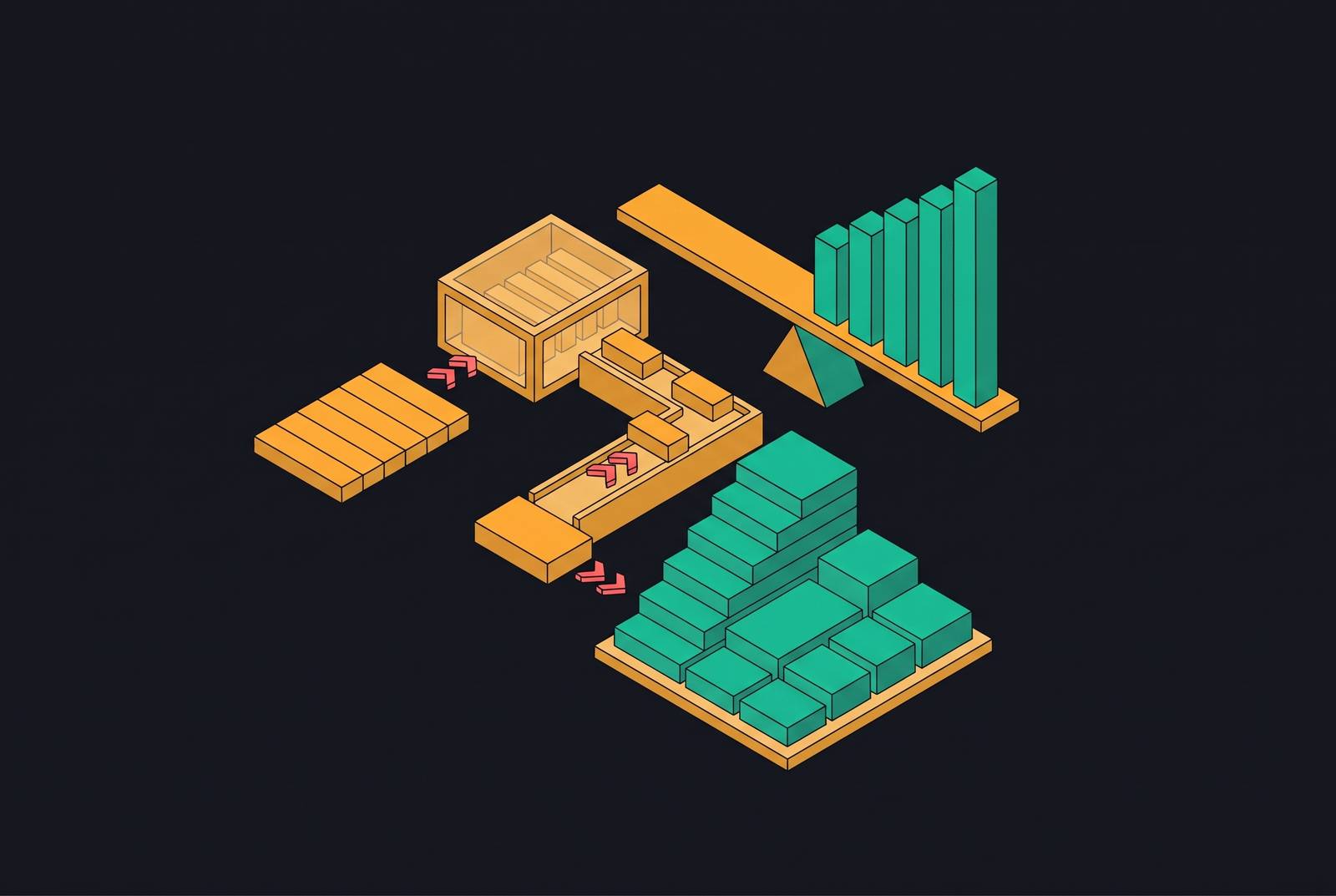
Deferred revenue shapes SaaS valuation because it tests whether reported ARR comes from revenue that will last or from accounting timing. Its reconciliation to billings, consumption and recognized revenue can expose the weaknesses that trigger price chips, or provide the evidence that supports a premium multiple. Finance teams protect that multiple by making the ARR claim traceable before diligence begins.
Why the SaaS multiple gap is wider than most finance teams realize
The distance between median SaaS valuations and the top decile reflects measurable differences in revenue quality. A buyer assessing recurring revenue is also assessing how reliably that revenue becomes cash and how much future delivery remains attached to it. Headline ARR cannot answer those questions alone. Two companies presenting similar ARR can therefore face different judgments about the durability of their revenue and the strength of their supporting records.
SaaS Capital’s January 2025 analysis places private SaaS companies at a persistent discount to public peers, with bootstrapped companies generally receiving lower ARR multiples than equity-backed ones. Growth and retention claims become more persuasive when the underlying accounting supports them without unexplained adjustments. Deferred revenue sits at that intersection because it connects advance billing with the obligation to deliver, exposing whether a recurring-revenue claim rests on a coherent billing model.
What ARR actually claims, and why buyers test it against deferred revenue first
ARR represents the annualized value of subscription revenue that is contracted and expected to continue without additional sales effort. It is a non-GAAP claim about future revenue, and seller and buyer can disagree on what it includes, especially when implementation work, pilots or other non-recurring items enter the calculation. Before assigning a multiple, the buyer must establish which revenue actually qualifies.
The buyer’s reconciliation moves from ARR to billings, through the change in deferred revenue, and into recognized revenue. Billings show how the stated recurring base turns into invoices, while deferred revenue shows how much is still awaiting delivery and has yet to be recognized. Collection must also be reconciled. The balance-sheet liability anchors this work, but its value comes from how it ties to the supporting records.
A gap does not explain itself away. When finance cannot reconcile these records before diligence, the buyer gains an opening to challenge either the ARR definition or the accounting behind it. Deferred revenue is therefore a live test of the ARR claim within the valuation discussion.
How deferred revenue flows through the income statement and balance sheet under ASC 606
Under ASC 606, revenue is recognized when performance obligations are satisfied. Cash that comes in before delivery creates a deferred revenue liability. Annual subscriptions billed in advance make this distinction particularly visible because the company collects the subscription payment while much of the service period remains undelivered.
As delivery occurs, the liability is released into recognized revenue at the pace required by the customer contract. For a subscription delivered month by month, the recognition schedule follows that delivery pattern. The schedule must track the liability by customer and its expected release dates, with balances that reconcile to the general ledger. An unexplained difference creates audit exposure. It also prevents a buyer from tracing the reported revenue back to the obligation that earned it.
Prepaid credits introduce a different release mechanism. A customer who buys credits or tokens has paid for future consumption, but the company has yet to earn that payment as revenue. The balance stays deferred until consumption occurs, with expected unused credits accounted for under the rules that apply. Consequently, the composition of deferred revenue is as important as its size, because time-based subscriptions and credit wallets require different evidence to support recognition.
The three ways deferred revenue distorts ARR and how each one triggers a price chip
Non-recurring inclusions inflate the recurring-revenue claim at its source. Implementation fees, one-time services and pilot contracts can enter reported ARR even though they do not support the same expectation of continuing subscription revenue. The deferred revenue balance may then change in ways that do not fit the claimed recurring base. Buyers challenge what qualifies for the multiple. Their adjustment targets the ARR claim rather than the business’s actual delivery performance.
Front-loading billings into a quarter to support an ARR target can produce a deferred revenue spike followed by flat or declining recognized revenue. The billing increase alone is not evidence of stronger recurring demand. When the recognition pattern fails to support the growth narrative, buyers treat the mismatch as a revenue-quality concern and use it to challenge the price. The unexplained relationship between the records gives buyers grounds to challenge revenue quality.
Uncertain credit breakage undermines the release schedule itself. Prepaid wallets can stay in deferred revenue even when there is no sound estimate of how many credits customers will leave unused. Without historical consumption data, an auditor or buyer cannot support when, or whether, the liability will become revenue. That uncertainty weakens the earnings evidence behind the valuation and gives the buyer another basis for a price adjustment.
How annual vs. monthly billing shapes the deferred revenue balance and the deal economics at close
Billing cadence changes what the buyer assumes at closing. Annual advance billing leaves a larger deferred revenue liability than monthly billing because more of the prepaid service remains to be delivered. That obligation affects deal economics even after the parties agree on an ARR multiple. The headline price is not the seller’s net proceeds.
In an asset purchase, the buyer typically assumes the prepaid service obligation while the seller retains the cash already collected. A working capital adjustment credits the buyer for the deferred revenue balance to compensate for that obligation. A large balance relative to ARR can therefore reduce the seller’s proceeds meaningfully without changing the stated multiple. The liability’s treatment belongs in the deal model before agreement on price.
Monthly billing usually brings a smaller deferred revenue balance and a smaller related adjustment, but it also makes cash collection less efficient. Annual billing improves cash flow and shows that customers have committed, while leaving more prepaid service for the buyer to deliver at close. For sellers preparing a transaction, the lesson is to model the working capital peg, ARR snapshot date and deferred revenue treatment before the LOI. That allows the parties to negotiate the economics deliberately rather than uncovering them as a late-stage price chip.
Why usage-based and credit-based pricing makes the deferred revenue problem structurally harder
Usage-based and credit-based pricing replace a predictable release schedule with one governed by customer behavior. A prepaid AI credit balance may fall by different amounts each month. It releases as the customer consumes the product. That variability makes recognized revenue harder to forecast and the connection between annualized revenue claims and the income statement harder to explain.
For breakage, historical consumption data must back up the estimate of expected unused credits, which must be recognized proportionally as active customers consume. Without granular, real-time metering, finance lacks the evidence needed to defend that estimate. A company combining subscriptions and usage also has two recognition schedules, one based on delivery over time and another based on consumption. Both must reconcile to billing and the general ledger.
The structural requirement is a connected evidence chain. Metering and billing cannot operate as unrelated problems when consumption determines the deferred revenue release. Fragmented systems for subscriptions, usage and credits can report conflicting consumption figures, leaving finance without a single source of truth for the schedule. The systems must show what each customer has consumed at a given time while keeping measurement separate from recognition. Without that data, finance cannot apply even an accounting policy that has been carefully written down.
What NRR signals about revenue quality and why deferred revenue accuracy is what makes NRR credible
NRR is one of the strongest signals buyers use to judge revenue quality because it shows whether existing customer revenue expands or contracts. Public SaaS companies with weak NRR trade at a fraction of the revenue multiples commanded by those with strong NRR, with outsized gains at the high end.
When NRR is calculated from recognized revenue cohorts, errors in deferred revenue release flow directly into the metric. Overestimated breakage can accelerate recognition, while underreported consumption can delay it. Either change can happen without a change in what the customer does. Yet both can alter the revenue assigned to the cohort and distort the apparent retention result.
A buyer finding inflated recognized revenue will therefore look beyond correcting NRR. The error calls the broader ARR and revenue-quality claims into question because the same recognition records support the seller’s valuation case. Accurate metering and clean deferred revenue schedules provide the evidentiary record that makes expansion credible by demonstrating that the reported retention result reflects customer activity.
How buyers construct the ARR-to-cash reconciliation and where sellers lose ground during diligence
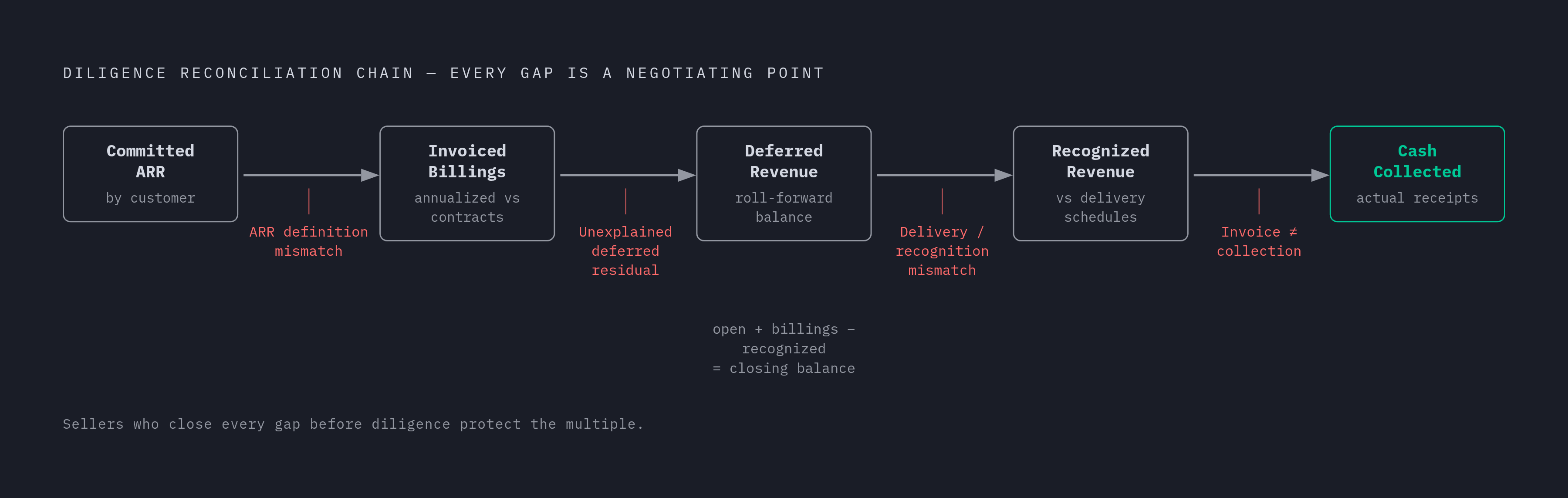
The buyer begins with committed ARR by customer and tests it against invoiced billings. This establishes whether the annualized claim maps to the contracts and billing schedules presented. The buyer also needs to distinguish invoicing from collection when assessing the cash claim. An invoice is not evidence of collection. Differences at this stage can show where definitions do not match, even before the buyer starts to review recognition.
The next step reconciles billings to the deferred revenue roll-forward. Opening deferred revenue, plus billings and less recognized revenue, should explain the closing balance within the schedule’s scope. Deferred revenue growing less than billings is normal when revenue is being released. An unexplained residual or a release that does not match delivery raises concern. Such a gap requires investigation into the billing records and recognition entries before it can support a conclusion about accounting compliance.
The buyer then compares deferred revenue releases with contractual delivery schedules and, for credit products, consumption records. Mismatches can indicate errors or unsupported manual adjustments. Sellers can prepare for this sequence with a reconciliation workbook containing ARR by customer, the billings schedule, the deferred revenue roll-forward and the recognized revenue tie-out. That preparation reduces the number of unresolved accounting questions available as negotiating points and leaves more room to discuss business quality.
What finance teams can do before the process starts to protect the multiple
Finance teams should first agree on and document what counts as ARR before any investor or buyer conversation. The definition should distinguish committed, invoiced and collected amounts. Its relationship to deferred revenue and the income statement must be explainable. Consistency in the ARR definition is essential because a reconciliation cannot fix an ARR claim if the rules for what it includes change from one reporting period or transaction discussion to the next.
The next preparation step is a monthly deferred revenue roll-forward by customer, showing the opening balance, new billings, revenue released and closing balance. Maintaining it before diligence provides a contemporaneous record. For credit and usage balances, finance should also write down the historical consumption data, the breakage estimation method and the accounting entries that follow from it. An undocumented estimate leaves room for an auditor or buyer to substitute a more conservative judgment. The support must explain both the balance and the timing of its expected release.
Billing infrastructure must make that evidence available. Real-time usage metering, with measurement separated from revenue recognition, allows finance to apply the accounting policy to a consistent consumption record, eliminating manual reconciliation of parallel systems. The resulting schedules demonstrate that the revenue-quality claim is supported by a maintained system. The multiple a company commands depends on whether investors and buyers trust its ARR claim, and deferred revenue is where that trust is earned or lost.