Tiered and Volume Pricing Rate Card Design
How to choose billing units and tier thresholds that protect margin and drive growth.

Every rate card starts with one decision that determines whether the rest of it holds up: what are you actually counting? Tier breaks, aggregation logic, the margin math that keeps finance up at night, all of it traces back to this. Get the unit wrong and nothing built on top survives contact with a real customer base. People skip this step because it feels obvious. It isn't.
There are two ways to blow it. Go too granular and you're billing on something the customer can't see or predict, individual tokens buried three layers inside a compound AI call. That doesn't create clarity. It creates anxiety, because customers can't model their own bill, so they pad their budget against the worst case. Go too coarse and you lump dissimilar actions into one bucket, "API calls" that quietly blend a cheap lookup with an expensive model inference, and you bleed margin on the expensive ones because the whole bucket got priced for the cheap average.
AI products feel this more than old-line software ever did, since every query carries a real, variable compute cost behind it. Bessemer Venture Partners puts AI gross margins at 50 to 60%, against 80 to 90% for regular SaaS. Pick the wrong unit and it doesn't just cost you at launch. Wait long enough, and it takes the whole pricing model apart the moment volume shows up.
A handful of unit types keep coming up, and each one fits a different job. API calls or requests work fine when the calls cost roughly the same to serve, and they fall apart the moment model mix starts drifting. Tokens or compute units track real cost more precisely for LLM workloads, but try explaining a token count to a procurement lead who just wants the number on the invoice. Credits work as a buffer, an abstraction layer that shields the vendor from cost swings, and that matters more than it sounds: the Stanford HAI 2025 AI Index found inference costs fell more than 280-fold between late 2022 and late 2024, and credits let a vendor absorb that kind of swing without renegotiating every contract on the books. Seats plus events blend the two, seat count gates access while events gate consumption, which helps when usage inside one team swings wildly from person to person. Outcomes, resolutions, tasks completed, sit closest to what the customer actually cares about, though they demand measurement that holds up the moment someone disputes it. Intercom prices its Fin AI Agent at $0.99 per resolution, charging directly for the outcome the customer cares about.
Whatever unit you pick, it has to show up in real time and hold up the moment a customer questions the invoice. If a support rep can't explain the billing unit in one sentence, that unit is generating churn, not expansion. It also boxes in what you can build later: a token-level unit demands millisecond metering, while a monthly-active-user unit tolerates lazy daily aggregation just fine. Match the unit to the metering system you can actually run, not the one that looks good in a deck.
The structural difference between graduated and volume pricing — and when each one fits
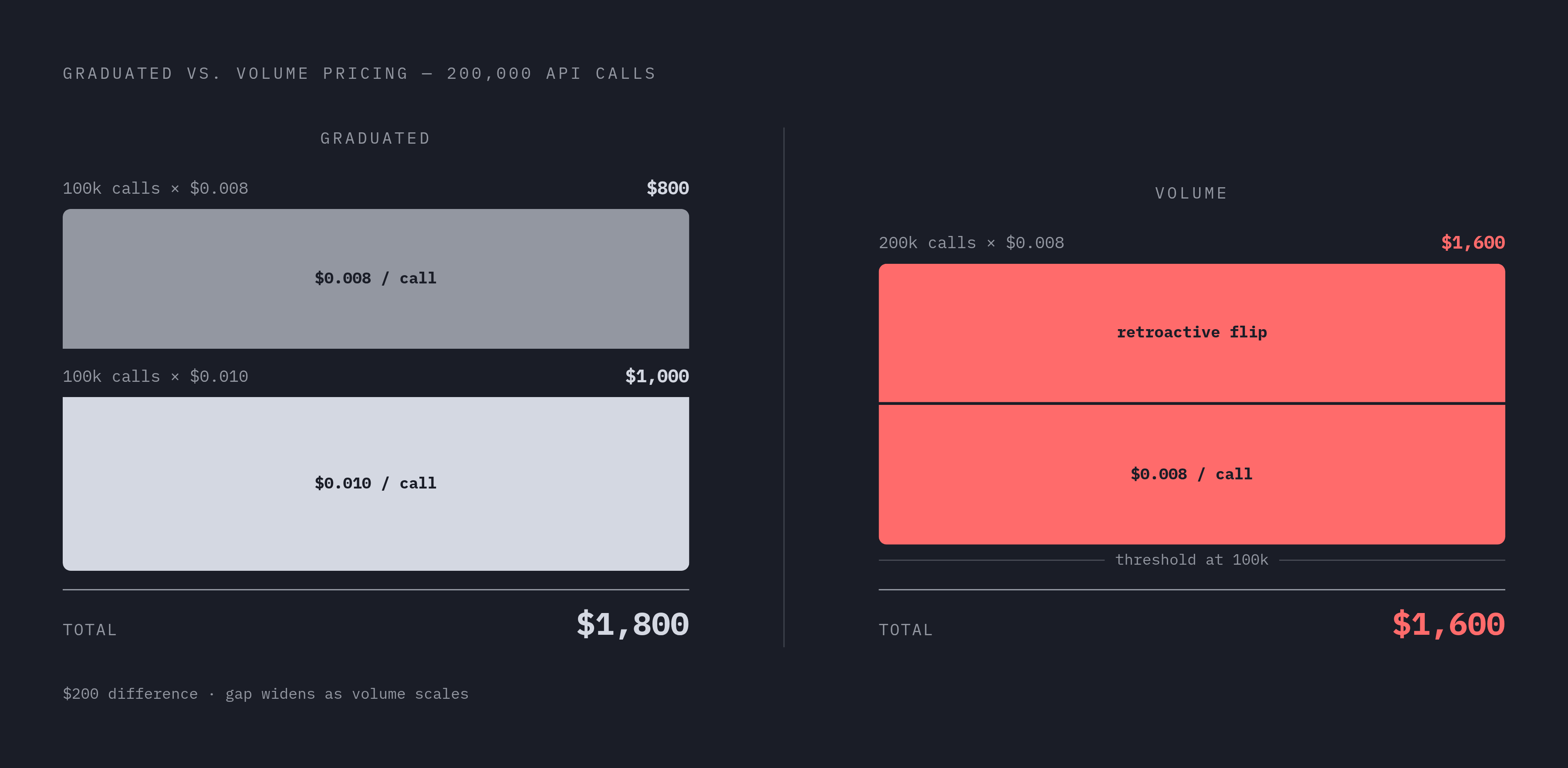
Graduated and volume pricing sit next to each other on a pricing page and look almost identical. Underneath, they produce completely different invoice math and completely different customer behavior. Conflating the two is one of the more expensive mistakes a pricing team can make, and it happens constantly.
Graduated, or stepped, pricing charges each usage band its own rate, and the customer's total blends across bands. First 100,000 API calls at $0.01 each, next 500,000 at $0.008, everything past that at $0.005. A customer at 200,000 calls pays (100,000 × $0.01) plus (100,000 × $0.008). Nothing complicated about it. Margin holds steady at every band, since the vendor never gives away a cheap rate on units that should have priced higher, and customers tend to find the invoice fair too, because they can trace it line by line and rebuild it themselves. This structure suits a wide usage distribution, some customers parked in early bands, others deep into later ones. It protects margin at low volume while still rewarding growth as it happens.
Volume pricing works differently. Cross a threshold and the entire volume flips to the lower rate, including everything already consumed below the line. That builds a cliff, and customers sitting near it have a real reason to nudge usage just past the edge to grab the discount. The margin risk is worse than it looks on paper too: a customer who crosses by even a hair gets the discounted rate applied retroactively across their whole usage, not just the marginal units above the line. Volume pricing fits fast-moving situations, land-and-expand plays, platform consolidation deals, competitive displacement, anywhere the point is pulling a customer to the next scale tier fast. In return it demands careful threshold placement. Set the cliff too low, and high-volume customers grab the deep discount without the vendor ever capturing the incremental value that discount was supposed to fund.
Model the P&L at the exact crossing point before choosing between the two. Volume pricing tends to look more generous in the sales room and cost more once it actually scales; the two aren't mutually exclusive, either. Plenty of enterprise contracts run graduated pricing for usage alongside volume pricing for committed-spend tiers, stacked in the same deal.
How to place tier thresholds so they reflect real usage clusters, not round numbers
The most common mistake on a rate card is setting thresholds at round numbers, 1,000, 10,000, 100,000, with zero relationship to where customers actually cluster. Round numbers read clean on a pricing page. They almost never match where real usage sits.
Miss the placement and one of two things happens. Set the threshold too low, 10,000 calls when most growth customers cluster at 8,000 to 9,000, and the expansion discount fires before the customer needed any nudge at all; margin walks out the door for nothing. Set it too high, 10,000 when the natural next plateau sits at 15,000, and customers feel no pull toward the next tier at all. The rate card just sits there doing nothing, instead of doing the one job it has.
Good placement starts with the customers already on the books. Segment them by monthly usage and look for the valleys, the actual gaps between clusters, not the midpoints between round numbers that look tidy on a spreadsheet. Find the usage level where customers start to churn instead of expand, and set the boundary just below that point, not above it. Pull the heavy tail out separately, the top decile by usage, and build a tier for them specifically instead of bolting them on afterward like an edge case.
New products without usage history need a different playbook. Start conservative, base the first thresholds on pilot customer data, and build in a quarterly review from day one, because the first guess will be wrong somewhere. Treat the first rate card as a draft, because it is one. The 2025 PricingSaaS 500 Index tracked over 1,800 pricing changes across 500 companies in a single year, 3.6 changes per company on average. That says plainly that pricing iteration is the norm, not a sign something went wrong upstream.
One thing gets overlooked constantly: what happens when a customer crosses a threshold mid-billing period. Partial-month proration, immediate application, next-period reset, pick one and write it down somewhere everyone can find it. Ambiguity here is where invoice disputes and finance headaches come from. A well-placed threshold also makes overages rarer and less contentious in the first place, since customers understand the economics before they ever cross the line.
Overage logic: why the rate and the mechanism are separate decisions
Vague overage design causes most of the trouble that shows up later. Every overage decision actually splits into two questions that get treated as one: what rate applies above the top tier, and how the overage gets triggered, communicated, and enforced.
On rate, three real options exist. List rate, no discount, maximizes revenue per overage unit but also maximizes bill shock; it fits products where switching is slow and genuinely painful for the customer to pull off. A blended or pro-rata rate charges overage at the top tier's band rate, predictable and low-surprise, at some cost to revenue capture. An overage discount prices the excess below the top tier's rate, trading short-term revenue for retention, and it makes sense where switching costs are low and losing a high-usage customer is a live risk.
On mechanism, the choices matter just as much, maybe more. A hard cap with an upgrade prompt stops usage cold at the tier limit until the customer upgrades: strong conversion pressure, but real friction and outage risk for anyone running production workloads on top of it. A soft cap with automatic overage billing lets usage keep going and bills the excess after the fact, but it only works with real-time metering and clear alerting, otherwise the customer's first signal is a surprise invoice landing in their inbox. Commit-and-true-up, common in enterprise annual contracts, has the customer commit to a floor and reconciles actual usage at period end; it postpones the overage conversation but dumps a pile of reconciliation work on finance at close. Usage alerts at configurable thresholds, 70%, 90%, 100% of the tier limit, are the most direct way to deal with the forecasting anxiety CIOs bring up constantly.
The real risk lives in the pairing, not in either decision alone. List-rate overage paired with a hard cap is brutal for the customer, no way around it. A blended rate paired with a soft cap and proactive alerts is close to painless by comparison. Which pairing makes sense depends on how critical the product is and who the customer is, not on which combination happens to be easiest to configure in the billing system this quarter. And the soft-cap-plus-alerts model has a hard prerequisite that gets skipped constantly: a billing pipeline that only aggregates usage once a day cannot warn a customer they're approaching a limit at 2pm.
Designing the discount curve so it creates expansion pull without compressing margins
The discount curve, the shape of the rate reduction from one band to the next, usually gets inherited from whatever the last pricing page did. Twenty percent off each band, say, because that's the number everyone remembers. It's rarely built from actual margin math, and quiet revenue loss hides in that gap for years without anyone noticing.
Three curve shapes cover most of the real ground here. Linear decay applies the same discount, dollars or percent, at every band. It's the easiest one to explain and almost never the right call, since it tends to over-discount high-volume customers who were already committed and never needed the extra push to stay. Front-loaded decay gives bigger discounts early and smaller ones near the top, which speeds the move off free or freemium plans while protecting margin once customers get large. Back-loaded decay flips that, small discounts early, bigger ones at the top, building real pull toward the highest tier available. That fits land-and-expand strategies where the enterprise tier is the actual target and the early tiers exist mainly to get a foot in the door.
Every band has a margin floor it cannot cross. The rate has to cover unit economics at that volume: infrastructure cost, support cost, whatever usage-correlated cost applies. For AI products running at 50 to 60% gross margin, a discount curve borrowed wholesale from a traditional SaaS business assuming 80 to 90% margins will eventually drown a band in red ink.
Run the expansion test before locking anything in. Take a cohort of customers who tripled their usage over a year and calculate what each curve shape does to revenue pulled from that cohort specifically. If the curve captures less revenue from the customers who grew the most than from the ones who grew modestly, the incentive structure is backward, and it needs rebuilding before it ships. Annual prepay discounts stack on top of all this too, and they need their own modeling, not an assumption that they're additive: a 20% prepay discount layered onto an already back-loaded curve can push the top tier into a loss for the vendor, and these interactions only show up once someone stress-tests them together on paper. Hugging Face's public GPU inference pricing, where rates drop as hourly usage climbs, is a real, working example of a back-loaded curve built to pull professional and enterprise workloads toward sustained use. The same logic carries straight over to API and AI feature pricing generally.
How hybrid rate cards stack seats, credits, and usage tiers without creating internal contradictions
Hybrid pricing hit 41% adoption in 2025, per Growth Unhinged, and most forecasts have it crossing the halfway mark within a year or two. Most new rate cards are going to stack at least two pricing dimensions on top of each other. Stacking is exactly where internal contradictions sneak in if nobody's checking for them.
Three stacking patterns show up again and again. Seat plus usage overage bundles a usage allowance into each seat license, then bills anything above the aggregate allowance at an overage rate; it's the most common enterprise hybrid by far, and its main failure mode is that per-seat allowances aggregate strangely once headcount shifts mid-period. Platform fee plus tiered consumption separates a flat fee, covering support, uptime, base features, from a tiered rate card for actual usage. The flat fee gives the vendor predictable revenue, the tiered card captures value as usage climbs, and the two stay cleanly apart from each other. Credit pool plus tiered replenishment allocates or sells a pool of credits, consumed at set rates per action, then prices replenishment on a tiered scale. It's the most flexible option going for AI products where actions carry wildly different costs to serve.
Stacking produces interaction effects, and those effects can generate pricing that makes no sense at the edges if nobody traces it through. Take a seat-based allowance that resets every month, stacked against a usage tier measured annually: a customer's monthly position on the usage tier has no real relationship to their annual commit, and finance ends up reconciling two clocks that were never built to sync in the first place. Every dimension in a hybrid rate card needs to share a common billing period, or there needs to be an explicit, written rule for how the dimensions interact across periods. Skip that step, and the rate card will eventually produce an invoice nobody on the team can look a customer in the eye and defend.