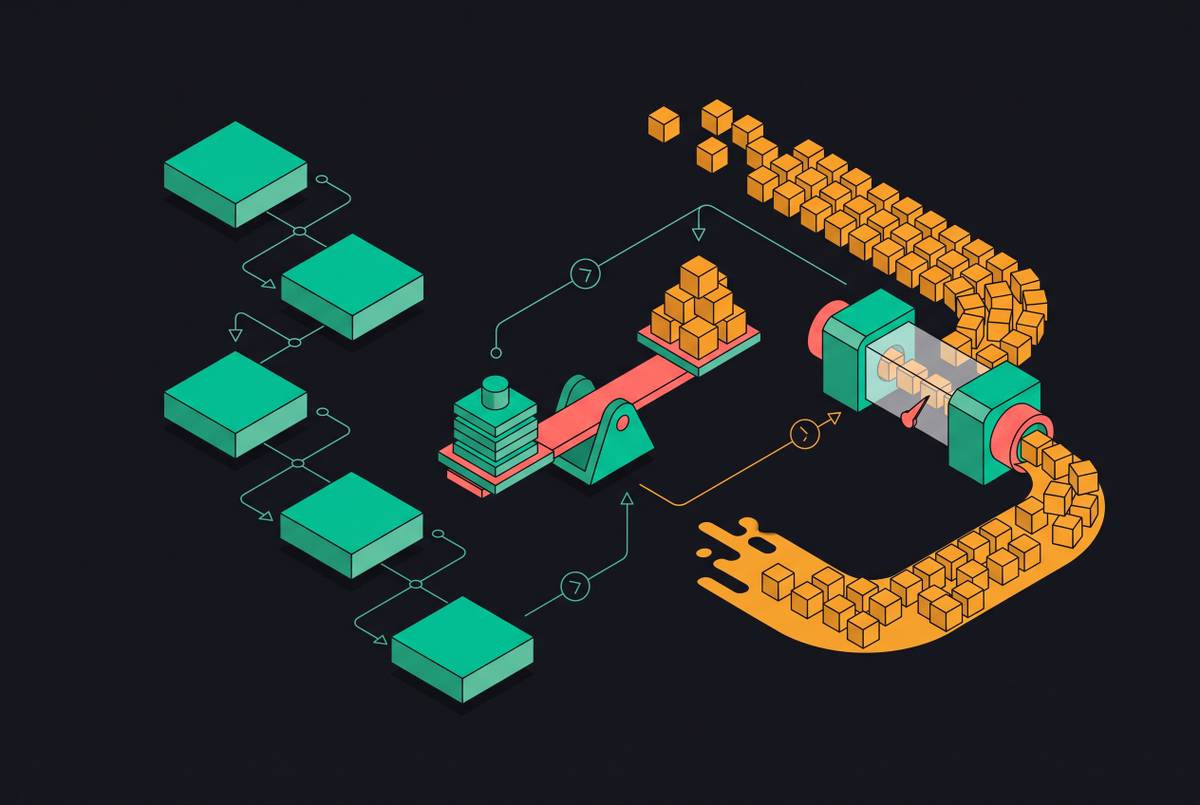
Dead-Letter Queue Handling for Failed Billing Events
A dead-letter queue protects revenue only with owners and safe replay.
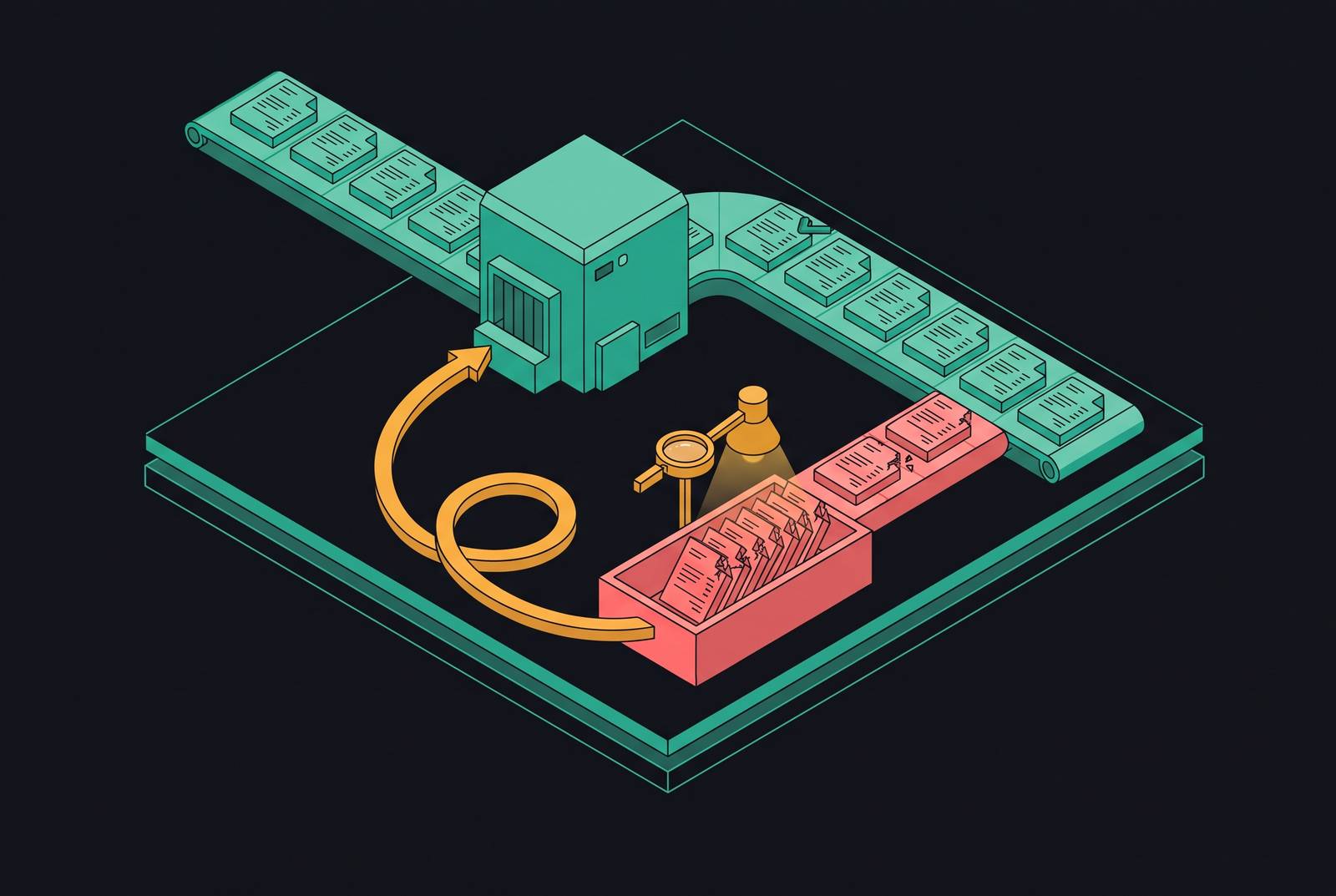
Dead-letter queue handling for failed billing events is a revenue control. A queue protects billing records only when it has an owner, evidence for triage, safe replay rules, and idempotent handlers. Without that operational loop, it merely postpones the loss of events that connect service delivery to customer charges and accounting records.
Why failed billing events are categorically different from other failed messages
A failed invoice.payment_succeeded or usage metering event can leave a gap between service delivered and revenue recognized. Unlike a routine customer.updated failure, that gap can change a charge, a consumed-credit balance, or an accounting record. The damage takes two distinct forms. A silent drop leaves gaps in downstream state, while duplicate execution can charge a customer twice. When there are many events, even a small failure rate can leave enough billing records missing to cause a business problem.
A fire-and-forget delivery can be lost during a ninety-second interruption, leaving state that does not fix itself when the connection comes back. Conversely, a metering worker can send a batch that the billing engine processes successfully, lose the acknowledgement, and retry the same payload. Provider webhooks also retry on bounded schedules regardless of downstream state. Billing systems have to keep failed work and expect the same event to be delivered again.
What a DLQ actually is and where it sits in the billing event pipeline
A dead-letter queue is the last stop in a defined retry policy. It preserves exhausted deliveries for a human or automated decision. In a billing pipeline using transactional-outbox discipline, the producer commits its state change and writes the event before delivery begins. A worker then attempts delivery, using exponential backoff after a non-2xx response or connection failure. Once the attempt budget is exhausted, the delivery moves to dead_lettered status and automatic retries stop.
The retained record must explain what failed. Its context includes the original body, event identifiers, failure reason or exception class, attempt count, consumer name and version, and first-seen and last-failed timestamps. Status codes, latency, and error strings for each attempt give triage an evidential basis. This preservation avoids both blocking a consumer indefinitely and discarding work after bounded retry windows expire. A DLQ differs from quarantine, which holds events so they can be checked or approved under set controls before replay, especially when their effects on payments need review.
Why a DLQ without an operational process is just a delayed data loss
Retention buys time, but it does not resolve failure. A queue with no documented owner, dashboard, or replay policy is a hidden-loss buffer whose contents may eventually expire. Its value depends on how quickly harmful failures surface, which classes qualify for automatic recovery, and which need approval. Repaired events also need to be tracked after replay, with thresholds for growth and age that set when to escalate. Without those decisions, the architecture stores failures but does not manage them.
On-call visibility alone does not close that gap. Ad-hoc monitoring leaves operators to classify severity and decide replay safety anew each time the same event type fails. Making that judgement each time costs more to run and leaves the cause in place. There is also a failure path inside the supposed safeguard, because the DLQ write itself can fail. If the consumer acknowledges the original record anyway, the event is silently lost under the appearance of successful handling. The operational rule is therefore to never commit past unresolved work in a partition.
Classifying failures before replaying them: transient, permanent, and ambiguous
The first triage decision is whether another attempt can succeed without a repair. Transient failures include network timeouts, rate limits, and temporary downstream unavailability. Most belong in delayed retries with exponential backoff and jitter, with replay after the dependency recovers subject to the safety controls below. Permanent failures need a different response entirely. A malformed payload, missing lookup key, or schema validation error needs repair, or a producer fix, before re-enqueueing. Ambiguous exceptions need a limited number of retries and a human check before bulk replay, while business-logic errors need manual review.
Error signatures make this classification repeatable. They still require context, because a schema error that looks permanent can reflect schema-registry lag or a deploy race. Bulk replay before the registry catches up merely refills the queue. The routing policy should send validation errors straight to the DLQ, delay transient failures, and use manual review when the effects on the business are unclear. Payment events need to pass a manual-approval checkpoint before they return to the main flow. Good records support those distinctions, while missing exception classes force operators to reconstruct them from scratch.
Idempotency is what makes replay safe rather than dangerous
Classification establishes whether replay is useful, but idempotency establishes whether it is safe. Every handler must produce the same outcome when an event arrives twice as when it arrives once. A preliminary existence check cannot guarantee that outcome. Two deliveries can both pass the check before either records completion, allowing both to execute the charge. This race is why duplicate protection has to be enforced atomically.
The concrete pattern is an atomic claim before the business write. A processed_webhooks table with a unique constraint on event_id lets the database arbitrate concurrent deliveries. An insert with conflict-do-nothing returns nothing when the event has already been claimed, and that worker stops. The claim and business operation must commit in the same transaction. Separate commits leave a crash window in which business state changes without a corresponding processed-event record, allowing a later retry to repeat the operation.
Processed IDs also need to be kept long enough. Provider retries and manual resends set the minimum, with a margin before scheduled cleanup using a created-at index. Replay raises another concern when handlers need events in order because they use relative changes such as seat or credit deltas. Payloads that hold the resulting absolute state, such as a new seat total or final balance, remove the need to rely on those relative updates. That payload design addresses a different problem from deduplication, because preventing the same event from executing twice does not restore delivery order.
Replaying backed-up billing events without triggering a failure storm
A backlog released all at once can overwhelm the system that has just recovered. The thundering herd then hits the billing database and downstream services, so recovery becomes a second incident even when duplicate protection works. Replay therefore needs its own throughput control. Operators should release batches with pauses, sized to what the downstream engine can absorb without degradation. A fall in DLQ depth shows that recovery is working before a large release causes a spike on the main topic.
Controlled replay should start with one subscription or event class before moving on to the full backlog. That limits the blast radius if recovery exposes another defect. Dead-lettered deliveries should come back as fresh pending deliveries of the same event, with the same event ID, payload bytes, and signature inputs. They can still race through the schedule and interleave with live events, so replay does not restore ordering. For events requiring repair, the classification and repair decision must precede this replay step.
Each replayed event needs an outcome that operators can follow. A return to the DLQ signals that the root cause was not resolved before replay. Without per-event tracking, the same broken work can circulate repeatedly while appearing to be under active recovery. The queue also serves as an incident record. Attempt-history timestamps identify affected events and their delays, turning an imprecise outage report into a bounded, auditable set of deliveries requiring attention.
Alerting and monitoring that make the DLQ visible before damage accumulates
A first-message alert should fire when any payment or usage event enters the DLQ. An age alert should then flag the oldest unresolved message when its age passes a set threshold. These signals answer different operational questions. The first exposes a new failure, while the second shows that recovery has stalled and consumed service may remain uninvoiced. Both need an owner and escalation rules, because unchecked queue growth can otherwise become an accepted background condition.
Useful metrics include DLQ ingestion rate relative to main-topic volume, failure-type distribution, message age, and reprocessing success rate. Failure categories should show whether an error is a validation, timeout, or business-logic error. A schema mismatch affecting many events needs one notification with a count. Correlation IDs preserved through the retry chain then let engineers reconstruct the full processing timeline instead of treating each failed attempt as an isolated symptom.
DLQs contain full event payloads and should be treated as sensitive stores. Access controls, encryption at rest, and data masking belong in the design from the outset. Masking includes stripping card numbers before stringification.
How a lost billing event becomes an accounting problem under ASC 606
Under ASC 606, the financial consequence depends on the event type. Pay-as-you-go revenue is recognized as usage occurs, so a dropped usage event can understate actual consumption in recognized revenue. Fixed subscriptions are recognized ratably over the service period, so losing one event has less effect on them, but event-driven plan changes and overages are still at risk. Prepaid credits reverse the timing of the cash and service relationship. Revenue remains deferred until consumption, so a missing consumption event can leave deferred revenue on the books after the service has been delivered.
These failures make an unresolved backlog a finance concern. The PCAOB's 2025 Conversations With Audit Committee Chairs Spotlight reported that interviewed chairs consistently flagged revenue recognition as a fraud-risk area because of its complexity and susceptibility to manipulation. Usage-based billing adds event-level granularity to that complexity, making an unmonitored DLQ an uncontrolled variable in the revenue figure. This is distinct from recognizing total contract value before usage is confirmed, which inflates near-term revenue. Dropped usage can distort the figure in the opposite direction and create restatement risk, linking on-call recovery directly to financial reporting.
Where billing infrastructure design determines how much DLQ complexity you carry
Homegrown billing spread across multiple codepaths creates separate integration seams, each with its own failure, triage, and replay paths. Metering and billing also have different service requirements. Metering is real-time, while billing is batch-oriented, and conflating them forces the DLQ to absorb failures that purpose-built separation would prevent. Schema changes, infrastructure upgrades, and new pricing dimensions then keep adding maintenance work to the retry and idempotency logic.
Silent drops and duplicate metering batches are especially consequential when they corrupt consumed-credit balances. Usage-based billing platforms such as Flexprice serve products that charge by tokens, credits, or API calls, where an event that is lost or counted twice causes a billing error. The architectural distinction is broader than any individual platform. Purpose-built infrastructure treats ingestion, idempotency, and retry policy as core concerns, leaving the DLQ as a last resort for genuine business-logic failures rather than a catch-all for missing infrastructure controls.
The build-versus-buy decision has to account for the ongoing work of recovery. For a payments company or billing vendor, building metering and invoicing infrastructure can be the product itself. For AI and SaaS companies whose product lies elsewhere, maintaining that pipeline competes with work that generates revenue. That cost continues after the initial implementation. Sound infrastructure reduces the failures that need exceptional handling, while a defined operational process makes the remaining workload retained in the DLQ recoverable.