Data Residency Requirements and Billing Data Localization
Billing platforms must now prove data stays within borders, not just pick a cloud region.

Data residency rules now decide which billing platforms even get a seat at the enterprise procurement table, before anyone runs a proof of concept or checks pricing. Where usage events, invoices, and audit trails physically sit, and who can touch them, has become a legal question with real fines attached, not an IT preference buried in a vendor questionnaire. This matters most for billing infrastructure specifically, because billing data (token counts, GPU-minutes, invoice line items, correction records) carries the same personal and behavioral data that residency laws were written to control.
Three terms get used interchangeably that shouldn't be. As a geographic fact, data residency is simply where data physically lives. Data localization is a hard legal mandate that certain data has to stay within a border, no exceptions. Data sovereignty is the broader legal framework, the set of laws that determine who can access data and under what authority, regardless of where the servers sit. The distinction matters operationally: a company can deploy a regional cloud instance in Frankfurt and still fail a localization requirement if the underlying compute provider allows inference, logging, or backup processing to occur in another country. Picking "EU region" from a cloud console satisfies the legal requirement for where data is hosted. It does not answer the localization or sovereignty questions, and regulators increasingly treat those as separate tests.
Billing data sits squarely inside this, whether vendors have priced that reality into their roadmaps or not. Usage events like tokens consumed, API calls, agent actions taken, and GPU-minutes burned are customer data under most privacy statutes. Invoices reference account identity, purchase history, and consumption patterns, which is exactly the kind of behavioral profile regulators worry about. Audit trails and correction records carry personal identifiers all the way through their lifecycle. Enterprise security questionnaires already ask where billing data lives, who holds edit rights over invoices, and whether contract amendments leave a trail anyone can audit later. Billing infrastructure is already on the compliance checklist. It just hasn't been treated that way by most vendors selling into this space.
How broad and fast the regulatory landscape is moving
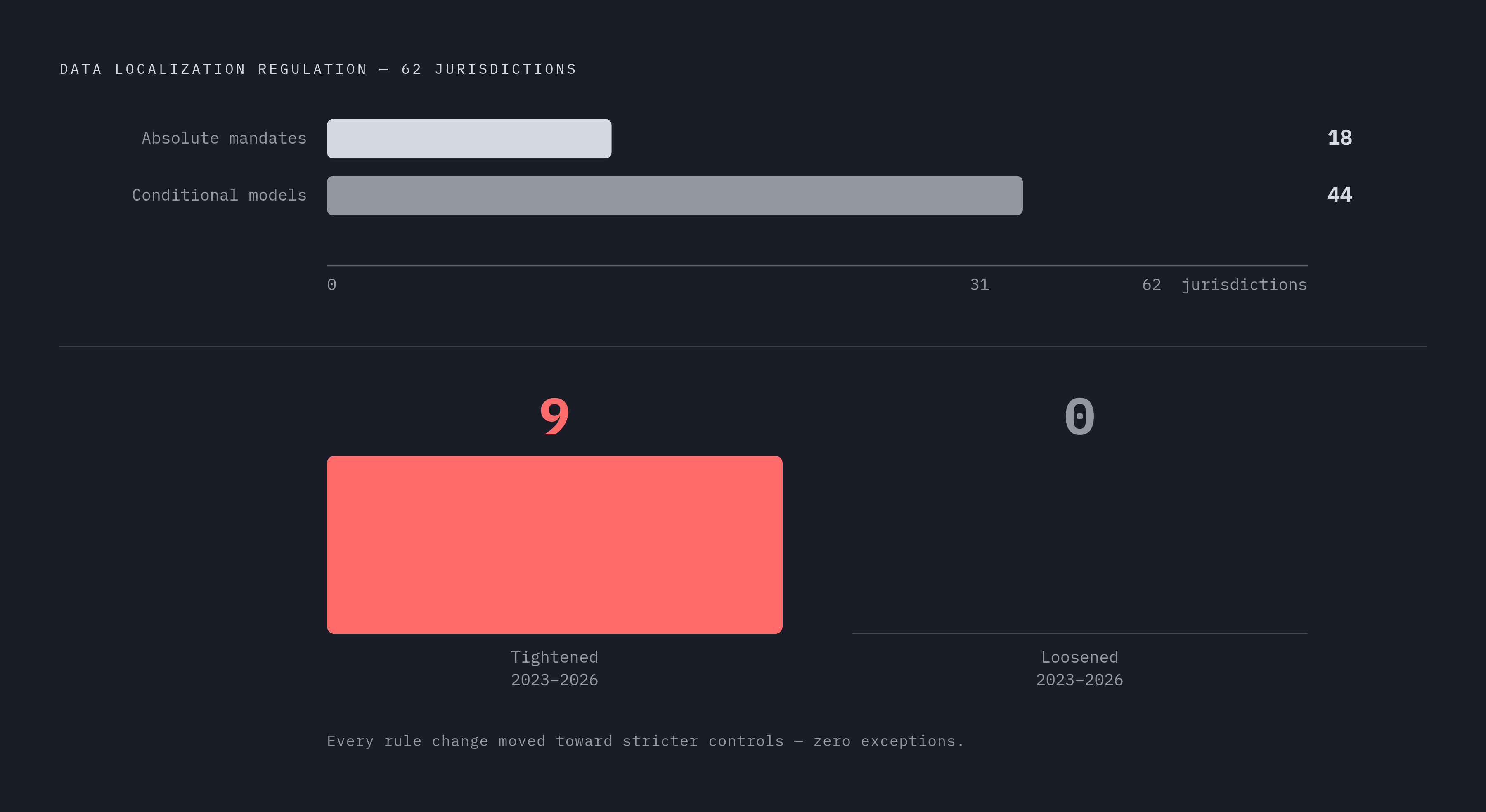
Sixty-two jurisdictions now have some form of data localization requirement on the books. Eighteen of those impose an absolute in-country mandate, no exceptions, no legal workaround. The other 44 use conditional models, where localization kicks in depending on the data category, the sector, or the size of the company handling it.
The direction only runs one way. Between 2023 and 2026, nine jurisdictions tightened their rules, moving from a conditional model to a stricter localization requirement for at least one data category. None loosened. Regulatory retreat on data localization has not happened anywhere in this window.
India illustrates the pace. The Digital Personal Data Protection Act is expanding local storage obligations, while a national central bank already requires payment system data to be stored exclusively within the country. A financial regulator's cyber security and cyber resilience framework includes a data localization clause for regulatory data, though that specific provision has been on hold since December 2024 pending further consultation, a useful reminder that even strict-sounding rules can stall in practice. Separately, the RBI's Digital Lending Directions took effect May 8, 2025, with a reporting deadline of June 15, 2025, adding fresh privacy and reporting obligations on top of the existing residency layer.
Indonesia requires public electronic system operators to run local data centers, with extra sector rules layered on for financial services and health data. Vietnam's Cybersecurity Law imposes data storage requirements on certain operators under specified conditions, and the country's new Data Law takes effect July 1, 2025. Saudi Arabia's Personal Data Protection Law has been fully enforceable since September 2024 and includes data protection obligations relevant to cross-border transfers. Bangladesh is adding a residency requirement through its Personal Data Protection (Amendment) Ordinance, set for 2026. Even Utah has entered this territory: House Bill 548 mandates localization for genetic data and blocks sequencing by companies tied to designated adversary nations, proof that this covers more than one bloc or region typically cited in these discussions.
The EU is a special case that should be separated from the pack. GDPR doesn't technically mandate localization. Chapter V requires a legal mechanism, an adequacy decision, standard contractual clauses, binding corporate rules, or another recognized legal mechanism, before any EU personal data can leave the EEA. Compliance requires legal cover, not merely a server location. In practice, though, many enterprises find hosting within a particular regional bloc is the simplest way to satisfy that legal test, which produces something that looks a lot like a localization mandate without technically being one.
Enforcement penalties as real budget risk, not theoretical compliance overhead
Three fines in recent memory show where this is heading, and the trend line is not encouraging for anyone treating residency as a paperwork exercise. Meta was fined €1.2 billion for unlawful EU-US data transfers, the largest single GDPR penalty issued to date. TikTok was fined €530 million for failing to protect EEA user data from unauthorized access originating in China. Uber picked up a €290 million fine for moving driver records across borders without the right legal basis.
The TikTok fine deserves a closer look, because the mechanism behind it applies directly to billing vendors. TikTok had conducted multiple Transfer Impact Assessments, the formal exercise companies run to check that a destination country's laws will actually protect transferred data. Regulators found those assessments failed to adequately establish that Chinese law would protect the data once it arrived. Having a TIA on file wasn't enough. The conclusion had to be right, and the company had to act on it.
That distinction, procedural compliance versus substantive compliance, is exactly the trap billing vendors can fall into. A vendor that checks the "data residency" box on a security questionnaire, while routing that data through infrastructure operated by a US-headquartered cloud provider, is standing in roughly the same spot TikTok stood in before the fine landed. The box gets checked. The underlying legal exposure doesn't go away.
Add to this the EDPB's 2026 enforcement push around transparency obligations under Articles 12 through 14 of GDPR, which covers how companies disclose data flows, including third-party sharing and cross-border transfers, in their privacy notices. The exposure isn't limited to where billing data physically sits. It extends to whether the vendor's public disclosures accurately describe where that data goes and who touches it.
The regional data privacy framework, meanwhile, survived its first legal challenge but remains under appeal at a top regional court, and regulators in several countries have already recommended that organizations build exit strategies for any transfer arrangement that depends solely on the framework. Standard contractual clauses as a backup, not an afterthought, is the sober read here.
Hard architectural constraints on billing infrastructure created by residency requirements
Localization rules generally do three things: they prohibit cross-border replication of certain data, they require processing to happen inside the regulated geography, and they mandate the use of domestic infrastructure. Each of those hits billing systems in a specific, mechanical way.
Prohibiting cross-border replication means a company can't stream its billing events, invoice records, and audit logs into a global data warehouse if the local law bans that transfer, no matter how convenient the warehouse is for finance reporting. Requiring in-country processing means the metering aggregation, the rating engine that turns raw usage into a price, and the invoice generation step all have to run inside the regulated border, not just store their output there afterward. Mandating domestic infrastructure means a billing vendor whose only deployment option is multi-tenant SaaS running on US-headquartered cloud infrastructure is disqualified from many enterprise deals before a single feature gets evaluated.
The CLOUD Act creates a gap that a lot of procurement teams miss. Selecting the EU region inside AWS, Azure, or Google Cloud does not guarantee sovereignty, because the US CLOUD Act gives US authorities a legal basis to compel data access from US-headquartered providers regardless of where the servers physically sit. True sovereignty, in the strict sense, needs one of three things: a provider that isn't US-headquartered, fully self-hosted infrastructure, or a legal structure specifically built to block extraterritorial access requests. That's a materially higher bar than picking a region from a dropdown menu, and it directly narrows the field of billing vendors who can credibly serve regulated enterprise customers.
AI billing widens the surface even further. Inference logs, token counts, prompt metadata, and agent action records are all billing-adjacent data. If the regulated scope extends to AI inputs and outputs, which the EU AI Act's governance framework suggests it does, then the metering pipeline itself becomes a regulated data processor, not just a back-office accounting function. That reclassification changes what "billing infrastructure" even means from a compliance standpoint.
Real-time metering makes this harder still. A billing system built to ingest usage events at millisecond speed, running across a distributed pipeline of message brokers like Kafka, stream processors, and analytics stores like ClickHouse, has to be deployable entirely within a sovereign boundary, not just the invoice layer at the end. Sovereignty for the invoice and exposure for the event stream underneath it is not a compliant posture.
How SaaS vendors' approaches to residency requirements reveal an architectural divide
Looking at how three well-known SaaS vendors have handled this reveals a pattern that says more about business strategy than about technical capability.
Notion opened EU data residency in Frankfurt in 2025, then added Tokyo, with Osaka as a backup region, and Seoul in 2026. The feature is restricted to Enterprise plan customers only. Figma took a similar path: EU hosting runs primary in Frankfurt with a backup in Dublin, Enterprise tier only, with Volkswagen Group named as a customer using the setup. Figma has since extended localized hosting to Australia, India, and Brazil, still gated behind the Enterprise tier.
Atlassian did something different. Data residency is available across eleven geographies, the US, EU, Germany, UK, Switzerland, Canada, Australia, Singapore, Japan, India, and South Korea, and it's available not just on Enterprise but on the Standard and Premium tiers as well. Atlassian has stated it won't raise prices on those tiers as a result of offering the feature there.
These approaches tell the story. Notion and Figma treat residency as a premium upsell, a revenue lever tied to the Enterprise tier where the biggest contracts and the highest margins live. That's a defensible business decision. It also means a mid-market customer in a regulated industry, running on a lower tier, doesn't get the architecture they may legally need. Atlassian's approach suggests the residency capability was designed into the platform early, as an infrastructure decision rather than a packaging decision, which is a different kind of commitment and a different kind of engineering investment.
OpenAI's move fits this same current. In November 2025, the company rolled out expanded data residency for ChatGPT Enterprise, ChatGPT Edu, and API Platform customers, letting businesses pin their data to specific geographic regions. That rollout is a direct answer to pressure from global enterprise buyers who couldn't sign a contract without it, and it signals that AI vendors are being pulled into the same residency conversation that SaaS platforms have been having for years, with a wider and messier data surface.
Why AI and usage-based billing products face a compounded residency problem
Usage-based and AI billing products carry a wider data surface than a traditional subscription ever did. Subscription billing mostly just needs a plan ID and a renewal date. Usage-based billing needs a metering pipeline that processes token counts, GPU-minutes, API call metadata, agent action logs, and inference records, and under GDPR and comparable frameworks, several of those categories can qualify as personal data in their own right, well before an invoice gets generated.
The scale of adoption is what makes this a mainstream problem rather than a niche one. Usage-based pricing moved from roughly 30% of SaaS companies in 2019 to around 85% by 2024. Separately, 42% of companies now monetize their AI features through usage-based or hybrid pricing models. That's not a small slice of the market experimenting with a new billing model. That scale is the market.
Credit-based pricing adds another layer of residency surface that's easy to overlook. The PricingSaaS 500 Index counts 79 companies now running credit-based models, and a prepaid credit wallet carries balance data, top-up transaction history, and consumption records, all of which have to sit inside the regulated geography if the customer is subject to a localization mandate. A wallet balance looks like a trivial number on a dashboard. Underneath, it's a running ledger tied to an identifiable account.
Outcome-based billing is the newest wrinkle. Gartner projects that 40% of enterprise applications will include AI agents by the end of 2026, up from under 5% previously, and pricing is following that shift: Intercom's Fin AI Agent charges $0.99 per resolution. Billing on outcomes, resolutions achieved, tasks completed, means the billing system now stores a record of what the AI actually did as well as how much of it ran. That outcome record is billing data and potentially sensitive operational data at the same time, and it falls under residency rules on both counts.
What billing infrastructure must be able to do to satisfy residency requirements
Deployment flexibility is the entry ticket, not a nice-to-have. A billing platform has to be deployable on-premises or within a customer-designated sovereign cloud boundary, not merely configurable to point at a regional SaaS endpoint somewhere. This single requirement disqualifies most conventional billing tools before anyone gets to feature comparisons or pricing negotiations.
Event ingestion has to happen inside the boundary, start to finish. The entire metering pipeline, ingestion, stream processing, aggregation, rating, needs to execute within the regulated geography. A platform that meters usage in a global data plane and only routes the finished invoice into a regional database has not satisfied an in-country processing requirement. The processing already happened somewhere else by the time the invoice is generated.
Audit trails need the same treatment. Raw event history, correction records, and dispute resolution flows have to be stored and queryable inside the sovereign boundary. Copying those logs into a global warehouse so finance can run cleaner reports is a common practice, and it's also a direct violation of localization mandates in jurisdictions that require it.
Multi-region architecture needs to isolate customers by jurisdiction rather than label their records with a region tag after the fact. An EU customer's token consumption events should never transit a US-based message broker, even briefly, even as a pass-through step on the way to somewhere compliant. Tagging data by region after it has already crossed a border doesn't undo the crossing.
Questions procurement and engineering teams should ask to evaluate billing infrastructure for residency compliance
Start with deployment. Can the platform run entirely on-premises or inside a customer-designated sovereign cloud, with no data transiting infrastructure the vendor operates elsewhere? If the vendor's answer is a "regional" SaaS option, ask whether that provider is US-headquartered, and if so, ask how the arrangement holds up against a CLOUD Act analysis, because a regional server location doesn't automatically answer that question. Ask, too, where the vendor is legally incorporated and where its data controller entity sits, since residency of the server and residency of the company that legally controls the data are two separate facts that often get conflated in sales conversations.
Then move to data flow. Does the metering pipeline, ingestion, aggregation, rating, run entirely inside the regulated boundary, or does any step in that chain quietly transit a global data plane on its way to the regional store? Where do audit logs, correction records, and raw event history actually live, and are they replicated anywhere outside that boundary for reporting or backup purposes? A vendor that can't answer these questions with architectural specifics, rather than a generic assurance about "regional hosting," hasn't earned the enterprise deal yet, and given the direction these regulations are moving, that gap isn't going to close on its own.