Multi-Entity Billing for SaaS Companies With Subsidiaries or Resellers
Most billing platforms weren't built to handle separate legal entities properly.

Multi-entity billing is a structural requirement, not a feature you switch on. It's a structural requirement, and most billing platforms were never built for it. They were built for a single legal entity, one currency, one tax jurisdiction, and everything else got bolted on after the fact through workarounds, spreadsheets, and finance teams doing manual reconciliation at month-end. Companies find out their billing tool can't actually model separate legal entities at the exact moment they need it most: during an international expansion, right after an acquisition, or when a business unit needs its own P&L. By then the cost isn't hypothetical. Lost enterprise deals, audit findings, and revenue leakage appear, and they compound every month the underlying cause goes unfixed.
The core distinction is what practitioners sometimes call entity-aware routing. Every object in a billing system, including every customer, subscription, usage event, and invoice, has to carry an entity identifier from the moment it's created. That identifier determines which legal name goes on the invoice, which tax registration applies, which bank account collects the payment, and which invoice numbering sequence gets used. Get this wrong at ingestion and there's no clean fix later. Reassigning a usage event to a different entity after the fact means unwinding revenue recognition, tax calculations, and reporting that already assumed the wrong entity. That's not a bug fix; it's a restatement.
The five capabilities that must work simultaneously in a multi-entity billing system
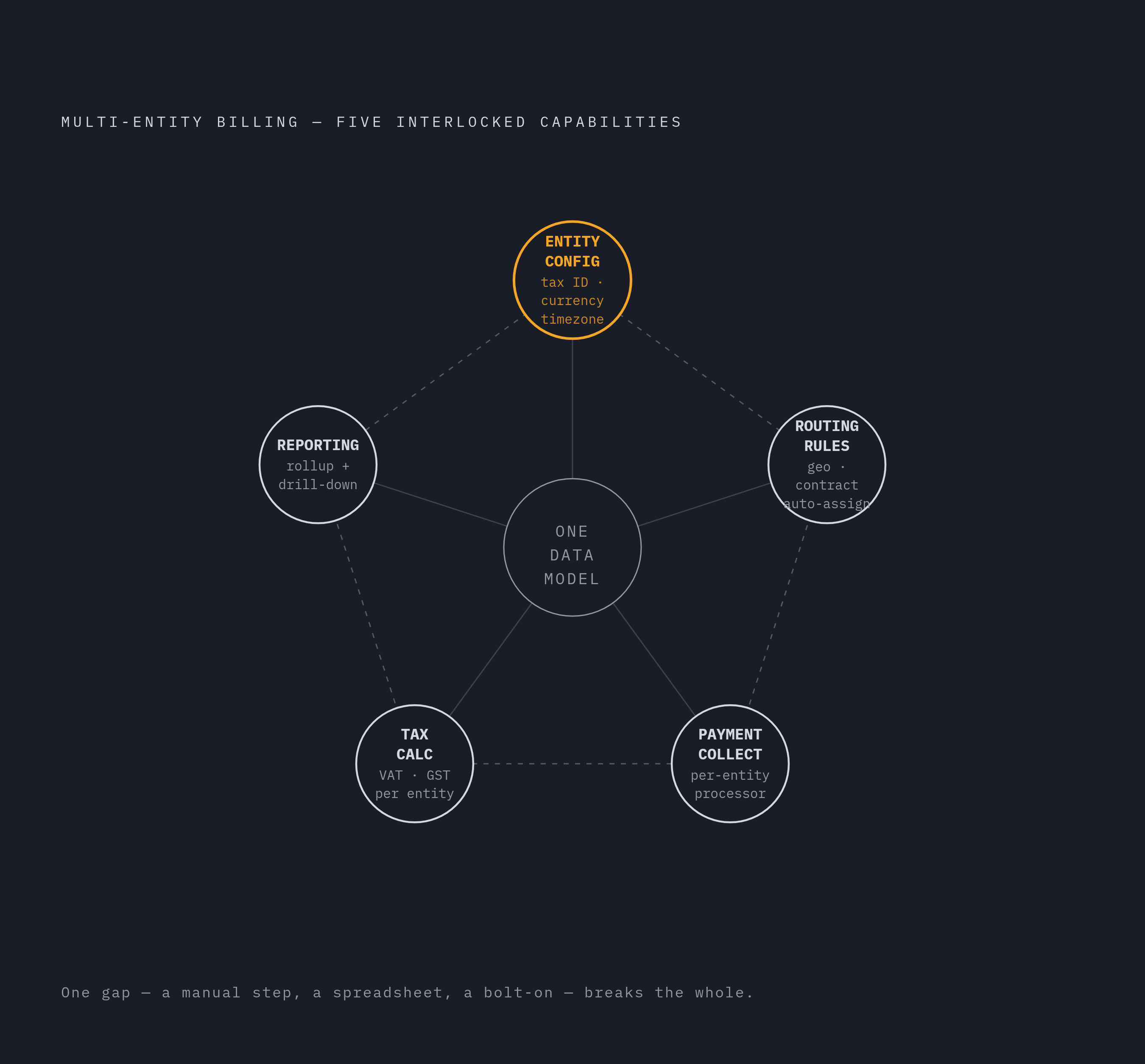
Five things have to work at once, on one data model, or the system isn't really handling multi-entity billing but is just simulating it with duct tape.
Entity-level configuration comes first: legal name, tax IDs, currency, invoice prefix, and timezone, all set per entity so each invoice meets local legal requirements without someone manually overriding a template every month. Second, automated routing rules assign customers to entities based on geography or contract terms, because leaving entity selection to a human is the single most common source of multi-entity billing errors. Incorrect entity assignment is one of the most common sources of audit findings in multi-entity billing operations.
Third, tax calculation has to run at the entity level, applying the right VAT, GST, or sales tax rate and registration number for that specific entity. This isn't just a global-company problem anymore. According to the Tax Foundation's Economic Nexus Treatment by State, all 45 states that impose a sales tax now enforce economic nexus, so domestic SaaS companies face nearly the same multi-jurisdiction tax complexity that international ones do. Fourth, payment collection needs to happen per entity too, through separate payment processor accounts or metadata-based routing, so funds and reconciliation stay clean per subsidiary. Mixing collections across entities isn't just messy, it produces audit findings.
Fifth, consolidated reporting has to roll up across entities while still allowing drill-down into any single one. The mechanism that makes this possible is entity dimension tagging on every financial record, which lets a company build one executive dashboard and one subsidiary-level P&L off the same dataset, instead of running duplicate pipelines for each view.
A fast diagnostic: if any one of these five capabilities needs a manual step, a spreadsheet, or a separate tool bolted on the side, the platform wasn't built for multi-entity. It's faking it, delivering the appearance of multi-entity support without the substance.
Three architecture patterns for multi-entity billing and what each trades off
There are basically three ways vendors build this, and each one trades something away.
The first is centralized with entity routing: one billing system, an entity_id field on every object, and config-driven rules that assign entities at the customer or subscription level. This works well for companies running somewhere between two and ten entities that want high throughput and mostly consolidated operations. Data residency has to be enforced at the application layer rather than through actual database isolation, so if a regulator wants proof that customer data from a given country never touches US infrastructure, the burden falls on how disciplined the engineering team was about tagging events correctly. Failing to prove that data never touched US infrastructure is a real risk, since the burden falls on how disciplined the engineering team was about tagging events correctly.
The second pattern is distributed: separate billing instances per entity or region, fully independent of each other. This is the right call when data residency requirements are strict, when a market is heavily regulated, or when an entity legally needs to be ring-fenced from the rest of the business. The trade-off is that consolidation now requires building a reporting layer on top of multiple independent systems, and every new entity adds operational overhead that doesn't scale linearly. Ten entities under this model isn't twice the work of five, the operational overhead grows substantially faster than the entity count does.
The third pattern is hybrid: one shared pricing catalog and billing logic engine, but entity-specific invoicing and payment routing sitting on top of it. This is becoming the pattern of choice for companies that want pricing consistency across subsidiaries (so a product team doesn't have to update five different catalogs every time a plan changes) without duplicating an entire billing instance for every entity.
Whichever pattern a company picks, the reporting requirement doesn't change: consolidated and entity-level views have to be possible from the same dataset, rather than from parallel pipelines that someone has to keep in sync by hand. And for regulated enterprises, there's a filter that applies before any of these three patterns even get evaluated: does the billing system need to run inside the customer's own infrastructure? On-premises or sovereign cloud deployment is a hard requirement in some industries, and it disqualifies cloud-only platforms outright, regardless of how well they handle entity routing.
Where multi-entity billing breaks down: resellers, parent-child hierarchies, and hybrid pricing
Reseller relationships expose the architecture's weak points fast. A reseller contract might need the bill-to entity to change mid-contract, and the billing system has to handle that without breaking historical invoicing accuracy or corrupting revenue recognition on contracts that started under a different entity. This is harder than it sounds, because it requires a kind of retroactive entity assignment that most systems simply weren't designed to do cleanly.
Parent-child hierarchies bring a different flavor of complexity. Enterprise customers increasingly want centralized budgets with usage distributed across teams or business units, so credit pooling and hierarchy modeling directly affect how well the system supports centralized budgeting, unlike simple per-seat pricing. The billing system has to support both a consolidated view (how much has the whole account spent) and an entity-level view (how much did this specific subsidiary or team consume), off the same underlying dataset, using entity dimension tagging as the connective tissue.
Usage-based pricing turns up the difficulty another notch. Attribution has to happen the moment a usage event arrives, tagged with metadata like region, model type, or workload, because trying to sort that out during month-end cleanup is where reconciliation nightmares start. Real-time attribution failure is usually the first thing that breaks once a company scales past a handful of entities and starts pushing serious usage volume through the system.
Then there's the intercompany layer, which finance teams have to maintain in parallel with customer-facing invoices. Both sets of documents need to be audit-ready. Automated intercompany billing should post balancing entries on its own, without someone manually creating journal entries every month. If a system requires manual reconciliation to make intercompany numbers match, it isn't actually handling intercompany billing, it's outsourcing the problem to finance and calling it a feature.
Tax compliance, currency, and data residency as first-class architectural requirements
For enterprise buyers in regulated industries, where an invoice comes from is often a dealbreaker, not a preference. Procurement teams routinely can't approve a vendor whose invoicing creates tax complications or data residency exposure on the buyer's side, and no amount of product quality overcomes that kind of compliance obstacle.
Tax complexity keeps expanding rather than settling down. As noted above, all 45 sales-tax states in the US now enforce economic nexus according to the Tax Foundation's 2025 State Sales Tax Economic Nexus Laws report, meaning even a company that never sells outside the US faces something close to the multi-jurisdiction tax problem that global companies deal with. In the EU, VAT registration and invoice formatting are largely harmonized under the EU VAT Directive, though individual member states can layer on their own additional requirements. Multi-entity billing systems need to apply the correct per-entity VAT registration number for each transaction, rather than a single number tied to headquarters. Markets like Australia and Canada add their own mandatory GST registration obligations on top of that, each tied to the entity actually transacting in that market.
Currency support matters just as much. A platform with a short list of supported currencies, or a narrow floor on which currencies can even be used for pricing, is disqualified from serious international enterprise deals before anyone even gets to the feature evaluation stage. And currency support without per-entity bank account routing doesn't solve the actual problem: mixing collections across currencies and entities creates FX reconciliation issues that no manual process can absorb once volume gets real.
Data residency closes the loop. On-premises or sovereign cloud deployment isn't an edge case anymore, it's a standard requirement for fintech, healthcare, and government contracts, where the billing system itself can be subject to the same residency rules as the product it's billing for. Cloud-only platforms are structurally locked out of that segment of the market, full stop, regardless of how good the rest of the product is.
How usage-based and credit-based pricing reshape multi-entity billing requirements for AI and SaaS products
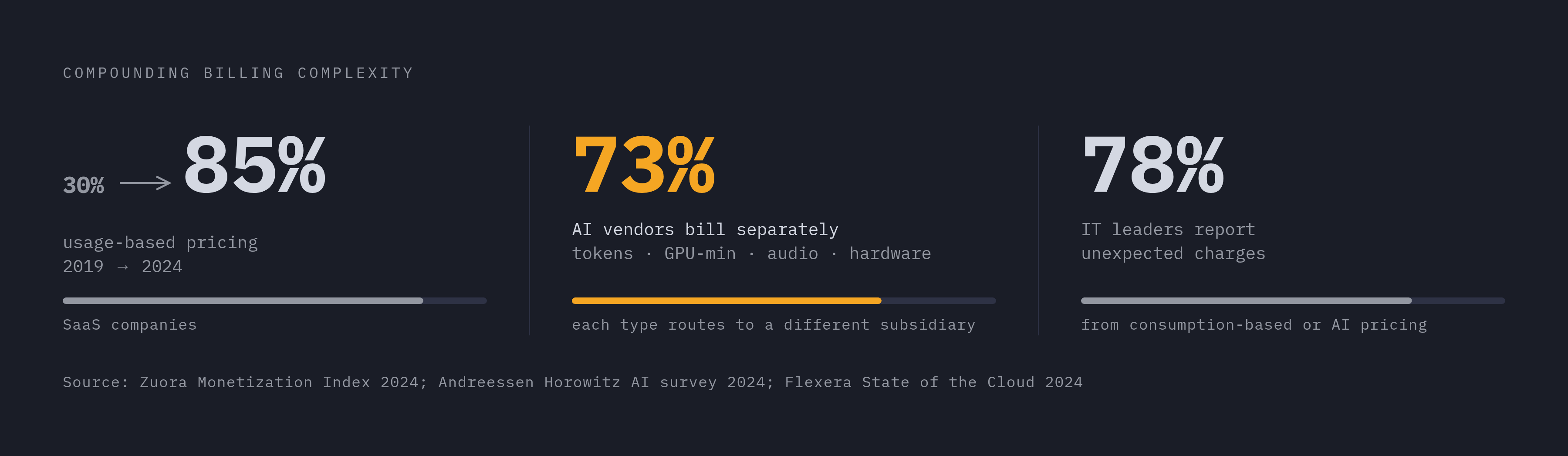
Pricing itself has shifted, and that shift is driving changes in billing infrastructure. The share of SaaS companies using some form of usage-based pricing rose from roughly 30% in 2019 to about 85% by 2024. Multi-entity billing now has to process consumption events as a first-class object, not just subscription line items, and route each one to the correct legal entity.
AI products add another layer on top. Seventy-three percent of vendors now charge separately for AI features, and a single product might be billing simultaneously across tokens, GPU-minutes, audio minutes, and hardware tiers, all while routing each of those consumption types to the correct subsidiary. That's a fundamentally harder attribution and routing problem than flat-fee multi-entity billing ever was.
Credit-based pricing introduces its own wrinkle. Prepaid credit wallets need to be tied to the correct entity at the moment of purchase, not at the moment of consumption, because an enterprise customer that buys credits through a parent entity and then burns them through a subsidiary has effectively created an intercompany transfer, and the billing system needs to model that automatically rather than leaving finance to sort it out after the fact. Parent-child credit pooling compounds this, since the system has to track the pool balance at the parent level and per-entity consumption simultaneously, in real time. And prepaid and postpaid billing aren't separate product lines anymore, AI and enterprise customers routinely need both running on the same engine, across multiple entities, at the same time.
The stakes of getting this wrong are concrete. Seventy-eight percent of IT leaders report unexpected charges tied to consumption-based or AI pricing models. In a multi-entity structure, those surprise charges land across different subsidiaries with different budget owners, which turns a billing accuracy problem into an accountability and dispute-resolution problem that multiplies with every entity added. Finance leadership needs a consolidated, real-time view of spend across the whole organization, while subsidiary budget owners need entity-level alerts on their own consumption, and the billing infrastructure has to serve both audiences off the same data, rather than a manual report someone builds every Monday. Pricing changes need to move just as fast: when a company wants to adjust usage pricing, that change should propagate to every entity automatically. Platforms that require entity-by-entity reconfiguration by engineers will grind pricing iteration to a halt.
Six architectural criteria for evaluating multi-entity billing platforms
Six questions separate platforms that actually handle multi-entity billing from platforms that market the term.
First: is the parent-child hierarchy native, or is it a bolted-on "multiple sites" pattern? In a native system, a customer exists once, usage rolls up automatically, each entity invoices independently, and finance gets one consolidated view without extra work. In the bolted-on version, customers and configurations get duplicated across sites, cross-entity workflows require manual coordination, and consolidated reporting has to be rebuilt outside the platform. The simple test: does the platform require a separate site, account, or instance per entity? If the answer is yes, multi-entity isn't native, it's a workaround with a UI.
Second: does usage attribution happen at ingestion? Attribution needs to occur the moment a usage event arrives, using metadata like region, model type, or workload, not during a month-end cleanup pass. If engineers have to manually route usage events to the right entity account, the platform isn't built for multi-entity usage billing, no matter what the sales deck says.
Third: is intercompany billing automated? Balancing entries should post on their own. If a finance team still needs to reconcile intercompany charges by hand at month-end, the platform has quietly pushed the hardest part of the problem back onto the people least equipped to absorb it manually every cycle.
Fourth: does consolidated reporting work without duplicate data pipelines? The mechanism here is entity dimension tagging on every financial record, so the same dataset can be aggregated for a CFO-level view or filtered down to a single subsidiary. If those two views require separate exports or separate pipelines, the architecture is incomplete, even if the reports themselves look fine.
Fifth: does the platform support deployment flexibility, meaning on-premises or sovereign cloud as a production-ready option, not a roadmap promise? Cloud-only platforms are structurally disqualified for enterprises with real data residency requirements, and "coming soon" doesn't help a company that needs to close a regulated deal this quarter.
Sixth: does pricing model flexibility hold up across entities? The platform needs to run subscription, usage-based, credit-based, and hybrid pricing simultaneously, and pricing changes need to propagate across entities without opening an engineering ticket. Platforms built primarily around subscription billing tend to buckle the moment usage or credit mechanics get layered on top of a multi-entity structure.
The cost of getting any of this wrong isn't abstract. Clari's 2024 Revenue Leak Report, based on a survey of 420 revenue leaders across the US and UK, found that RevOps leaders estimate losing about 26% of revenue to systemic breakdowns in the revenue process, with billing errors, pricing drift, and missed usage charges cited among the leading causes. In a multi-entity structure, every one of those failure modes gets multiplied by the number of entities running through the system.
How major platforms handle multi-entity billing in practice
Running any billing platform through the six criteria above tends to reveal the same pattern: most systems handle one or two of these well and lean on manual process, spreadsheets, or a services team to cover the rest. A platform might have excellent tax engine coverage but require a separate instance per entity. Another might handle usage attribution cleanly but push intercompany reconciliation onto finance every month. The gap almost never appears in a sales demo, because demos run on two entities and clean data. It becomes visible eighteen months later, once a company has acquired a subsidiary, opened an EU entity, or signed a reseller who wants the bill-to changed mid-contract.
The honest evaluation approach is to walk a platform through all six criteria with the company's actual entity structure, actual tax jurisdictions, and actual pricing model, rather than trusting a feature list. A platform that's native on parent-child hierarchy but weak on real-time usage attribution will fail differently than one that's strong on tax automation but requires a separate site per entity. Neither failure mode is hypothetical. Both produce manual reconciliation work that someone in finance has to do every single month, for as long as the mismatch between the business structure and the billing architecture goes unresolved.