Usage Data Ingestion Pipeline Architecture for Billing Systems
Metered billing pipelines need architecture that catches overspending before invoices ship.
A usage data ingestion pipeline built for billing has to be right in a way that most data pipelines don't. When a marketing analytics pipeline drops a few rows, someone notices a dip in a dashboard and moves on. When a billing pipeline drops a few rows, a customer gets undercharged, or worse, overcharged, and that becomes a support ticket, a chargeback, or a churn event. The failure mode is a financial one, not a data quality problem.
Hybrid pricing adoption jumped sharply in a single year, per Growth Unhinged's State of B2B Monetization report, while seat-based pricing and flat-fee subscriptions both declined over the same period, showing the market pressure behind this is not abstract. That shift means more software companies now depend on metered billing infrastructure to run their core revenue engine than at any point before, and metered billing infrastructure is only as trustworthy as the pipeline feeding it.
The clearest illustration of what happens when that infrastructure is treated as an afterthought is the Cursor incident from July 2025. A single developer on an annually-billed plan with no spend cap generated a massive invoice in the span of one day. The billing math itself was correct. Usage happened, and usage was billed for. But nothing in the architecture caught the spend before it reached the customer, because no alerting layer and no enforcement layer existed to catch it. That's an architecture problem, not a bug, and it's the exact kind of problem the rest of this piece is about.
The canonical pipeline stages and their guarantees
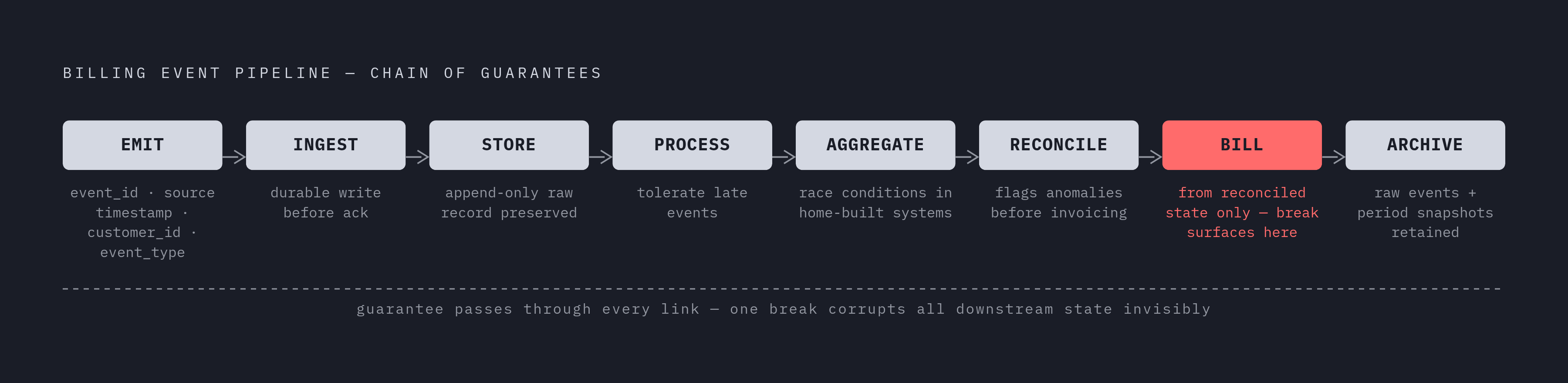
The canonical billing event flow moves data through the same stages: Emit, Ingest, Store, Process, Aggregate, Reconcile, Bill, and Archive, and each stage makes an implicit guarantee to the next, so breaking any one of those guarantees silently corrupts downstream billing state. That sequence is a useful mental map, but the map understates what's actually going on. Each stage hands a guarantee to the next one, and if that guarantee gets broken anywhere along the chain, the corruption becomes visible only downstream, often at invoice time, when it's hardest to trace back to its source.
Emit is where the event is born. At minimum, a well-formed billing event needs a stable event_id, a timestamp set at the source rather than at arrival, a customer_id or subscription_id, and an event_type. Skip any of these four fields and everything built on top of that event becomes suspect later.
Ingest is the handoff to the message broker: Kafka, Kinesis, or Pub/Sub. The broker has to accept the event durably before it acknowledges the producer. No acknowledgment without a durable write, full stop. Store follows immediately after: events land in an append-only store before any transformation touches them, which preserves the raw record for audit and for replay if something downstream needs to be recomputed.
Process is where billing logic actually runs: metering, rating, entitlement checks. This stage has to tolerate events that arrive late without corrupting a billing window that's already closed. Aggregate rolls events up into per-customer, per-period summaries, and it's the stage where home-built systems most often introduce race conditions under concurrent writes. Reconcile compares the aggregated usage against what the contract says should be there and flags anomalies before an invoice ever gets generated. Bill then generates invoices from that reconciled state, not by re-deriving totals from raw events at the last minute, because re-deriving at billing time just reopens every idempotency problem the pipeline was supposed to have already solved. Archive closes the loop, retaining raw events and period snapshots for whatever regulatory and contractual retention window applies.
Collapsing stages that were meant to stay separate is the mistake that shows up most often in practice: processing events the moment they're ingested, or re-aggregating everything again at bill time. Either shortcut erases the audit trail and makes replay after a pipeline failure effectively impossible.
Why asynchronous ingestion is non-negotiable
The first architectural decision, the one everything above depends on, is synchronous versus asynchronous processing. Querying a database to price every usage event the moment it arrives is the most common anti-pattern in early billing builds, and it's also the first thing that breaks once volume climbs.
AI workloads make the failure obvious fast. Token generation, API calls, and inference cycles fire at millisecond speed, and a synchronous design forces a database round-trip on every single one. That latency doesn't stay contained. It compounds across the system as throughput rises, until the billing path becomes the bottleneck for the entire product. Worse, a synchronous design ties the billing calculation directly to the product's hot path, so a slow billing database doesn't just produce a slow invoice. It produces a product outage.
Agentic AI raises the stakes further. IDC forecasts, cited in BetterCloud's analysis of the SaaS industry, project the population of actively deployed AI agents reaching enormous scale by 2029. An agent that executes thousands of discrete actions in a single session generates thousands of billing events in that same session, and a synchronous path simply cannot absorb that load without collapsing.
The fix is to decouple emission from processing. An event like event_type: 'ai_token_generated' gets pushed into a fast broker, Kafka, RabbitMQ, Kinesis, or Pub/Sub, the producer gets an immediate acknowledgment, and background workers handle the actual aggregation per tenant and per billing period on their own schedule. The timestamp stamped on that event has to reflect when it happened at the source, not when it showed up in the queue, or the billing period attribution will be wrong. Arrival time drifts under network delay, and if arrival time gets used to decide which billing period an event belongs to, the result is systematic under- or overbilling right at every period boundary.
If events sit in a queue before they're processed, billing state still has to reflect what a customer is doing right now. Async ingestion by itself doesn't answer that question. The stream processing layer does, and that's the subject of the next section.
How stream processing enables real-time billing state
Stream processing is what applies billing logic to events as they arrive off the broker, with stateful aggregation writing to a billing state store in well under a second, making real-time enforcement possible without ever forcing the ingestion path to slow down and wait.
What that unlocks is a short list of capabilities that batch billing simply cannot offer. Customers can watch their consumption in-flight rather than discovering it at invoice time, which directly addresses the kind of bill-shock scenario the Cursor incident put on public display. The system can fire a live alert, or block a request outright, the instant usage approaches or crosses a defined threshold. And when a customer's credit balance runs out, the billing state store reflects that almost immediately, so entitlement enforcement can stop the next request before it adds another dollar to the bill.
None of that is available to a batch system, because batch billing state runs hours or days behind actual consumption. That lag was tolerable when the product was a monthly seat subscription and nobody expected real-time visibility into anything. It's a structural mismatch for AI products, where a single runaway session can produce a five-figure charge before anyone downstream even knows it happened. The business consequence of that mismatch is already visible in how finance teams talk about their own AI bills: invoices that read more like utility statements than software subscriptions, with line items that are hard to trace back to any specific business activity. Spend caps, real-time alerting, entitlement enforcement, and customer-visible usage dashboards are the four components usage-based pricing requires that seat-based pricing never did, and all four depend on a billing state store that's current, not a snapshot from last night's batch job. Stream processing is the only architecture that keeps that store current without choking the ingestion path that feeds it.
The three failure modes that corrupt billing state even in well-designed async pipelines
Getting the architecture right, async ingestion plus stream processing, doesn't mean the pipeline is safe. Three failure modes will still corrupt billing state if nobody engineers against them explicitly: duplicate ingestion, clock skew, and stream loss during outages. Each one is subtle enough to pass code review and still produce a wrong invoice months later.
Duplicate ingestion is the most direct threat, because retries are a fact of life in any distributed system, and every retry is a potential duplicate event. The only real defense is idempotency: every billing event carries a stable event_id, and the processing layer uses it to catch and discard duplicates before they ever reach aggregation. That ID has to be generated at the source, not by the broker and not by the processor, and it has to stay the same across every retry attempt. Generate a fresh ID on each retry and the whole mechanism does nothing. In a billing context, a duplicate that slips past detection and reaches aggregation doesn't just skew a metric. It produces a double charge a customer will notice, dispute, and remember.
Clock skew is quieter but just as damaging. When ingestion nodes run on unsynchronized clocks, events from the same logical billing period can land in different aggregation windows depending on which node touched them. Some usage ends up counted in period N, the rest slips into period N+1: one period gets systematically underbilled and the next gets systematically overbilled. Fixing this requires using source-side timestamps rather than server-arrival timestamps and keeping clocks synchronized across every emitting service through NTP or an equivalent protocol. That's an operational discipline that has to be maintained continuously across every service that emits a billing event, not a code fix.
Stream loss during an outage is the blunt-force version of the same underlying risk. If the broker goes down, or an ingestion service loses connectivity mid-outage, whatever events were produced during that window are simply gone, and gone events mean missed charges that rarely get recovered later. The only real defense is durability at the source: producers buffer events locally in a durable write-ahead log or retry queue until the broker confirms receipt, rather than firing events off and hoping they land. Building that kind of durable producer takes considerably more engineering effort than wiring up a simple HTTP call to an ingestion endpoint, and it's one of the strongest arguments for buying billing infrastructure instead of building it from scratch, since durable producer SDKs are already a solved problem inside purpose-built platforms.
How idempotency and event ordering interact
Idempotency solves one problem: it stops a single event from being counted twice. It does nothing for a second, entirely separate problem, which is what happens when events arrive out of the order in which they actually occurred relative to a billing period boundary. Those are two different failure classes, and they need two different fixes.
Ordering failures bite hardest right at period boundaries. An event with a source timestamp that falls inside period N has to be attributed to period N even if it physically arrives after period N has already closed in the system. Getting this wrong undercharges the customer for a period whose books have already closed, and that revenue is often never recovered. This isn't a rare edge case under AI workloads. Network jitter, retry delays, and events arriving from multiple distributed producer nodes all introduce reordering routinely, and a naive aggregation window that simply closes on a fixed schedule will misclassify events every time this happens.
The standard architectural response is a watermark, a grace period during which the aggregation window stays open past its nominal boundary specifically to catch late-arriving events and attribute them correctly before the period finalizes. That grace period creates a real tradeoff: hold the window open longer and accuracy improves, but invoices take longer to generate; close it faster and invoices go out sooner, at the cost of a higher chance that late events get misattributed. Deciding how long that window should stay open is a product question as much as an engineering one, since it comes down to how quickly customers expect to see their invoice after a period ends.
A related wrinkle occurs when a customer's plan changes mid-period, a tier upgrade, a credit top-up, a commit adjustment. Events that straddle that change have to be rated against whichever plan version was actually in effect when they occurred. Process them out of order against the wrong plan version, and the resulting billing error often stays invisible until reconciliation catches it, which by then may be too late to fix cleanly.
Multi-dimensional pricing makes the aggregation problem significantly harder
Everything above assumes a product billing on one dimension. Most AI products don't. Tokens, GPU-minutes, voice minutes, API calls, storage GB-hours, hardware tiers: once a product prices across several of these at once, aggregating them stops scaling linearly, because each dimension needs its own metering logic, its own rating function, and its own aggregation state, and all of them still have to reconcile into one invoice at the end.
Each pricing dimension functions, in effect, as its own aggregation pipeline. It has its own event types, its own unit of measure, its own rate schedule, and often its own period semantics: some dimensions bill by the second, others by the day or the month. Running those pipelines separately and joining them only at invoice time opens up a consistency risk immediately. If the token pipeline and the GPU-minutes pipeline disagree about which billing period a given event belongs to, the resulting invoice is simply wrong. The more defensible approach is a unified aggregation model that handles arbitrary pricing dimensions in a single pass, which takes billing infrastructure purpose-built for multi-dimensional schemas rather than a generic stream processor bolted together with ad-hoc configuration.
Some companies now price across hundreds of distinct dimensions at once. No generic data pipeline configuration holds up at that level of complexity. It takes a system designed from the schema layer upward to absorb a new pricing dimension without a fresh round of engineering work every time product adds one.