On-Premises Billing Infrastructure for Enterprise Security Requirements
Regulated industries demand billing infrastructure they can physically control and audit.
Billing infrastructure is not a back-office convenience. For enterprises in healthcare, defense, financial services, and government contracting, where a billing platform runs, and who can physically touch the servers, has become a security and compliance question with real regulatory teeth. This piece walks through what that question actually demands, and how a buyer tells a genuine on-premises billing deployment from one that only looks like it on a slide.
Cloud-first has been the default posture for most enterprise software buying decisions for roughly a decade now. But that default is getting a harder look inside regulated industries, where legal and security teams are asking whether public cloud fits every workload, or just the convenient ones. Dropbox and 37signals have both pulled critical infrastructure back out of the public cloud, citing cost as the driver, Dropbox into colocation facilities, 37signals onto on-premises hardware. That matters here for a different reason: it shows that moving off shared cloud infrastructure is a considered, strategic decision made by technically sophisticated teams, not a fallback for companies that never modernized. For billing specifically, the question is what a piece of software that touches contract terms, consumption data, and revenue figures for every customer on the platform needs in order to meet enterprise security bars while living only in someone else's infrastructure. It's whether a piece of software that touches contract terms, consumption data, and revenue figures for every customer on the platform can meet enterprise security bars while living only in someone else's data center.
What the compliance frameworks require from software vendors handling billing data
Billing systems carry more sensitive material than most product teams give them credit for: pricing tiers, negotiated discounts, consumption patterns that reveal how a customer actually uses a product, and enough identity data to reconstruct a customer relationship end to end. That's exactly the kind of data GDPR, HIPAA, PCI DSS, and a growing list of sector-specific rules were written to govern.
GDPR fines run up to 4% of a company's global annual revenue, and the regulation applies to any vendor processing data belonging to EU residents regardless of where that vendor is headquartered. HIPAA backs its physical safeguard requirements for electronic protected health information with civil penalties up to $1.9 million per violation category per year, and those safeguards apply to vendor-deployed systems, not just the covered entity itself. PCI DSS non-compliance brings card network fines, higher transaction fees, and in bad enough cases, loss of the ability to process payments. The EU's Digital Operational Resilience Act now requires financial entities to manage risk from their ICT third parties directly, including cloud providers and data platforms, and financial services buyers increasingly cite DORA when they ask for on-premises deployment.
SOC 2 Type 2 isn't a law, but it functions like the answer key procurement teams check against before they'll even get on a call. Per Konfirmity's analysis of vendor audits, vendors without a clean SOC 2 report face sales cycles running 9 to 12 months, with the security review alone eating up 4 months or more. A clean report can cut that timeline by half or more. For an on-premises deployment, that report has to do more work: in a cloud-hosted SaaS arrangement, the vendor's certifications cover a meaningful chunk of the buyer's compliance burden. On-prem flips that. The buyer owns the physical stack, the network perimeter, and the application logic, and auditors assess the deployment accordingly, not the vendor's cloud posture. Billing platforms don't get a pass on any of this: billing events, invoices, and usage records need retention periods that satisfy the audit evidence requirements of whatever framework applies. Security questionnaires from Fortune 500 buyers for on-prem vendors commonly run into the hundreds of questions, sometimes past 800, covering physical security, disaster recovery, and hardware lifecycle. A billing vendor answers all of them or it doesn't get the deal.
How on-premises SOC 2 audits differ from cloud-hosted audits
In a cloud-hosted audit, physical security is largely inherited. A vendor can point to a major cloud infrastructure provider's own SOC 2 report to cover the data center layer, though the customer still has to address the Complementary User Entity Controls that sit on top of it. On-prem or colocation deployments remove that shortcut. The vendor has to show its own physical controls: biometric scanners and badge readers at entry points, mantraps, CCTV footage retained for a defined window (30 to 90 days is a typical range), locked server racks with restricted key access, visitor logs that actually match badge swipe records, and current fire suppression inspection paperwork. Perimeter firewalls and intrusion detection systems need documented change management behind every firewall rule change.
Auditors have a name for the failure mode here, informally: relying on a hardened perimeter while leaving what happens inside it unchecked. A locked server room with no documented entry log isn't a control, it's a coincidence. Auditors grade repeatable, documented process, not good intentions or a door that happens to lock.
The AICPA's five Trust Services Criteria all apply differently once the deployment moves on-prem. Security is the mandatory baseline: physical access, logical access, network perimeter, personnel procedures. Availability covers disaster recovery, hardware redundancy, and documented power and cooling. Processing Integrity governs the accuracy of billing calculations and event processing, which matters enormously for metered billing where a miscounted event becomes a wrong invoice line. Confidentiality covers encryption of billing records at rest and in transit, along with access controls on invoice data. Privacy covers how the system handles any personal data riding along in billing records, customer names, entity identifiers, consumption patterns tied to individuals. Asking a billing vendor for a SOC 2 Type 2 report is the right first move, but it isn't enough on its own. The report needs to cover the on-premises deployment model specifically. A SOC 2 written against the vendor's cloud-hosted product tells a buyer nothing about the version actually going inside their walls.
The security data point that frames the vendor selection decision
IBM's Cost of a Data Breach Report 2024 puts the global average cost of a breach at $4.88 million, and breaches involving data spread across multiple environments cost more and take longer to find. Billing infrastructure sits precisely at the boundary the report is describing: a system spanning the buyer's internal environment and external vendor dependencies.
A breach in a billing platform doesn't just leak revenue numbers. It exposes consumption patterns, contract terms, and pricing structures for every customer running through that platform at once, which is a wider blast radius than most single internal systems carry. That's the lens regulated buyers apply when they ask whether a vendor's on-prem option holds up as a fully audited, physically separate, customer-controlled deployment, or is a checkbox added to win a deal. Gartner's 2025 Magic Quadrant for SaaS Management Platforms found organizations that don't centrally manage their SaaS lifecycle are five times more likely to face a cyber incident or data loss, a finding that lands hard for enterprises already running hundreds of applications on average, approaching 700 at the largest companies according to SaaS management research. Nobody wants to add one more cloud-only vendor to that pile without a good reason.
Deployment architecture requirements for regulated industries' billing platforms
Data residency comes first. Billing data has to stay inside a defined jurisdiction, and a platform whose data plane only runs in US regions is disqualified from a lot of EU, defense, and government deals before anyone even opens the product. Network isolation matters just as much: the billing system needs to run inside the buyer's own network perimeter without a required outbound call back to the vendor's cloud control plane, since that call is itself an exfiltration path. Some defense and government environments go further and require full air-gapping: the billing platform has to function with no internet connectivity.
Encryption requirements stack up fast. Records need encryption at rest and in transit, and customer-managed encryption keys so the enterprise, not the vendor, holds the keys. Post-quantum cryptography is starting to show up as a real requirement for organizations retaining data long-term, a concern that's been circulating in the mainframe security world for a while now and is migrating into broader enterprise infrastructure conversations. Identity has to run through the buyer's existing provider, LDAP, Active Directory, or a standards-based single sign-on protocol, rather than forcing a separate login system just for billing. Every action inside the platform, ingesting a usage event, generating an invoice, changing a pricing rule, adjusting a credit wallet, needs to produce an immutable audit log that can satisfy SOC 2 Processing Integrity evidence requirements. Disaster recovery, including hardware redundancy and documented recovery time objectives, needs to be owned by the deploying organization directly instead of quietly delegated to a cloud provider somewhere upstream. Confidential computing, which encrypts data even while it's being processed rather than only at rest or in transit, is emerging as a requirement for AI workloads specifically, and security teams are starting to flag it as a near-term baseline for anyone handling sensitive data at scale.
Security surface area created by metered and usage-based billing compared to flat-rate billing
Flat-rate subscription billing is a light workload from a security standpoint. It processes a small, predictable number of events: a renewal each month, the occasional upgrade or cancellation. Metered billing for an AI product looks nothing like that. It ingests usage continuously, every token processed, every API call, every GPU-second, and in high-throughput deployments that volume can climb into the millions of events per second.
Every one of those events is a record that has to be stored, processed, and retained, and in a regulated deployment, kept inside the controlled environment the whole time. That means the security surface of a metered billing system scales with usage volume, not customer count. A single enterprise customer running a heavy AI workload can generate more billing events in a single day than a flat-rate platform processes across an entire year. The stakes go beyond billing accuracy, too: token-level usage logs can reveal what questions users are asking, which workflows are running, and how much capacity different departments are burning through, all of which may fall under a company's own data classification rules regardless of what the billing vendor thinks of it.
Because of that, on-prem deployment for metered billing can't stop at moving the billing engine into the customer's data center. The entire event ingestion pipeline, message brokering, stream processing, metering aggregation, and storage, has to run inside the controlled environment too. Credit wallet mechanics add one more wrinkle: real-time balance tracking and enforcement decisions have to be computed and stored inside the perimeter, since a wallet check that calls out to the vendor's cloud to decide whether to block usage defeats the point of deploying on-prem.
The architectural components a billing platform must bring on-premises, not just the application layer
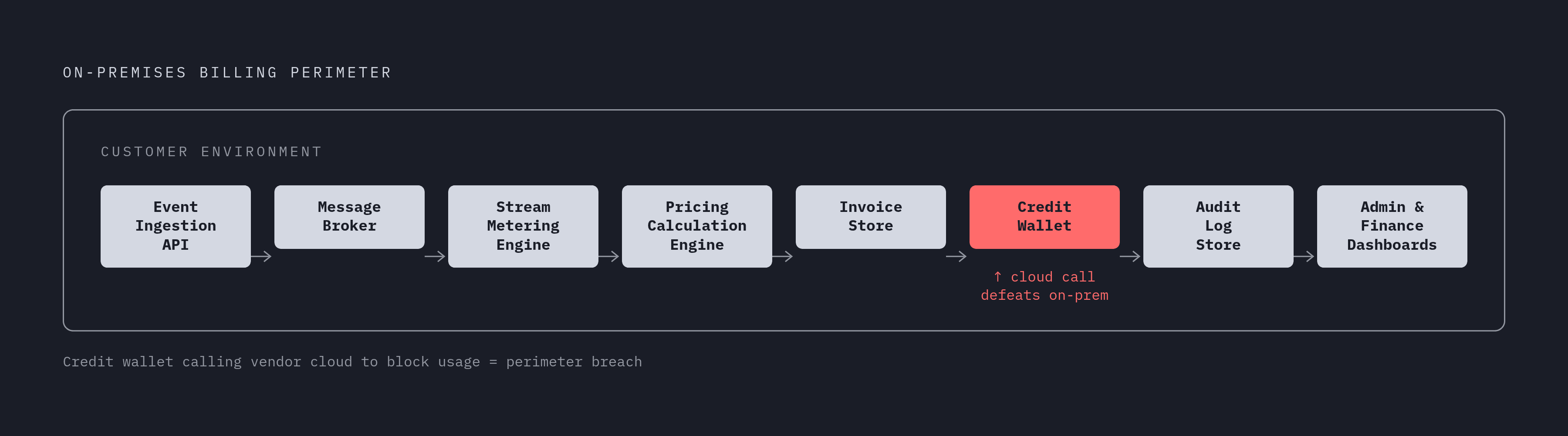
A platform that deploys only its application layer on-prem, while quietly routing usage events, metering calculations, or pricing logic through a cloud-hosted service, hasn't actually kept customer data within the customer's jurisdiction. It has moved the application layer customers can see and left the metering, pricing, and event logic that matters where it was.
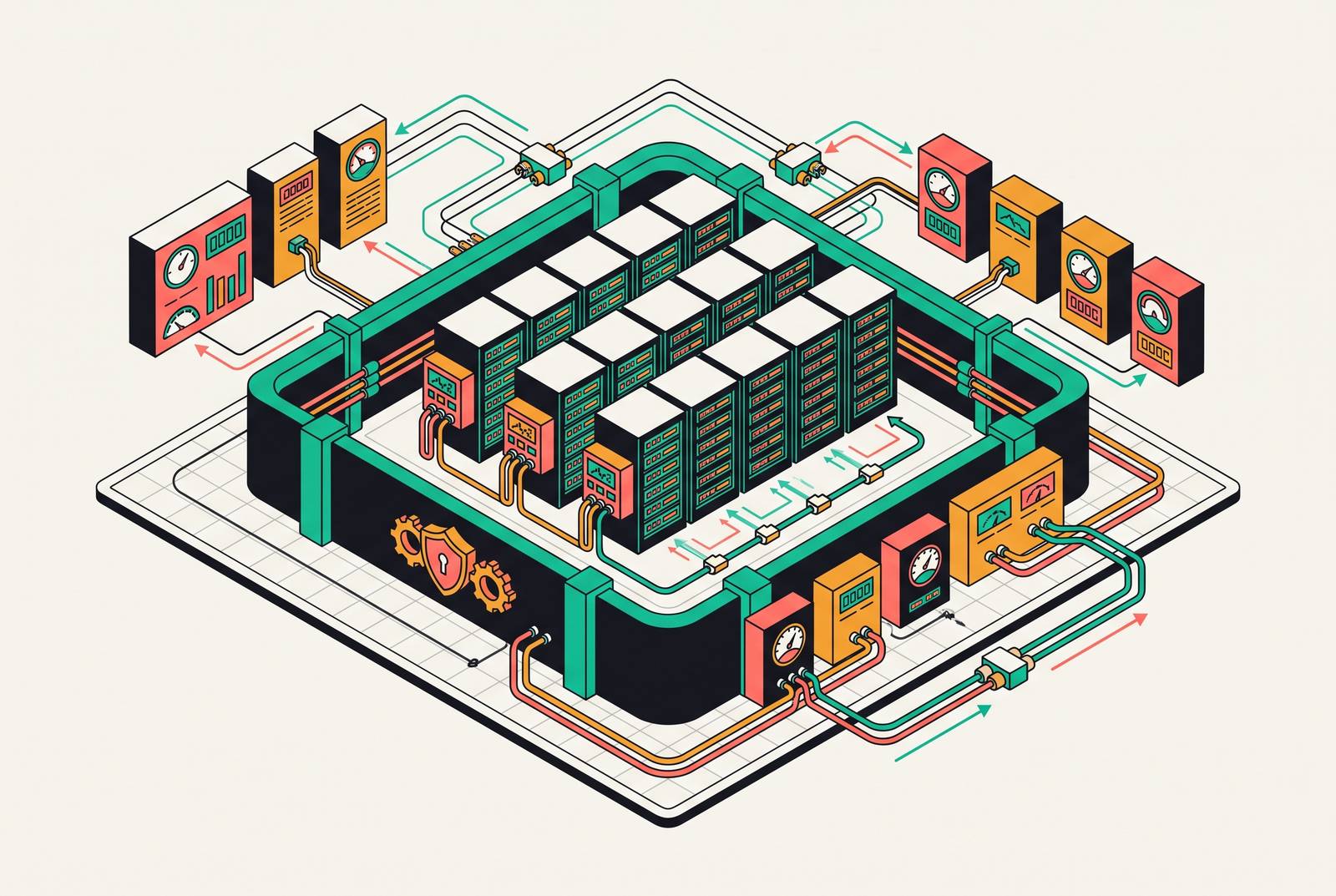
Several components need to run inside the customer's own environment for the deployment to count as genuinely on-prem. The event ingestion API, the endpoint that receives raw usage events from the customer's product, needs to be reachable on the private network without routing through the vendor's cloud. In high-throughput setups, a message broker (a Kafka-equivalent layer that buffers events, absorbs back-pressure, and allows replay) has to sit on-prem too, since it's holding raw, unprocessed usage data before anything has been aggregated. The stream processing and metering engine, which turns raw events into usage totals like token counts or GPU-minutes, belongs inside the perimeter for the same reason. So does the pricing calculation engine, which applies commercially sensitive pricing logic to that metered usage and produces the actual charges. Rendered invoices need to be stored on-prem, credit wallet balances need to live and update inside the perimeter since usage-blocking decisions depend on them in real time, and the audit log store recording every billing action needs to sit there as well to satisfy SOC 2 evidence requirements. Even the admin and finance dashboards matter: if those interfaces query a cloud-hosted data store behind the scenes, data is leaving the perimeter no matter how the deployment gets described in a sales deck.
The useful question for a buyer to ask a vendor directly: draw the architecture diagram, and mark which boxes sit inside the customer's environment versus which ones make outbound calls to the vendor's cloud. That diagram either shows a real on-prem deployment or it doesn't.
Interaction between on-prem deployment requirements, pricing agility, and finance team workflows
Security requirements alone don't solve the whole problem, because regulated enterprises still need to change prices, launch new packaging, and run finance operations without filing an engineering ticket every time. OpenView's SaaS Benchmarks found that 98% of SaaS companies change pricing at least once a year, and 55% say their current billing stack can't keep up with those changes efficiently. Regulated companies aren't exempt from that pressure just because their infrastructure is locked down.
The tension is straightforward: cloud-hosted billing platforms usually let a product manager change a pricing rule through a UI that talks to a cloud control plane in real time. On-prem deployments put that same pricing engine inside the security perimeter, where changes have to pass through a controlled change management process instead. A well-built on-prem billing platform handles this by separating the pricing configuration layer, an admin interface finance and product teams can use directly inside the controlled environment, from the core event processing pipeline, so a pricing update doesn't force a redeployment of the metering infrastructure underneath it. Pricing rule versions need audit trails so every change is logged and attributable, which SOC 2's Change Management criteria require anyway. Invoice generation, revenue recognition exports, and usage reporting all need to be available inside the on-prem environment too, since regulated enterprises can't route that data out through a cloud-hosted reporting layer just because it's more convenient. Customers selling AI products to their own regulated customers face a related problem: those end customers want to see their usage in-flight, so the usage dashboard or API needs to run on-prem as well, not through a vendor-hosted portal that ships consumption data back out to the vendor's cloud in the process.
Evaluating whether a billing platform's on-prem option is genuine or a feature checkbox
Most billing platforms were built cloud-first, with on-prem bolted on later once enough enterprise deals demanded it. The architecture reflects that history. A platform designed from day one for cloud-only deployment tends to have cloud dependencies baked into the metering engine, the pricing calculation service, and the event pipeline, places that are hard to remove afterward. Retrofitting those pieces to run on-prem is possible, but it's a different engineering effort than designing for it from the start, and buyers can usually tell the difference once they ask for the architecture diagram.
The signals to check are concrete. Does the vendor's SOC 2 report explicitly cover the on-premises deployment, or only the cloud product. Does the event ingestion pipeline, not just the application UI, run inside the customer's environment. Can pricing changes happen without an outbound call to the vendor's cloud. Is credit wallet enforcement computed locally or does it depend on a round trip somewhere else. A vendor that answers those questions with a clear diagram and a report that names the on-prem deployment specifically has built something real. A vendor that answers with marketing language about flexibility and hybrid architecture, without naming which components actually stay inside the perimeter, is offering a checkbox dressed up as a deployment option. For a regulated enterprise, that distinction is the whole evaluation.