Consumption-Based Pricing vs Subscription Pricing in SaaS
Hybrid pricing lets SaaS companies balance predictability with usage-based growth.

Consumption-based pricing and subscription pricing meet different needs in SaaS. The choice is not which model wins, but which revenue, customer, and operating tradeoffs a business is prepared to own. For most modern SaaS products, that points toward a hybrid, provided the billing infrastructure can support fixed commitments and variable usage together.
Why the subscription-vs-consumption debate is the wrong frame
The market has moved beyond the binary comparison. Usage-based adoption has grown sharply since 2023, with consumption charges largely layered onto subscriptions. Hybrid pricing is now the dominant structure in SaaS. That changes the decision from choosing one model to determining which parts of a product belong under each.
Popularity alone does not settle that design question. A combination must fit the product’s economics, the buyer’s planning process, and the vendor’s ability to bill it.
What each model is actually solving for
Subscription pricing solves for predictability on both sides. The vendor gets fixed recurring revenue, and the buyer knows how much it has agreed to spend. Negotiating leverage concentrates at renewal, when the parties can revisit the commitment. The commercial agreement anchors payment to access.
Consumption pricing instead solves for alignment between payment and use. A buyer can start with a small commitment, and revenue expands as usage grows without a commercial renegotiation. Expansion becomes part of the pricing mechanism itself. This supports land-and-expand motions because customers do not need to commit to their eventual scale at the outset.
Value-based pricing takes that logic a step further. It charges for a business result. Intercom's Fin, Zendesk, and Salesforce Agentforce Help Agent illustrate this approach through charges per resolved ticket. Sierra AI charges primarily for successful resolutions without human intervention, with contracts typically also including a per-conversation rate for low-value interactions and a platform fee. Understanding these purposes establishes the options, but the tradeoffs determine which option fits.
The real tradeoffs vendors accept when they choose consumption pricing
Net revenue retention is structurally higher under usage-based and hybrid models because customers who use more pay more without a seat-count renegotiation. That mechanism also exposes revenue to changes in consumption, making forecasts less dependable than fixed recurring commitments.
Enterprise planning adds to that uncertainty because annual budgets are based on fixed entitlements. Finance teams must manage the gap between what customers budgeted and what they actually ran. Revenue alignment therefore introduces a forecasting burden of its own. Vendors gain a direct link to growth while accepting the variability that comes with it.
Transitions concentrate a separate set of go-to-market risks. HubSpot's shift to AI agent per-resolution pricing helped drive a large stock drop in a single day in 2026, showing that the risks include how the change is carried out as well as the pricing logic itself. Subscription billing barely touches the product, but consumption billing needs API instrumentation, event pipelines, and real-time quota enforcement. Engineering becomes part of the revenue process.
The real tradeoffs buyers accept when their vendors move to consumption pricing
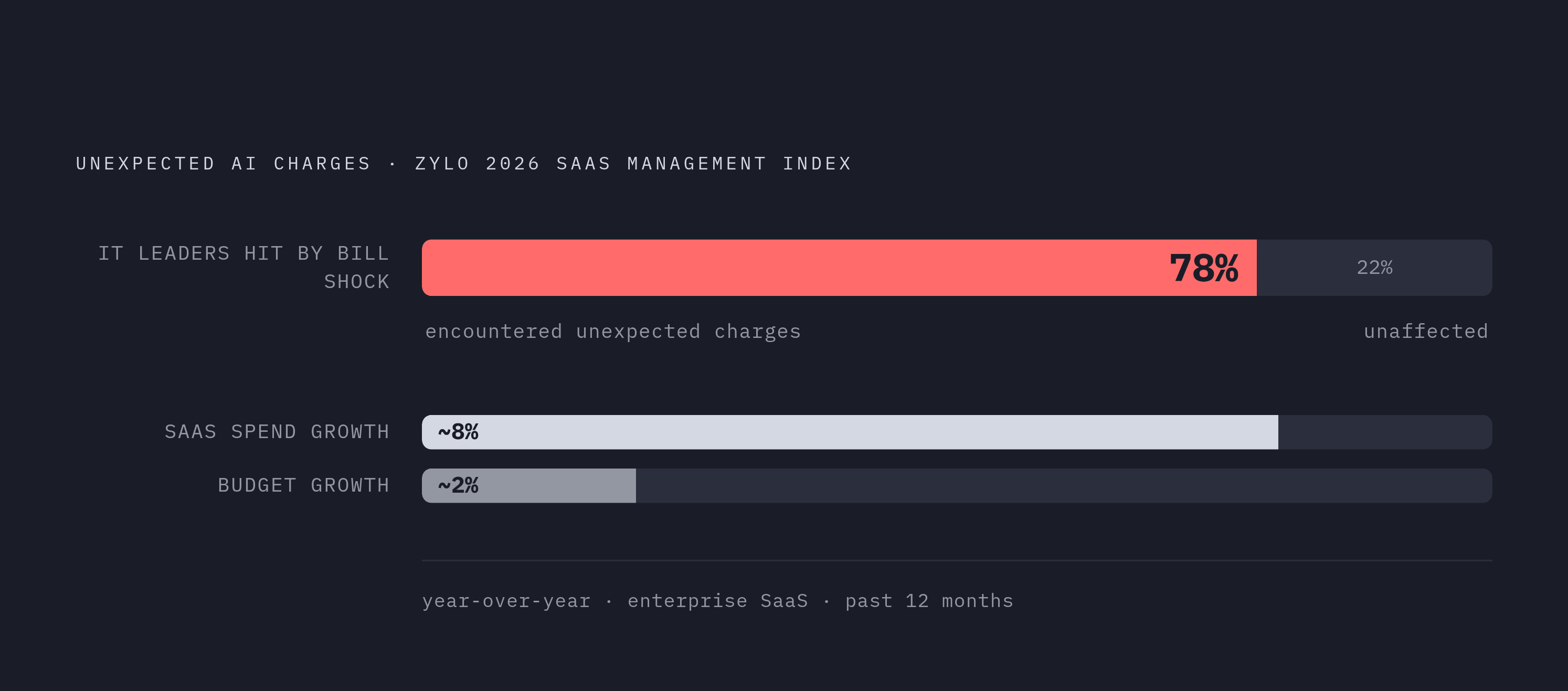
Buyers can accept usage-based economics and still struggle to budget for them. Zylo's 2026 SaaS Management Index found that 78% of IT leaders encountered unexpected charges linked to AI or consumption features in the past twelve months. The same report found that enterprise SaaS spend rose nearly eight percent in a single year while IT budgets grew a fraction of that. Vendors monetizing AI features and adding consumption charges to existing subscriptions drove that increase. The planning gap is already visible at enterprise scale.
Lower unit prices do not necessarily close that gap. Even as per-unit AI costs fell sharply, total AI spending grew dramatically because volume expansion outpaced price deflation. A budget therefore needs forecasts of both how much activity the product will generate and what each unit costs.
For vendors, that difficulty is a retention concern. Buyers ask for usage floors, caps, rolling usage reports, and real-time spend visibility because those controls make variable charges manageable. A consumption dashboard is consequently more than a way to reduce billing questions. Without it, customers discover their exposure only through charges they did not anticipate.
Why AI products specifically cannot be priced on subscriptions alone
AI breaks the assumption that value scales with users. A product can perform more work without adding seats, while each inference or agent run incurs a real marginal processing cost. Those costs are high, and economies of scale at the feature level are limited and hard-won. A flat subscription does not recover incremental costs as execution grows. At the same time, seat-based pricing can leave additional value unpriced precisely when the product becomes more useful.
Prepaid credit wallets have surged as an intermediate solution. They let buyers commit to a spend floor while actual consumption is metered against that commitment. The wallet creates a budget anchor without removing the variable revenue component. It addresses the budget-shock problem of pure consumption while preserving a charge for execution.
Outcome pricing pushes beyond execution to the result achieved. Fin and Sierra charge per resolved ticket in AI customer service, and outcome pricing can also charge for converted leads and completed automated workflows. Outcome pricing requires attribution infrastructure that most billing platforms cannot support today, because the invoice depends on identifying a qualified business result.
How hybrid pricing actually works in practice
The base subscription prices access and establishes a revenue floor, while a metered layer charges for API calls, compute credits, AI agent resolutions, or tokens. Seats can still be part of the access layer without being the only measure of value. The structure separates the right to use a product from the amount of work it performs.
The 2026 SaaS Pricing Trends research report identifies three emerging AI monetization patterns. Feature-gating reserves AI capabilities for higher tiers, creating an upsell path from the subscription base. Token or credit add-ons add consumption credits to that base, with the credits sold and metered on their own. Outcome pricing charges per qualified result and requires attribution to avoid invoice disputes.
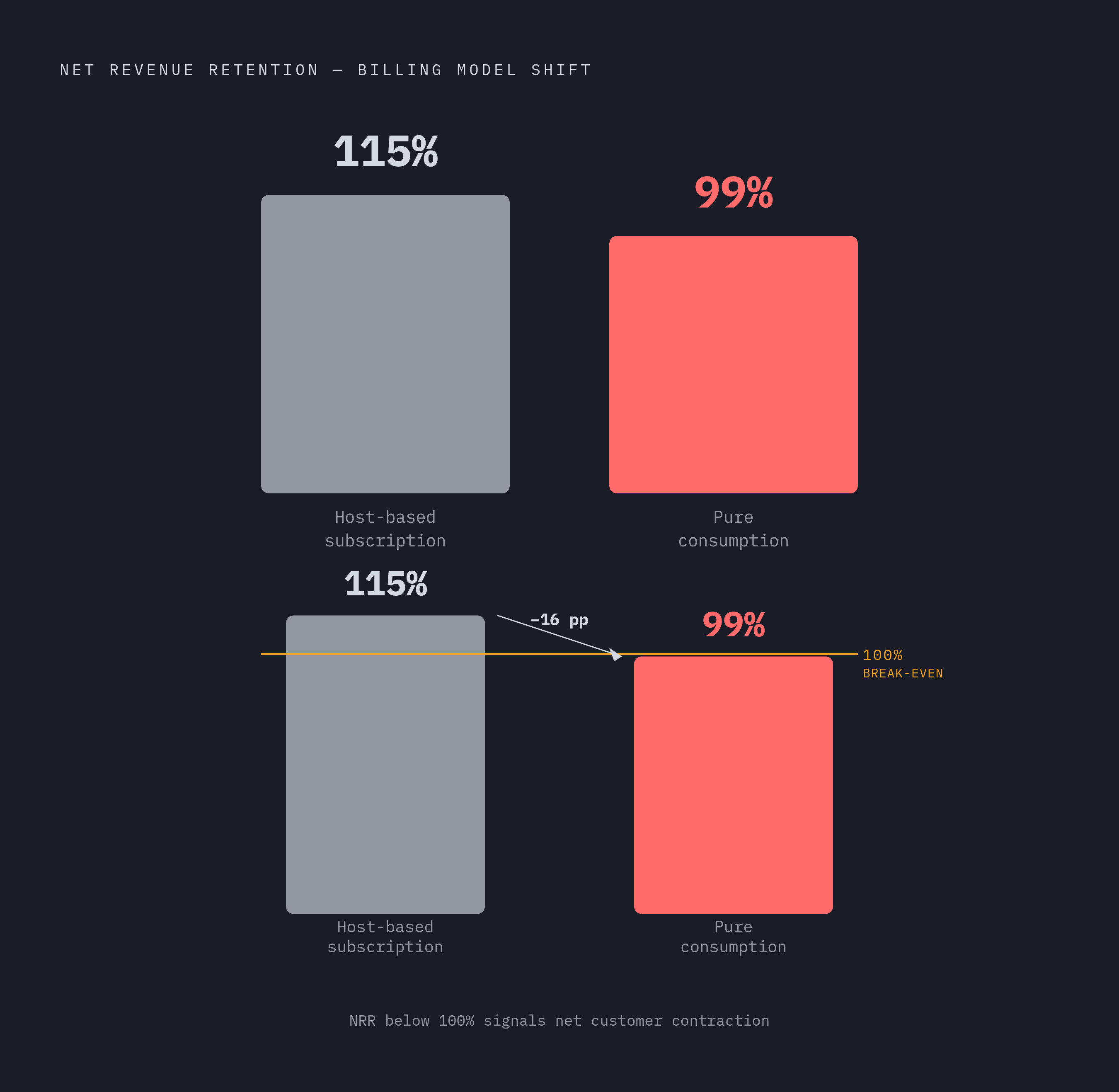
Sierra’s platform fee, successful-resolution charges, and per-conversation rates illustrate how several dimensions can coexist in a contract. Pure consumption has no such fixed fee, which changes the risks. New Relic moved from host-based subscriptions to pure consumption billing and saw net revenue retention fall from ~115% to ~99%, before subsequently being taken private for $6.5B. That sequence does not establish that the pricing change caused every subsequent outcome.
How to decide which model — or blend — fits your product
The decision should begin with how the product delivers value. If value scales linearly with users, as in collaboration tools and seat-licensed productivity software, subscription-primary pricing fits that relationship. It also fits buyers whose procurement and finance rules call for fixed annual commitments, including those in heavily regulated industries. A top-down enterprise sales motion strengthens this case when predictable ARR is a commercial requirement. Here, predictability is part of what the agreement provides.
Consumption-primary pricing fits a different set of conditions. If usage varies sharply across customers or over time, as with API platforms, data pipelines, and AI inference, a fixed access fee may poorly represent the work delivered. When marginal costs are high enough to matter, there is more reason to charge for use. A product-led growth motion also works best when it is easy to start, so buyers can learn how much they use before making a larger commitment. Pure consumption is most plausible when value is clearly metered and customers are sophisticated enough to manage it.
Hybrid fits products where access stays the same but the amount of work they do varies. That describes the majority of modern SaaS products, where users, seats, or environments coexist with AI runs, API calls, or compute. It also accommodates enterprise buyers seeking a commitment floor and product-led buyers seeking a small starting point. The strongest objection is operational: sales must quote the charges that vary, finance must forecast the revenue that varies, and billing must handle both. The response is infrastructure that hides this complexity from customers, rather than a simpler price that misrepresents the product.
What migrating between models actually costs and how to do it safely
Introduce it for new signups first and keep existing customers on their current plans. At renewal, add a usage component to the existing subscription with an included allowance sized so average users see no bill change. This sequence limits disruption to established commitments.
The redesign and the implementation have different scopes. A focused hybrid pricing redesign that includes choosing a metric, designing the pricing structure, financial modeling, and a pilot launch usually takes six to ten weeks. Full implementation, including metering infrastructure, billing integration, revenue recognition updates, and sales enablement, usually runs eight to sixteen weeks. The work extends beyond publishing a new price. Sales motion, accounting treatment, and customer trust all depend on the transition being sequenced correctly.
Revenue recognition is a less visible implementation cost. Consumption models need systems that process large numbers of transactions, lengthy negotiations over custom contracts with ramps and commitments, and detailed audit trails to comply with ASC 606 and IFRS 15. These needs must be part of the implementation plan before billing begins. A working usage meter alone does not complete the migration.
Why billing infrastructure is what makes or breaks hybrid pricing in practice
Hybrid pricing often fails because infrastructure built for subscriptions cannot handle it. Most legacy platforms cannot count usage, model multiple pricing dimensions, and run prepaid and postpaid mechanics on one engine. Pricing logic must operate against aggregated usage counts while preserving the fixed commitments in the same agreement.
A metered architecture should be asynchronous and event-driven for decisions that do not need an immediate response. Synchronous processing belongs where real-time quota enforcement or a credit balance check requires it, within a tight latency budget. Purpose-built platforms handle late-arrival windows, deduplication, and multi-currency conversion out of the box. That scope supports significantly faster integration than custom builds. It also places usage processing within the billing system rather than leaving it as a separate engineering project.
Prepaid wallets and postpaid invoices must work together. AI and enterprise products often need both, and using separate systems adds work to reconcile them. This architecture also needs usage dashboards and budget alerts for customers, because seeing spend as it happens helps prevent bill shock, churn, and support costs. Those costs can dwarf the billing platform’s price.
Financial services, healthcare, and the public sector require on-premises or sovereign cloud deployment, data residency compliance, and signed data processing agreements. A hosted-only platform can be disqualified at the RFP stage before pricing capabilities are evaluated. Purpose-built usage billing addresses the combined requirement through a single system that ingests events at scale, models pricing dimensions, supports prepaid and postpaid mechanics, and runs where the customer’s infrastructure runs.