Dynamic Pricing Rules for AI Inference Workloads
Inference costs vary by model, time, and token count—not a flat rate.

AI inference costs money in a way that has nothing to do with how software used to be priced. A GPU cycle spent on a 70-billion-parameter model at 2am costs a fraction of what the same call costs at noon on a frontier model under peak load, and no flat per-seat fee captures that swing. Dynamic pricing rules let a company charge for what a request actually costs to serve, adjusting on the fly instead of leaning on an average that may not hold for a full quarter.
Inference draws on GPU cycles, memory bandwidth, and model weights one request at a time. That's a different kind of consumption than a seat license or a server slot rented by the month, and the price of that draw moves depending on which model answered, how many tokens went in and out, whether the response streamed back live or sat in a batch queue, and what the cluster looked like the moment the request landed. Training a model is a cost you pay once and set aside; inference scales with every user call, which is why it now eats the majority of production AI compute spend, and why gross margins at inference-heavy companies sit well below what SaaS vendors got used to over the last decade.
Here's the part pricing teams can't wave away. Per-token costs have dropped sharply as model providers compete and chips get faster, yet total inference bills at most companies keep climbing anyway, because usage grows faster than the cost curve falls. Some people call this "LLMflation." Whatever the name, a flat-rate model eats all the volume risk, with no lever for model choice, token count, latency, or time of day.
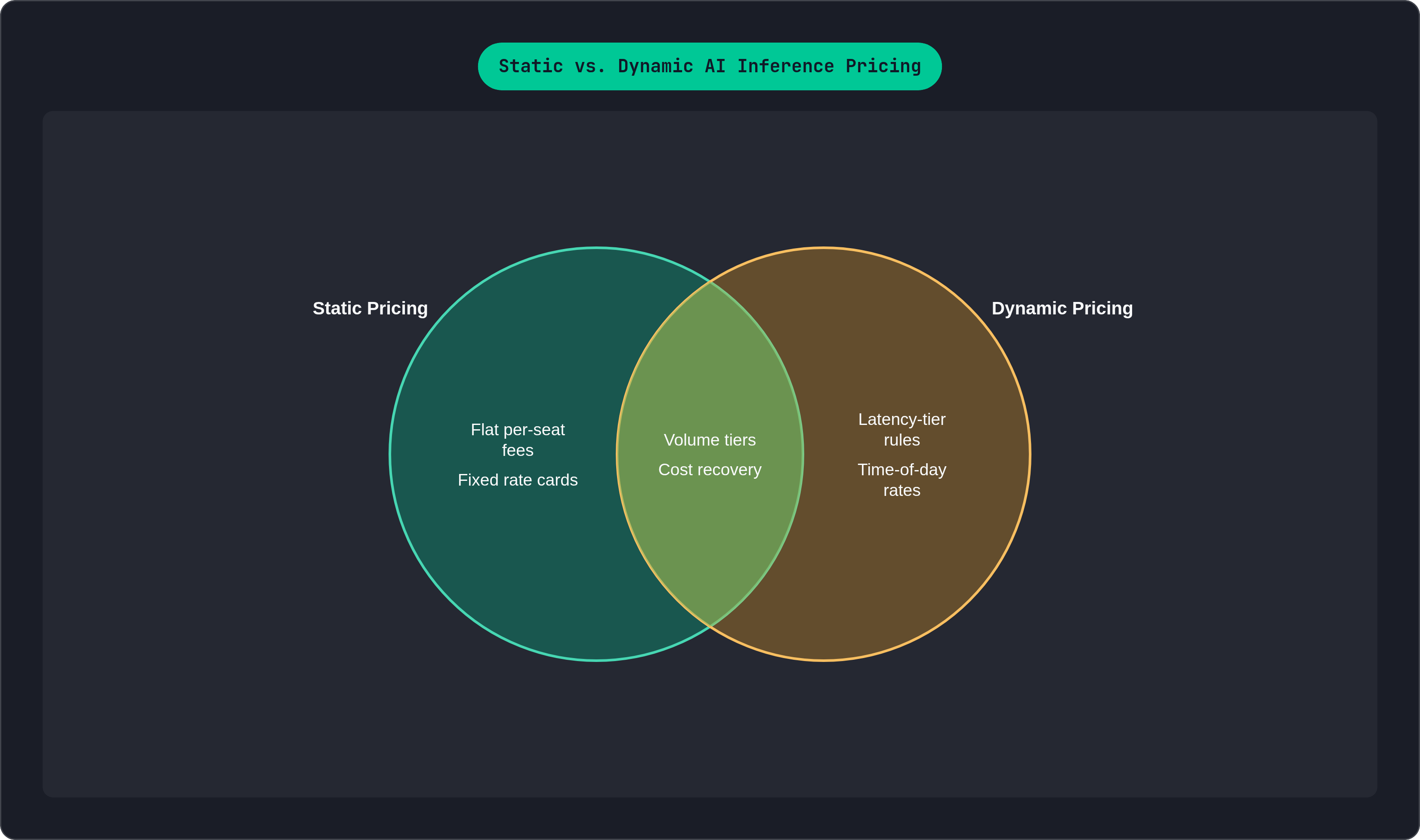
Strip a dynamic pricing rule down and it's a conditional layer sitting between a raw metered event and the dollar figure that lands on an invoice: if X is true about this request, charge rate Y. The complexity lives in how many things X can be. For inference that list runs long: model, input and output token counts, cached tokens (which cost less to serve and should bill less), latency class, plan tier, time of day, and how much the customer has already burned through that period, since crossing a volume threshold can flip the rate mid-cycle. A static rule has one input, quantity, and one rate. It can't touch any of that.
The goal is accurate cost recovery and a bill the customer can actually read, so complexity for its own sake works against the point. Credit-based pricing handles that tension well: credits act as a layer of indirection, so a platform can apply different internal conversion rates to different request types without making the customer learn raw GPU pricing. The customer sees "this action costs 40 credits," and whatever sits underneath that number can shift without anyone noticing.
Here's a gap worth naming: call a pricing model "dynamic" while an engineer still has to open a pull request and ship a deploy every time a rate changes, and you've built something closer to a static model with extra paperwork.
The metering foundation that dynamic rules depend on
A pricing rule is only as good as the event feeding it. Hand it bad data and it produces a confident, precise, wrong number every time, no matter how well the rule itself was written.
A production inference metering pipeline needs four pieces working together. Event capture grabs token counts, model IDs, latency class, and request metadata the moment inference happens, not reconstructed later from logs. Normalization takes the different event shapes coming out of different model providers and forces them into one consistent billable unit. Rating applies the right rule to each normalized event based on its attributes, and aggregation rolls those rated events into period totals for invoices, dashboards, and enforcement checks.
Inference pipelines run asynchronously, and that creates a real headache: a response can finish and get logged before its own retry does, so the metering system has to handle events arriving out of order without double-counting or dropping anything. Deduplication isn't optional. Skip idempotent ingestion and a retried request produces a duplicate charge, and duplicate charges are one of the most common sources of billing disputes once a platform gets past its first few dozen customers.
Cached tokens deserve their own paragraph. A repeated prompt prefix hitting a cache costs meaningfully less to serve than a cold token, and a metering layer blind to that difference can't pass the savings through, no matter what the pricing rule wants to do.
Then there's the burst problem. AI agents and batch jobs produce spiky, unevenly spaced traffic, quite different from the smooth rhythm of a SaaS renewal cycle. An ingestion layer built for gentle traffic falls behind under that load, and stale state at the enforcement layer means customers blow past their limits before anyone notices. Flexprice built its metering setup around this exact traffic shape: entitlement checks at sub-50ms P99 latency, billions of API events processed a month, SDK-based ingestion that batches events client-side so one traffic spike doesn't take the whole pipeline down with it.
Designing rules for the three main inference pricing constructs
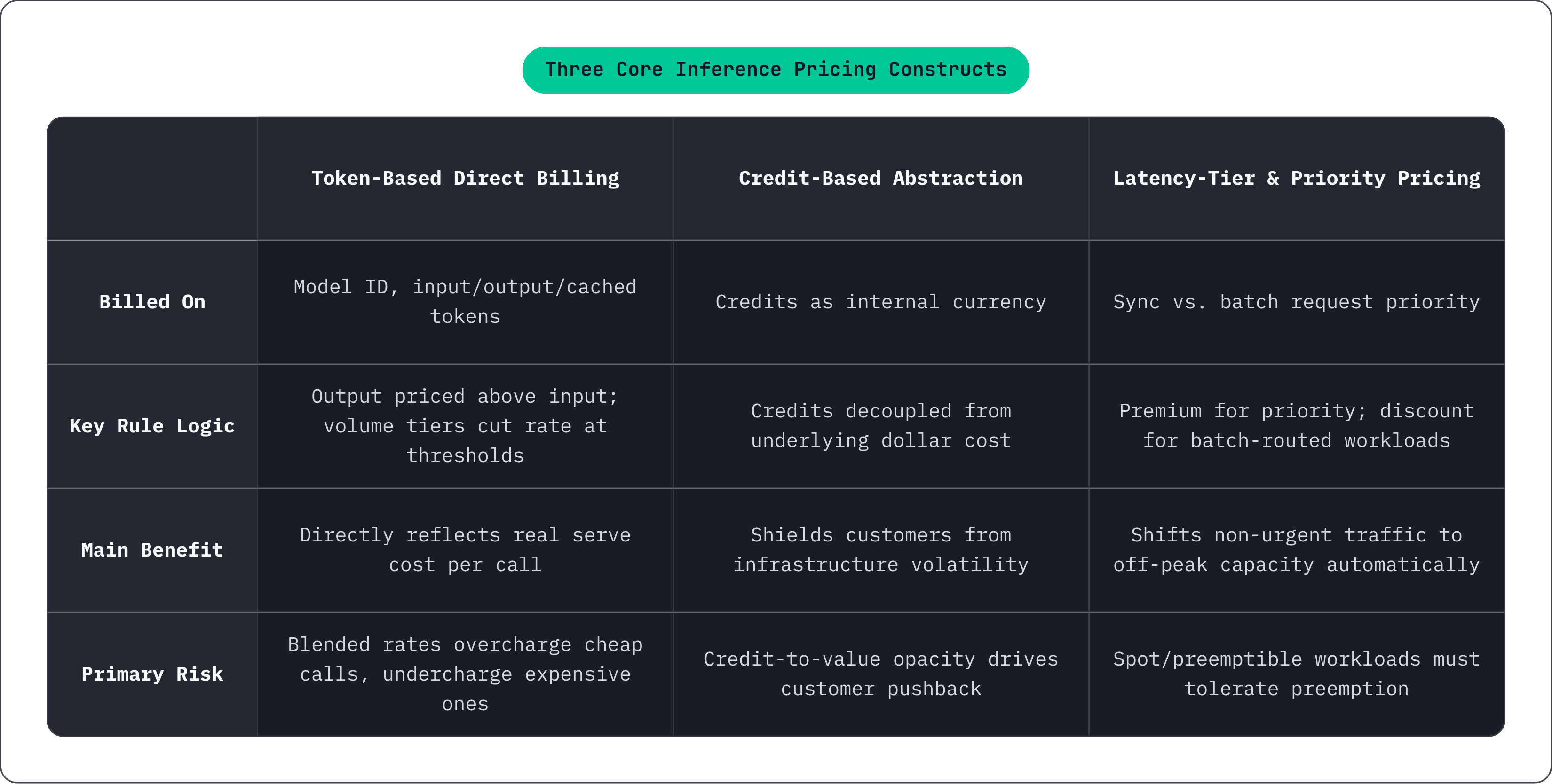
Most production AI pricing falls into one of three shapes.
Token-based direct billing prices off model ID, input tokens, output tokens, and cached tokens, usually with output priced above input, since generating text costs more than reading a prompt, and cached tokens priced lowest or free. Volume tiers cut the per-token rate once a customer crosses a consumption threshold within the billing period, rewarding heavy usage while still protecting margin on small new accounts. Model-switching logic matters too: a customer calling a frontier model and a cheaper, smaller model in the same period needs each call billed against its own rate card, not a blended average that overcharges the cheap calls and undercharges the expensive ones.
Credit-based abstraction turns credits into their own currency. The rule sets how many credits a given request type costs, and that figure is decoupled from whatever the underlying dollar cost is doing at any given moment. Customers prepay in credits, watch the balance tick down, and never see the infrastructure volatility underneath. Credit pools raise their own set of rule questions, and there's no clean default answer to any of them: shared across a team or allotted per seat, hard-gated when exhausted or allowed to overdraft up to a cap, expiring at period end or rolling forward. Credit fatigue is a real risk as more vendors lean on this model. When the credit-to-value mapping isn't obvious, customers push back, and they push back loudly.
Latency-tier and priority pricing reflects a real cost difference: synchronous, low-latency inference for user-facing features costs more to serve than a request sitting in a batch queue. A tiered rule charges a premium for priority-flagged requests and a discount for batch-routed ones, which shifts non-urgent workloads to off-peak capacity on its own, no manual scheduling needed. Spot pricing pushes this further, offering a materially lower rate for workloads that can tolerate preemption, since spot and preemptible GPU capacity cuts infrastructure cost substantially. Letting customers pick their own tradeoff here does double duty: it's pricing design and capacity planning at once.
How entitlement enforcement connects rules to real-time customer experience
A pricing rule evaluated only at invoice time can only report an overage after the damage is done. Enforcement has to happen at request time, before the inference call goes out the door.
The decision sits right before dispatch: does the customer have entitlement left, whether that's a credit balance, a tier limit, or a rate limit, and based on that, does the request go through, get throttled, or get rejected? The catch is latency. An enforcement check that adds any real delay to a live inference call isn't viable for a user-facing product, so the check has to resolve from a local cache rather than a round-trip to some database elsewhere in the stack.
What happens when entitlement runs dry is itself a rule, and it should be configurable, not hardcoded. A hard block fails the request outright. A soft cap lets it through but fires an alert to customer and operator. Metered overage lets it through and bills the difference at a set rate. Graceful degradation reroutes the request to a cheaper model or a lower-priority queue instead of cutting the customer off cold. None of these options is universally right; the correct choice depends on the plan tier and how much trust has been built with that particular customer.
There's also the question of what happens when the entitlement service itself falls over. Enforcement has to fall back to cached state with some tolerance for staleness, and whether that fallback fails open or fails closed is a business call, not an engineering afterthought. This same enforcement layer is where customer-defined budget caps live, and letting an enterprise buyer set their own hard spending ceiling is about the most direct answer available to the cost-forecasting anxiety that keeps AI procurement deals stuck in legal review for months.
Structuring pricing rules to manage customer spend anxiety without capping revenue
Spend anxiety kills more AI deals than pricing complexity does. A buyer who can't model their worst-case monthly bill either walks away from the proposal or demands a flat fee that quietly shifts all the margin risk back onto the vendor.
Separate access from consumption, so the customer always knows their floor cost, and give them controls over their ceiling. A committed baseline plus overage gives the customer a defined usage volume inside their subscription and a defined rate for anything past it, so they know the minimum and can reasonably estimate the maximum. Customer-defined spend caps, enforced by the platform rather than policed by a support rep watching dashboards, let the customer set their own hard monthly limit. Threshold notifications warn a customer once they've burned through a set fraction of budget, giving them time to adjust before the invoice arrives instead of after. Volume discounts tied to forward commitment convert the customer's usage uncertainty into revenue the vendor can actually plan around.
The hybrid model, a flat subscription for access and seats plus usage-based or credit-based billing for the AI consumption itself, has become the dominant pattern among mid-to-large AI companies for exactly this reason. It gives the buyer a predictable floor and gives the vendor a lever that scales with real infrastructure cost.
Customers who can see exactly which rule applied to each request, which model rate, which tier, which credit conversion, dispute invoices far less often than customers handed a single number with no breakdown behind it. Transparency at the rule level keeps finance teams from opening a support ticket every billing cycle, and it costs less to build than most engineering teams assume.
Keeping rules in sync with inference cost changes over time
Inference unit costs don't sit still. Model providers reprice often, new models show up and undercut the old ones overnight, and hardware cost curves keep shifting under everyone's feet. A rule set that's accurate at launch drifts out of line with real infrastructure cost within months, not years.
Across AI and SaaS broadly, repricing now happens on a cycle measured in months. Companies still treating pricing as something to revisit once a year at a planning offsite are, by definition, already behind. When inference costs shift, a few things need to move together: the per-token or per-credit rate for every model in the catalog, the volume tier breakpoints (a drop in unit cost can leave old thresholds over-discounting your highest-volume customers), and the latency premium between priority and batch rates, which compresses as batch infrastructure gets faster.
The real bottleneck is usually organizational, not technical. If updating a rate requires an engineer to write code, get a review, and ship a deploy, the team updates it rarely, out of sheer friction, even when the business case is obvious to everyone in the room. The rule configuration layer needs to sit apart from application code so product and finance can make the change directly, without waiting on an engineering sprint that has three other priorities ahead of it. Companies that test pricing changes systematically, running different rules against different customer cohorts, see meaningfully better revenue outcomes than companies that set a rate once and walk away.
Most AI companies that launched with usage-based pricing have already changed the model at least once, and that fact alone says something: treat the first rule set you ship as a draft, not a finished product.
What a production-ready dynamic pricing rule system looks like end to end
A handful of pieces have to work together here, and none of them can be weak without the whole system breaking somewhere downstream, usually at the worst possible moment.
Event ingestion has to capture inference events at high throughput without duplication, carrying model ID, token counts, latency class, and customer context, with SDK-based batching that survives a burst instead of buckling under it. Normalization and enrichment translate those raw events into consistent billable units, resolve model aliases, and attach plan and segment context from the customer record. The rule evaluation engine applies the right rate card based on event attributes, handles the conditional logic for volume tiers and credit conversions and time-based rates, and produces a rated event with an audit trail showing exactly which rule fired and why.
Entitlement enforcement runs low-latency balance and limit checks against current customer state, with enforcement behavior configurable by plan tier and spend controls visible to the customer directly. Invoicing and reporting aggregate the rated events into invoices broken down by model, latency class, and time period, handing finance clean numbers without a manual reconciliation step at the end of the month.
Building all this from scratch takes months of dedicated engineering work, and the work doesn't stop once the system ships. It turns into a permanent on-call obligation, because every one of these components has failure modes that only surface under real production load. Teams building in-house consistently underestimate a handful of specific things: deduplication edge cases that only show up at high event volume, rule correctness when a customer switches plans mid-cycle, enforcement latency once the entitlement service is actually under load, and the reconciliation headaches that show up when event timestamps don't line up cleanly with billing periods.
Building this infrastructure well means the engineers who understand the product spend their hours on the product, not on a billing pipeline that was never the company's actual business.