consumption-based billing platforms that support agentic and credit-based pricing models
Credit-based systems are winning, but platforms must support migration to outcome-based pricing.

Consumption-based billing means the invoice reflects what a customer actually used, rather than a fixed entitlement bought in advance. Three variants dominate the AI landscape right now, and I've watched each one solve a different problem for a different kind of buyer, usually after the first approach fails somebody.
Per-event or per-token billing charges for the raw unit: API calls, tokens processed, individual agent actions. It's a transparent option, and, frustratingly, a hard one for a finance team to forecast, because almost nobody outside engineering has a gut feel for what a thousand tokens actually buys. Credit-based billing sits a layer above that. Customers prepay into a balance, complex tasks burn more credits than simple ones, and whatever the vendor meters underneath, tokens, compute-seconds, GPU-minutes, gets abstracted into a unit a finance person can actually hold in their head. Outcome-based billing goes further, charging per resolution or per verified result. Intercom's $0.99 charge per resolved support ticket is the example everyone reaches for, and for good reason: it ties the invoice directly to value delivered. It's also the hardest of the three to meter, because "resolved" has to be defined, verified, and defended against disputes, and disputes come.
Credit-based pricing is the one moving fastest. It roughly doubled year-over-year in 2025, and most SaaS vendors adding generative AI features have already bolted some version of a hybrid credit model onto their product. Credits became the default on-ramp because raw token costs mean little to a buyer, while a balance that visibly ticks down as work gets done is something finance can budget against. I'd add that this is less a design choice than a translation problem: engineers think in tokens, buyers think in dollars, and credits are the currency conversion.
Here's the part that actually matters for anyone picking infrastructure this year. Most teams treat credits as a waypoint on the way toward something else, and the industry keeps drifting toward outcome-based pricing as metering and verification get good enough to support it without embarrassing anyone in front of a customer. So the platform a company picks today has to support that migration rather than lock the business into a credit model permanently. What's emerging in practice is a three-layer setup: a base platform fee, an AI consumption metric stacked on top, and a value-aligned packaging layer that turns both into something a sales rep can sell without a whiteboard. A platform worth its contract handles all three at once, regardless of which layer happens to be fashionable this quarter.
The three technical requirements that separate capable platforms from inadequate ones
Three things separate a platform that can run agentic billing from one that just claims to.
Real-time balance enforcement is the first, and it's the one most billing systems botch, because they were built for a slower world. An AI product needs a decision about whether a request should proceed before any GPU cycles get burned on it, and that decision has to sit on top of ordinary metering and invoicing. The failure mode is specific and ugly: a metering pipeline that processes events in batches falls behind the moment an agent starts firing thousands of events a minute, the enforcement check reads stale balance data, and the customer sails past their credit limit before anyone notices. By the time reconciliation catches up, the overage already happened. Check for sub-50ms read latency on balance checks, atomic wallet deductions so two simultaneous requests can't spend the same last dollar, and idempotency guarantees so a retried event doesn't get billed twice.
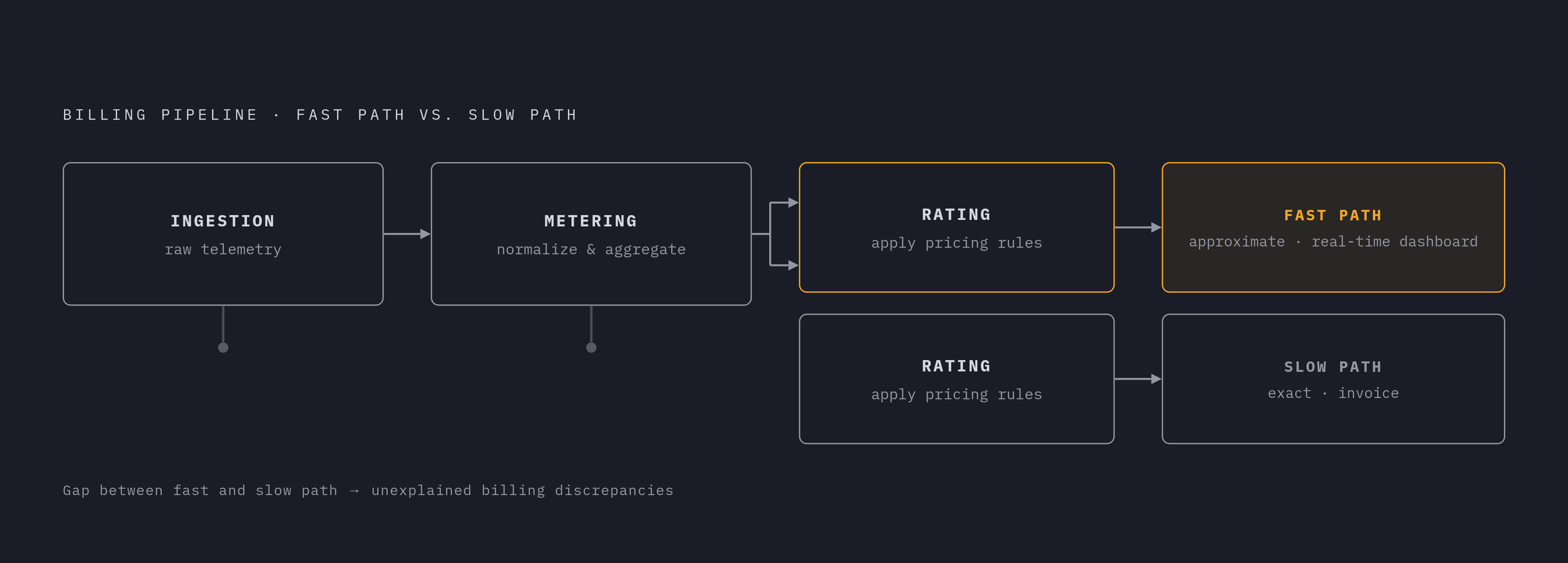
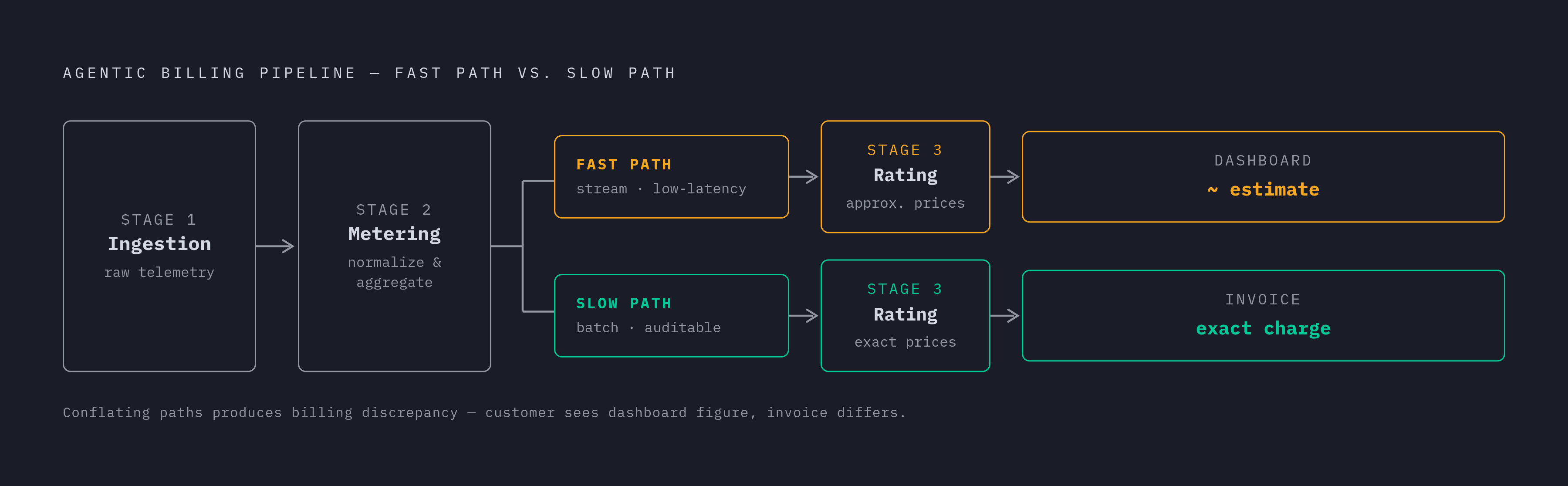
The second requirement is handling multi-step event chains. An agentic task is rarely one event; more often it's a chain. A tool gets invoked, an LLM call goes out, memory gets read, an output gets written, a verification step runs, and each link is potentially billable on its own while staying tied to everything before and after it. The pipeline has to capture, correlate, and total across that whole chain without dropping an event or attributing cost to the wrong tenant. In practice this looks like a three-stage pipeline: ingestion captures raw telemetry, metering normalizes and aggregates it into billable metrics, and rating applies pricing rules to turn those metrics into actual charges. Serious platforms run two paths underneath at once, a fast path producing approximate numbers for a customer's real-time dashboard, and a slow path producing exact numbers for the invoice. Both have to exist, and they have to agree closely enough that nobody sees a dashboard figure contradict an invoice figure. Multiple aggregation windows matter too, minute, hour, day, since a pricing model built around peak usage can't run on one flat time bucket.
Third: hybrid model support without a re-engineering project every time the pricing team wants to try something new. Most SaaS companies already run hybrid pricing, a base fee plus variable consumption, and that share keeps climbing. A platform that only handles one billing dimension forces engineering to stitch together two separate systems, which undercuts the point of buying infrastructure instead of building it. Analysts tracking hundreds of SaaS companies over a single year counted thousands of pricing and packaging changes, something like three or four per company on average. That's the iteration speed a billing platform has to support as a baseline, not as an exception it tolerates twice a year.
The metering architecture underneath: what the stack actually needs to look like
Underneath all of this sits an ingestion and aggregation architecture that has to be fast and durable at the same time, and getting both right is genuinely hard, harder than most vendor decks let on. The pattern most serious platforms converge on uses something like Kafka, or an equivalent event-streaming layer, for buffering and back-pressure management, so a burst of agent activity doesn't just drop events on the floor. From there, a columnar store such as ClickHouse, paired with materialized views, turns the raw event stream into tumbling time windows that feed both the real-time dashboard and the historical invoice.
Deduplication at ingestion isn't optional. Idempotency keys and replay protection need to be built in from day one, because a billing system that double-counts a retried agentic step creates more than a financial error: it erodes the one thing billing infrastructure exists to protect, a customer's trust in the number on the invoice. On raw scale, some open metering architectures report handling up to a million billing events per second, while some usage-billing platforms are engineered around a floor somewhere near 200,000 events per second. The exact ceiling that matters depends on the workload in front of it, but any vendor who can't state a throughput number with a straight face shouldn't make the shortlist. I've sat through pitches where the answer to "what's your throughput ceiling" was a shrug dressed up as confidence, and that tells you everything.
Geography matters more than people expect going in. Usage data needs capturing as close to the user, or the agent, as possible, to keep latency out of the enforcement decision, then it gets reconciled centrally afterward for billing. Multi-region gateway deployment is a requirement for any company operating globally, not a checkbox on a sales deck. And when a vendor says "real-time," push on what that actually means. Fast-path aggregation for balance display is a genuinely different system from slow-path aggregation for invoice finalization, and a vendor who talks about the two as if they're interchangeable is glossing over an engineering split that customers eventually feel, usually as a billing discrepancy nobody on their side can explain.
How the major platforms compare on agentic and credit-based billing criteria
Judge any platform against the three technical requirements above, plus deployment flexibility and however much friction the developer experience adds on day one.
Some platforms position themselves as a purpose-built metering layer feeding a separate downstream billing and invoicing system. That's a legitimate architecture, particularly strong on event ingestion and aggregation, but the team adopting it still has to bolt on a distinct billing and invoicing layer afterward. Fine for a company that already has billing infrastructure and just needs usage metering added on top, but a worse fit for a team that wants one system covering the full path from event to invoice. Platforms built this way tend to lean into enterprise features like account hierarchies, audit logging, and compliance reporting, which starts mattering the moment a company sells into regulated buyers.
Other platforms sit closer to the entitlement and pricing-rule layer, developer-facing, with strong configurability for how a product gets packaged and priced. These generally handle pricing rules and entitlement enforcement well. Check the metering throughput underneath carefully, though, because agentic workloads generate event volumes that a platform tuned for subscription-style usage was never built to absorb.
At the more specialized end, some platforms are built from the ground up around agentic and credit-based demands specifically. What's worth naming concretely: low-latency P99 on balance checks, native support for usage-based, credit-based, seat-based, and hybrid pricing on the same account without stitching together separate systems, documented throughput at the scale agentic workloads demand, and configuration tools that let product and finance teams change a pricing rule without filing an engineering ticket. That last one is the only realistic answer to a market running several pricing changes a year per company.
There's also a category of open-source metering cores, built on the same Kafka-and-columnar-store pattern, offering real technical transparency and deep customization. These handle millions of billable events per second at the metering layer without much trouble. The tradeoff is straightforward: an open-source core shifts more of the integration and long-term maintenance burden onto the buyer's own engineering team. That's a real cost, and it deserves honest weighing against the build-vs-buy calculus later in this piece.
Whichever category a platform falls into, ask what the documented P99 latency for a credit balance check under load actually is, how the system handles event deduplication across retried agentic steps, whether a non-engineer can change a pricing rule without a code deployment, and what an invoice looks like when a single customer session spans thousands of sub-events. A vendor who answers with specifics has earned a real conversation. A vendor who answers with adjectives hasn't.
Why hybrid pricing, not pure credit billing, is where most AI companies will settle
Credit-based pricing's surge through 2025 looks, at a glance, like a wave that keeps building, but look closer and it reads more like a transitional moment. Most teams adopting credits today will tell you, if you ask them directly, that they see it as a stepping stone rather than a permanent architecture, because credits abstract cost without solving the value-alignment problem that enterprise buyers eventually push back on.
Hybrid pricing is where the market is actually converging. A large and growing share of SaaS companies already run a hybrid model, a base fee combined with variable consumption, and that share climbs every year. The pull toward hybrid comes from two directions at once: enterprises want budget predictability that pure metered billing struggles to give them, and AI vendors want pricing that reflects real value delivered in a way a flat seat fee rarely could. Retention data backs this up. Companies with an outcome-based component in their pricing see meaningfully higher retention and satisfaction scores than companies without one, and pure metered billing, with no anchor to value, struggles to close enterprise deals, and struggles even more to keep them renewed once the honeymoon period ends.
Salesforce's move to Flex Credits, pricing at 20 credits (roughly ten cents) per standard action regardless of the underlying token consumption behind it, is a useful case study of the tension at play. It abstracts complexity away from the buyer, which helps adoption. It also creates a kind of cross-vendor opacity that sophisticated enterprise buyers are starting to push back on, because they can't easily compare what they're actually paying for across different vendors' credit systems. A procurement team that can't compare apples to apples eventually asks why not, and that question doesn't have a comfortable answer yet.
Underneath all of this sits a margin reality traditional SaaS never had to deal with. AI companies typically run gross margins in the 50 to 60 percent range, well below the 80 to 90 percent traditional software enjoyed for decades, because every inference call carries a real compute cost behind it. Pricing architecture has to reflect that directly; a flat-rate or pure seat-based model struggles to. The implication for anyone choosing billing infrastructure today isn't subtle: a platform that only handles credits, and can't also run a base fee plus an outcome tier plus a usage overage as one coherent model, is already behind where the market is heading.
The build-vs-buy question, answered for agentic billing specifically
Billing feels, on the surface, like a solved problem: a database table, a cron job, a webhook into a payment processor. That intuition holds right up until agentic workloads show up and break it, and I mean that almost literally, in the sense of pipelines that fall over during a demo.
What actually changes is the volume and the latency budget. An active agent session can throw off thousands of billable events a minute, and a homegrown pipeline built for subscription webhooks falls behind almost immediately once that load hits it. The sub-50ms enforcement requirement makes it worse, because the credit check has to return before the LLM call even fires, which turns billing from an accounting exercise into a real-time systems problem. Deduplicating millions of events per session, without losing one and without double-counting a retry, is its own infrastructure project, not something a small team knocks out over a sprint. And with pricing changing several times a year at most companies now, the system has to be reconfigurable by product and finance people directly. A hand-rolled internal system almost never gets built with that flexibility in mind, because nobody plans for it until the third or fourth painful pricing change forces the issue.
The stakes of getting this wrong show up in the data already: a strong majority of IT leaders report getting hit with unexpected charges tied to consumption-based AI pricing they didn't fully see coming. That's a signal about the risk of choosing the wrong platform, not just an anecdote. Building the wrong thing in-house compounds it, because an internal billing pipeline turns into permanent on-call engineering work. Every new pricing experiment, every new model added to the product, every enterprise contract with custom terms becomes a ticket someone has to prioritize against actual product work.
There's an honest case for building anyway, and I don't want to wave it away. If the consumption model really is simple, event volumes really are low, and pricing really isn't going to change much, an in-house system holds up fine. But the bar for all three of those conditions is higher than most teams admit to themselves at the start of an agentic product, and pricing complexity has a way of showing up faster than anyone budgeted for, usually right after the first big customer asks for a custom deal.
What to validate before signing a billing infrastructure contract
Ask for documented P99 latency on balance checks, and ask for a load test result or a reference customer operating at the event volume the product actually expects to hit. A marketing claim without a number attached deserves real skepticism, the kind you'd apply to a vendor who describes their API as "blazing fast" without a benchmark in sight.
Confirm the platform has an actual pre-compute enforcement path, separate from post-hoc metering. For credit-based AI products these are two different systems, and both need to exist; a platform that only meters after the fact struggles to stop a customer from blowing through their balance before anyone notices. Check whether the platform can run a base subscription fee, a credit balance, and a usage overage tier simultaneously on one customer account, configured through a user interface rather than a code deployment. That configurability is what makes frequent pricing changes survivable instead of exhausting.
Migration path matters as much as day-one setup. Ask how the platform handles moving customers between pricing structures: grandfathering legacy plans, running parallel pricing cohorts during a transition, handling mid-cycle changes for customers locked into annual contracts. Ask plainly whether the platform produces an audit-ready invoice automatically, or whether someone on finance spends every month-end reconciling event logs against a spreadsheet regardless of what the sales deck promised.
For enterprise buyers specifically, four items belong on the checklist without exception: SOC 2 Type II or equivalent compliance documentation, an on-premises or VPC deployment option for data residency requirements, account hierarchy support for multi-entity or reseller billing structures, and an uptime SLA at the highest available tier or better. None of that is exotic; it's just what a company's entire revenue recognition process depends on, and it deserves to be treated that way in the contract negotiation, not as an afterthought in an appendix.
Pricing that works lets a business actually steer itself. Product teams run real experiments instead of guessing, and finance closes the books without a fire drill at month-end. Pricing infrastructure that doesn't work has a way of becoming permanent anyway, mostly because nobody wants to be the one who migrates a live billing system while customers are watching, and that's usually how a company ends up with engineers getting paged for invoice discrepancies at two in the morning, years after the original vendor decision got made in a rush.