Multi-Tenant Usage Isolation in Shared Metering Infrastructure
Architectural isolation prevents metering errors that no downstream reconciliation can fix.

In June 2026, GitHub Copilot's metered billing took effect, and a single request could eat up double-digit percentages of a monthly allowance with little warning, which shows that a metering system can be technically accurate and still fail the customer at the point of invoice. That failure did not originate in a support queue or a dashboard design choice. It originated in the architecture that counts usage before any bill is ever generated. Tenant isolation in shared metering infrastructure is a billing correctness problem first: when usage events cross tenant boundaries, or when a tenant cannot see what it is accumulating in real time, the resulting invoice is wrong or unverifiable by construction, and no reconciliation process downstream can repair a counting layer that got it wrong at the source. Usage-based pricing adoption has grown substantially since 2023, and more AI SaaS companies now price on consumption, though adoption varies by segment, so the metering layer is no longer just a reporting adjunct to the billing system; it has become the billing system. Everything that follows in this piece treats isolation as an architectural requirement for correct invoicing that happens to produce cleaner bills as a side effect.
The canonical failure mode is noisy-neighbor distortion: a single tenant whose workload spikes can distort the usage figures reported to other tenants sharing the same infrastructure, not merely by slowing their requests down but by misattributing consumption into their ledgers. This distortion is not something a finance team can catch and correct after the fact. Once an event has been counted against the wrong tenant and an invoice has gone out, the error has already become a customer dispute, a chargeback, or quietly lost revenue that nobody notices until an audit finds it. Security and performance benefit when tenant boundaries hold, but they are not why the boundaries have to hold. The invoice is why.
The four layers where tenant boundaries must hold for billing to be trustworthy
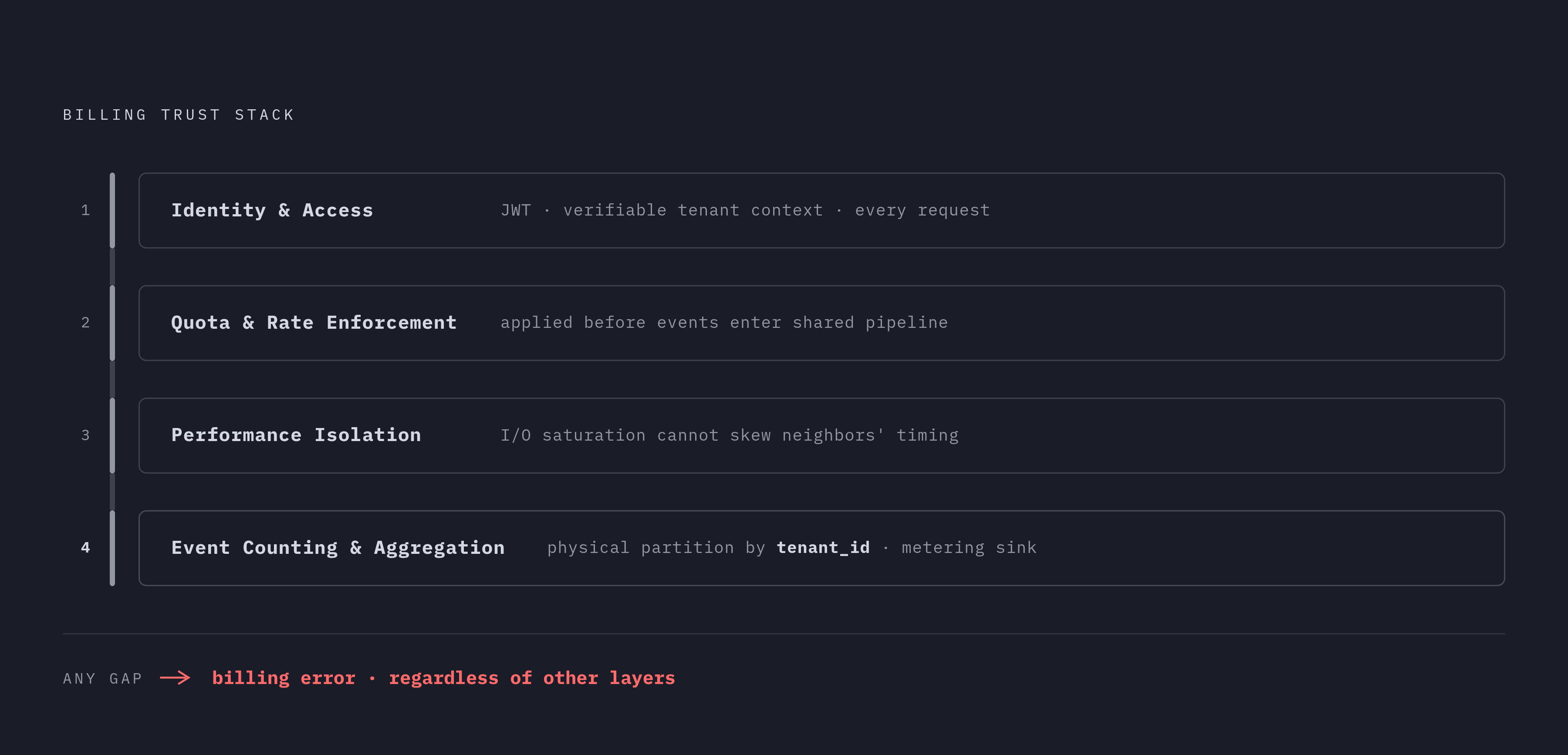
Correct metering depends on isolation holding simultaneously at four layers: identity and access, quota and rate enforcement, performance controls, and event counting. A gap at any single layer propagates forward into the number a tenant is eventually billed, regardless of how carefully the other three layers were built. This is a map of where the architecture has to hold, not a deep treatment of any one piece; the event pipeline gets its own full treatment next, and rate limiting and quotas get a section after that.
The first layer is identity and access. You need a verifiable tenant context attached to every request before any usage event gets recorded. The standard production pattern carries a tenant ID in a JWT, validates it at the application boundary, and propagates it into the database session. Without this, a misbehaving or misconfigured client can emit events that land in the wrong tenant's ledger, which produces a billing error with the same financial consequences as a security breach even though no security control was technically violated. Row-level security in PostgreSQL serves as a backstop here: even when application code forgets a tenant filter, RLS prevents cross-tenant reads and writes, and the same principle extends to the metering sink itself.
The second layer is quota and rate enforcement per tenant. It has to apply before events enter the shared pipeline rather than after aggregation, because if you enforce it after the fact, you cannot stop a noisy-neighbor distortion from already reaching other tenants' counts. The third layer is performance isolation: when one tenant's batch job saturates I/O or CPU, the resulting latency can distort the timing and completeness of usage events emitted by neighboring tenants, turning a performance problem into a billing inaccuracy. The fourth layer is event counting and aggregation itself: the metering sink needs physical partitioning so that a query against one tenant's rollups is structurally prevented from scanning another's, since logical separation through tenant_id filters alone is necessary but not sufficient.
Deployment tiers tend to map onto how much isolation strength a tenant needs. Shared infrastructure fits lower-tier tenants where cost efficiency matters more than dedicated resources, but enterprise tenants need partitioned or dedicated infrastructure, because their contract values make a metering dispute expensive to absorb. Most production systems end up hybrid: shared infrastructure handles the long tail, and dedicated or partitioned resources get reserved for high-value accounts. The metering architecture has to track this tiering deliberately, because otherwise the billing exposure concentrates precisely in the accounts where a mistake costs the most.
Designing the event pipeline to count each tenant's usage exactly once
The event pipeline is where billing correctness is actually made or lost. Queue structure, transport choice, deduplication logic, and sink partitioning decide whether the invoice numbers coming out the other side reflect what each tenant really consumed. The standard production pattern is asynchronous, append-only ingestion: the application drops a raw event onto an internal message queue and returns immediately, and a dedicated worker consumes and aggregates it later, decoupling the billing critical path from the serving critical path.
You choose a transport for correctness, not for infrastructure taste. Kafka and Kinesis retain the event log, so you can reprocess a full billing period after a rating-logic error surfaces, and that ability to replay is what turns a discovered bug into something correctable rather than a permanent revenue leak. SQS drops the log once a message is consumed, so if a rating-logic fix surfaces after the fact, you cannot apply it retroactively, and the error it caused becomes permanent. Teams choosing a transport for a metering pipeline are choosing, whether they realize it or not, whether a future billing bug will be fixable or final.
Idempotent ingestion is not optional. Networks retry, clients retry, and queues redeliver, so naively counting every ingested event will overcharge tenants whose events got delivered more than once. The fix is to attach a deterministic idempotency key to every event, check it against a dedup store before adding the quantity to a tenant's running total, and use something like a SET NX in Redis or a unique constraint in the sink to turn at-least-once delivery into exactly-once accounting. The dedup TTL matters as much as the mechanism: it has to exceed the maximum replay horizon, because a TTL shorter than the replay window lets duplicate events from a reprocess slip back into the ledger and get counted twice.
Sink partitioning by tenant_id is the physical enforcement of the billing boundary described in the previous section. A query for one tenant's rollups must be structurally prevented from scanning another tenant's chunks, and logical filtering in the query layer only guards against bugs; it is not a substitute for physical partitioning. Aggregation design also does real work beyond correctness. You roll a million per-token events into one hourly aggregate per tenant and meter, and that is what makes rate limits on external billing APIs operationally irrelevant; this aggregation step is exactly where raw infrastructure telemetry becomes a billable quantity rather than a stream of noise.
Pricing rules change over time, and the pipeline has to enforce that events are metered under the rules in effect when they occurred rather than the rules in effect when they happen to be rated. Applying current rules to historical events produces an incorrect invoice even when every event was counted exactly once. The pipeline needs to tag each event with the rule version in effect at ingestion time, not at rating time, so that a later rate change does not silently rewrite the past.
AI workloads add a layer of difficulty that older usage-based systems rarely had to handle: the same prompt can yield different token counts across runs, particularly with streaming, function calling, or agent chains. Metering logic built for deterministic output sizes will misfire against this variance, so the pipeline has to record the actual count observed at execution time and tolerate the variance rather than assume a fixed shape for every request.
Rate limiting and quota enforcement as per-tenant billing correctness primitives
Per-tenant rate limiting is a billing correctness mechanism, not just a fairness or stability control. If one tenant's burst of traffic can affect the pipeline's behavior for neighboring tenants, causing delays, retries, or dropped events, then the counts that eventually reach the invoice are no longer solely a function of what each tenant actually consumed. Rate limits have to be enforced at the tenant boundary before events enter the shared pipeline, not applied as a cap on an already-aggregated total. Capping after aggregation does nothing to stop the noisy-neighbor distortion from occurring in the first place; it only clips the offending tenant's own invoice after the damage to everyone else's counts has already happened.
Fair resource allocation is part of pricing integrity; it is not a separate operational concern. Smaller customers on lower-tier plans need to see consistent performance even when larger customers spike, because if they don't, they end up subsidizing larger customers' overages through distorted usage figures they never agreed to absorb.
The GitHub Copilot case from earlier belongs here as much as it belonged in the opening. Counting was technically correct, but developers still reported that single requests consumed double-digit percentages of a monthly allowance with little warning. That gap between accurate counting and real-time visibility is an architectural property. Spend visibility depends on a metering system maintaining real-time per-tenant aggregation rather than batch-accumulating events and surfacing them only at invoice time. A system that aggregates correctly but only hourly or daily will always produce the GitHub Copilot outcome: a tenant discovers the cost of a decision after the decision has already been made. Rate limiting, quota enforcement, and real-time aggregation are three expressions of the same underlying requirement, that a tenant's consumption be knowable, boundable, and isolated from its neighbors at every moment, not reconstructed after the fact.
What pricing archetypes demand from the metering layer
Different pricing archetypes place different demands on the metering layer's isolation guarantees, and each one fails in its own characteristic way: pure pay-as-you-go exposes revenue leakage, hybrid models expose double-counting, outcome-based models expose definitional disputes, and credit abstraction exposes deferred-revenue misreporting.
Pure pay-as-you-go pricing, charged per token, per call, or per invocation, maps every event directly onto a billable charge, so event misattribution becomes an immediate revenue error, either a missed charge or an overcharge. The tenant boundary in the pipeline has to be exact under this archetype because there is no bundled allowance to absorb a small miscount. AI inference nondeterminism is especially acute here: since the same prompt can yield different token counts across streaming or agent-chain runs, the metering system has to record the actual count observed at execution time rather than an estimated or rounded figure.
Hybrid seat-plus-usage-credit pricing is the dominant archetype in the market, and it pairs a seat fee that covers a bundled allowance with metered usage charged on top. The metering layer has to correctly distinguish in-bundle consumption from overage consumption at the tenant level, and a miscount here causes an overage charge to apply when it should not, or not to apply when it should. Gong Credits, announced in June 2026 with customer emails sent in late May 2026, layer a company-wide shared credit pool on top of existing per-seat pricing, metering AI Trackers, MCP server access, and API-based AI workflows. That shared pool spreads across every user inside a single customer's account, so it is itself a multi-tenant metering problem nested one level down from the vendor's own tenant boundaries. Salesforce Agentforce shows a similar pattern from a different angle: its pricing spans per-user add-ons, Flex Credits consumption, and per-conversation billing, and seat fees may still require separate consumption credits for platform access. The boundary between seat-covered activity and metered activity has to be enforced in the pipeline itself, not inferred after the fact at invoice time.
Outcome-based pricing meters what happened instead of how much happened. Intercom Fin charges $0.99 per resolved customer interaction, and its 2026 pricing documentation defines several distinct successful outcomes, including resolutions, Procedure handoffs, disqualifications, and qualifications. The metering layer under this model has to record not just that an AI call occurred but that a defined outcome was actually reached, and any dispute over what counts as a resolution is, at bottom, a dispute about what the metering layer counted. Pega took a different route, announced at PegaWorld on June 8, 2026 and set to arrive in Q3 within Pega Infinity 26: it eliminates the per-token charge in favor of a flat rate per completed case regardless of how much AI consumption sits behind it. That design moves the metering burden from counting tokens to counting cases, but the isolation requirement remains: a case still has to be attributed to exactly one tenant with no bleed-through from another.
Credit abstraction adds a translation layer on top of raw metering, but it does not remove the need for it. Snowflake's compute-credit model converts per-second compute metering into a credit-based unit, but per-second billing, with a 60-second minimum, still applies underneath that credit layer. The credit layer is a metering translation layer in its own right, so it has to maintain per-tenant credit balances accurately: prepaid credit wallets generate deferred revenue, and you have to recognize it as credits are drawn down against actual usage. Under ASC 606, prepaid credits sit on the books as a contract liability, deferred revenue, drawn down as usage occurs, so if the metering layer recording credit consumption is inaccurate at the tenant level, the result is not just a wrong invoice but incorrect revenue recognition.
Why finance teams inherit the billing correctness problem
When metering, invoicing, and revenue recognition run on separate systems that were never designed to agree with each other, reconciliation turns into the permanent job of the finance team. This is the structural consequence of treating billing correctness as something to check for in a report instead of building it correctly into the counting layer from the start.
The failure here is architectural. If the metering layer does not guarantee per-tenant accuracy at the point of counting, finance teams inherit that gap as a reconciliation burden at month close, and the first week of every month turns into a manual correction cycle for errors that were actually introduced weeks earlier at event ingestion. The ASC 606 exposure described above means a credit-balance error at the tenant level is not only a customer-facing billing mistake, it is a revenue recognition problem that an auditor will eventually ask about. Every layer discussed in this piece, identity and access, quota enforcement, performance isolation, event counting, idempotent ingestion, rule versioning, real-time aggregation, exists to prevent that error from being created in the first place, because none of it can be recovered by a finance team working backward from an invoice that has already gone out the door.