Real-Time vs. Batch Aggregation for Usage Metering
Real-time catches usage violations instantly; batch discovers them too late.
Usage metering decides what shows up on every invoice, what an entitlement check returns, and whether a credit balance says yes or no to the next request. Get the aggregation layer wrong and every downstream number inherits that error, and nobody notices until a customer does. The real question is whether your latency needs, your pricing logic, and your infrastructure budget actually point the same direction. A lot of teams still treat batch as the safe default and real-time as some exotic upgrade, and that assumption stopped holding up a few years ago, right around when usage-based and credit-based pricing took over.
What each aggregation model actually does at the pipeline level
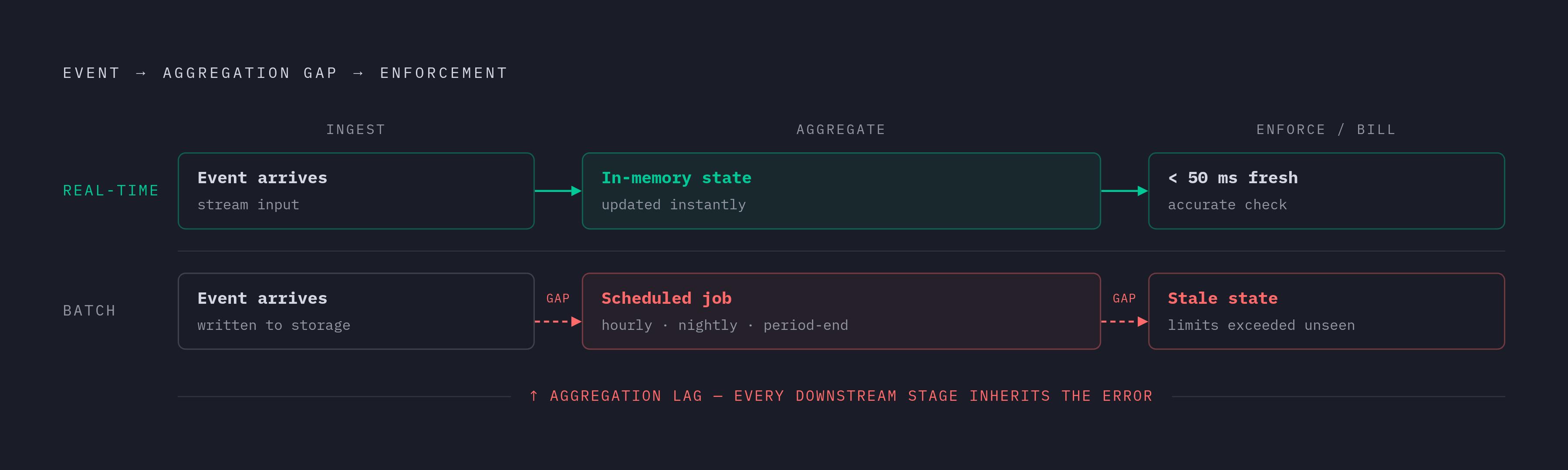
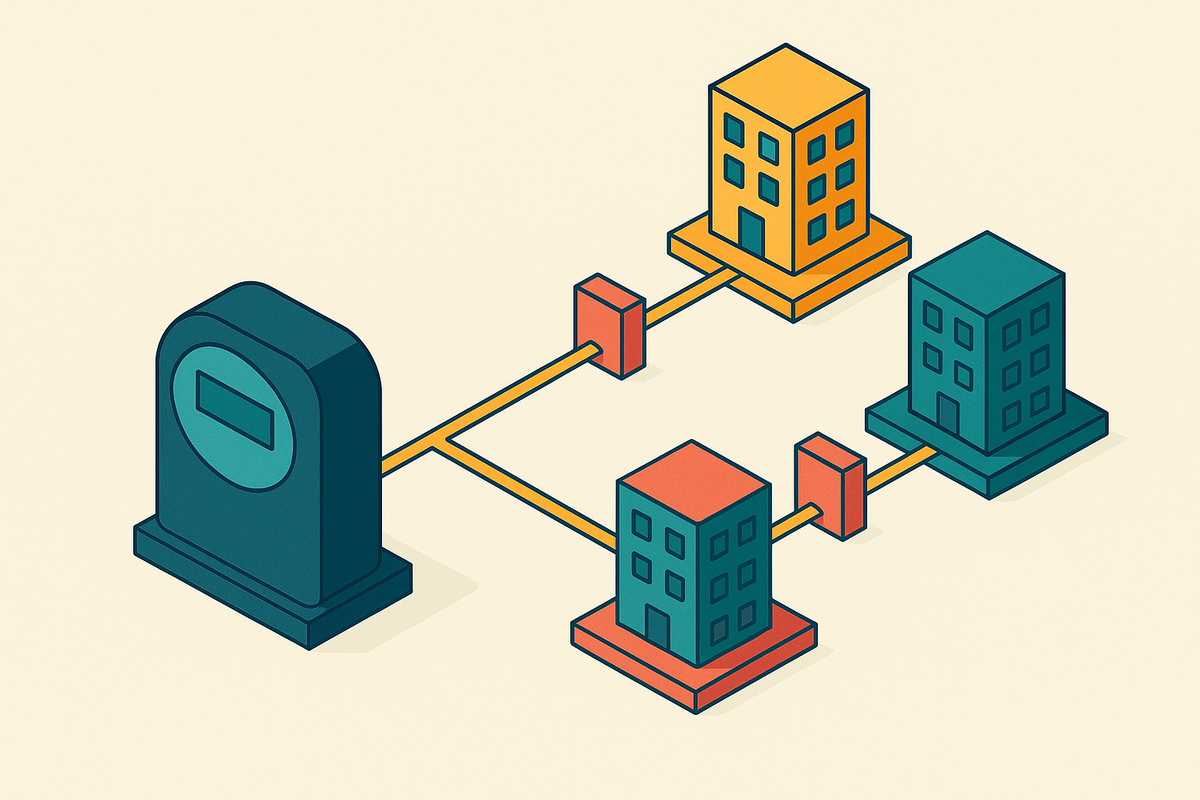
Every metering system moves through three stages: ingest the event, aggregate it, then hand off to enforcement or billing. The aggregation model decides how fast data moves through that middle step, and that speed puts a hard ceiling on what the third step can do.
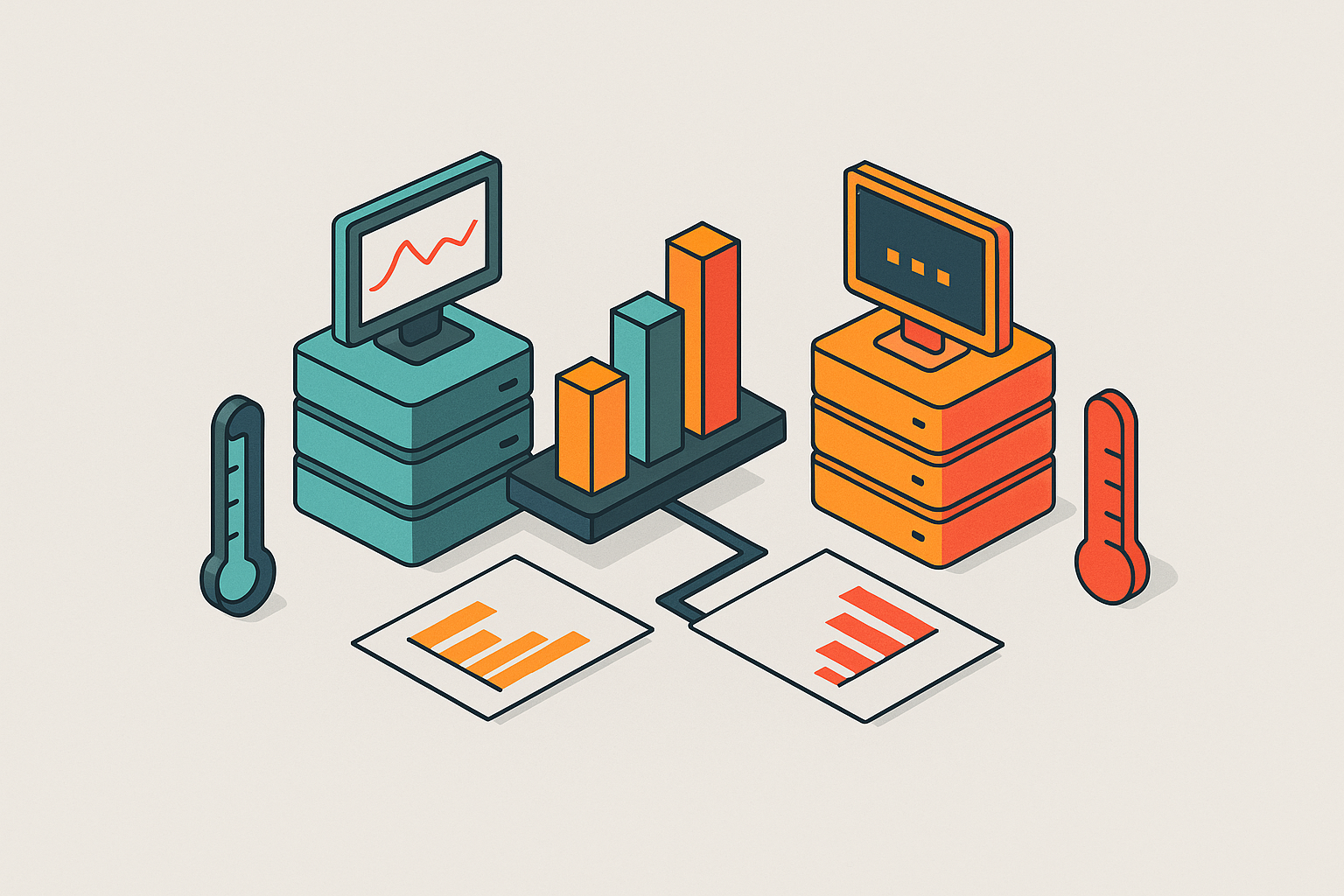
Real-time aggregation processes events in memory the second they hit the ingest path. A metric updates the instant the event arrives, so a query gives you a number that's current to the millisecond, not whatever the last job left behind. Once an event folds into the aggregate you can usually toss the raw record; the aggregated state is what sticks around. That's what makes enforcement work, since a balance check at request time reflects usage from a few milliseconds ago instead of last night's numbers. The common setup pairs a high-throughput queue, Kafka almost by default at this point, with a fast read layer. We run Kafka for ingestion and ClickHouse for metering at Flexprice, built specifically around that read pattern.
Batch runs on a completely different clock. Events sit in storage until a scheduled job, hourly, nightly, end of period, comes through, reads everything, aggregates it, writes the result. That's fine for reconciling a bill at period close. It struggles at stopping someone from blowing past a limit before the next batch run even happens. Batch jobs also tend to burn more compute per run than a streaming system spends per event, and a delayed run doesn't self-correct. The gap just sits there until the next scheduled pass.
Neither model gets to skip the annoying parts: deduplication, limit enforcement, mid-cycle plan changes, grandfathering old rates for existing customers. Picking a model doesn't remove that work. It just changes how hard each piece is to get right.
Where batch aggregation holds up and where it breaks
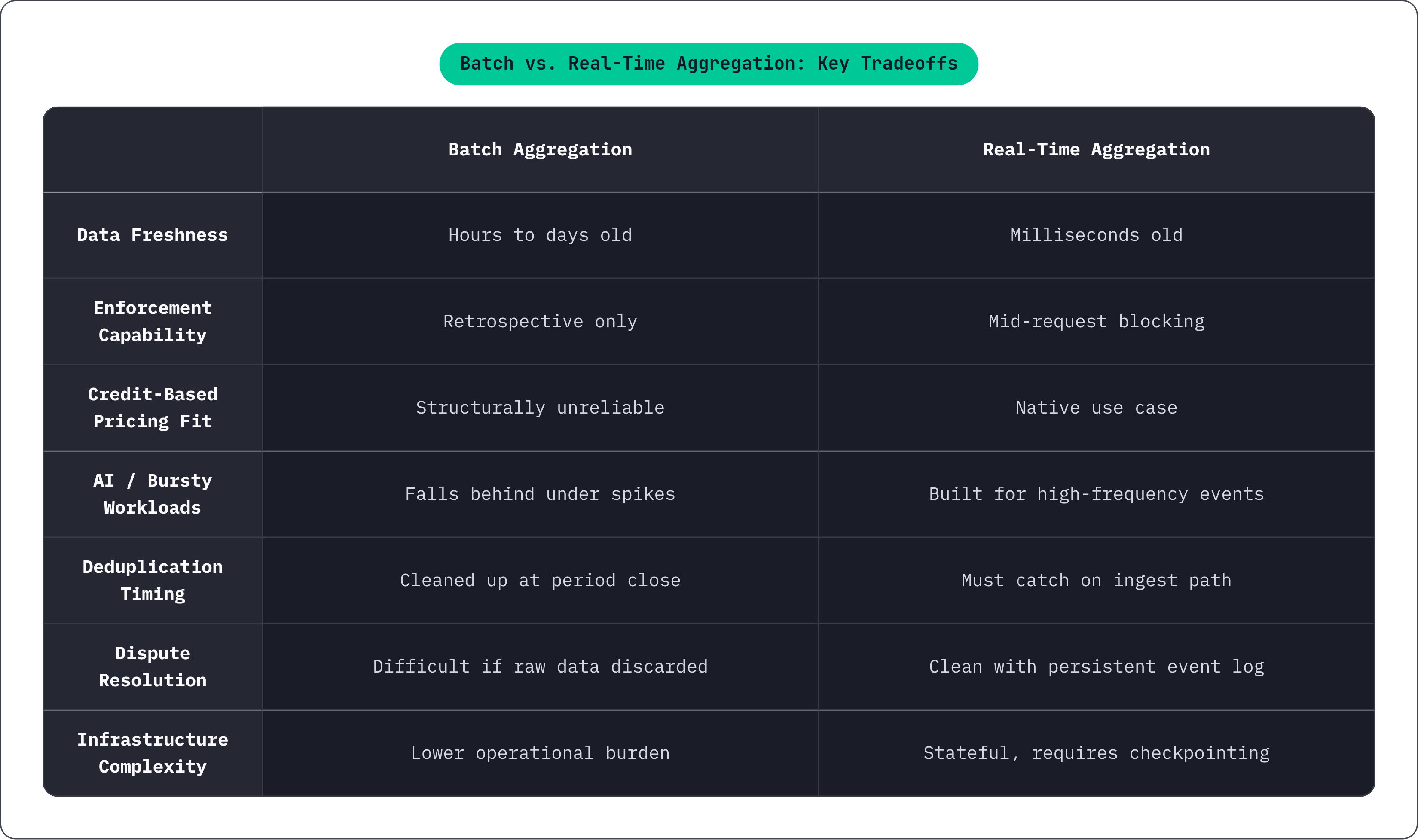
Batch works fine when pricing reconciles at period end, usage is predictable, and there's no hard credit limit sitting in the request path. A customer billed monthly for a seat count, or capped at some number of report exports, doesn't need millisecond-fresh numbers. Finance wants an accurate total at month close, refreshed on whatever schedule matches how the business actually looks at its books.
It falls apart the moment enforcement has to happen mid-cycle. A customer with a hard spending cap can blow through it hours before the next batch job even notices, and by the time that job catches up, usage that should've been blocked already went out the door, and probably already got billed. Bursty traffic makes this worse: events arrive faster than the batch interval can absorb, the pipeline falls behind, and every enforcement decision made in that window is working off stale data. Close a billing period on an incomplete aggregation and you've handed the customer an invoice they're going to dispute.
Disputes are where batch pipelines really show their age. A customer can't reconcile a line item against their own logs, so they escalate, and now someone has to trace the charge back to raw events. Pipelines that discard or archive raw data aggressively can't do this cleanly; it turns into real digging. A dropped event from a network blip or a stalled pipeline stage might not surface until the period's already closed, and at that point the team is issuing a credit and apologizing instead of just fixing a number.
Why AI workloads specifically break batch assumptions
AI products throw off a volume and shape of usage data that batch pipelines were never built for. A single agent workflow can generate thousands of events a minute: tokens consumed, individual agent actions, intermediate reasoning steps, a mid-task switch from one model to a cheaper one, each carrying its own per-unit cost. Cost per request isn't fixed the way an API call used to be. It moves with model choice, input length, whether the system's running an expensive reasoning mode or a cheap one. Metering has to attribute cost at each step, not log one flat event when the whole request finishes.
Here's the failure mode in practice. A high-volume agent workflow pushes events faster than the pipeline processes them, the enforcement layer reads a stale credit balance because aggregation hasn't caught up, and the customer sails past their limit while the system keeps serving requests it should've blocked. The overage gets served, then it gets charged. Metering catches up an hour later, and by then it already happened.
Credit-based pricing, now the default for a growing share of AI products, depends entirely on that balance check being current. If the number is minutes old, credit overruns aren't an occasional bug the team trips over; they're structurally guaranteed to happen. And this isn't just a hyperscaler problem. A mid-market AI product with a modest but active user base hits the same wall at volumes nowhere near web scale, because the issue is the gap between when usage happens and when the system finds out about it, not raw throughput.
The real tradeoffs inside real-time aggregation that vendors rarely advertise
Real-time aggregation fixes the staleness problem. It also introduces a set of costs that rarely make it into a sales deck.
Processing events as they arrive creates small discrepancies that need reconciling later. Streaming systems need real reconciliation logic, where batch gets that almost for free at period close just by re-reading everything once. Finer-grained metering, tracking per token or per reasoning step instead of per request, drives compute and storage load up fast, which is why teams end up doing adaptive aggregation instead of logging everything at max granularity forever.
Stateful stream processors need checkpoints and fault tolerance to hold context and keep latency low, and running that day to day is genuinely hard. Deduplication gets harder too: retries and outages during high-throughput ingest create duplicate events, and a real-time system has to catch those right on the ingest path. It doesn't get the luxury of cleaning things up later at period close the way a batch job does.
Then there's entitlement state. To avoid tacking extra latency onto every request, enforcement checks need to resolve from a local cache instead of a network round trip. That cache has to stay warm, stay consistent, and have a real fallback for when the upstream system goes dark for a minute. None of this is a drop-in. Real-time metering means the team either runs stateful infrastructure itself, or buys a platform built to carry that weight instead.
The decision variables that actually determine which model fits
Enforcement timing comes first. Does the product need to block or warn a customer mid-request, before a limit gets crossed? If so, real-time is the whole point, not a nice-to-have. If billing is purely retrospective, invoiced at period end with no hard caps, batch does the job fine.
Pricing structure comes second. Credit-based or prepaid products need a balance that's accurate the moment the request lands, and batch simply can't deliver that. Hybrid pricing, a subscription base plus usage overage, usually needs real-time enforcement on the usage side even when the subscription side reconciles fine in batch. A pure post-pay subscription with no hard limits doesn't need any of this urgency.
Event rate and burstiness matter next. High-frequency, bursty traffic, the kind AI agents and busy API platforms throw off, will overwhelm a batch interval and leave enforcement running on stale state. Predictable, low-frequency events, seat activations and the like, are served just fine by batch.
Then ask how fast the pricing itself changes. Teams iterating on rate cards, plan structures, or credit adjustments need a metering layer that absorbs those changes without a pipeline rebuild each time. Batch systems built on hard-coded aggregation logic turn every pricing change into an engineering ticket, and that gets old fast.
Last, audit and dispute requirements. Enterprise and regulated customers expect to trace a charge back to the raw event that produced it. Implementation details vary, but a real-time system that keeps its raw event log around usually gives dispute resolution a much cleaner starting point than a batch job that already threw the source data away.
Hybrid aggregation as a practical architecture for products that span both requirements
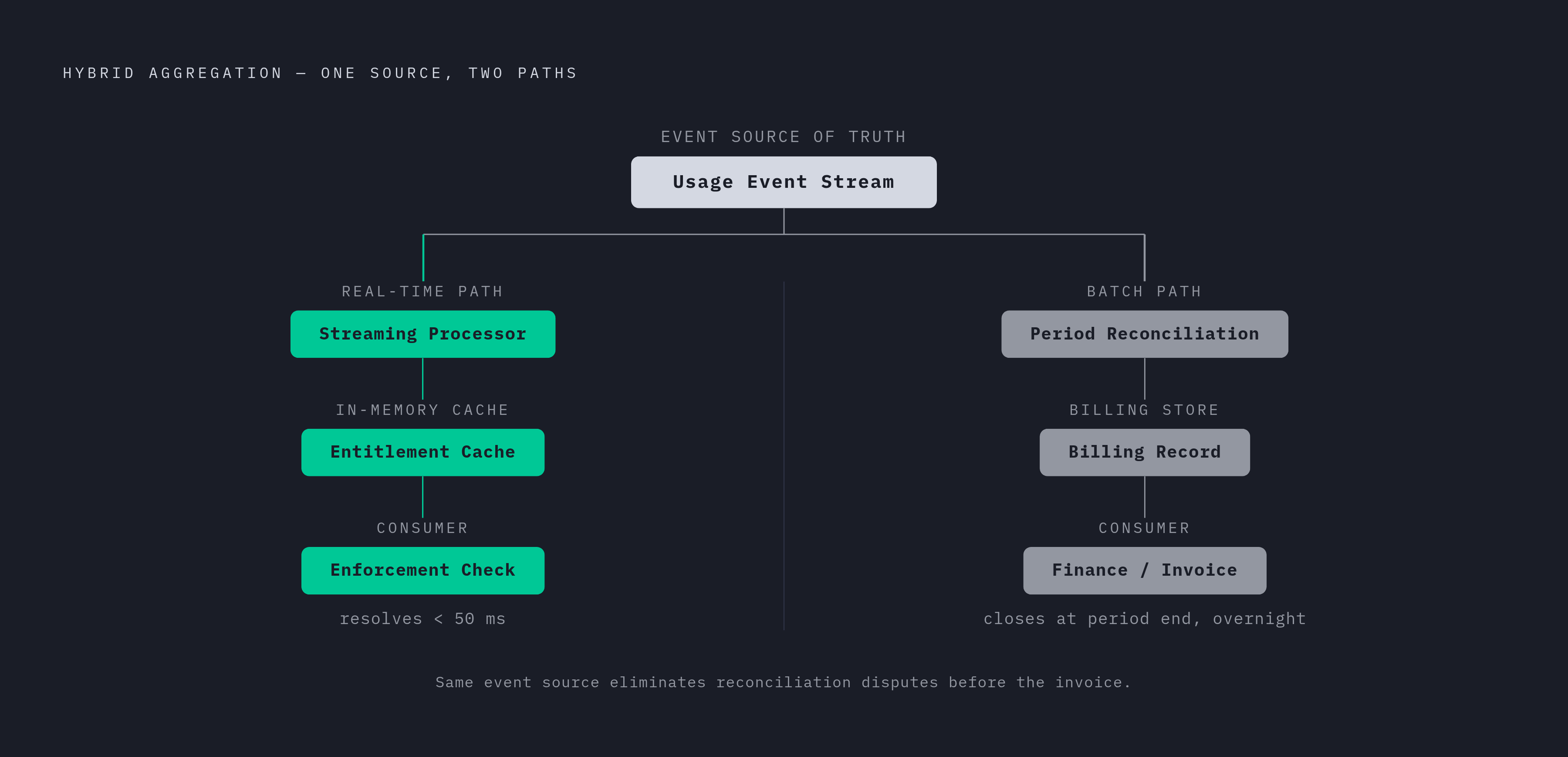
Most production systems that handle enforcement and invoicing well run real-time streaming for enforcement decisions and a periodic batch job for billing reconciliation and revenue reporting, both reading off the same event stream but serving different masters.
Enforcement reads from the continuously updated cache or in-memory state. Finance reads from the batch-reconciled store that closes cleanly at period end. That split reflects a real difference in requirements: a credit check needs to resolve in under 50 milliseconds, while a monthly invoice can bake overnight. Treat those as the same latency problem and you end up building the wrong thing for one of them.
The hard part is keeping the two paths honest with each other. If the reconciliation job lands on a different total than what the real-time system counted all month, you've got an internal dispute before the customer ever sees the invoice. Building that reconciliation layer in-house is usually where engineering effort quietly piles up; it's the third system nobody put on the original roadmap. When you're evaluating a platform instead of building one, look for a single event source of truth feeding both the metering and billing layers. That solves the reconciliation problem once, at the infrastructure level, instead of through glue code someone has to babysit forever.
What building this in-house actually costs versus what teams budget for
Teams budget for the ingestion pipeline and the aggregation layer. They almost always underbudget deduplication, limit enforcement, mid-cycle changes, grandfathering, the reconciliation layer, and audit trail infrastructure. Nobody thinks about these until something breaks.
The maintenance burden compounds quietly too. The engineers who built the metering system become its permanent on-call rotation; every pricing change, every new plan configuration, every billing bug routes back to the same small team, indefinitely. Take the common failure case: a bug that's been miscalculating usage for months finally surfaces, and the team has to drop feature work to dig through logs, write backfill scripts, and manually correct a stack of invoices. The cost isn't just engineering hours. There's also the trust a customer loses when a corrected bill shows up three months late.
There's a legitimate case for building this yourself. Teams already storing usage events in Snowflake, BigQuery, or Databricks, and writing their own rating logic on top, can hold onto real flexibility that way. But that only makes sense when the metering requirements are genuinely unusual, and the team has the staffing to maintain the system for years, not just ship it once and walk away. For most AI and SaaS companies, the sprint spent building it is the smaller cost. The bigger one is the permanent slice of engineering attention that billing infrastructure eats instead of the product.
What a well-designed metering platform does so the team doesn't have to
A metering platform worth using handles high-throughput ingestion, deduplication on the ingest path, real-time balance reads for enforcement, batch reconciliation for billing close, and event-level audit trails, all as one system instead of five tools stitched together with custom code. At Flexprice we run Kafka for ingestion and ClickHouse for metering, and the stack holds sub-50ms P99 latency on enforcement checks while processing over 10 billion API requests a month, with enforcement and reconciliation running on the same infrastructure instead of two systems bolted together after the fact.
A few questions cut through the marketing fast when you're evaluating any platform. Can pricing logic change without redeploying the metering pipeline? Does enforcement resolve from a local cache with a real fallback, or does every check trigger a network call? Is the raw event log kept around for dispute resolution, or does only the aggregated output survive? Does the platform support on-premises deployment for customers whose data residency requirements won't budge?
Architecture comes first: real-time, batch, or hybrid, decided against the actual variables your product faces, not whichever model sounds more sophisticated in a pitch deck. The platform gets picked to fit that decision, not the other way around. Pricing agility follows directly from metering agility, because a team that can change a rate card without filing an engineering ticket can actually use pricing to grow the business. A team stuck on a hard-coded aggregation pipeline spends that same energy asking engineering for permission every time finance wants to try something new.