Monthly Reconciliation of Metering System Data to General Ledger
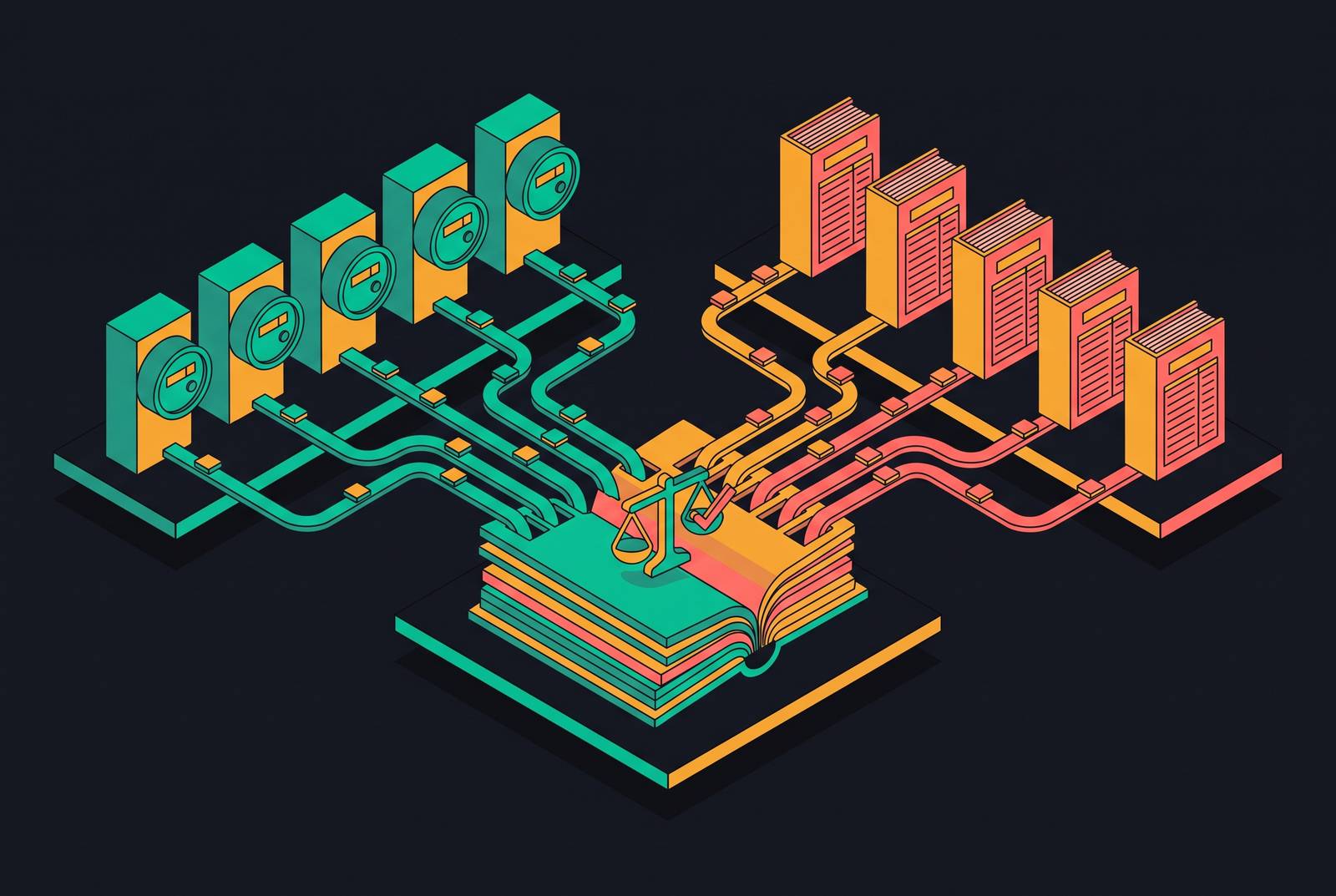
Utility billing settled this problem decades ago: meter reads get verified against billed amounts before the journal entry posts, not after the books close. Usage-based software and AI billing have not settled it because the problem is structural. Monthly reconciliation of metering data to the general ledger poses a harder problem for a consumption-priced product than for a subscription business, because consumption pricing multiplies the systems and discrepancies a finance team must chase to close the month on schedule.
Usage-Based Billing and the Reconciliation Problem
A subscription close is a settled ritual. One invoice goes out per period, one revenue schedule governs recognition, and one journal entry captures the result. The billing system and the general ledger agree by construction, because there is only one number in play and everyone downstream inherits it. Reconciliation, in that world, is a formality: a check that confirms what was already known rather than an investigation into what actually happened.
A usage-based product has no such luxury. Three separate systems have to agree at the same time, and none of them was designed with the others in mind. The metering layer records what happened at the event level, the raw clicks, API calls, tokens, or compute-seconds a customer actually consumed. The rating engine applies the contract to those events and decides what they're worth. The general ledger applies GAAP and decides what was actually earned in the period, independent of what was billed or even collected. Each of these systems runs on its own clock, stores data in its own format, and defines a "billable unit" in its own terms. A metering platform might timestamp an event in universal clock time at the millisecond it occurred; a rating engine might batch that event into a billing period measured in the customer's local time zone; the ledger cares about neither, only about when the performance obligation was satisfied under ASC 606. None of these three systems was built to talk to the other two without someone in the middle doing the translation by hand.
Hybrid pricing makes the problem compound. Most SaaS and AI companies no longer run a single pricing dimension. A single customer record might carry a seat-based subscription fee, a usage charge metered in arrears, a credit balance drawing down in real time, and a committed-spend floor that has to be checked against actual consumption before anyone can tell whether the customer owes more or has unused commitment left over. Each of those dimensions has its own rules for when it is earned, how it is rated, and how it maps to an account in the chart of accounts. Adding a pricing dimension increases the number of places where the three systems can disagree by more than one. It multiplies, because every new dimension has to reconcile against every other one already on the customer's record.
The five failure modes between the meter and the ledger
The places where metering, rating, and the ledger stop agreeing are not scattered at random. They occur at the same five points in nearly every usage-based billing stack, and naming them precisely is what makes it possible to close them for good.
The first failure mode sits at the tagging layer, where billing data gets mapped to the chart of accounts. Cloud and product resource tags are the thread that connects a raw usage event to a specific GL code, and when that thread breaks, the billing system doesn't throw an error; it defaults. Because nobody owns it, failures there go undetected longer than almost anywhere else in the stack.
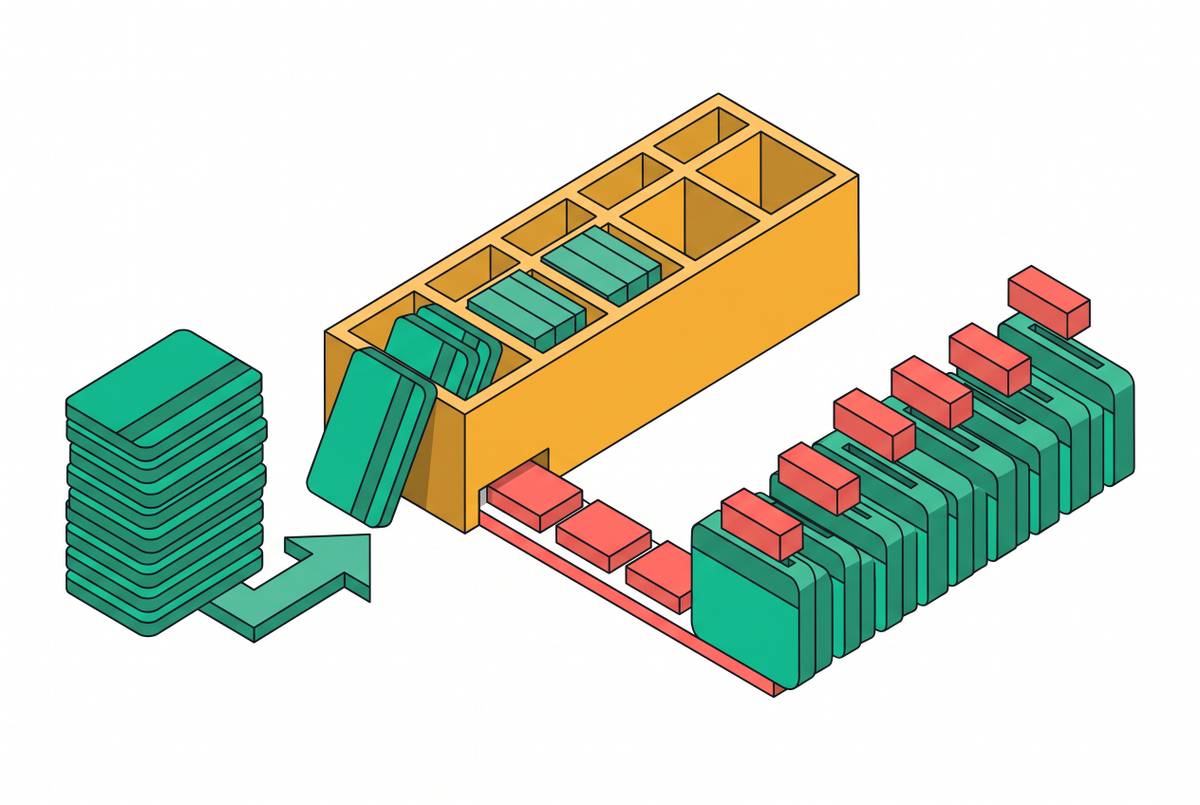
The second failure mode is timing. Usage events don't arrive on a schedule that respects month-end. In distributed systems, some nodes report quickly and some report late, and a backlog from a failed ETL job can push a real chunk of billable activity past the close date. Most in-house pipelines were never built with that logic as a first-class requirement, so it tends to get bolted on only after the first incident makes the gap obvious.
The third failure mode is specific to AI products, and it deserves the closest look because it's the least intuitive of the five. Multi-turn reasoning chains and tool-call cascades sharpen the distortion further: a small share of complex customer requests can consume a wildly disproportionate share of total inference cost, a skew that an average-cost attribution model simply cannot see, because it was built to measure typical behavior, not the tail.
The fourth failure mode is the rating engine running out of room. All of that has to resolve into one correct number, and this is usually the first place an in-house billing implementation breaks under its own complexity. Negotiated per-customer rate overrides add another layer of state that has to reconcile against the actual signed contract rather than the published rate card, and if a rate change gets applied in the metering system with the wrong effective date, the error shows up twice: once on the invoice and once in the GL allocation behind it.
The fifth failure mode is revenue recognition firing on the wrong trigger. One of the most common errors in usage-based billing is recognizing revenue on the date payment is received rather than the date the performance obligation was satisfied. ASC 606 ties recognition to when the obligation is satisfied, and for a metered product that means the service delivery period, not the invoice date and not the payment date. Contract modifications complicate this further. A plan upgrade, a renegotiated rate, or a committed-spend amendment typically calls for cumulative catch-up accounting rather than a full retrospective restatement, and that kind of adjustment is not something a lookup table can handle; it needs a rules engine built for the purpose. Flatten that bundle into a single revenue line and both the recognized revenue and the deferred revenue balance come out wrong. None of these errors is catastrophic in isolation, but missing credit notes, refunds, and deferred revenue roll-forwards accumulate month over month, so a discrepancy that looks trivial in January is often material by the second quarter.
The Cost of These Failures: Revenue Leakage, Close Delays, and Compliance Exposure
Each of these five failure modes has a financial consequence attached to it, and those consequences sort into three categories: money left unbilled, time lost in the close, and risk carried into compliance and procurement. Each lands on a different part of the organization, which is part of why the problem is so easy to under-prioritize until it isn't.
The first cost is leakage: revenue that was earned but never billed. A metering system that doesn't independently check each invoice against the signed contract will systematically undercharge enterprise accounts with complex, negotiated rate structures, since those are exactly the accounts where rating complexity is highest and errors are easiest to miss. The overages weren't new. They had existed in the data all along; the reconciliation layer was simply the first thing capable of surfacing them.
The second cost is time, specifically the hours a finance team burns every month on manual reconciliation. When RevOps calculates ARR one way and finance calculates it another, and both calculations are internally consistent but neither reconciles to the general ledger, the result is a governance failure that appears in board meetings and diligence processes, where the question isn't which number is right but why the company doesn't know.
The third cost is compliance and procurement exposure. SOC 2's Processing Integrity criterion asks whether a system's processing is complete, valid, accurate, timely, and authorized. For a billing system, a documented reconciliation failure is direct evidence of a gap against that exact criterion, not just an internal inconvenience. Enterprise buyers increasingly treat SOC 2 attestation as a baseline requirement before they'll sign, so a billing system with a known reconciliation problem can stall or block a procurement deal.
The fourth cost is harder to put a dollar figure on but just as real: the loss of customer trust when a reconciliation failure produces an invoice the customer never saw coming. A customer who believes their consumption has stayed within a known range and then receives a bill that contradicts that belief isn't just annoyed about the amount. According to analysis published by Aakash Gupta, the post documenting the incident reached hundreds of thousands of views within a week. The HappyRobot case and the Cursor case are not the same story. HappyRobot is about money a company failed to collect. Cursor is about money a customer never expected to owe, surfaced in public, at scale, almost overnight.
The architectural precondition: why metering and billing must share one data model
Most of what looks like a reconciliation process failure is actually an architecture failure. The metering system and the billing system speak different languages, built around different assumptions about what a billable event even is, and reconciliation is the translation layer that sits between them and inevitably breaks down somewhere. The root cause underneath all five failure modes described above is not sloppy process, but two or three systems that were never meant to share a single source of truth.
The standard fix the market reaches for, connecting a metering tool to a separate billing tool through an integration, doesn't remove the translation layer. It just relocates it into a connector that has to be maintained indefinitely and that breaks every time either vendor changes its schema. The GL mapping layer illustrates the problem well: it sits between the billing engine and the ERP, and because it belongs fully to neither side, billing teams treat it as finance's responsibility and finance teams treat it as billing's responsibility. That ambiguity is why failures there go undetected the longest.
A system that ingests raw usage events, applies the rating engine, and posts journal entries from one shared data model removes the translation layer by construction. The same logic applies to SaaS metrics generally: a company that computes ARR inside the ERP, from the same data the ledger uses, gets a number that reconciles to the financials automatically, rather than one that has to be tied out by hand after the fact. The same principle holds for usage events. If the metering layer, the rating logic, and the GL posting logic all read from the same underlying record, there's no translation step left to fail.
For AI products specifically, this means the metering layer itself has to carry distinctions that a generic integration can't add after the fact: separating cached tokens from full-price tokens, counting tokens consumed by failed or retried inference attempts, and attributing the cost of multi-turn reasoning chains back to the customer action that triggered them. These aren't optional refinements bolted onto an existing pipeline. They have to be built into the metering layer from the start, because once usage data has already been flattened and aggregated, that granularity is gone for good.
The reconciliation workflow that closes the gap: from raw event to posted journal entry
Closing the gap between the meter and the ledger comes down to five stages, each with its own controls, and skipping any one of them is exactly where the failure modes described earlier re-enter the process.
The first stage is event capture and enrichment at the source. A usage event needs to be captured the moment it happens and tagged immediately with the metadata that GL mapping will eventually depend on: customer ID, product dimension, contract version, and cost center. Deduplication has to happen here too, at ingestion, because a retried event that slips past this stage without being recognized as a duplicate becomes a double-counted journal entry later, when it's far harder to trace back to its source.
The second stage rates the event against the customer's actual signed contract. The output of this stage is a rated usage record that stands on its own and can be checked independently against the invoice. That independent, verifiable record is the foundation that let HappyRobot's reconciliation layer catch its unbilled overages.
The third stage is an independent reconciliation layer that recalculates the expected invoice from raw usage and the signed contract, then compares that recalculation against what the metering and rating systems actually produced. Discrepancies should appear as exceptions, with enough context attached to resolve them immediately, instead of as an unexplained balance-sheet variance that someone has to investigate forensically after the books are already closed. This is the same discipline utility billing has used for years: meter reads get checked against billed amounts before the journal entry posts, not after the close is final.
The fourth stage is revenue recognition tied to performance obligations. Deferred revenue balances for prepaid credits or annual commitments need to update as those credits are actually drawn down, so the balance sheet reflects the obligation that's genuinely still outstanding.
The fifth and final stage is posting to the general ledger with full audit-ready drill-through. Every journal entry needs enough dimensional detail attached, customer, product, period, and contract version, that an auditor can trace any revenue line all the way back to the specific usage events and contract terms that produced it. That traceability is what turns a month-end close from a reconciliation exercise back into what it was always supposed to be for a subscription business: a formality that confirms a number everyone already trusts.