Pricing Experiment Governance for Billing Changes in Enterprise SaaS
Finance-led controls let SaaS teams test pricing and still unwind it cleanly.

Pricing experiment governance in enterprise SaaS makes commercial learning safe without turning billing into a reconciliation exercise. Effective governance defines ownership, testing controls, rollback paths, and infrastructure requirements before an experiment starts. Its purpose is controlled velocity, so teams can change pricing regularly without compromising contracts, revenue records, or customer trust.
Why pricing changes in enterprise SaaS carry a different category of risk than other product decisions
Enterprise pricing tests affect named accounts that have signed contracts, negotiated rates, and binding expectations that their bills will be predictable. The exposure extends well beyond a conversion miss. A failed change can breach contract terms, trigger audit clauses, or become a trust issue during renewal negotiations. A mid-term change can also create ASC 606 / IFRS 15 revenue recognition complications when it modifies the transaction price of an existing performance obligation without proper documentation.
These financial consequences are inseparable from account relationships. A pricing surprise discovered by a CFO mid-contract can undo months of expansion conversations. Even a change permitted by the contract can damage trust if it appears on an invoice before the customer understands it. As vendors move toward usage-, agent-, and outcome-based pricing, buyers face less predictable charges and become more sensitive to changes.
What governance for pricing experiments actually means in practice
Governance is a set of operating controls. It answers four questions about who can propose a change, how it gets tested safely, what rollback looks like, and how billing infrastructure supports the full cycle. Ownership prevents experiments for which nobody is accountable. Testing controls make results trustworthy, while rollback design prevents unresolved billing state from becoming manual reconciliation work. These controls require infrastructure that can run them.
These questions organize the lifecycle from proposal approval through rollout, reversal, and close-out. Approval establishes responsibility and acceptable exposure before testing begins. Staging then generates evidence within that boundary, while rollback provides an exit and infrastructure executes both paths. The objective is to contain the consequences of failed experiments before customers or billing teams have to absorb them.
A cross-functional council supplies the visibility that no single team has. Finance sees recognition and forecast effects, Sales sees contract and relationship risk, and Customer Success sees churn and expansion signals. Legal assesses contractual exposure, while Product and Engineering establish what the billing system can execute. Finance should chair the council because pricing changes are financial commitments.
How a pricing proposal moves from idea to approved experiment
A pricing proposal should move beyond a Slack message to become a structured artifact. Its hypothesis names the behavior or metric the change is expected to move. Defined success metrics and duration prevent the team from deciding afterward what would count as success. A named owner establishes accountability for the proposal. The rollback trigger and billing requirements show whether the experiment can end safely, rather than leaving that question until approval has already created momentum.
Scope deserves the closest scrutiny in the proposal. It must identify the affected segments or cohorts and explicitly state whether any customers with existing contracts are included. Testing prices on new sign-ups is a go-to-market decision, while changing prices for existing customers introduces contract modification and relationship concerns. Legal must review any test that includes customers with existing contracts. The proposal must document whether current MSA and order form language permits the change before the experiment begins.
Approval requirements should rise with account and revenue exposure. A test limited to new-cohort sign-ups in a single geographic market needs less scrutiny than one touching enterprise renewal accounts. Changes with high exposure need a review by the full council, while proposals with less risk can take a lighter path to approval. This keeps scrutiny proportional to the failure the controls are intended to prevent.
Why staging matters and how to structure a rollout that is actually safe to unwind
A staged rollout keeps exposure low as the team learns how the pricing works. It begins with a small percentage of new traffic, observes defined metrics for a fixed period, and expands only when those metrics hold. Existing customers remain on their current rates until the change has been fully validated on new cohorts. This separation is a customer trust control as well as an experimental boundary. It keeps unproven pricing away from accounts whose commercial terms need their own review.
Conversion alone cannot justify moving to the next stage. The rollout also needs evidence from new bookings by tier, downgrade rate, 90-day cancellation, average discount depth, support escalations by customer tier, and net dollar retention trajectory. These signals distinguish an early sales improvement from a change that later damages expansion. Weekly KPI reporting for 12 weeks after launch gives teams a regular way to check progress. The reports should help teams decide when to move to the next stage, with no separate round of paperwork.
The staging plan must precede the first assignment. Percentages, durations, expansion triggers, and rollback triggers belong in the experiment record before results can influence them. Accelerating because early numbers look strong, or pausing indefinitely because one week looks weak, changes the test after evidence has arrived. Such adjustments introduce selection bias and establish a precedent for bypassing controls when they become inconvenient. Pre-registration makes the resulting decisions defensible to Finance and Legal.
What rollback actually requires, and why it must be designed before the experiment launches
Rollback is a technical workflow. The billing state created during an experiment determines what reversal will require. If each variant becomes a separate plan object in the production catalog, customers must be migrated off those objects when the test ends. Those migrations generate subscription update events, proration calculations, and possible invoice changes that customers may interpret as errors. Cleaning up enterprise billing can affect what customers pay in a way that cleaning up a consumer A/B test does not.
The architecture should keep experiment assignment separate from billing state. The experiment layer controls which pricing logic a customer sees, while the billing system maintains the canonical plan configuration. Keeping them as separate objects with separate state allows assignments to be deactivated while keeping experimental variants out of the permanent catalog. Any remaining divergence between an account’s plan and the selected configuration still requires a controlled migration.
The exit path must be in place before launch. It records the decision and supporting metrics, applies the selected canonical configuration, migrates divergent accounts, and deactivates variant assignments, with timestamps and operator identities for each step. A path that depends on manual reconciliation has omitted the experiment’s ending from its design. The trigger must also be specific, such as downgrade rate crossing an agreed threshold, support escalations exceeding baseline, or an enterprise customer reporting a billing discrepancy. Agreeing on when to stop in advance keeps teams from having to debate whether poor results are bad enough to end the test.
The billing infrastructure requirements that make governance executable rather than theoretical
Billing infrastructure must be able to run the pricing logic before an experiment is approved. It needs to model simultaneous configurations without filling the production catalog with experimental plan objects, attribute usage to the correct variant, and generate accurate invoices for both control and variant populations. Transaction-level audit logs must timestamp and attribute every plan assignment, migration, and rollback event to an operator. These records support internal governance and Finance’s revenue recognition work.
Usage metering adds a real-time requirement to that foundation. A customer consuming credits under an experimental tier needs to see consumption before the invoice arrives. Governance requires dashboards that customers can see and spend alerts to be in place from the start. Without timely visibility, bill shock can create support disputes that contaminate the experiment’s commercial signal. The test then measures the effects of a billing surprise as well as the price itself.
The engine must also support the full billing model. An annual commitment with usage overages may require prepaid credit wallets and postpaid invoicing within the same experiment. A model that combines tokens, workflow executions, and a base platform fee needs all three in place before launch. A platform built for usage-based pricing has these capabilities at its core, while one built around renewals may need a separate metering layer. That separation forces usage records and invoice calculations to be brought together manually, which governance is meant to prevent.
How governance requirements change when experiments involve usage-based or hybrid pricing models
In a flat-rate test, the direct revenue difference is bounded by control and variant prices across the affected cohort. With consumption-based charges, customer exposure remains open-ended until usage is known, while inaccurate or delayed metering can cause vendor revenue leakage. Governance must therefore control consumption risk as well as commercial performance. A successful conversion result does not establish that either party can manage the resulting bill.
Pre-commitment spending caps should be standard terms of the experiment. They establish a boundary customers can forecast before participating. Account-level budget circuit breakers should apply automated hard stops as usage nears pre-agreed thresholds, so Customer Success does not have to track consumption by hand. Business unit cost allocation reporting is also required from the first day. Enterprise customers need to attribute pilot spending to cost centers, and a pilot can fail on procurement grounds even when its pricing economics work.
Hybrid tests require subscription and overage charges on one accurate invoice. Splitting those billing mechanics between systems leaves teams with reconciliation work in every billing cycle as well as when an experiment ends. Zylo’s 2026 SaaS pricing research identifies hybrid pricing as a growing emerging model while noting that per-seat pricing still accounts for the majority of enterprise SaaS spend. The distinction is important for governance planning. Dual-mechanic billing should be supported as standard even though hybrid pricing has yet to account for most enterprise spending.
Closing an experiment correctly — the decision record, winner implementation, and account migration
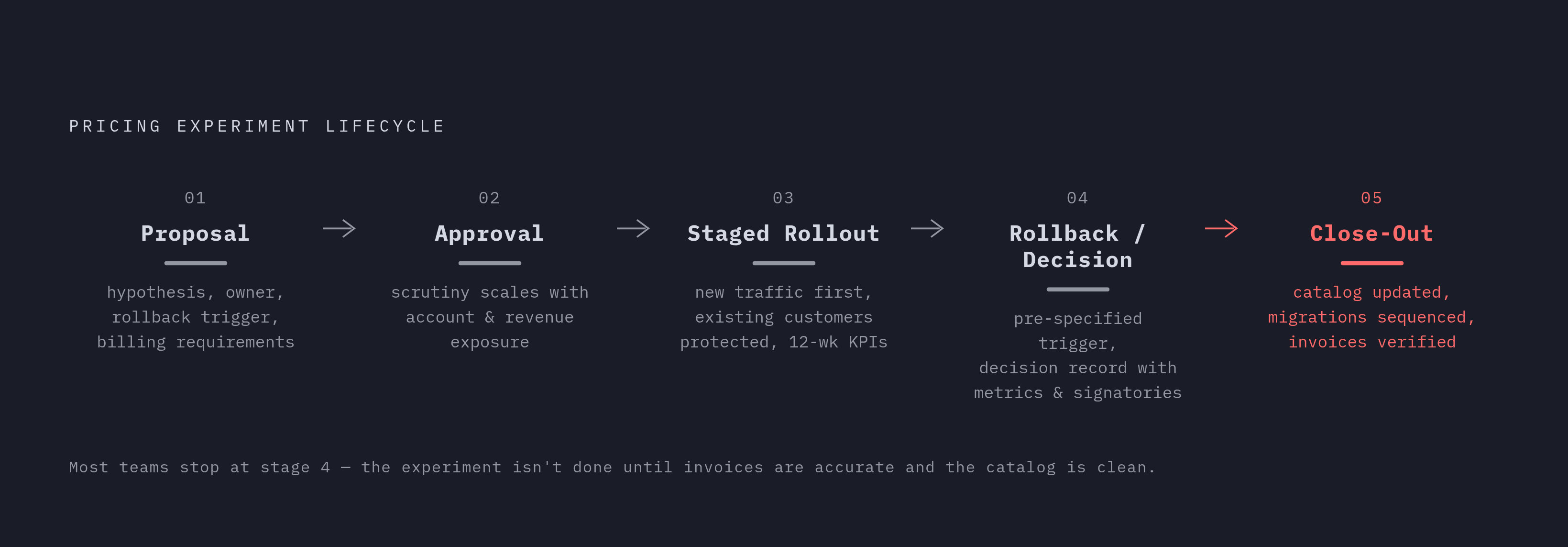
Declaring a winner begins the operational close-out. The decision record must capture the supporting metrics, decision date, decision-makers, and precise configuration of the selected pricing model. It becomes the source of truth for Finance’s recognition work, Legal’s contract amendment process, and Customer Success’s account communications. A general conclusion that a variant performed better is insufficient. The record must identify the actual settings that implementation will apply.
Winner implementation then follows a controlled migration sequence. The canonical plan configuration is updated to match the selected settings, and every account assigned to a divergent variant is identified. Those accounts are migrated in sequence rather than through an undifferentiated bulk update, with individual event logging. Variant assignments are deactivated and experiment-specific catalog objects removed. The experiment record remains open until the first post-migration invoice cycle has been checked for accurate charges across every migrated account.
Legacy customers require a separate migration track from new-cohort implementation. Results from new sign-ups do not authorize changes to existing contracts, which still require Legal and Customer Success review. As a governance deliverable, customer communication must have a defined owner and timeline, particularly when the change alters metering or invoice structure. Separating these obligations prevents the winning test from becoming an automatic ratchet across the installed base.
Formal close-out also prevents experiment debt from accumulating. Orphaned plan objects, unresolved assignments, and manual account overrides create billing paths that become expensive and error-prone to maintain. Success therefore means that even a failed test ends with accurate invoices, a clean catalog, an auditable decision record, and customers who were not surprised by their charges.