Engineering Cost of Maintaining In-House Billing Codepaths
Building billing is the easy part; maintaining it quietly drains engineering.

In-house billing codepaths cost more to maintain than their initial scope suggests. The build produces a working system, but ownership creates a permanent claim on engineering capacity. As pricing evolves and billing becomes embedded in the product stack, that claim grows. The build-or-buy decision therefore turns on the cost of maintaining a second product beyond shipping its first version.
Why billing looks like a contained project before you build it
Shubhendu Shishir, Head of Engineering at Simplismart, described the demands of his team’s homegrown billing system with a revealing phrase. “It's just how it is”. The response captures how easily maintenance becomes an accepted condition of operating the product rather than a cost attributed to an earlier architectural decision. The estimation error starts well before that acceptance.
Track usage, work out the charge, create an invoice, and process the payment. A prototype covering those steps genuinely is achievable in a few weeks, perhaps with credit wallets included. Vendor estimates put the build phase at 2–3 months. Neither estimate, however, establishes what the team will have to support once customers depend on the result.
Running the system in production brings work that was rarely part of the original plan. Deduplication and backfill handling for out-of-order events complicate usage capture, while proration and mid-cycle changes complicate otherwise straightforward calculations. Dunning flows, entitlements, subscription lifecycle edge cases, and revenue reporting add responsibilities beyond generating a correct invoice. These are not optional refinements to the prototype. Owning a billing flow entails these responsibilities, yet their ongoing cost often appears only as a share of every subsequent sprint.
How usage-based and credit-based pricing turn billing into a system that touches every layer of the product
A flat subscription fee can run largely in the background without closely involving the product stack. Consumption pricing changes that relationship at its root. Usage must be measured wherever it occurs, so billing becomes a first-class engineering concern. Instrumented API calls feed event pipelines and real-time aggregation, while pricing logic operates against live counts. Quota enforcement also reaches into the application layer, making billing part of how the product grants access.
Credits extend that dependency into the request path. Real-time balance checks must not add API latency, and credits must be applied in the right order. The system also needs automated access blocking when credits deplete, customer-facing burn-rate visibility, and grace period logic. A credit wallet is therefore not just another way to display an amount owed.
The dominant pattern combines committed seats or tiers with metered usage and dedicated AI-consumption credits, requiring the billing system to support all three simultaneously. Changes to one dimension must coexist with the others. When pricing configuration is tied to the event stream, even a change to commercial terms needs a software deployment, so pricing decisions move only as fast as engineering has time for them.
What the ongoing maintenance burden actually looks like once the system is in production
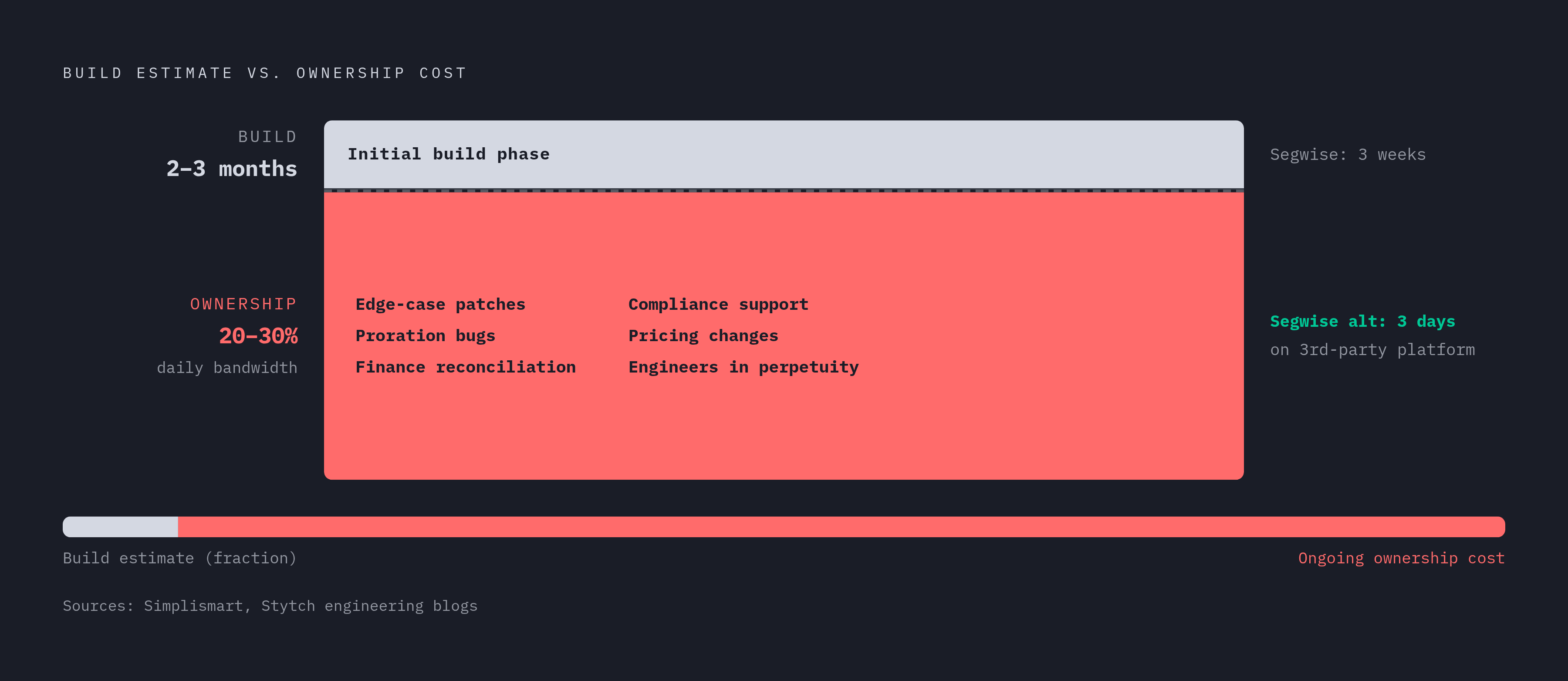
Simplismart spent 1.5–2 months building its billing system. After launch, maintenance consumed 20–30% of daily engineering bandwidth, yet the system still broke under heavy load and synchronized data through non-real-time cron jobs. Shishir called the work “building billing as a second product”.
Stytch came to a similar view before deciding to build its own system. Its evaluation found that homegrown billing would require a couple of engineers in perpetuity, making ownership a standing team allocation. That allocation covers work with no single completion date. Edge-case patches, proration bugs, requests from finance for reconciliation, and pricing changes keep coming after the first build is done. The permanent tax is the capacity required to keep the system accurate, responsive, and available.
At Simplismart, sales could not close a deal with a custom rate without first filing an engineering ticket. A pricing exception therefore competed with product work before the contract could proceed, while finance depended on engineering to act on billing needs. The constraint extended beyond the engineering backlog itself. After moving to a dedicated billing platform, the team recovered a significant share of its engineering bandwidth and achieved substantially faster pricing iteration, showing how closely commercial flexibility had been tied to the homegrown codepaths.
Why the burden compounds rather than stabilizing over time
The first pricing model is rarely the last. Tiered pricing, volume discounts, per-customer overrides, promotional rates, and contract-specific minimums arrive after the billing architecture is already serving customers. In a homegrown system built around the original model, these additions require migrations on live customer data. Maintenance grows because the system must accommodate new terms without losing the ability to support those already in use.
Metering choices can limit pricing for a long time. The architecture chosen early in the build determines which future pricing options it can support, turning an implementation choice into a limit on go-to-market strategy. A model that seems simple from the business side may not fit how the system handles usage. The business then needs more than new pricing logic. It needs changes to the infrastructure on which that logic depends, with the existing customer base already attached.
This accumulation also changes the economics of leaving. As billing becomes embedded in the product stack, the cost of migrating away grows with the cost of maintaining it. The system is no longer an isolated component that can be judged only by its own code. It is connected to product access, customer agreements, finance workflows, and the organization’s ways of changing prices. That creates lock-in without a vendor contract, because retaining the system consumes more capacity while replacing it becomes a larger undertaking.
The compliance and finance accuracy burden that engineers did not sign up to own
Getting billing right takes more than charging the customer the right amount. ASC 606 treats usage-based pricing, performance bonuses, and volume discounts as variable consideration. The standard requires estimating total expected consideration and constraining that estimate to an amount where a significant revenue reversal is not probable. Recognizing the full value of a potential overage contract on day one is a material failure, because recognition must follow metered consumption.
That requirement gives metering a role beyond invoice calculation. For usage-based revenue, it is also the mechanism supporting revenue recognition, so its accuracy becomes part of the finance control environment. Subscription, usage-based, and hybrid arrangements can involve complex multi-element performance obligations that past control architectures were poorly designed to handle. When billing is in-house, engineering owns the code supporting those obligations. Compliance work therefore joins the same maintenance queue as billing changes that affect the product.
SOC 1 Type II reports do not always match ASC 606 revenue-recognition objectives exactly, so auditors and management have to deal with the gaps. An internal system avoids no such responsibility merely by being internally controlled. It places the full audit burden inside the organization, where engineering must support the evidence and accuracy that finance requires.
When finance cannot trust the automated results, its requests go back to engineering, adding more ongoing work for the team that owns the system. Vercel reduced its need for temporary manual-reconciliation staffing by half after moving to a dedicated billing platform. The result shows that billing architecture can affect staffing beyond the team maintaining it.
The legitimate case for building in-house, and where it actually holds
Complete control over pricing logic, data ownership, and integration architecture is a legitimate reason to build internally. A custom system also removes vendor dependency and revenue-share arrangements from the billing architecture. For some products, that control serves a concrete requirement. There may be no off-the-shelf platform that fits outcome-based pricing, multi-sided marketplace billing, or dimensions that no existing platform models. In those circumstances, building is a response to the product’s actual needs.
Enterprise contracts can strengthen that case through their variability. Custom metrics unique to one account, bespoke discounts, special billing cadences, and commitments with drawdowns, floors, and overages all place demands on the underlying model. A platform that cannot represent those terms moves custom engineering into the integration around it. An internal architecture designed for the required variability can therefore be a rational choice.
Deployment and governance requirements can make the decision more direct. On-premises or sovereign cloud requirements from regulated or public-sector customers disqualify many external platforms before feature evaluation begins. Data sovereignty can narrow the available options further. In some enterprise contexts, full audit access through an in-house system is the only architecture that satisfies governance requirements.
What the decision actually costs when the build-or-buy question is answered honestly
Outside those conditions, the relevant comparison is total cost of ownership and the product work that ownership displaces. Build time is only the first entry in that calculation. The decision must also account for ongoing engineering time, support for finance, slower contract changes, and how hard it will be to migrate later. A technically capable team can still make an expensive allocation choice. Operating billing must justify the capacity it will take from the rest of the product.
Segwise spent three weeks building its own credit infrastructure before scrapping it, then shipped working credit infrastructure in three days on a third-party platform. Kush Daga’s conclusion was direct. “don't build a credit system yourself. The work never stops. It just gets less visible.” Replit exposed a different part of the same opportunity cost by avoiding a 4–6 month product launch delay when it chose not to build a new in-house billing system. These decisions concern time available for the business.
For AI and usage-first products, the architectural comparison must cover the full production requirement. That includes real-time event ingestion, multi-dimensional pricing, prepaid credit wallets with postpaid invoices, and pricing configuration that does not require a deployment. Metering and billing are one connected problem. A custom metering layer joined to a payment processor can retain the integration maintenance burden even when payment processing itself is external. Infrastructure built for these needs has options that support millisecond event ingestion, both payment mechanics, and on-premises deployment to meet enterprise requirements.
Flexprice, a usage-based billing platform and the vendor behind the case data cited here, is one such option. Its Simplismart example describes the team moving from homegrown billing to metered infrastructure, recovering engineering bandwidth and changing pricing without a code deploy.
Billing ownership should be evaluated as a continuing resource commitment, with internal development justified by requirements rather than by the apparent simplicity of the first build. Product and finance should be able to change pricing without going through engineering every time. That outcome requires an architecture in which commercial configuration is not trapped inside deployment-dependent code. The final decision belongs against the team’s other priorities. It turns on what engineering time is worth, and how much of it the organization intends to allocate permanently to billing.