Metering Granularity Tradeoffs for Token-Based AI Products
Choosing metering granularity wrong destroys margins, breaks pricing, and kills customer trust.

Metering granularity is the resolution at which a token-based AI product counts and attributes usage. Get it wrong and three things go bad at once: margins go dark, the pricing model breaks under its own assumptions, and customers stop trusting the invoice you send them. Nobody plans for this to happen. It shows up the day someone finance-adjacent asks why tracked usage and the provider bill are $40,000 apart, and no one in the room can say when the gap opened.
An assumption baked into almost every early metering setup causes the trouble: one user action equals one billable unit. That holds for exactly as long as it takes someone to ship an agentic feature. A single query can trigger a dozen model calls inside a reasoning loop, each with its own input and output count. Conversation history makes it worse, because input tokens don't accumulate on a flat line, they accumulate on a curve that steepens as the context window fills.
Underneath that sits consumption most metering setups never catch. Retry logic burns tokens on failed calls that produce nothing billable. Retrieval-augmented generation quietly inflates the input side with embedding calls and retrieval context on every prompt. System prompts, tool schemas, and structured output instructions ride along invisibly on the product dashboard, then show up in full on the provider's invoice. Whether a team can even see that gap depends entirely on the granularity it chose to meter at, back when nobody was paying attention to the choice.
What metering granularity actually means in a token-based system
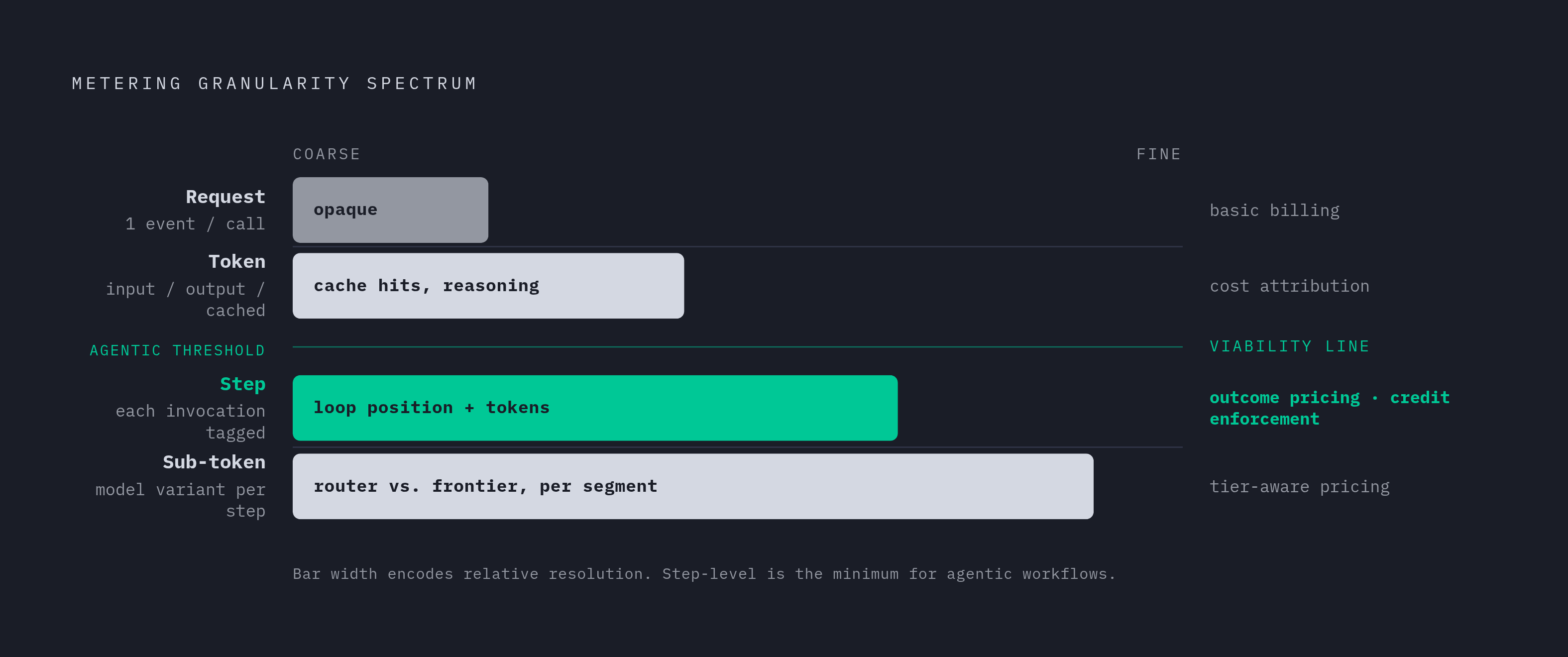
Granularity is the resolution at which usage gets captured, attributed, and stored. Think of it as a dial with several settings, and the settings interact in ways that punish anyone who picks one without thinking through the rest.
At the coarse end sits request-level metering: one event per API call, regardless of how many tokens that call burned. One notch finer is token-level metering, splitting input from output and, where the provider supports it, cached or reasoning tokens within the same call. Finer still is step-level metering, built for agentic workflows, where each model invocation inside a multi-step loop generates its own event tagged to its place in that loop. At the far end sits sub-token or model-tier granularity, distinguishing cost by which model variant touched which part of the pipeline. A cheap routing model and a frontier model can sit in the same request and cost wildly different amounts.
Attribution is a separate axis, and people conflate it with resolution constantly. Resolution tells you how finely you're counting; attribution tells you who or what generated the count: a user, an API key, a feature, a tenant, a single agent run. Coarse attribution hands you a total. Fine attribution traces that total back to the session or workflow step that produced it. A team can have token counts accurate to the decimal and still have no idea which customer is driving them, if the attribution layer wasn't built to match.
Then there's the temporal piece, how often events get flushed, aggregated, made queryable. Batch processing on an hourly or daily cycle is cheap and simple. Near-real-time processing is expensive and hard to build, and it's the only option if a spending cap needs to fire before a customer blows past it. This is mostly an infrastructure cost question, and it caps which dashboard and enforcement features are even on the table.
A team can pick fine-grained token counts and pair them with coarse attribution, and end up with numbers accurate down to the token that are also completely useless, because nobody can trace them back to a customer or a decision worth making.
How granularity level shapes cost accuracy and margin visibility
Token prices keep falling on a per-unit basis. That hasn't simplified billing at all. Per-workflow costs are climbing as agentic loops get longer and context windows fill faster than unit prices drop. Cheaper tokens, consumed in much greater volume, add up to a costlier product than the per-unit price would suggest.
Request-level metering hides the cost structure of anything with more than one step. A developer sees one call go out, one response come back. Underneath, the model might have made dozens of invocations, each one adding to a context payload that grows with every turn. If the event only fires at the boundary of the request, every intermediate step vanishes from the record. The cost was real; the visibility wasn't.
Margin takes the direct hit. Gross margins on AI-native products are still finding their floor, and a company that can't see actual token consumption per workflow has no way to know whether a given feature sits above or below its target margin on any given day. You can't manage what your own metering layer refuses to show you.
Making it worse is the input-output price gap. Most providers charge the two at very different rates, and a request-level count flattens that ratio into one number. A response ten times longer than average shows up identical in the log to a short one. Two requests that cost wildly different amounts land on the books as the same line item.
Mixed-model pipelines pile on from there. Route a request through a cheap embedding model, a mid-tier reasoning model, and an expensive frontier model in one interaction, and coarse metering collapses it into a single aggregated token count, blurring together costs that can differ by an order of magnitude. Finance teams closing the books on that number aren't working from a real figure. They're working from an approximation, and the error compounds as the product does.
How granularity shapes what pricing models are even possible
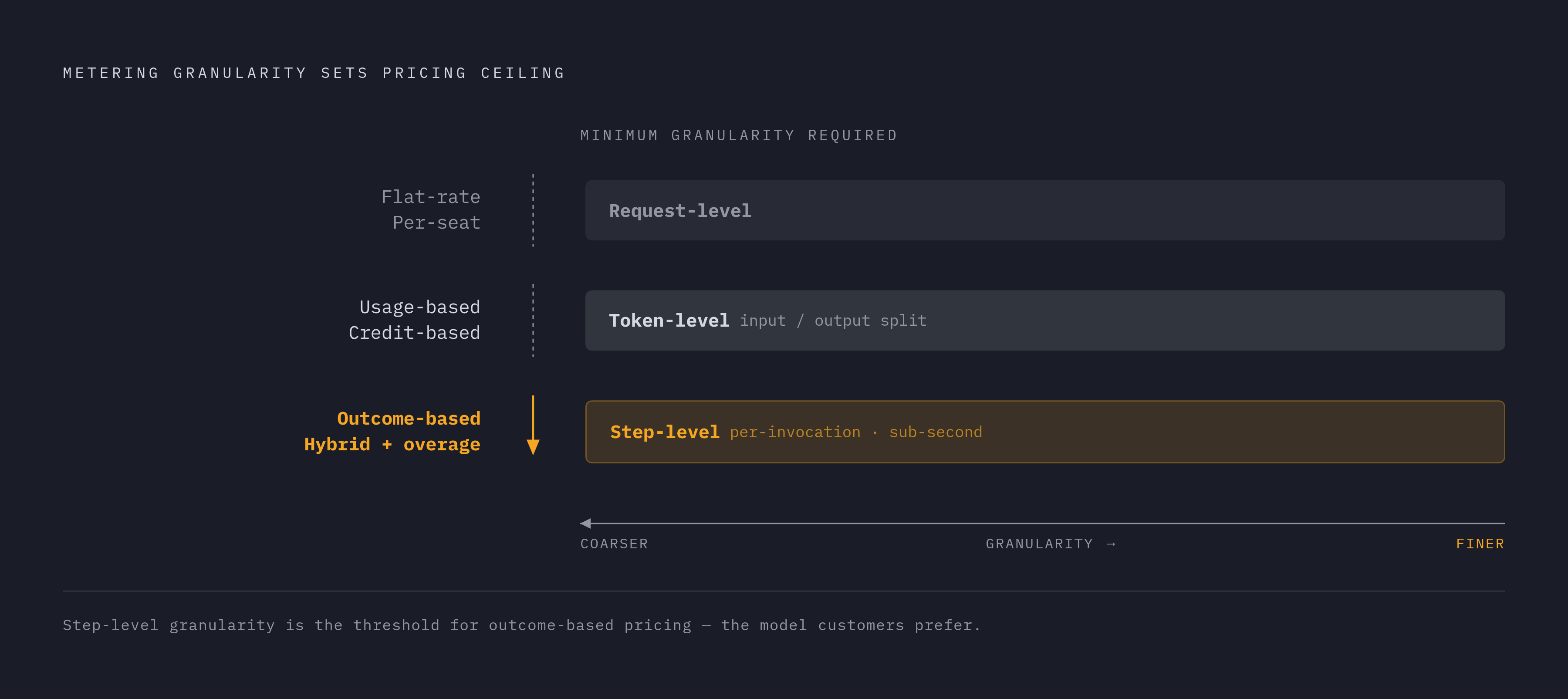
Here's the part most teams underestimate until it bites them: whatever pricing model a company can credibly offer is bounded by what its metering can actually measure. The architecture sets the ceiling. Pricing strategy lives under it whether anyone likes that or not.
Take outcome-based pricing, charging per resolution or per completed task, popular because customers would rather pay for results than raw consumption. It only protects margin if the full token cost behind every outcome is known. A $0.99 resolution fee is fine if that resolution burned a modest number of tokens. It's a disaster if it burned orders of magnitude more, and there's no way to tell the difference without granular tracking underneath the price.
Credit-based models carry the same dependency one level down. Credit deductions have to map to actual consumption, which means per-token or per-step attribution, not a periodic estimate. Hybrid models, seat-based with metered overage stacked on top, need a clean line between what the seat covers and what triggers extra charges. Coarse metering blurs that line, and a blurry line is exactly where billing disputes start.
Agentic workflows raise the stakes further. Analysts at Gartner and elsewhere expect agents to show up in a large share of enterprise software within the next two to three years. That's precisely the use case where request-level metering is most dangerous, because a single agent run isn't one request but a chain of them, and treating the chain as one billable event throws away exactly the information a credit or outcome model needs to survive contact with reality.
Worth noting here is Google's move away from unlimited AI access toward a tiered credit system. Even an operator running infrastructure at that scale found flat-rate access couldn't hold up against metered reality, and the shift meant building granularity into the product itself rather than bolting it on after launch. Credit bundles and tiered allowances only work as pricing mechanisms if the platform can enforce them in real time, at sub-second latency, knowing exactly how much of a balance a workflow has already burned through. Without that, a pricing team's ability to run experiments, reprice a feature, test a new tier, launch a credit-per-outcome model, is capped by what the metering layer can actually see.
How granularity affects customer trust and the billing experience
Customers trust usage-based billing to the degree they can predict and verify it themselves. That shows up in dispute rates and churn, not just in survey sentiment. An invoice built on request-level totals with no per-feature breakdown gives someone a number with no story attached. Customers who can't reconcile a number against their own activity assume the worst. Why wouldn't they?
The "surprise charge" complaint that keeps coming up in AI billing conversations is a transparency failure as much as a pricing one. That pattern traces straight back to metering that wasn't granular enough to explain itself before the invoice landed.
Granular data is the raw material for any dashboard worth building. "4.2 million tokens this month" tells a customer almost nothing. Usage broken down by feature, by user, by individual agent run tells them what actually happened, and lets them manage a budget instead of just absorbing whatever number shows up. Enterprise buyers tracking spend across multiple teams need that attribution layer badly. A total alone doesn't cut it.
There's a sequencing habit worth adopting: ship the usage dashboard before touching the pricing. Separating "here's what you're using" from "here's what you'll be charged for it" gives customers room to trust the numbers before those numbers start costing them anything. Credit-based models turn this into a real asset when the metering is fine enough to show a live balance, since customers watch it tick down and can connect the movement to their own actions. The moment that balance moves in a way they can't explain, trust breaks, and it doesn't come back easily. Enterprise procurement teams increasingly ask for event-level export, not just an invoice total, as a condition of signing a contract.
The infrastructure cost of finer granularity
None of this comes free. Finer granularity means more events, full stop, and capturing per-step token counts in an agentic workflow can multiply event volume by an order of magnitude over request-level metering.
The load lands at three points. Ingestion has to absorb a much higher event rate without dropping data during traffic spikes, which means higher-throughput pipelines and sturdier queuing than a request-level system ever needed. Aggregation, rolling fine-grained events into something billable, gets heavier computationally as volume and rollup complexity both climb. Enforcement is the sharpest constraint of the three: checking a credit balance or usage cap fast enough to matter requires a low-latency read layer kept in sync with the ingestion stream, and the finer the granularity, the more often that layer has to update.
Fine granularity opens failure modes that simply don't exist at coarser resolution. Take concurrent agent sessions drawing against a shared credit pool. Each session can read the same balance before either commits its debit, so without atomic operations, both proceed, and the balance goes negative without ever tripping the limit meant to stop it. This stays invisible at request level, only showing up once usage is tracked at the step level under real concurrency, which happens to be exactly the scenario agentic products run on. Deduplication gets harder too. Basically solved at request level, but inside a retry-heavy agentic loop at step level, guaranteeing exactly-once processing takes real engineering work.
Teams operating at scale tend to converge on a dual-path design: a fast, approximate aggregation path for dashboards and real-time enforcement, and a slower, exact path for the final invoice. That split exists because the tension between latency and accuracy doesn't resolve itself at fine granularity; someone has to design around it on purpose. Fine-grained metering never arrives free of cost, and the honest question is whether the margin visibility, pricing flexibility, and trust it buys are worth what it takes to build.
Matching granularity level to product stage and pricing model
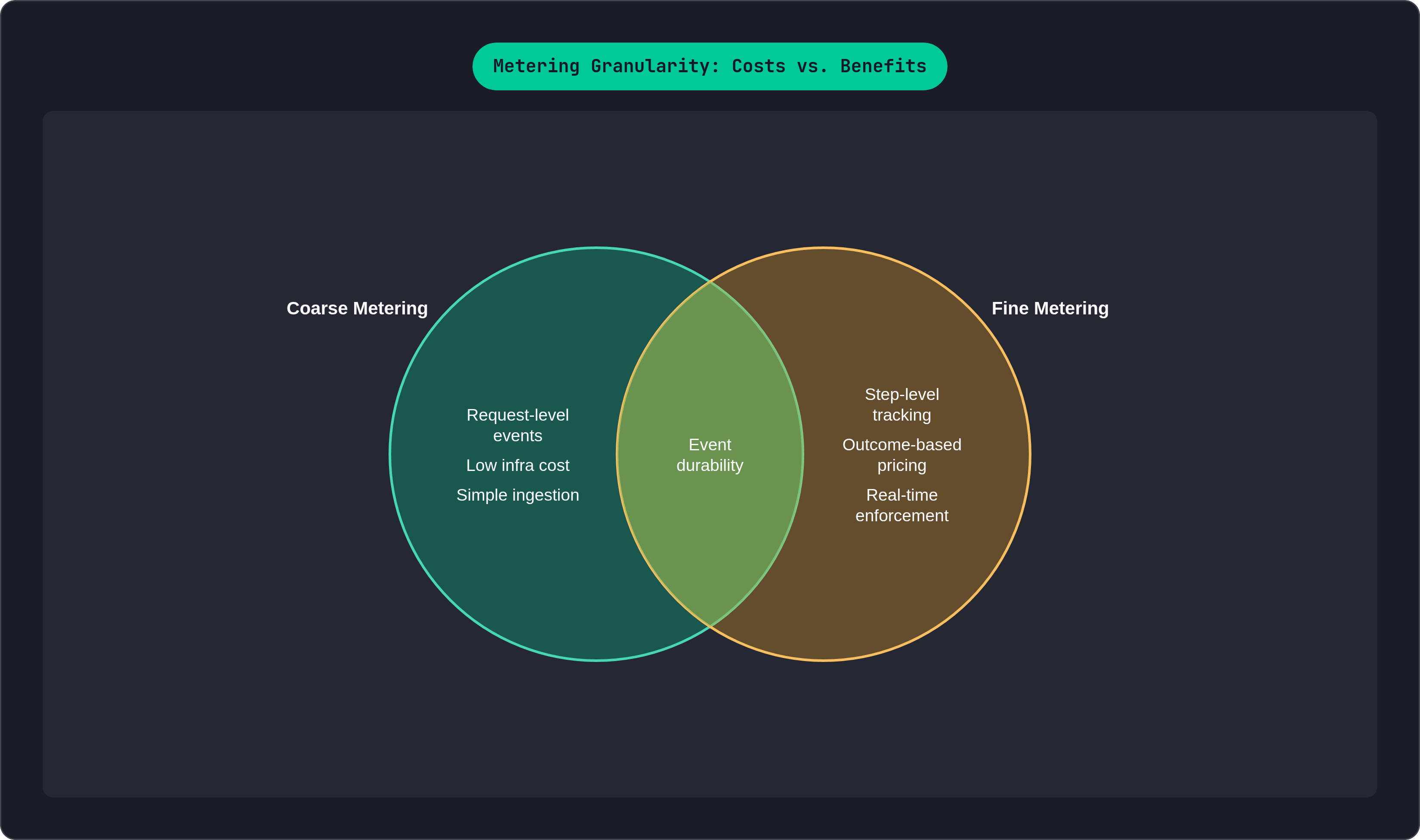
There's no single right answer here. The correct resolution depends on the pricing model in use, the shape of the product's architecture, and the scale the team is operating at right now, not the scale it hopes to hit next year.
Early-stage products running simple single-model inference under a flat-rate or per-seat plan don't need much. Request-level metering is usually enough to understand usage patterns and set a first price point, and the priority at that stage is getting accurate totals attributed correctly by customer, not building a per-step breakdown nobody asked for yet. One trick worth knowing: run fine-grained metering quietly in the background without surfacing it to customers, a kind of shadow billing, so a team can see what a granular invoice would look like before committing to sending one.
Move into usage-based or credit-based pricing and token-level granularity stops being optional. Capturing the input-output split from day one saves a painful migration down the line, since that split matters directly for margin math once volume grows. Per-feature attribution at this stage also opens the door to pricing experiments, letting a team reprice one feature in isolation without disturbing everything else.
Agentic or multi-model pipelines need step-level granularity, no way around it. Every model invocation in the workflow has to emit its own event, tagged with its position in the chain and which model variant handled it. Skip that, and outcome-based pricing goes margin-blind while credit enforcement becomes something a team hopes works rather than something it knows works.
The sequencing principle holds across all of it: granularity has to lead pricing complexity, not follow it. Teams that launch a hybrid or outcome-based model before their metering layer can support it are pricing on guesswork dressed up as strategy. With agents projected to make up a large share of enterprise software within a couple of years, teams selling into that market need step-level metering built into the architecture now, before the agentic features ship, not stapled on after a customer disputes an invoice.
What the metering layer must handle regardless of granularity choice
A few requirements don't move no matter where a company lands on the spectrum. Event ingestion has to be durable and ordered. Events that vanish during an infrastructure hiccup, or get counted twice, undermine every billing number built on top of them. This is the floor everything else stands on.
Deduplication isn't optional. Retry behavior in model provider APIs and client SDKs means the same token consumption can generate more than one event, and the metering layer has to catch and collapse duplicates without throwing away legitimate ones by mistake. Enforcement latency matters just as much. A credit check that arrives too slowly doesn't stop anything, it just documents the overrun after the damage is done. A billing event that shows up long after the usage happened is how disputes start and how vendors end up quietly eating costs they never priced in.
Mid-cycle changes add another layer of difficulty. A customer upgrading or downgrading partway through a billing period needs their usage split and attributed correctly to the right plan for each segment of that period, and getting this wrong generates support tickets fast. Underneath all of it, every billed number needs to trace back to the raw events that produced it. Not just for routine reconciliation, but for the disputed invoice, the enterprise security review, the SOC 2 audit where someone asks for proof the number is real.
Some purpose-built billing infrastructure tools address this layer specifically, offering real-time credit balance tracking, sub-50ms enforcement latency, and event ingestion meant to hold up under high-volume AI and API traffic, so engineering teams building AI products aren't also stuck building billing infrastructure on the side. The dual-path aggregation problem can be handled directly with fast approximate reads for enforcement and dashboards and exact aggregation for the invoice, without a team having to design that split itself. For enterprise customers with data residency or security constraints, on-premises deployment options exist, so the metering infrastructure travels with the product instead of turning into a separate compliance headache.
Granularity as an ongoing decision, not a one-time architecture choice
Most AI companies reprice within their first year of launch. That's not usually proof the original strategy was wrong. It's proof that the product, the cost structure underneath it, and the competitive landscape all moved faster than any pricing model drawn up at launch could have anticipated.
Every repricing event is quietly a re-metering event too. Moving from flat-rate to hybrid, or hybrid to credit-based, or per-seat to outcome-based, each transition demands a different resolution of usage data than the one before it. Companies that treat granularity as a decision made once at the start keep finding themselves rebuilding the same infrastructure under deadline pressure, usually right when a customer is already asking questions they can't fully answer.
The teams that handle this well treat their metering layer the way they treat pricing itself: as something meant to be adjusted, not poured in concrete on day one. That costs more upfront, but it's also the only approach that survives contact with a product that's still growing, and if the product is any good, it will keep growing past whatever plan anyone had for it.