Automated Invoice Reconciliation for High-Volume Usage Billing
Metering pipeline failures cause billing errors before reconciliation tools even open the invoice.
Usage-based billing does not fail at the reconciliation step. It fails upstream, in the metering pipeline, hours or days before anyone opens a matching tool, and by then the invoice is already wrong. The standard playbook, matching a line item to a purchase order, assumes a fixed quantity and a document to check it against. Neither exists when the invoice gets calculated after the fact from a stream of raw events. Fixing that means rebuilding the metering and billing infrastructure itself. Buying better reconciliation software will not do it, and most of the industry is still buying reconciliation software.
What high-volume usage billing actually looks like at the event level
A high volume of invoices is an accounts payable problem. A high volume of usage events that produce those invoices is a metering and billing infrastructure problem, and it's one nobody has ever solved with a spreadsheet. Finance teams that treat the two as the same thing get the diagnosis wrong before they've even started.
Look at how the pricing actually works. Snowflake bills on consumption across storage, compute measured in virtual warehouse credits, and cloud services. AWS meters hundreds of services down to granular units. Twilio charges per API call, per message, per capacity unit consumed. OpenAI and Anthropic bill on tokens, with separate rates for input and output. None of these are line items in the traditional sense. They're the output of a calculation run on raw telemetry after the fact, and that calculation is where the invoice either holds up or falls apart.
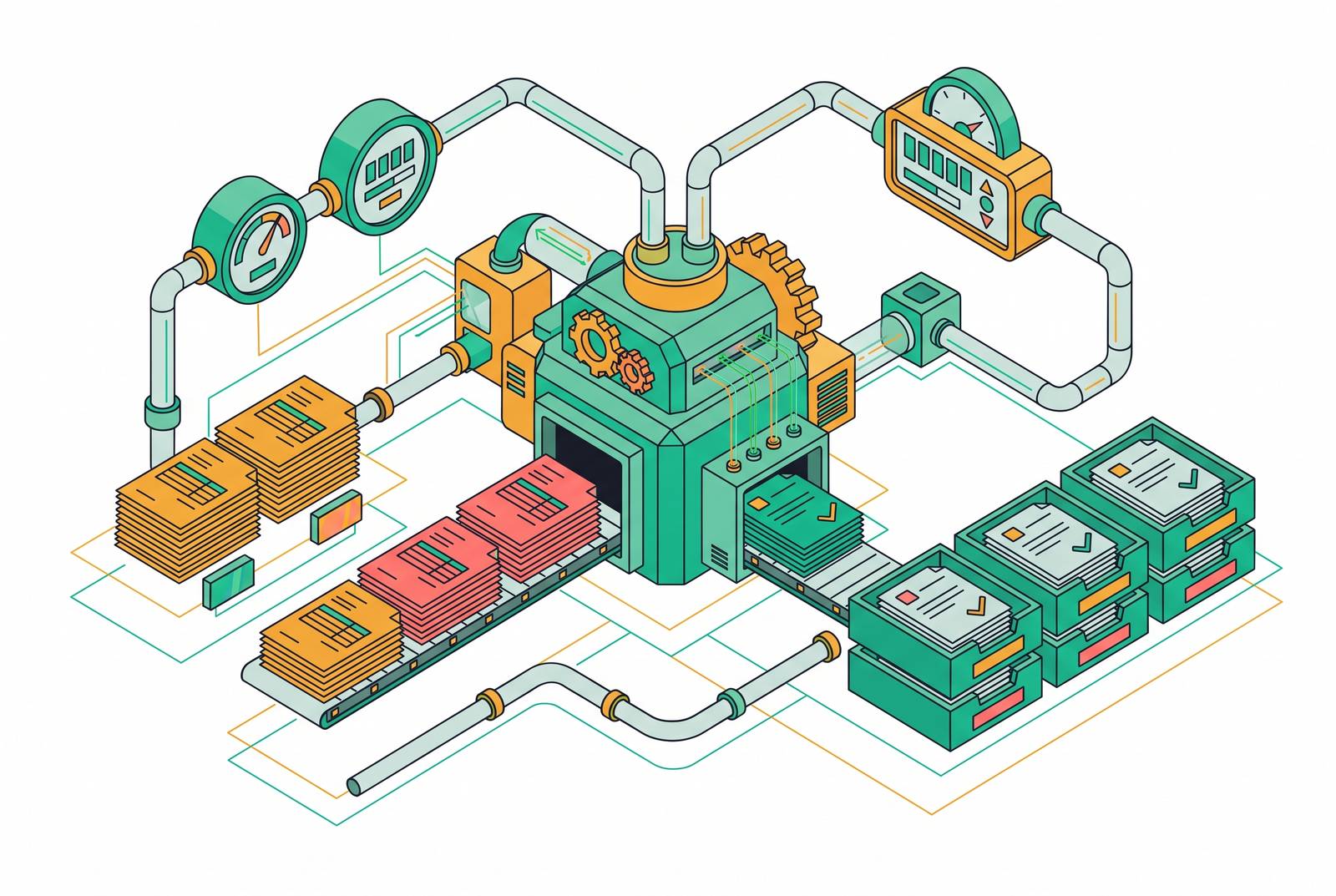
The calculation runs in three stages, and every one has to be right, not just mostly right. Ingestion collects the raw events, API calls, tokens consumed, storage written, agent actions completed, often at millisecond speed and enormous volume. Metering normalizes and aggregates that stream into billable metrics. Rating applies the pricing rules, tiered, volumetric, graduated, prepaid credits, to turn the aggregated metric into a charge. A metering system built for this workload has to handle up to a million billing events per second without losing accuracy. That number is a threshold drawn from operating conditions rather than a marketing spec. It's a correctness floor, because a dropped event at that volume compounds into a material revenue discrepancy, sent as a wrong invoice to a customer who is going to notice.
Volume is only half of it. A product billing simultaneously across tokens, GPU-minutes, audio minutes, megapixels, and hardware tiers cannot be modeled by a system built around a small, fixed set of line item types. Outcome-based billing makes it stranger still. HubSpot announced outcome-based pricing for its Breeze AI agents in April 2026. Clay introduced a dual-track model in March 2026 that separates platform execution, billed as Actions, from data enrichment cost, billed as Data Credits. In both cases, the "quantity" being billed is a derived or aggregated measure, not a simple count. It's a judgment call about whether a task succeeded, and no quantity-times-price formula was ever built to hold that kind of judgment.
By the time a reconciliation tool opens an invoice, the system has already counted, aggregated, rated, and assembled a charge out of millions of discrete events. Accuracy gets won or lost there. Everything downstream is paperwork.
Where reconciliation errors in usage billing actually originate
Metering errors account for an estimated 3 to 7% of annual billing leakage in usage-based SaaS businesses, the gap between revenue actually earned and revenue actually invoiced. That is not a rounding issue at scale, and it does not originate where most finance teams go looking for it.
Missed events are the obvious culprit: usage that never got ingested because a service was briefly down, a client SDK dropped the call, or the ingestion pipeline had no retry logic. Duplicate events run the other way, the same API call metered twice because at-least-once delivery got implemented without deduplication. Late-arriving events raise a harder question with no clean answer: a usage event that shows up after the billing period has closed, does it land on the current invoice, the next one, or does it just disappear? Rating errors creep in when the wrong price card applies, a tier boundary gets miscalculated, or a prepaid credit balance fails to decrement before overage charges kick in. Aggregation drift happens when running totals in a billing state store diverge from actual source event counts, usually because replays or retries were never built idempotent.
None of these produce a discrepancy that invoice-matching software can do anything about. There is no purchase order to check against, no goods receipt to verify. The error gets baked into the invoice before anyone opens a reconciliation tool. It is not sitting between two documents waiting to be caught.
Companies running separate billing codepaths, one for subscriptions, one for usage, one for credits, make this worse by design, because each codepath drifts independently of the others. The predictable result: the first week of every month gets spent reconciling the codepaths against each other, before anyone even reaches the customer. Reliability targets in this space reflect how little slippage gets tolerated. The recovery point objective for a billing pipeline is zero events lost, full stop, and the maximum acceptable downtime before events stop being metered runs around one hour. Reconciliation errors in usage billing are engineering failures wearing a finance costume. Sharper matching rules applied to a bad invoice just produce a fast, confident, wrong answer, and the confidence is the dangerous part.
Why the standard reconciliation tooling stack was not designed for this failure mode
Automated reconciliation tools pull financial data from multiple sources and apply rules-based logic to match transactions, one-to-one, one-to-many, many-to-many. For what they were built to do, they do it well: matching settled bank payments to open invoices, catching duplicate supplier bills, flagging quantity mismatches in PO-based procurement, handling partial payments and chargebacks. The reconciliation software market reached $3.52 billion in 2024 and is projected to climb to $8.9 billion by 2033. That's a category maturing fast, and it's solving the wrong layer of the problem for usage billing.
Best-in-class AP teams now process invoices in 3.1 days, against 17.4 days for standard departments, according to Ardent Partners' AP Metrics That Matter 2025 report. Automation is genuinely closing that gap. But speed of matching means nothing when the invoice being matched came out of a broken metering pipeline. The tool matches the wrong invoice to the wrong amount quickly, cleanly, and with total confidence, and that confidence is exactly what makes the error hard to catch.
Roughly 75% of AP departments worldwide now use some form of AI in their operations, and reconciliation breakdowns still happen constantly when invoice formats vary, reference numbers don't line up, or ERP records fall out of sync. Usage billing introduces a mismatch that predates all of that. Standard AP reconciliation assumes a fixed set of line items to check against an external document, a PO, a contract, a receipt. Usage billing produces line items with no external document counterpart at all. The only source of truth is the metering system itself, and that's precisely the layer the reconciliation tool never touches.
Vendors like to point to exception handling as their real differentiator, and it is genuinely useful for what it does. It just cannot resolve a metering error. It can flag that an amount doesn't match the customer's own usage logs, and then a human still has to dig through the event data to find out why. AP reconciliation tooling and usage billing accuracy are two different problems that happen to look similar from a distance. Buying sharper matching software does not fix a metering pipeline that was never counting correctly to begin with, and no amount of exception-queue polish changes that fact.
What accurate invoice generation in usage billing actually requires
The goal is invoices correct by construction, so reconciliation becomes a confirmation step instead of a search for what went wrong. That's a different design target than what most billing stacks were built around, and it changes which properties actually matter.
Four properties make it possible. At-least-once ingestion paired with exactly-once accounting means events never get silently dropped, and deduplication, usually through idempotency keys, ensures the same event never gets counted twice. Partitioning by customer keeps one customer's usage spike from corrupting another customer's running total, which matters more than it sounds once volume gets uneven across an account base. Real-time aggregation against a durable state store, often something like Redis, keeps the billing period's total current at all times, rather than reconstructed from batch logs once the month ends. Event replay capability, usually backed by a message broker like Apache Kafka, means any billing period can be recomputed from the original source events if a pricing rule turns out to have been applied wrong.
Stream processing versus batch processing is the fork in the road here, and it is not a minor architectural preference. Batch systems leave billing state hours or days stale, which makes real-time credit enforcement and live spend alerts effectively impossible. Choose batch, and those features are already gone, no matter what the product roadmap promises. Stream processing applies billing logic as events arrive, so the system's view of usage stays close to real.
Pricing complexity has to live in the rating layer from day one, not get bolted on after the fact. Graduated tiers, volume discounts, prepaid credit wallets, overages, outcome-based charges: the rating engine needs to know which rule applies to which event the moment that event lands. Prepaid credit wallets running alongside postpaid invoicing on the same engine are no longer an edge case worth deferring. AI credit adoption grew 126% year-on-year in 2025, and 29% of companies now use some form of AI credit model. That's mainstream, not experimental, and treating it as a future problem is a mistake teams tend to make right up until launch day.
Audit trail completeness belongs on this list too, and it is a correctness requirement, not a compliance checkbox. Every line item needs to trace back to the exact events that produced it, so a dispute gets resolved by showing the customer the underlying data, not by asserting the total is right. The practical test: can finance close the billing period without burning the first week of the month reconciling codepaths against each other? If not, what's being produced is a rough estimate wearing an invoice's clothing.
The pricing complexity that makes reconciliation harder over time
Usage billing does not settle into a stable configuration and stay there. AI and SaaS companies routinely cycle through multiple pricing approaches in their early years, and research tracking pricing changes across the industry finds that frequent packaging adjustments are the norm rather than the exception. That is the steady state for companies that have already found their footing. That's the steady state, and any infrastructure decision that assumes otherwise is already out of date.
Each change carries its own reconciliation risk. A new tier boundary means events from earlier in the billing period and events from later in it may need different rating rules within the same invoice. A new usage dimension, say, adding GPU-minutes to a product that used to bill only on tokens, means old invoices and new invoices no longer share a line item structure. A credit model introduced mid-contract means the system suddenly runs prepaid and postpaid mechanics side by side for the same customer, on the same invoice.
Hybrid models, combining subscriptions, usage-based charges, and token-based systems, are the norm now, not the exception. Each layer carries its own rating logic, its own reconciliation demands, sometimes its own billing cycle. SAP has signaled a shift toward AI consumption pricing. Anthropic lowered Enterprise seat prices for Claude, from as much as $200 per seat down to the $10 to $20 range, while shifting more of the charge to usage, though total enterprise costs have tended to rise anyway because API discounts disappeared and mandatory consumption commitments took their place. Every signal across the industry points toward more complexity, not less, and betting on stabilization is the wrong bet.
Go-to-market pressure only accelerates it. Among companies above $50 million in ARR, roughly half plan to introduce AI credits, and about a third of companies across the broader market plan to roll out credits within six to twelve months. Teams that have not already built credit wallet infrastructure will hit a reconciliation crisis on launch day itself, not sometime after. Pricing needs to be changeable by product and finance teams without a corresponding engineering ticket attached to it. If every pricing change requires a code deployment, it also requires a reconciliation audit afterward just to confirm the change applied correctly across every billing period still in flight. Pricing velocity is a permanent condition of usage-based businesses, and the infrastructure has to absorb it without generating new reconciliation debt each time it happens.
What finance and engineering teams need to see to trust an invoice
Finance teams need to close the month without reconstructing what happened from raw logs after the fact. That means invoices that document themselves: every line item traceable to the aggregation that produced it, every aggregation traceable back to the underlying event stream. Nothing short of that actually counts as closing the books.
Engineering teams need something adjacent but distinct: confirmation that the billing system counted what the product actually emitted. Not an audit of the invoice after it's issued, but direct access to the same event data that generated the charge in the first place. Customers need a third thing entirely, real-time visibility into their own consumption. Metered products that can't show a customer their usage while it's happening produce bill shock, and bill shock produces churn and support tickets, which just pushes the reconciliation problem further downstream instead of solving it.
Real-time spend dashboards and hard-limit enforcement, cutting off requests the instant a customer exceeds a credit balance, are only possible with stream processing underneath. Batch architecture cannot support either, because its view of billing state is always behind by definition. The audit trail requirement is not purely internal either. When a customer disputes a charge, the only real resolution is showing them the exact events that produced the line item. "The system says so" does not hold up when an enterprise finance team is reviewing a seven-figure invoice line by line, and it shouldn't.
In 2024, only 60% of invoices were manually entered into ERP accounting systems, down from 85% in 2023, a meaningful drop. But automation only helps if what gets automated was correct to begin with. An invoice that needs a support ticket or a spreadsheet audit to verify still requires reconciliation. Call it what it is: a disputed invoice that hasn't happened yet.
How to evaluate billing infrastructure for reconciliation accuracy, not just feature coverage
Asking a vendor whether the platform has a reconciliation dashboard, an exception queue, or a matching engine is the wrong first question, and it's the one most buyers ask anyway. Those features solve problems downstream of metering. None of them compensate for a pipeline that drops events, double-counts them, or applies the wrong price card, and no amount of dashboard polish changes what happened upstream.
The better questions go straight at the metering layer. Can the system prove zero event loss under load, not just claim it on a spec sheet? What happens, specifically, to an event that arrives after the billing period has closed, and is that behavior configurable or fixed in code? Can a full billing period be recomputed from the original event log if a pricing rule turns out to have been wrong, or does correcting an error mean manually adjusting the invoice after the fact? Does the rating engine support prepaid credits, tiered pricing, and outcome-based charges on the same customer at the same time, without separate codepaths that drift apart from each other?
None of this shows up on a typical feature comparison chart, because those charts get built around what a reconciliation tool does after an invoice already exists. The real evaluation happens one layer down, at ingestion, metering, and rating, because that's where the accuracy of every invoice downstream actually gets decided. A billing system judged only on how well it reconciles has already conceded the more important question: whether it needed to reconcile anything in the first place.