Revenue Cycle Mechanics in Subscription and Usage SaaS Businesses
How five interconnected systems drive revenue accuracy in subscription and usage-based SaaS.
Revenue in subscription and usage-based SaaS looks simple from the outside: a customer signs up, gets charged, and money lands in the bank. Underneath that surface sits a chain of five interdependent mechanics, metering, entitlement enforcement, invoicing, revenue recognition, and reconciliation, and each one can fail on its own without tripping an alarm anywhere else. The teams that close their books in days understand this chain as a system; the teams stuck chasing errors for weeks usually built it as five disconnected parts.
Under ASC 606 and IFRS 15, revenue is recognized when performance obligations are satisfied, not when the invoice is issued and not when cash is collected. For a twelve-month seat subscription billed upfront, that means recognizing one-twelfth per month regardless of when payment arrived. Usage-based charges are recognized as consumption actually occurs, which requires metering data accurate and timely enough to hold up under audit. Prepaid credits sit on the balance sheet as deferred revenue until they are drawn down, and hybrid models, seats plus usage, for example, require each component to follow its own recognition pattern simultaneously, which means the billing system has to produce line-item, period-level data fine enough for finance to split those components apart cleanly.
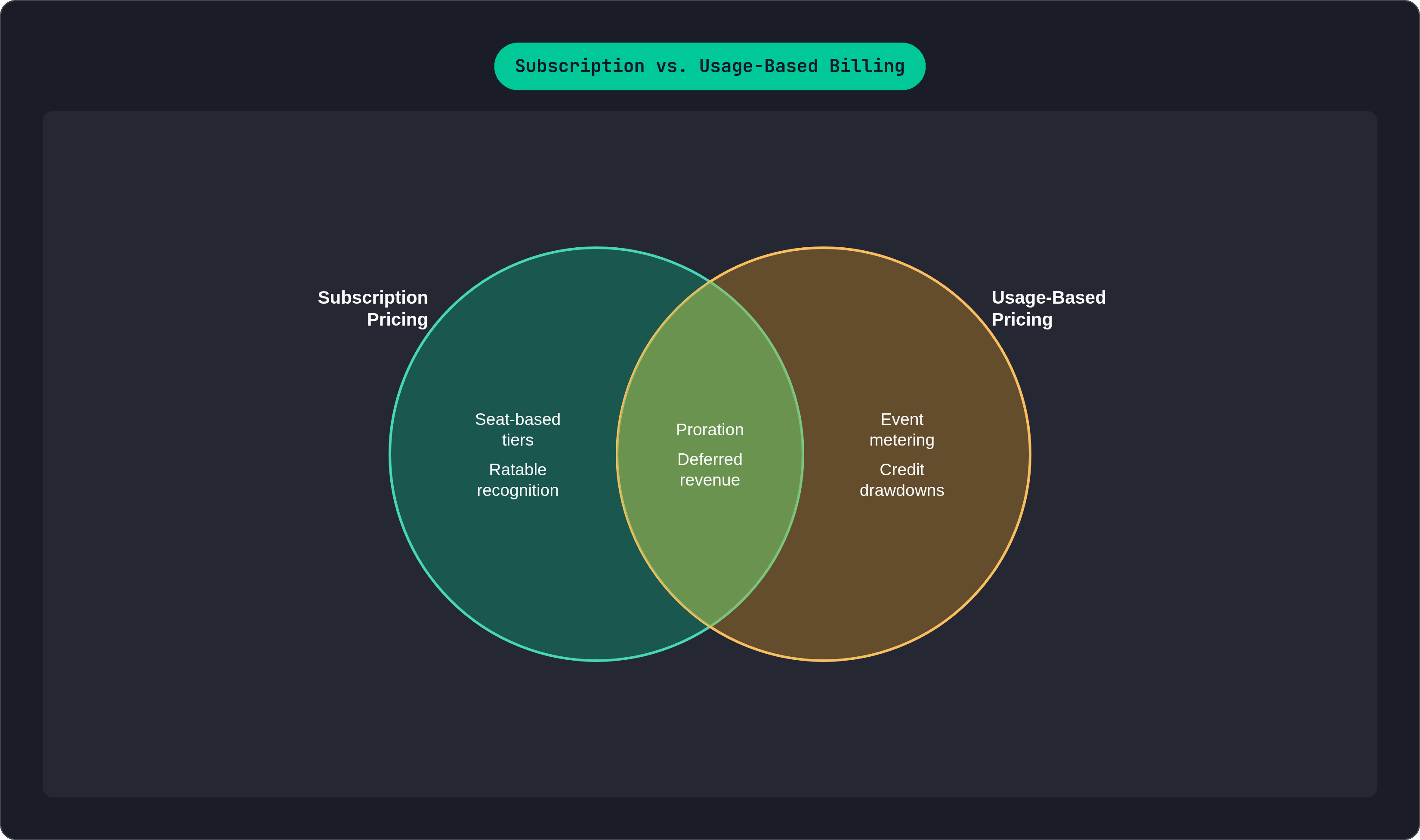
Subscription pricing alone introduces real complexity: tiers, upgrades, downgrades, proration, renewal timing. Usage-based pricing multiplies it, because now every unit of consumption, every API call, every token, every compute-minute, has to be captured, validated, priced, and billed without error. Hybrid models, seat plus usage, credits plus overage, compound both problems at once. A break anywhere in this chain doesn't just create an annoying invoice. It delays revenue recognition, produces customer disputes, and quietly accumulates reconciliation debt that compounds month over month. This piece treats the revenue cycle as a pipeline, not a single event, because that's the only frame that actually explains where things go wrong.
How metering sits at the foundation of every downstream billing decision
Metering is the continuous capture and recording of usage events: API calls, tokens consumed, compute minutes, active seats, data processed. It splits into two categories that behave very differently. Discrete events, a single inference call, a file upload, are one-off occurrences that need to be captured exactly once. Continuous state, seat counts, active licenses, storage volume at rest, needs to be sampled or tracked over time rather than logged as a single event. Treating both categories the same way is a common design mistake, and it shows up later as billing discrepancies that nobody can explain.
At scale, the ingestion problem is a velocity problem. Usage events arrive fast, sometimes in bursts, and the system has to capture them without losing any, duplicating any, or delaying any past the point where they're still useful. For AI products specifically, this isn't an abstract concern. A user's credit balance can hit zero in the middle of a session, and if the system is reading a stale balance, it has already handed out usage it can never bill for. That's not a rounding error. That's revenue given away, permanently, because the read happened a beat too late.
The common failure modes are well understood by anyone who has run one of these systems: dropped events during ingestion spikes, duplicate recording when retry logic isn't idempotent, clock skew between client and server that scrambles event order, and aggregation lag that makes real-time balance checks unreliable even when the underlying data is technically correct. "Real-time" gets used loosely in this industry. What it should mean is sub-second capture and near-immediate availability for downstream checks. What it often means, in homebuilt systems, is a batch job that runs hourly or overnight, which makes live enforcement structurally impossible no matter how good the rest of the stack is.
Metering is the single source of truth for everything that happens afterward. If it's wrong, the invoice is wrong. If the invoice is wrong, recognition is wrong. And if recognition is wrong, reconciliation stops being an accounting task and becomes a forensic one.
What entitlement enforcement actually does and where it sits in the cycle
Entitlement enforcement is the runtime decision: can this customer take this action right now, given their plan, their current usage, and whatever balance they have left? It runs on two inputs. The first is what the customer is entitled to, their plan terms, purchased credits, contracted limits. The second is what they've already consumed, which has to come from the metering layer in as close to real time as that layer can manage.
This check has to happen before the action is served, not after. Enforcing a limit after the fact isn't enforcement; it's an audit. By the time a post-hoc check catches an overage, the customer has already consumed the resource, and the business is now choosing between eating the cost or having an awkward billing conversation.
The failure modes here tend to be quiet rather than dramatic. Checking a cached balance that's gone stale allows consumption that's technically already been exhausted. Enforcing limits at the wrong granularity, account-level when the contract says workspace-level, or vice versa, produces access decisions that don't match what was actually sold. Grace periods and soft limits, when handled inconsistently, turn a policy question into a support ticket every single time. And overage logic that isn't wired into the invoicing layer means a customer can consume above their limit and simply never get billed for it, because the two systems never agreed on what "overage" meant in the first place.
Metering and entitlement are frequently built as separate systems joined by an implicit contract, an assumption about how fresh the data needs to be, how it's formatted, how fast it updates. When that contract is loose, this is exactly where silent revenue loss begins. It's also worth saying plainly: for credit-based AI products, the entitlement check is a trust signal as much as a technical one. A clear "you have 340 credits remaining" message builds confidence. An unexpected hard stop, with no warning and no explanation, is the kind of moment that turns a paying customer into a churn statistic.
How invoicing translates metered consumption and plan terms into a billable document
The invoice is a calculation artifact. It has to reconcile plan charges, usage charges, proration for mid-cycle changes, applied credits, taxes, and discounts into one document that both the customer and the finance team can trust. That means invoice generation depends on several inputs arriving correctly and on time: aggregated usage from the metering layer for the full billing period, the pricing rules tied to that customer's specific plan (tiered, volume-based, flat, per-seat), any mid-cycle plan changes and how they're prorated, prepaid credit balances and how they offset new charges, and any contracted discounts or minimum commitments layered on top.
Proration is where a lot of customer disputes are born. A customer who upgrades on day fourteen of a thirty-day cycle owes a different amount than a customer who joins fresh on day one, and getting that math wrong, even by a small margin, is the kind of error customers notice immediately because it shows up as a specific dollar figure on their statement.
Timing adds another layer. Arrears billing, charging after the usage period closes, keeps usage accuracy simple but creates a lag before cash actually arrives. Advance billing, common for seat charges, gets cash in sooner but demands accurate proration whenever seats or plans change mid-cycle. Hybrid billing, seats in advance and usage in arrears, is common in practice and requires the invoice to stitch two different timing models into one coherent bill without confusing the customer about what they're being charged for and when.
Automated invoice generation tends to break in a few predictable places: pricing rule changes that don't apply retroactively the way finance intended, usage aggregation jobs that haven't finished running before the invoice generation kicks off, and manual overrides that get applied once and then forgotten, untracked, until someone stumbles on the discrepancy months later. None of this is cosmetic. The invoice is a legal and financial document. Errors here create accounting liabilities, not just customer service tickets, and they complicate audits in ways that take far longer to unwind than they took to create.
How does revenue recognition work in usage-based and subscription SaaS businesses?
Billing and recognition are not the same event, and conflating them is one of the more expensive mistakes a finance team can make. Billing is when a customer gets charged. Recognition is when accounting rules allow that charge to be recorded as earned revenue. Under ASC 606 in the US and IFRS 15 internationally, revenue is recognized when, and as, performance obligations are actually satisfied, not when the invoice goes out and not when the cash arrives.
The mechanics differ by model. A twelve-month seat-based subscription billed upfront is recognized ratably, one-twelfth per month, regardless of when the cash was collected. Usage-based charges are recognized as usage actually occurs, which only holds up if the underlying metering data is accurate and timely enough to support that claim under audit. Prepaid credits are recognized as they're drawn down, not when the customer originally paid for them; unearned credits sit on the balance sheet as deferred revenue until they're consumed. Hybrid models often have each component following its own recognition pattern simultaneously, which means the billing system has to produce data at a granularity fine enough for finance to split those components apart cleanly.
This is what builds the deferred revenue waterfall that shows up on every SaaS balance sheet, and it's a direct reflection of how accurately the earlier stages performed. Inaccurate metering or invoicing doesn't just create a billing error; it distorts the waterfall itself, understating or overstating deferred revenue in ways that ripple into every subsequent reporting period. Finance teams need specific things out of the billing layer to close cleanly: usage data tied to the correct period, line-item detail on every invoice, credit drawdown records, and a clear audit trail of every mid-cycle change. When the billing infrastructure can't produce that data on its own, finance falls back to spreadsheets and manual extraction. That fallback is the root cause of month-end closes that take weeks instead of hours.
Where reconciliation fits and what it reveals about the health of everything upstream
Reconciliation is where every upstream assumption gets tested against reality. In practice, it involves matching payment receipts against open invoices, verifying that what was collected matches what was recognized, resolving discrepancies between what metering recorded and what invoicing actually billed, confirming deferred revenue balances against credit drawdown records, and investigating disputed line items before writing them off or crediting them back.
For teams running on weak billing infrastructure, this process is genuinely painful, because each discrepancy requires tracing back through metering logs, invoice histories, and plan change records that often live in systems that don't talk to each other. None of that tracing is automatic. Someone has to do it by hand, cycle after cycle.
The compounding problem is the part that does the real damage. Errors that go uncaught in one billing cycle carry forward into the next: deferred revenue balances stay overstated, usage discrepancies pile on top of each other, and each subsequent month-end close gets a little harder than the one before it. If reconciliation is consistently eating the first two weeks of every month, that's not a finance staffing problem. That's evidence of systemic failure upstream, and finance is just the team stuck holding it.
A well-instrumented billing pipeline makes a different outcome possible: automated matching, exception-only review, and a close measured in days rather than weeks. The cost of getting stuck in reconciliation debt goes beyond the hours lost. Finance teams working through that debt are slower to produce accurate forecasts, slower to catch pricing problems before they become customer-facing, and slower to support the go-to-market decisions that depend on trustworthy revenue data in the first place.
How the five stages interact as a system and where silent failures propagate
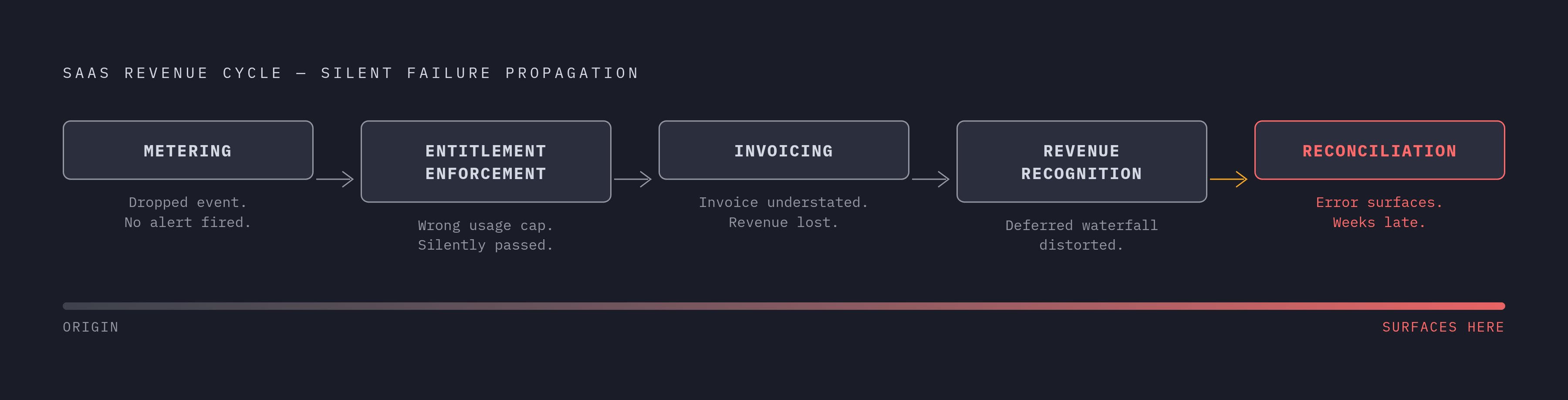
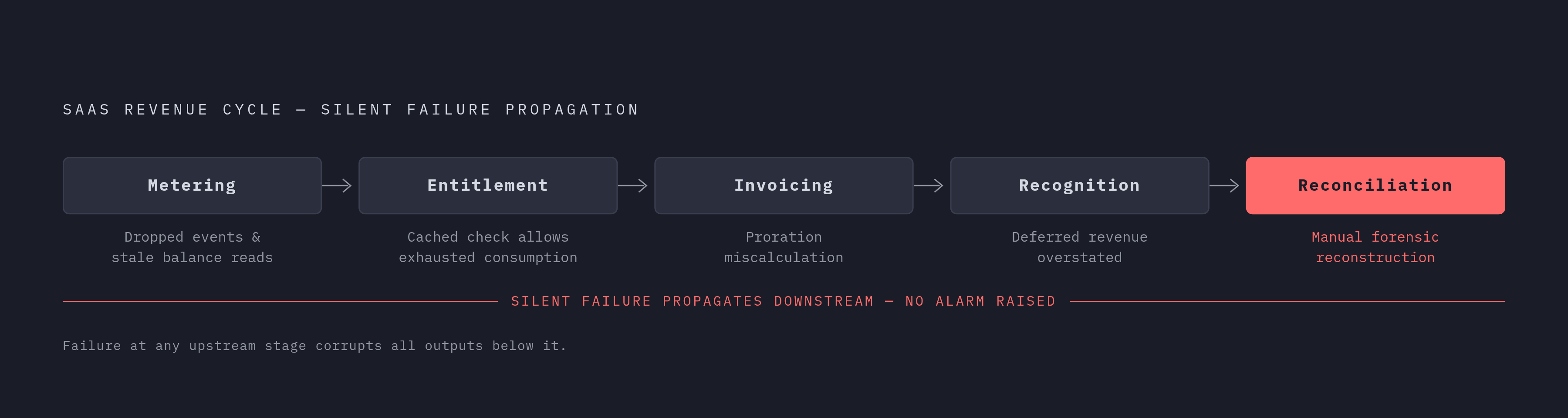
Each stage produces an output the next stage depends on. Metering feeds entitlement, entitlement informs invoicing, invoicing drives recognition, and recognition determines exactly what reconciliation has to go verify. The handoffs between stages are where things go wrong, and they tend to go wrong quietly.
A silent failure is an error that doesn't raise an alarm in the stage where it happens but corrupts the output of a stage further down the line. A dropped metering event doesn't throw an error; it just means the invoice comes out slightly low, and nobody notices unless they're comparing usage logs line by line. A proration miscalculation doesn't fail loudly either; it just means a customer is undercharged until someone eventually catches it, usually during an audit rather than in the moment it happened. A credit drawdown that isn't logged correctly doesn't break the product experience at all; it just means deferred revenue sits overstated on the books until reconciliation finally surfaces the mismatch, weeks or months after the fact.
That lag between failure and detection is the real danger. In a monthly billing cycle, a metering error on day two of the period might not surface until the close on day thirty, at which point the investigation is entirely retroactive: someone is reconstructing what happened rather than catching it as it happened. Teams that built billing in-house are disproportionately exposed to this pattern, because the five stages are frequently owned by different systems, different teams, or different scripts, with no unified data model and no shared audit trail connecting any of them.
Designing for observability across the full cycle means a few concrete things: event-level audit trails that can be queried all the way from the original metering event through to the specific invoice line item it produced, automated anomaly detection on usage aggregations before invoices are generated rather than after, and reconciliation dashboards that flag mismatches close to real time instead of surfacing them only at month-end. Teams that understand the cycle as a genuine system tend to build, or buy, infrastructure that treats every handoff between stages as a validation point, not just a data pass-through.
What modern billing infrastructure needs to handle to support all five stages reliably
The mechanics above set a fairly specific bar for what billing infrastructure actually needs to do. Event ingestion has to be real-time and idempotent, so duplicate and dropped events stop being a metering-layer problem entirely. Entitlement checks need to read live usage state rather than a cached snapshot, because a stale read is functionally the same as no check at all. Pricing configuration needs to handle tiered, volume, seat, credit, and hybrid models without requiring custom code for every new pricing idea the product team comes up with. Invoice generation needs to apply proration, credits, and discounts correctly against period-accurate usage aggregates, automatically, every cycle. Revenue recognition data needs to export at the granularity finance actually works in, line-item, period, component, not just a single invoice total that finance then has to manually decompose. And the whole thing needs a unified audit trail running from the raw event to the recognized dollar, so reconciliation becomes an automated check rather than a manual reconstruction project.
Legacy flat-rate billing platforms struggle here for a structural reason: they were built for a world where the invoice calculation is simple, seats multiplied by price, and usage was an afterthought rather than the primary driver of revenue. Retrofitting that architecture for usage-based and hybrid pricing tends to produce exactly the seams described throughout this piece.
The build-versus-buy question comes down to surface area. Building all five stages internally means building and maintaining five separate subsystems, plus the integrations between them, plus each subsystem's own distinct failure modes, and that surface area is much larger than it looks when a team scopes the first stage, usually invoicing, and assumes the rest will follow easily.
The stakes are highest for AI-native companies, where credit consumption happens at inference speed. When that's true, all five stages have to operate at that same speed; a billing platform that batches any one of them reintroduces the exact silent failure modes covered throughout this piece, just at a faster clock rate. Get the cycle running cleanly and the organizational payoff is immediate: engineering stops carrying billing on-call rotations, product can experiment with new pricing without filing an engineering ticket first, and finance closes the books in days. At that point the revenue cycle stops being a source of drag and becomes what it should have been from the start: infrastructure the rest of the business can actually grow on.