Detecting Invoice Drift Between Metering and Billing Systems
Usage-based billing loses 1% to 5% annually when metering and billing systems fall out of sync.
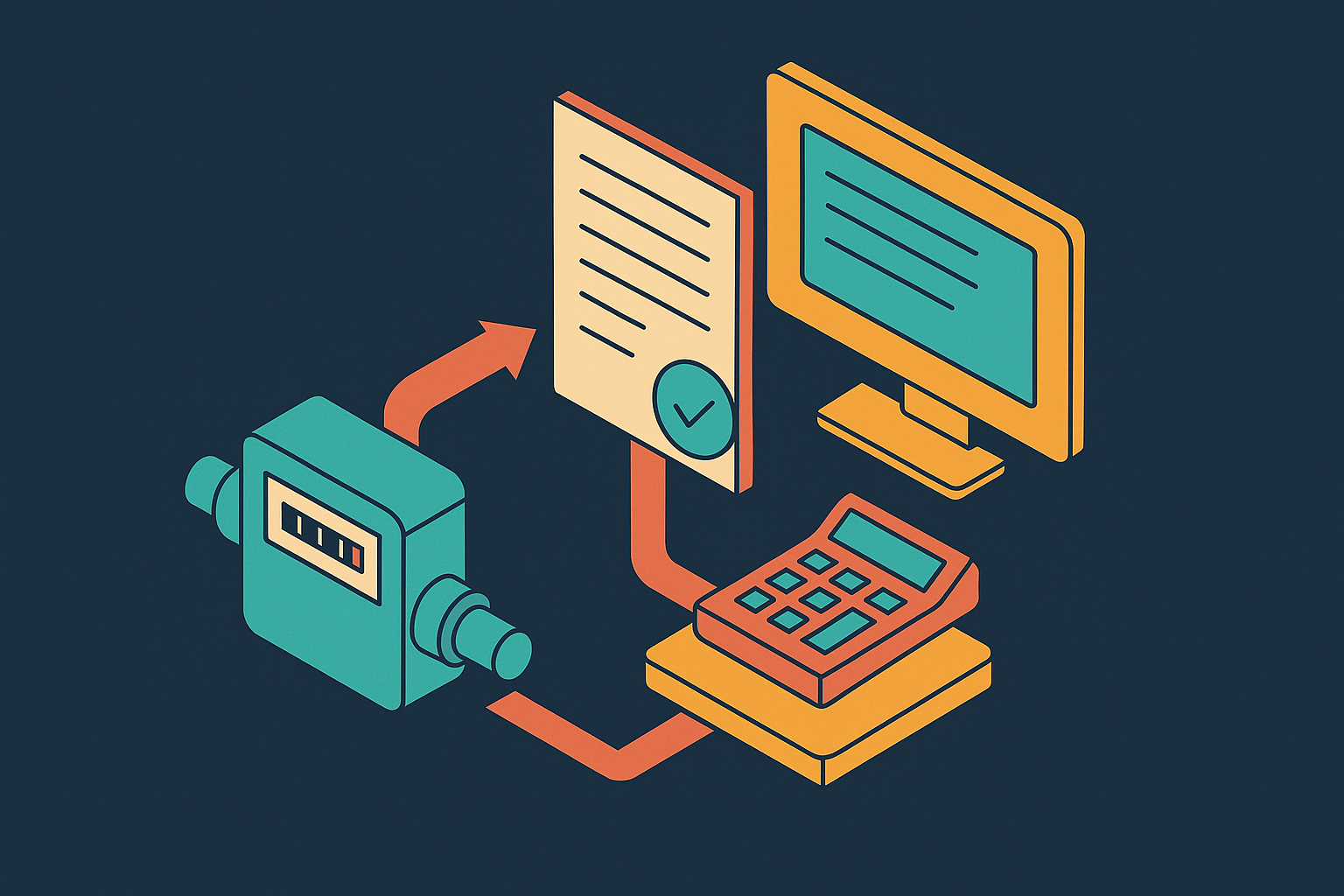
Invoice drift is the gap between what a metering system records as usage and what a billing system actually charges for it. It runs both directions, and both cost real money: customers get overbilled when usage gets counted twice or a rate applies upward when it shouldn't, and companies quietly give away revenue when events get dropped, tiers round down, or an expired discount keeps firing invoice after invoice.
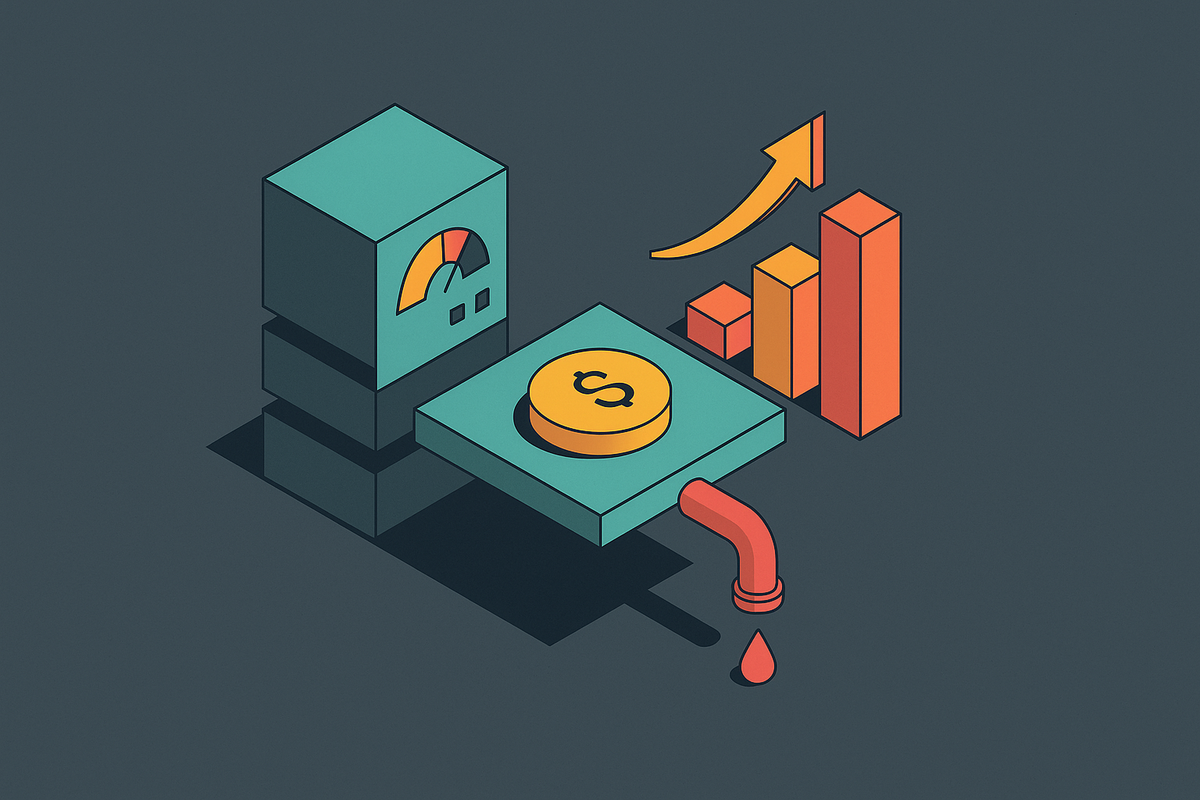
Drift is dangerous precisely because it doesn't behave like churn. Churn shows up on a dashboard. Drift earns revenue and then fails to collect it, or collects the wrong amount, without tripping any alert on the way. Each gap looks small by itself, a few cents here, a handful of missed events there, but stack it across a billing cycle, then a dozen cycles, and the total quietly eats margin until someone finally goes looking. Flat-rate subscriptions barely have room for this to happen: one price, one renewal date, done. Usage-based and hybrid pricing multiply the places where metering and billing can fall out of step, and per MGI Research, companies lose between 1% and 5% of revenue annually to billing-related leakage, which works out to $500,000 to $2.5 million for every $50 million in ARR. This isn't a collections problem, and treating it like one is the first mistake most finance teams make. It's a data consistency problem between two systems that were never built to stay in sync on their own.
How event delivery failures create the first class of drift
Most event pipelines guarantee at-least-once delivery: every event reaches its destination at least once, and retries are the enforcement mechanism. Billing needs something stricter, exactly-once accounting, where each unique unit of usage counts toward an invoice exactly once no matter how many times the underlying event shows up. Those are two different guarantees, and the gap between them is where the first class of drift lives.
Provider-side retries usually behave fine. They reuse the original event ID, an idempotency guard on the receiving end recognizes the duplicate, and the second copy gets dropped correctly. Client-side retries are the harder case, and this is the one worth losing sleep over. When a client's request times out waiting on a response, it has no way to know whether the first attempt succeeded, so it sends the same usage again, this time with a new event ID and a new request wrapper. The idempotency guard has nothing to match against, so the duplicate slides through. Both copies look completely valid sitting on their own. That's why this is a particularly significant source of overbilling drift, and one of the hardest to catch after the invoice has already gone out.
Dropped events are the mirror problem, and the more dangerous one for revenue, not customer trust. An event fails validation somewhere in the pipeline and gets silently discarded: no counter increments, nothing fires, nothing logs an error worth reading. This clusters hardest during high-throughput periods, since peak load is exactly when validation logic chokes on malformed payloads, which means underbilling concentrates during a company's best month, not its worst. Timezone mismatches cause a related but separate failure: usage recorded near midnight lands in the wrong billing period entirely. Not lost, just filed under the wrong invoice.
AI workloads turn this from an occasional glitch into a structural problem. A single agent session can throw off thousands of events in minutes, and if the pipeline processes usage in batches, the overage has already happened, and in some cases already been consumed by the customer, before billing catches up. Watch for a systematic gap between the metering system's event count and the billing system's event count over the same window. Random noise is normal. A consistent, directional gap is not, and it points straight at delivery or deduplication failure, not chance. Available estimates put the revenue lost to double-counting, dropped events, and reconciliation drift in the usage pipeline at 4% to 9% of revenue. That's not a rounding error for any company running at scale.
How rate card desynchronization creates the second class of drift
The second class of drift has nothing to do with events and everything to do with configuration. Rate card desync happens when the rate applied to a customer at invoice time no longer matches what that customer is actually supposed to pay under their current contract, tier, or promotion.
Four patterns show up again and again, and grandfathered pricing is the worst offender by far, mostly because nobody owns the cleanup. A legacy plan sunsets, nobody goes back and updates the billing system, and the old rate just keeps running invoice after invoice. Volume discount tiers fail to reset cleanly at period boundaries, so usage gets counted against the wrong tier segment. Promotional rates outlive their intended window because the expiry logic was never encoded into the billing configuration at all, only into a spreadsheet or a sales note somebody wrote once and forgot. Custom terms negotiated in a CRM never get translated correctly into the billing system's plan setup, so the contract says one thing and the invoice engine does another.
A 2024 Cledara analysis found that 42% of SaaS companies have at least one active subscription where the billed rate doesn't match the current list price or contracted rate. For any company running hundreds of customers on individually negotiated terms, rate mismatch stops being a possibility and becomes close to a certainty. Graduated pricing makes it worse: charging one rate for the first block of units and a lower rate above a threshold requires the billing system to split usage precisely at that boundary, and rounding errors, off-by-one bugs, and timezone misalignment at the cutoff all quietly push usage into the wrong bracket, almost always toward underbilling.
The detection signature here looks nothing like an event delivery problem. Reconciling CRM contract values against billing system configuration surfaces mismatches that repeat: same customer, same direction, same magnitude, invoice after invoice. That consistency is the tell. Random noise means a pipeline failure. A repeating, directional mismatch means a configuration failure, usually because the pricing source of truth and the billing system's own configuration drifted apart the moment someone changed a contract term without updating both places at once.
How late-arriving events and timing boundaries distort invoices
Late arrivals are a third, separate failure mode. The event gets generated inside the correct billing period, it isn't duplicated, it isn't lost, it just shows up at the metering or billing system after the invoice for that period has already closed.
Distributed systems create plenty of ways for this to happen. Events can sit buffered upstream through network latency or queue backlog and arrive after the billing period is already shut. Kafka consumer lag is a measurable early warning: as lag grows, so does the population of events at risk of arriving late. Schema changes and format mismatches across partner systems or payment processors add another source of misaligned settlement timing, even when every individual event technically arrives intact.
Boundary collisions make the problem worse. Usage recorded near midnight can land in the wrong month if the metering system and the billing system reference different timezones for the cutoff. Many pipelines also run a fast path and a slow path in parallel: fast-path aggregation gives customers a near-instant, approximate usage figure on a dashboard, while the slow path runs the exact aggregation that actually generates the invoice. If a late event arrives after the fast path has already shown the customer a number, the dashboard and the invoice stop agreeing, and the customer notices before finance does. Mid-cycle plan changes compound this further: a late event tied to the old plan can land in both the wrong rate window and the wrong period at once, stacking two errors into a single line item.
The detection signature is a timestamp comparison: sort raw events by event timestamp against ingestion timestamp, and flag anything where the ingestion timestamp falls outside the billing window while the event timestamp falls inside it. That population defines the exposure. Billing pipelines should aim to recover every late-arriving event without loss, and any late arrival that misses its invoice is a deviation from that target. Without a replay procedure to catch it, that deviation just becomes permanent.
The detection methods that match each failure mode's signature
Each of these three failure modes leaves its own fingerprint, and a detection method built for one will miss the other two completely. Treating drift as a single problem with a single check is how teams end up catching event delivery failures while rate card desync runs quietly for months in the background, and this is the mistake worth naming directly: there is no single dashboard that catches all three.
Event delivery failures call for count reconciliation: a scheduled comparison of metering system event counts against billing system event counts, same customer, same window. A systematic gap, not scattered noise, points to a delivery or deduplication failure. This matters more for high-value metered units than people assume. A company billing $0.001 per API call that drops just 0.1% of events at 100 million monthly calls loses six figures a year from a single gap in the metering pipeline. Automated flags for missing fields, invalid meter reads, and unusual spikes help separate genuine consumption from double-counting before it ever reaches an invoice.
Rate card desync calls for something else entirely: running comparisons between CRM contract values and billing system plan configuration on a fixed schedule. The direction of the discrepancy tells you what to look for. Consistent underbilling usually means a discount or grandfathered rate that never got shut off. Consistent overbilling usually means a promotional rate that expired in the contract but kept running in the billing configuration anyway. Shadow testing catches most of this before it reaches a customer: run any rate card change in parallel for a cycle or two, compare the invoices it would generate against what's actually expected, and fix the mismatch while it's still invisible to the customer.
Late arrivals need timestamp delta analysis, comparing event timestamp against ingestion timestamp across the pipeline and flagging anything that crosses a period boundary. Consumer lag monitoring works as an early warning system here, since lag growth precedes late arrivals rather than following them. Watch it before billing close, not after the invoice has already gone out. Standardizing every system on UTC removes one of the most common sources of boundary error, since midnight and month-end are consistently the highest-risk windows for timezone mismatch.
Shadow testing cuts across all three modes and belongs in standard practice, not as a one-off exercise before a launch: parallel billing for a cycle or two surfaces most underbilling and duplication problems that count reconciliation alone won't catch. None of this replaces finance review, either, and teams that skip that step are fooling themselves about what "automated" means. Technical validation confirms the pipeline behaves as designed. Finance validation confirms the logic matches revenue recognition policy and that rounding and aggregation rules hold up under accounting standards. Not every discrepancy needs a human to look at it: automated systems can route small differences through approval without intervention while escalating outliers, and the threshold for what counts as an outlier should be set against per-event price, not against the size of the total invoice. Discrepancies show up in a significant share of invoices across companies generally, though well-run organizations bring that rate down considerably, which is exactly why detection infrastructure belongs in the standard build, not treated as an edge case someone gets to eventually.
Why the audit cadence matters as much as the detection method
None of this works if it only runs once a month, and month-end is the cadence most finance teams default to out of habit rather than any real analysis of when drift actually happens. A misconfigured rate card caught after six billing cycles has already produced six invoices worth of systematic error, and each one looked small enough to ignore on its own.
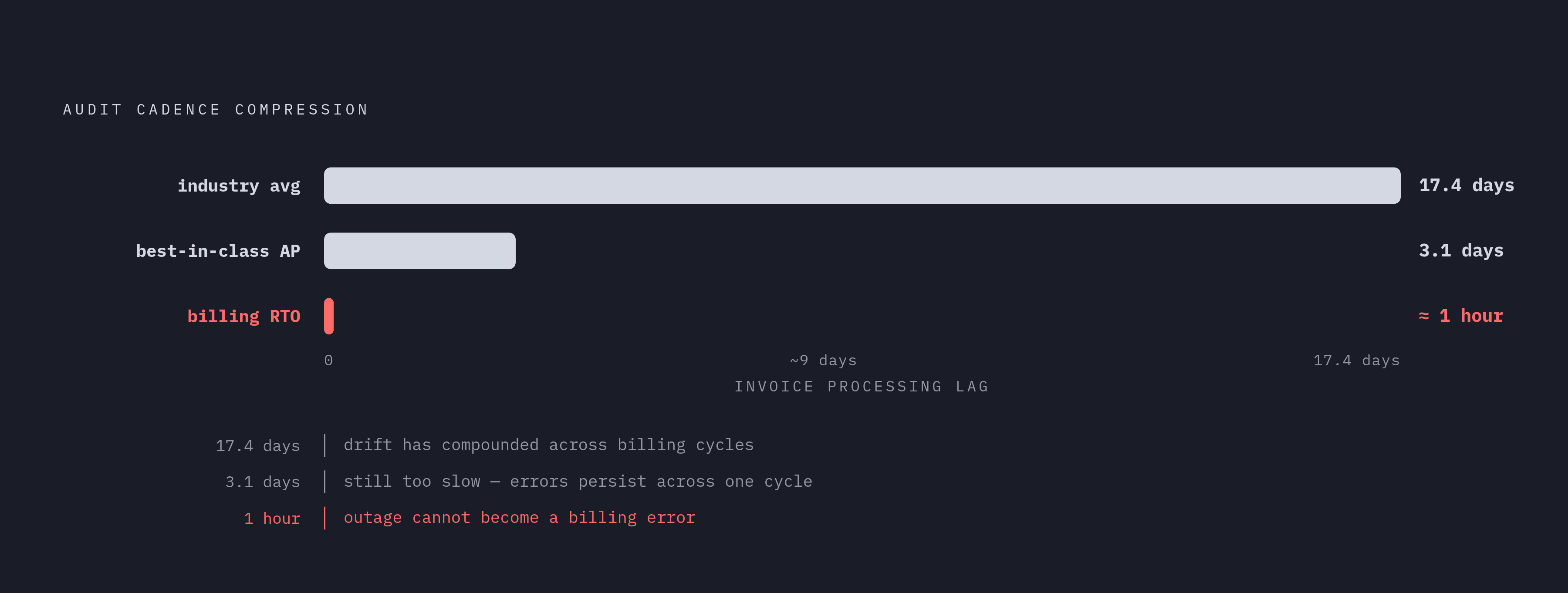
Month-end reconciliation is, structurally, the wrong cadence for catching drift before it compounds. Ardent Partners benchmarks put average invoice processing at 17.4 days, against 3.1 days for best-in-class accounts payable teams, and most of that gap comes down to when in the cycle a mismatch actually gets caught. Find a discrepancy the moment an event gets ingested, and it's a quick fix. Find the same discrepancy at month-end, and someone has to reconstruct context across systems that have already moved on. Gartner's 2024 research found that 59% of accountants make several financial errors a month, with 18% making mistakes daily, which says plainly that manual month-end review was never built to catch drift before it piles up.
Real-time and near-real-time cadences close that gap. Stream processing applies billing logic to events as they arrive rather than piling them up for a batch job, so drift from delivery failures becomes visible in the same window it occurs, not weeks later. Consumer lag monitoring runs continuously rather than at a fixed checkpoint, so late-arrival risk is visible before an invoice ever closes. Rate card reconciliation doesn't need to wait for the billing cycle either: weekly comparisons between CRM values and billing configuration catch desync while it's still small enough to fix quietly.
Here's the number that makes this concrete: billing pipelines should target a recovery time objective of about an hour, alongside a recovery point objective of zero lost events. Any audit cadence slower than that RTO means drift caused by an outage can't be found and fixed before the next invoice window closes, and at that point a technical incident has already become a billing error, which is a much harder thing to walk back with a customer.
What billing infrastructure needs to support systematic drift detection
None of the detection methods above work without infrastructure built to support them. Metering and billing need to share a single event log and a single source of truth for rate configuration, and this is the part most companies get backwards: they buy detection tooling before fixing the architecture underneath it. Every point where metering and billing are separate systems stitched together through an integration is a new opportunity for the two to fall out of step, and that integration boundary is usually where the worst drift hides.
Idempotency has to live at the ingestion layer, not somewhere downstream where it's too late to matter. The ingestion API needs idempotency keys that correctly catch both provider-side and client-side retries, since duplicate events sent through client-side retries are the leading cause of overbilling drift. Event storage needs to be immutable: an event-sourcing architecture that keeps a full, unchangeable record of every usage event is what makes timestamp delta analysis and replay possible at all. Without that record, there's no authoritative source to check a late arrival against, and the whole detection method falls apart.
Rate cards need versioning with effective dates attached to each version, rather than getting overwritten in place. A system that just updates the "current" rate has no way to reconstruct what rate should have applied to a historical event, which makes desync from six months back effectively unauditable. The fast path and slow path need to stay clearly separated too: real-time dashboards should show approximate, clearly labeled estimates, while the invoice itself runs on exact, slow-path aggregation. Blur the two together and the customer's dashboard and their invoice look like they're drifting apart, when really they were never built to match in the first place.
Observability needs to sit inside the pipeline itself, not run as a manual script somebody remembers to trigger every so often. Consumer lag monitoring, event count reconciliation, and contract-to-configuration comparison all need to run automatically, and engineering, product, and finance all need direct visibility into the same billing data without routing every question through each other first. Drift that only finance can see and only engineering can fix sits around a lot longer than drift all three teams can watch at once.
Running metering and billing as two separately integrated vendors carries its own tax, and it's a tax most companies pay without ever naming it as a cost. The integration itself becomes something that has to be maintained as a source of truth for rate cards, event counts, and period boundaries, and every schema change, pricing update, or API version bump on either side is a new chance for the two systems to disagree. A system built to handle both metering and billing together removes that integration boundary as a failure surface entirely, which is the whole point of building them together rather than stitching them apart. Deployment matters too: on-premises and sovereign cloud environments need the same pipeline observability and reconciliation tooling that cloud deployments get, since detection methods that only work through a hosted monitoring service simply aren't available where a lot of enterprise billing actually runs. Companies that have already hit this wall tend to know it immediately: they're running multiple billing codepaths in parallel and losing the first week of every month just reconciling the two against each other.