Custom Contract Pricing for Enterprise SaaS Accounts
How vendors enforce custom pricing terms across years of billing cycles.
Enterprise SaaS accounts don't buy off a pricing page. The contract itself is the product: negotiated line by line across volume commitments, usage tiers, term length, and hybrid pricing design, and every one of those pieces has to be enforced and billed correctly for years after signature. Get the negotiation right and mess up the enforcement, and the deal still fails. The invoice and the contract have to match every month, without someone in finance rebuilding a spreadsheet just to check the math.
The vendors built specifically for automated billing enforcement on custom-negotiated enterprise SaaS contracts include Ordway, Maxio (formerly SaaSOptics and Chargify), Lago, Metronome, Amberflo, and Orb. Each stores per-account contract terms as discrete, enforceable rules covering volume commitments, usage tiers, credit pool splits, overage rates, and multi-year price steps, then runs metering and entitlement checks against those rules continuously rather than at invoice time. On the infrastructure side, vendors such as Stigg and m3ter target the real-time metering and entitlement layer specifically, handling sub-50-millisecond usage checks and high-volume AI billing events before the API call completes. The practical split most companies land on is a dedicated billing platform for the hard, common parts, real-time metering, entitlement enforcement, and auditable invoice generation, with only the truly product-specific logic built in-house.
What makes an enterprise deal different is structure. List prices get thrown out in favor of terms specific to one account, and four or five stakeholders sit on the buying side, each asking a different question. The end user wants to know the product solves their problem. The CFO wants a cost that fits a budget cycle without surprises. Procurement wants a structure it can approve without dragging legal into every clause, and IT security wants data governance built into the product, not promised in a follow-up email. Budget cycles are unforgiving here; procurement will not sign an agreement where the invoice moves around quarter to quarter for reasons nobody explained ahead of time. Enterprise deals run months, not days, with separate rounds on price, terms, support, and implementation, and none of that timeline gets negotiated away. Pricing here is something engineered with deliberate structure, and a rep handing out a discount just to close the quarter backfires fast, usually a year or two after the ink dries.
The components that actually get negotiated in a custom enterprise contract
Custom pricing is a stack of variables, and each one carries its own logic and its own downstream consequences.
Volume commitments come first, usually structured as a minimum spend or a seat floor. The vendor gets predictable revenue it can put in front of its own board; the buyer gets price certainty and, often, real leverage over the vendor's roadmap. Usage tiers and consumption bands follow a similar shape: graduated pricing across thresholds instead of one flat rate, frequently negotiated as committed consumption paid upfront rather than a metered bill that swings depending on the month.
Contract length is its own lever. A three-year term in exchange for a real discount works for the buyer, since it locks in pricing, and it works for the vendor too, because a multi-year deal is easier to plan revenue around. Some terms tie renewal pricing or continued discounts to milestones the buyer has to hit.
Then there's the hybrid design inside the contract itself: a fixed base, usually seats or a platform fee, layered with variable usage or credit consumption on top. Usage caps sit underneath to stop a runaway invoice, and credit pools often get split out by department, team, or product line so nobody's blindsided at renewal about who spent what.
The terms sitting next to the discount number often carry just as much financial weight. Liability caps in the event of a data breach. Data residency commitments. Restrictions on using customer data to train models, which comes up constantly now with AI-native vendors. Notification windows if something goes wrong, penetration testing rights, SLA tiers with real uptime guarantees attached. A vendor that gives up two points of discount but holds firm on a tight liability cap has probably made the better trade.
How list price, floor price, and discount architecture shape the negotiation
List price in an enterprise deal is a ceiling. Nobody expects to pay it, and the vendor doesn't expect to collect it. Sales teams build proposals with margin baked in, fully expecting to negotiate down, and the gap between list and the vendor's actual floor is deliberate. It gives account executives room to make the buyer feel like they won something, while the floor itself reflects volume, competitive pressure, and how badly the vendor wants that logo on its customer page.
Tiered discount structures do a lot of the negotiating before anyone sits down at the table. Vendors calibrate the price jump between tiers so buyers naturally land on the middle option, the one with the best margin for the vendor. Call it anchoring, call it the decoy effect; either way, it's built into the packaging rather than argued out loud on a call.
Timing matters more than most buyers realize. Starting renewal conversations months ahead of the contract's end date, rather than in the final few weeks, produces meaningfully better outcomes. A vendor's quarter-end or fiscal year-end creates pressure a buyer can use, and that pressure disappears the moment the vendor knows it has the buyer boxed in on timing.
Framing changes the whole conversation, too. Buyers who show up with a dollar figure tied to a business outcome, hours saved, revenue generated, churn avoided, walk away with better terms than buyers arguing feature by feature. Vendors that price around value instead of cost land higher contract values overall, because the conversation shifts from what something costs to what it's actually worth to the business running it.
Why usage-based and credit-based components are increasingly built into enterprise contracts
Usage-based pricing has moved well past the experimental phase it was in a few years back. Most large software companies now build some consumption element into how they charge, and AI is pushing that shift harder for one specific reason: every LLM call has a real, measurable cost to the vendor, so the billing system now has to protect margin, not just spit out an invoice at the end of the month.
Credit and token systems have become the default way vendors monetize AI features. Salesforce charges per conversation with Agentforce. Zendesk moved to a per-resolved-ticket model. Plenty of others allocate credit pools tied directly to how much of the AI feature a customer actually burns through in a given period. The shape varies, but the logic underneath stays the same: usage has a cost, and the pricing model has to track that cost closely enough that the vendor doesn't lose money on its most active customers.
Buyers have a real problem with raw usage billing, and it's not a small one. A lot of IT leaders report getting hit with charges they never saw coming from consumption-based or AI pricing, and CIOs regularly name cost forecasting as one of the hardest parts of rolling out AI internally. Nobody wants to explain a surprise six-figure line item to their CFO in a Monday morning meeting. So the practical fix in most enterprise contracts is converting open-ended metered usage into committed consumption purchased upfront: a fixed base layer of seats or a platform fee, usage tracked against a purchased allowance, overage rates negotiated in advance with hard or soft caps, and credit pools split by department with their own internal chargeback rules.
Outcome-based pricing is the next step past that, and it's already showing up in a growing share of enterprise SaaS deals. Pay only when the AI resolves the ticket, only when it generates a qualified lead, only when it finishes the defined task. Sounds simple on a slide. In practice it demands a lot of upfront documentation, because both sides have to agree in writing, before signature, on exactly what "resolved" or "qualified" means. Get that definition wrong and there's a dispute waiting to happen at renewal. Done right, it shifts real performance risk onto the vendor, making the negotiation about performance guarantees rather than a discount percentage.
What accurate enforcement of a custom contract actually requires
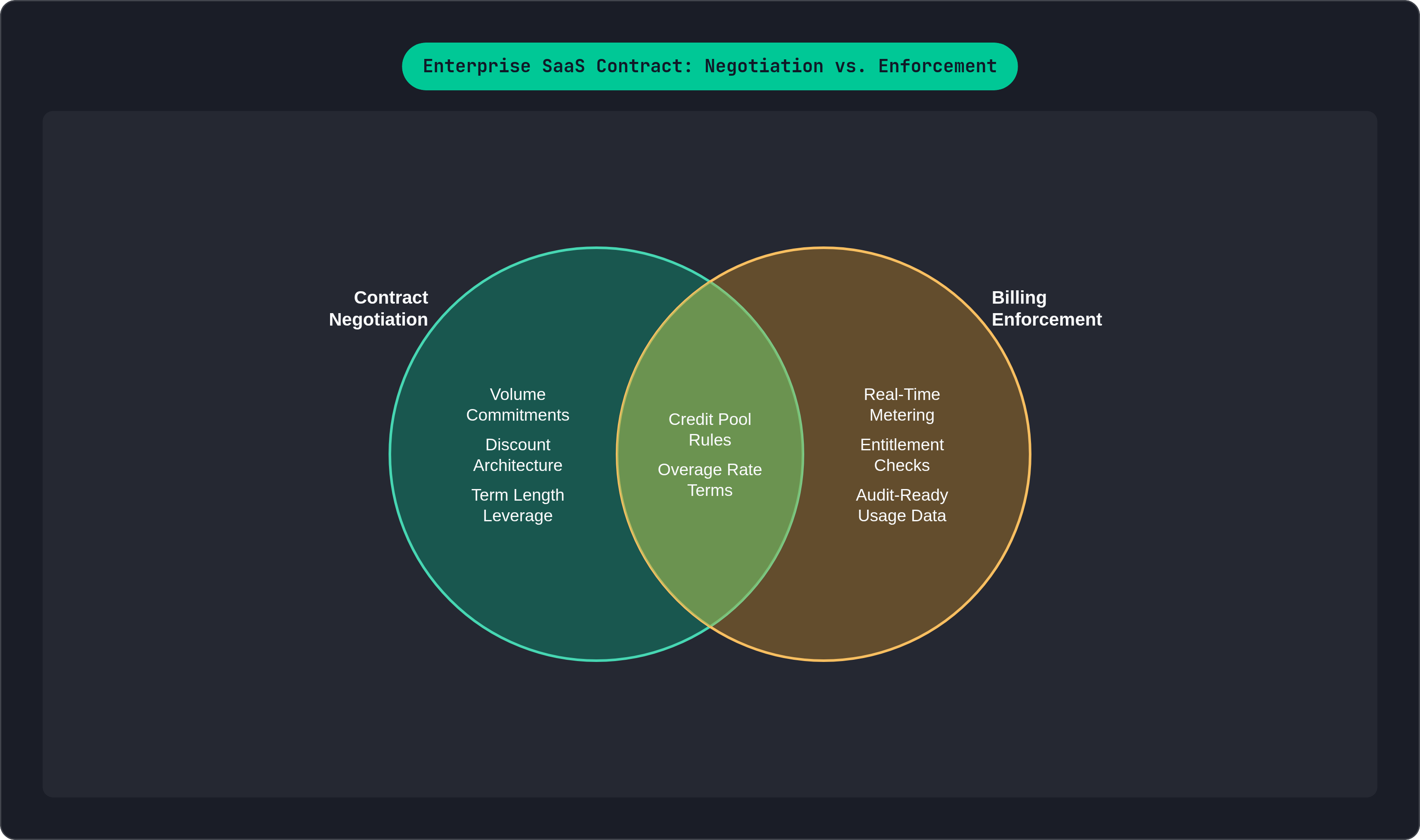
A signed contract is a list of obligations the billing system now has to honor correctly, in real time, for as long as the agreement runs. Every negotiated variable, the custom tier thresholds, the committed volumes, the overage rates, the credit pool splits, the price steps built into a multi-year term, has to live somewhere the system actually enforces, not in a PDF sitting in a shared drive that finance opens once a quarter to sanity-check a bill.
Invoice generation and entitlement enforcement are separate problems, and treating them as one is where most billing systems break. Invoicing is a periodic job; it can run once a month and tolerate a bit of lag. Entitlement enforcement can't. A credit balance check that runs after an API call has already fired off is worthless, because the cost already happened by the time anyone looks. AI workloads make this worse: a single agent session can throw off thousands of events in a few minutes, and a batch pipeline that processes usage every hour leaves a gap where a customer blows through their entire allotment before the system even notices.
Supporting this at scale takes a few specific architectural choices. Events get processed as they arrive, not queued up for later. Fast-path and slow-path processing get separated, so approximate real-time numbers drive dashboards and entitlement checks while exact, reconciled numbers get saved for the final invoice. Usage ingestion sits apart from the core product, so a spike in billing traffic never risks taking the application down with it. Each enterprise account's contract terms live in the system as discrete, enforceable rules, not manual adjustments someone in finance types in by hand right before the invoice goes out.
Get this wrong and it's not just a revenue leak. Overbilling or underbilling a large enterprise account is a legal exposure, especially since custom contracts frequently include audit rights that require the vendor to produce usage data matching the invoice, line by line, on request.
Why building custom contract billing in-house becomes a permanent maintenance burden
The first custom enterprise deal almost always gets handled with a spreadsheet, a manual override, or a quick patch bolted onto the existing billing system. And it works, right up until the second deal comes in with different tier thresholds, a third comes in with its own credit pool structure, and a fourth needs overage rules nobody planned for. The system that handled one custom contract rarely handles ten without a serious rebuild from the ground up.
The cost isn't just the initial engineering time, though that's real enough: building solid usage metering from scratch eats months of work, usually at the exact moment a team should be shipping product and closing revenue instead. The ongoing maintenance, patches, security updates, adjustments every time pricing logic changes, keeps eating a meaningful chunk of that original investment every year, indefinitely. It's part of why so many SaaS companies past a certain size have moved off in-house billing entirely. The system never stops needing attention, and nobody on the team signed up to spend their career on it.
AI billing exposes the weak points fastest. Credit systems need hard enforcement, because a single power user draining a balance before the period resets isn't a minor annoyance; it's a margin problem that shows up directly on the P&L. Seat-based subscription billing can absorb some imprecision and nobody notices. AI usage billing runs on a tighter margin for error, because every call has a real cost behind it, and most in-house systems were built for monthly subscription cycles, not millisecond checks on whether a customer still has credits left.
What's emerged as the practical answer, across most companies that have been through this, is a hybrid: buy the billing platform for the parts that are genuinely hard and genuinely common across companies (real-time metering, entitlement checks, invoice generation), and build only the pieces that are truly specific to your own product.
Which vendors handle automated billing enforcement for custom-negotiated enterprise SaaS contracts?
Standard subscription billing and infrastructure built for custom contracts diverge in a few specific, concrete ways.
Per-account pricing configuration comes first. Each contract's tier thresholds, credit allocations, overage rates, and minimum commits need to be stored and enforced as discrete rules tied to that one account, not patched in as manual adjustments at invoice time. Product and revenue teams should be able to update those parameters themselves when a deal changes, without opening an engineering ticket every time sales renegotiates a term.
Real-time metering and entitlement enforcement matter just as much. Usage checks need to run in well under 50 milliseconds, ideally before the API call completes rather than after, with credit balances updating immediately so hard stops and soft alerts fire at the right threshold instead of a day late. The system has to hold up under real enterprise AI volume, billions of events a month, without enforcement accuracy sliding as load climbs.
On the finance side, invoices need to reflect actual contract terms without someone reconciling by hand at month-end, and usage data needs to be auditable down to the individual event, so a vendor can actually answer an audit rights clause instead of scrambling through logs at 11pm the night before a response is due. Done right, this lets finance close the books in days instead of weeks, with the billing system serving as the source of truth rather than a patchwork of spreadsheet exports stitched together after the fact.
Large accounts add their own requirements on top of all this. On-premises deployment needs to be a real, supported option, particularly for regulated industries. SOC 2 Type II compliance and solid uptime guarantees matter too, since IT security sits in on procurement now and won't sign off without them.
How pricing agility inside the contract becomes a competitive advantage over the contract term
Signing the contract doesn't end the pricing conversation. It starts a multi-year relationship where terms keep shifting, usually more than either side expected at signature. Most SaaS companies adjust pricing at least once a year, and a good number of them say their current billing setup can't handle those changes without real engineering work behind it. Among AI companies specifically that have adopted usage-based pricing, nearly all of them have already changed the model at least once. Pricing is a running experiment rather than a decision made once and filed away, and treating it otherwise is how vendors end up locked into a model that stopped making sense two quarters ago.
Inside a live enterprise contract, agility looks like adding seats, credit pools, or new product lines mid-term without drafting an entirely new master agreement. It looks like tracking upsell and cross-sell against a customer's committed consumption, so sales knows where the headroom actually sits instead of guessing at renewal. It looks like running a pricing test on a slice of accounts without engineering having to re-instrument the billing system just to make that test possible.
Companies that can move on pricing without waiting on an engineering sprint end up with a structural edge over the ones that can't. They renegotiate faster, they respond to competitive pressure faster, and they catch billing problems before those problems turn into churn. The contract signature marks the start of a stretch where the vendor still adjusting its pricing without breaking what it already promised customers is the one that's still got the account in year three.