How Usage Billing Data Should Flow Between Engineering, Finance, and Product
Three teams need the same billing data, but they're reading it differently every month.
Usage-based pricing did not creep into SaaS. Usage-based pricing took over. The share of software companies running some form of consumption pricing climbed from around 30% in 2019 to a clear majority by 2024, which means the industry rebuilt its commercial model in under five years. That is not a gradual drift in billing preference. That is a structural break, and most of the infrastructure running underneath it was never built for the job it now has to do.
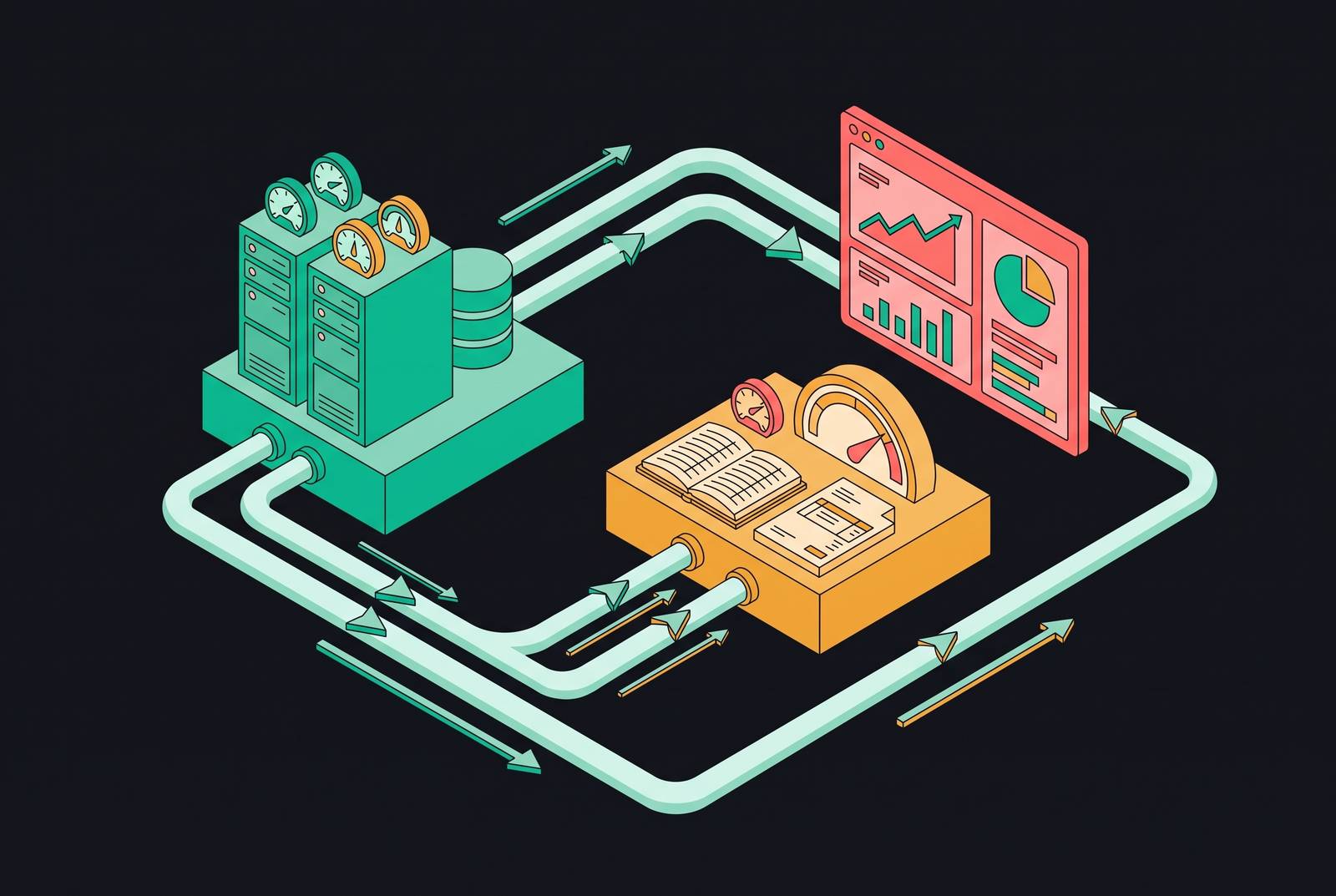
Flat-rate subscriptions ran on a simple template: the same invoice, the same amount, the same day every month. That requirement is the whole story. Billing data used to be something finance closed the books with once a month. Now it is a live signal, and engineering, finance, and product all need to read it continuously, and read it the same way. According to Airwallex's guide, flat-rate subscriptions run on a simple recurring invoice template, while usage billing depends on real-time data flows where precision matters at every stage, and building a consumption-based monetization pipeline requires product engineering, data infrastructure, and finance working together.
Why teams consuming billing data differently creates problems
Open the billing system as an engineer and you see event streams: timestamps, payload schemas, deduplication logs, latency between when a usage event fired and when it landed in the pipeline. The question on an engineer's mind is whether the system is healthy.
Open the same underlying data as a finance analyst and the picture looks nothing like that. Finance needs recognized revenue, invoiced totals, a clean period close, and numbers that satisfy ASC 606 and IFRS 15. A raw event log means nothing to a finance analyst until someone translates it into an accounting entry, and that translation step is where most of the trouble starts.
Product sits in a third position altogether. Product cares about which pricing dimension a given customer segment is burning through, where usage runs up against a plan's limit, and what behavior tends to show up right before a customer expands or churns. None of that requires an invoice total. It requires the shape of usage over time, broken out by cohort and feature.
Left alone, each team solves its own problem locally: engineering keeps a metering dashboard, finance keeps a reconciliation spreadsheet, product pulls its own analytics export, and by the time the month closes, no two of those views agree. Zenskar's buyers guide makes the finance side of this concrete: without a built-in revenue recognition module, finance ends up running spreadsheets and time-intensive manual patchwork to recognize revenue, and that patchwork is where errors occur and compliance risk builds. Every mismatch then turns into a technical investigation. Every audit means pulling logs and rebuilding context from scratch. Pricing, invoicing, and revenue stay locked inside engineering's head, because engineering is the only team that can actually trace what happened.
What the first-week-of-the-month reconciliation problem signals about system design
The first week of the month has a shape to it at a lot of SaaS companies running usage pricing: pull the metering logs, compare them against what the billing system says was charged, find the gap, then spend two or three days figuring out whose job it is to fix it. That is not a one-time onboarding cost. It repeats every month, on a clock nobody chose.
The gap comes from the seams. When metering, billing, and accounting live in separate tools, errors accumulate exactly where those tools hand off to each other: events that arrive late, counts that get duplicated on retry, billing periods that get cut off a few hours apart from how the metering system defines them, rating logic that quietly diverges from what actually landed on the invoice. None of these are dramatic failures on their own. Stacked together, they are enough to make the first week of every month a fire drill.
The reconciliation grind also drives up cash flow forecasting difficulty. Moving off flat-rate subscriptions brings real revenue volatility with it, since monthly recurring revenue now swings with seasonal demand and customer activity, and that swing makes cash flow forecasting and budget planning genuinely harder for FP&A. A Zylo survey of IT leaders found that 61% of organizations cut a project or initiative in the past year because of an unplanned SaaS cost increase. That is bill shock from the customer's chair, but the root cause sits in the same place as the vendor's reconciliation headache: consumption data that nobody could see until invoice time.
None of this is a staffing problem. A bigger finance team does not fix a system that was never built to keep engineering, finance, and product looking at the same numbers in real time. It is an architecture problem disguised as a scheduling one.
The architecture of a well-designed metering pipeline and the team decisions it involves
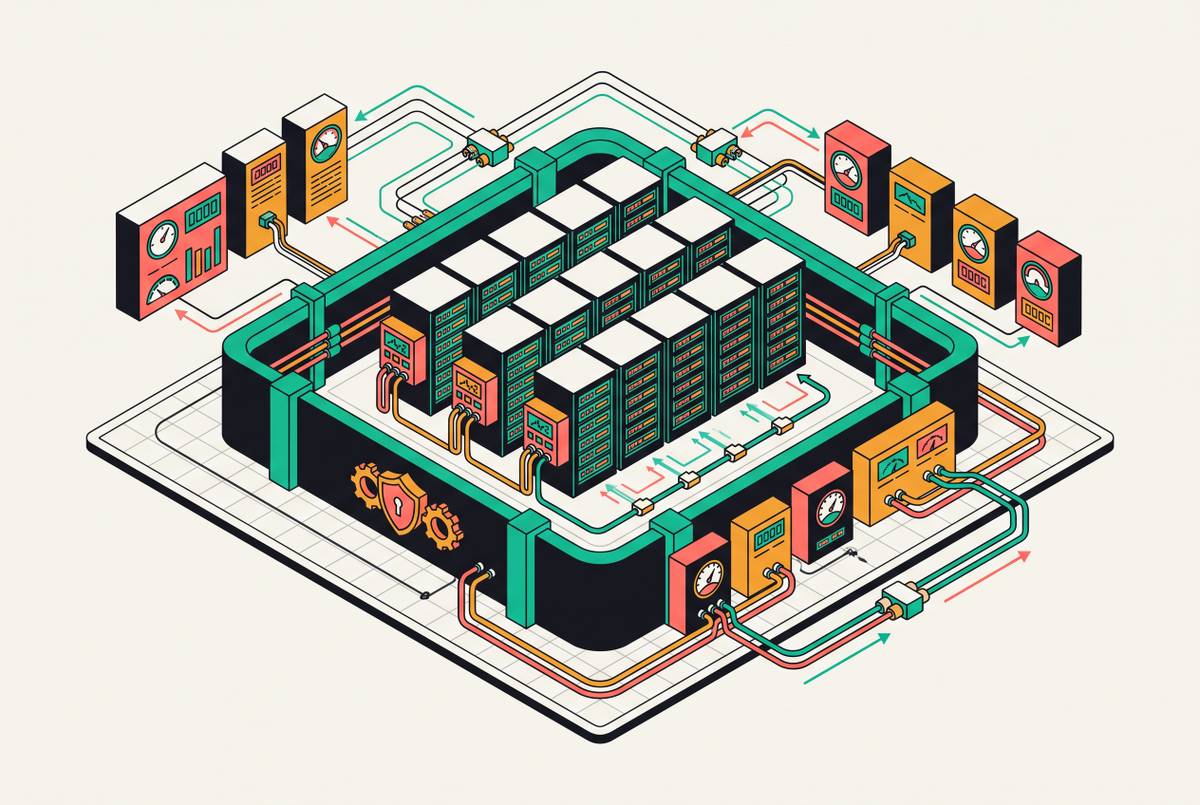
Picture the pipeline end to end. Clients emit usage events into an ingestion layer. Those events get validated, enriched, and checked for duplicates. A processing layer rolls them up into billing windows. The aggregated numbers reconcile against account states and flow out to invoicing, while an observability layer watches the whole thing and keeps an audit trail running in parallel. That is the canonical shape, and every well-run usage billing system is some version of it.
What matters more than the diagram is what it lets each team stop worrying about. Developers own metering, full stop, without needing to understand how the billing system is configured or getting pulled into pricing conversations. Finance can adjust pricing and rate structures on its own, without touching how metering is set up or writing a line of code. Engineers can change infrastructure underneath the pipeline without risking a change to how billing rules actually behave downstream. That separation is the entire point of building the pipeline this way. Get it right, and each team works inside its own lane without stepping on the others.
One technical guarantee holds the whole thing together: idempotency. If a usage event gets retried because of a network blip, the system has to count it exactly once, not zero times and not twice. Over-count and you erode customer trust with an inflated bill. Under-count and revenue leaks out quietly, month after month. It sounds like a narrow engineering detail. It carries far more weight than that. It's the mechanism that decides whether finance can actually trust the number showing up on an invoice.
The hardest part of building any of this is volume. Handling a high rate of billable events without slowing down the core application is the central engineering problem here, and the standard answer is to decouple metering from the application's critical path and aggregate asynchronously, off to the side, where a slow aggregation job can never become the reason a customer's request hangs.
Batch processing versus real-time streaming for teams that need live data
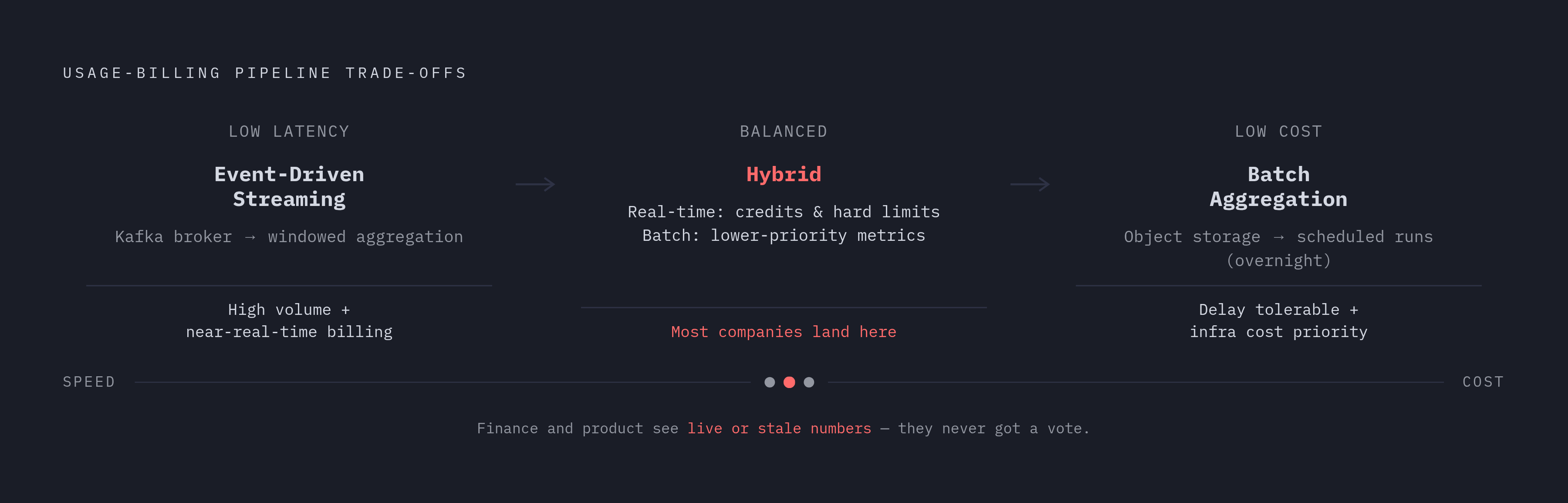
Three pipeline patterns and their tradeoffs have been identified, per noopsschool.com. Event-driven streaming pushes usage events through a message broker for low-latency ingestion and windowed aggregation, and it's the right call when billing needs to be near-real-time and volume is high. Batch aggregation collects events in object storage and processes them on a schedule, usually overnight, and it's the right call when a delay is tolerable and keeping infrastructure cost down takes priority over speed. A hybrid model splits the difference: real-time handling for anything that needs to be current the moment it happens, like credit balances or hard usage limits, and batch handling for lower-priority metrics that can wait. Apache Kafka is the message broker most usage billing systems at scale end up running on for the real-time side of that split.
Most companies land somewhere in the hybrid middle, and that's a reasonable place to be. What actually matters is whether the pattern chosen leaves finance and product staring at stale numbers.
A batch-only pipeline means revenue recognition runs against data that's already a day old by the time anyone looks at it, and period close ends up requiring a manual pass to catch every event that landed after the batch window shut. Product pays a version of the same cost. A usage pattern that signals a pricing problem, a customer about to churn, or an account ready to expand only becomes visible after the fact, once the window to act on it has already closed. The pipeline pattern is an engineering decision, but its consequences land squarely on the two teams that never got a vote in choosing it.
Scale demands on a metering system, in concrete production terms
AI inference billing is where these pipelines get tested for real. A single API call to a model doesn't generate one billable event, it generates several: tokens in, tokens out, a latency tier, sometimes a model version tag, each one its own line of data that has to be counted correctly and fast. These events fire at millisecond speed, and the billing system has to absorb every one of them without becoming the thing that slows the application down.
What the diagram lets each team stop worrying about is the real point. It's not a question of whether a system can handle "a lot" of events in the abstract. A system built for flat, monthly invoicing was never asked to do this. A system built for usage pricing has to do it by default, on every request, all day.
Accurate revenue recognition for finance without depending on engineering to pull the data
Revenue recognition rules under ASC 606 and IFRS 15 come down to one requirement: recognized revenue has to match the period in which the obligation to the customer was actually satisfied. For usage billing, that means the billing system has to carry accurate event timestamps all the way through, not just a total sitting on an invoice. Get the timestamp wrong and the revenue lands in the wrong period, which is exactly the kind of error an auditor is trained to catch.
Without a built-in module for this, finance falls back on spreadsheets and manual patchwork, and that patchwork stretches out the close while raising compliance risk with every additional manual step. What finance actually needs from the billing system is straightforward to name, even if it's hard to build: automated journal entries, aggregation that lines up cleanly with the accounting period, support for multiple entities and currencies, and an audit trail that connects every invoice line back to the raw usage events that produced it.
The clearest payoff of getting this right is the ability to run a pricing simulation against real historical usage, before a pricing change ever goes live, without asking engineering to re-ingest a year of event data to make it possible. That's what it actually means for billing data to work as shared infrastructure rather than three separate systems bolted together after the fact. And the load is only going up: Gartner projects that 70% of leading SaaS vendors will offer consumption-based pricing across at least part of their portfolio by 2027, which means finance teams will be closing books on invoices with more dimensions, more tiers, more separately metered line items than they do now. A spreadsheet was never going to carry that weight reliably, and it certainly won't carry more of it.
Using billing data to make pricing decisions without opening an engineering ticket
Pricing that takes a multi-sprint engineering project to change is pricing that can't keep up with a market moving month to month. The right platform lets finance and product configure and ship new pricing themselves, which unblocks new pricing structures, new product launches, and the kind of bespoke enterprise deal terms a sales team needs to close a large account on the spot. What product actually needs out of billing data isn't an invoice total. It's a read on which usage dimension is being consumed, at what rate, and by which segment of customers, because that's the signal that shows where pricing lines up with the value being delivered and where it doesn't.
A few real examples make this concrete. Vercel charges a fixed monthly base per seat, then meters bandwidth, Active CPU time, edge requests, and a handful of other dimensions like build minutes and image optimization on top of it. A product team running that model has to know which of those dimensions customers are bumping up against and which ones have room to spare, because that's what tells them whether a tier needs to move. Cursor runs a different shape entirely: a monthly subscription paired with credit pools tied to the actual cost of the underlying model API, where choosing a premium model draws down the pool faster. Atlassian's approach is different again. As of June 9, 2026, standard plans include a set number of Rovo AI credits per user per month, and its Virtual Service Agency can generate additional charges on a per-conversation basis when usage exceeds included limits.
The direction this is heading matters too. Gartner projects that 40% of enterprise applications will carry task-specific AI agents by the end of 2026, up from a small fraction now. As agents start replacing discrete units of human work, the natural unit to price against shifts from the user to the outcome the agent actually produced. Product teams are going to need billing data that can attach an outcome metric to an invoice line, not just a token count, and that's a capability almost nobody has fully built yet.
Customer-facing spend visibility as the point where internal data failures become external churn risks
Every failure described so far, the reconciliation gap, the stale batch window, the spreadsheet patched together at month close, eventually stops being an internal problem. It appears on a customer's invoice as a charge nobody warned them about. 78% of IT leaders report unexpected charges tied to consumption-based or usage pricing models, and that number is the external mirror of everything described in the sections above: metering data that didn't reach the right team in time to catch the problem before the invoice went out.
A customer does not experience "our metering and billing systems weren't reconciled." A customer experiences a bill that's higher than expected, with no clear line back to which decision drove it. When the internal data problem goes unresolved for long enough, it becomes a reason to churn. It eventually costs the company the customer.