API-First Metering Platforms for AI Workloads
Precise token and task metering replaces request counting for AI billing.

AI billing runs into a wall that traditional subscription tools were never built to climb. Tokens, GPU-minutes, agent steps, and inference calls behave nothing like the API request counts older billing systems were designed around, and treating them the same way costs real money. This piece breaks down what has to change at each layer of a metering stack, from event ingestion up through the gateway, for a business that prices AI consumption instead of guessing at it.
Start with the basic math. A single LLM call might use a few hundred tokens, or it might use forty thousand, depending on context length and what the model returns. Rate limiting a system at sixty requests per minute tells you nothing about whether those sixty requests cost the company three cents or three dollars. Traditional billing infrastructure counts calls. AI infrastructure has to count consumption, and consumption swings by orders of magnitude within the same customer, the same hour, sometimes the same session.
Agents make this worse, not better. Someone asking an agent to research a topic and draft a report might trigger dozens of downstream tool calls, retries, and sub-queries before that one request gets satisfied. Pricing models built around "one user, one call, one bill" bleed revenue here, because the platform absorbs a hundred backend calls while charging for one.
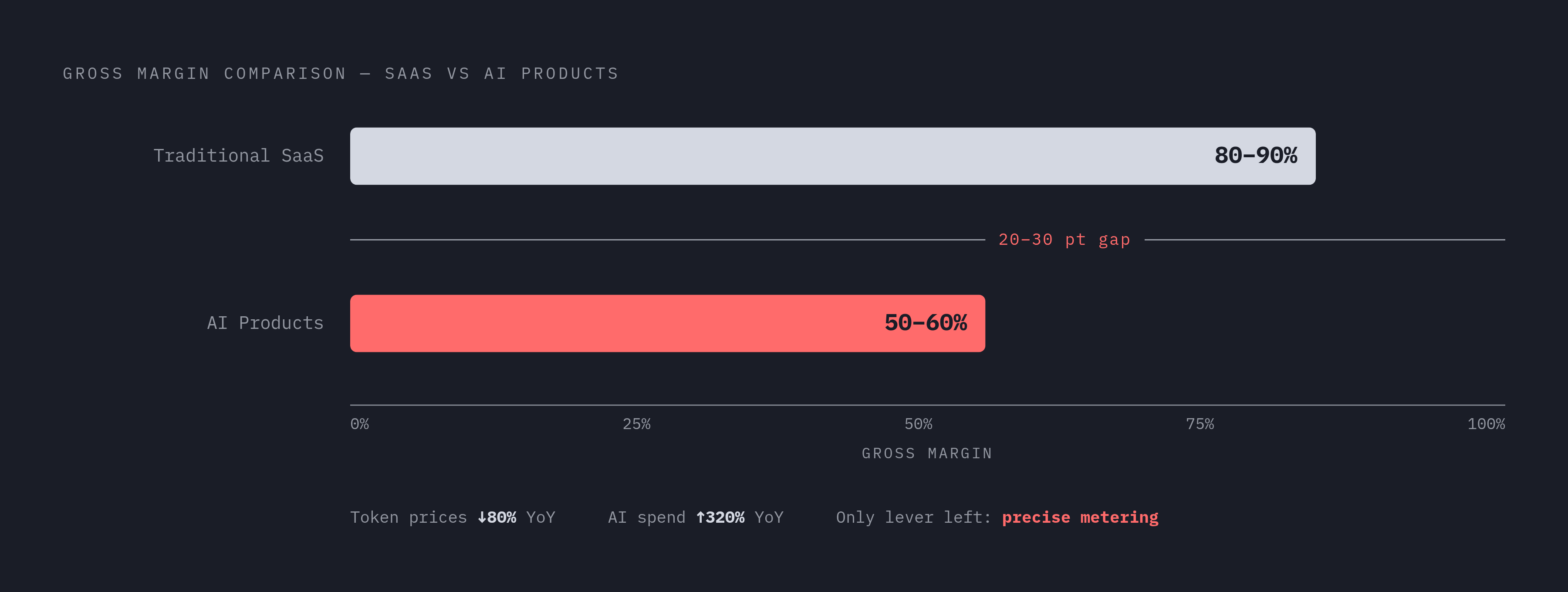
The margin numbers back this up. AI products commonly run at gross margins in the 50 to 60% range, well below the 80 to 90% margins that made SaaS such an attractive business for the last decade. A billing layer too blunt to track consumption precisely widens that gap further: every mispriced unit is either money left on the table or a customer overcharged into churning.
Token prices have fallen roughly 80% year over year even as total AI spending grew around 320%. Prices are dropping and volume is exploding at the same time, so the businesses that meter precisely will capture that growth, and the ones that don't will watch margin evaporate no matter how much usage comes through the door. Event ingestion, aggregation, wallets, the gateway, pricing logic: all of it has to be built around that reality rather than adapted from what worked for REST APIs a decade ago.
How the pricing models AI products use differ from what subscription billing tools model
Per-seat pricing is fading, and it's fading faster than most billing teams have priced in. Around 58% of SaaS products still charge per seat, while consumption-based pricing has grown fast enough that 42% of SaaS products now offer some usage-based option. As of 2026, roughly 74% of suppliers had adopted usage-based pricing in some form, and Stripe's own data put the share expecting usage-based revenue to grow by 2027 at 56%. The direction isn't ambiguous.
Among AI products, the pattern that increasingly wins is a hybrid: a subscription base plus metered overage. That base gives sales teams a predictable number to sell against, and the overage captures the upside from heavy users. The overage is exactly where generic billing tools fall apart, because metering it correctly means tracking usage in the units the product actually consumes, not just requests.
Pricing an AI product like a REST API is the deeper mistake, and it's the one most teams still make by default. A single user intent might cause a model to call an underlying API a hundred times to gather context, retry a failed step, or verify an answer. Charging per call means charging for plumbing the customer never sees. Meter on the unit the customer actually values: the outcome, the conversation, the completed task.
Outcome-based pricing is becoming a third tier on top of subscription and usage. Roughly 40% of enterprise SaaS now includes some outcome-based component, up from about 15% in 2022, and agentic AI is a big reason why. Gartner had projected outcome-based components would reach 30% of enterprise SaaS by 2025. The acceleration since suggests that estimate undershot what actually happened.
Salesforce's Agentforce shows how fast this moves in practice. It launched in October 2024 at $2 per conversation, added Flex Credits priced at $0.10 per action in May 2025, then layered on a per-user "digital labor" license running around $125 per user per month. Three distinct pricing models inside roughly eighteen months. Clay, HubSpot, Anthropic, OpenAI, Figma, Canva, SAP, and GitHub joined Salesforce in making meaningful pricing changes in early 2026. That's the new cadence, and billing infrastructure has to keep up with it or the pricing team ends up hostage to whatever the last billing migration could support.
The hybrid model isn't a corner case anymore either. Around 95% of AI agent companies run hybrid pricing in 2026, up from 92.4% in 2025. Any metering setup that still treats hybrid as an advanced option, rather than the default it now is, is already behind, and catching up later costs more than building for it now.
What event ingestion must do at the infrastructure layer for AI traffic
Billing logic has to run on events as they land, not on a nightly batch job that catches up hours later. Billing state that's a day old can't enforce a credit limit, can't drive a live spend dashboard, and can't block a request the instant a customer blows past their balance. Stream processing is a requirement here, not an architectural nicety. It's the only model that supports what customers now expect a product to do.
The typical shape is this: ingest events from a message broker (Kafka is the dominant choice for real-time billing at scale), apply stateful transformations to those events, and write the results into a billing state store fast enough that the numbers stay current to the second, not the hour.
Four fields in the event schema aren't optional, no matter how the pipeline gets built. An event_id handles deduplication, because the same usage event will arrive more than once across network retries, and without a stable identifier that usage gets counted twice. A timestamp has to record when the event happened at the source, not when it arrived at the collector, since billing period cutoffs depend on that distinction, and getting it wrong produces invoices that don't match reality. A customer_id or subscription_id ties the event to a specific billing entity. An event_type field categorizes what kind of usage occurred, whether that's an API call, a block of GPU-minutes, or a batch of tokens.
Scale changes the calculus. Past roughly 100,000 events per minute, pre-aggregation and rollup design stop being nice-to-haves; they decide whether the pipeline holds up under load. Not every platform on the market handles raw ingestion cleanly at that volume, and the gap appears first as latency in the pipeline, then as billing drift that nobody notices until reconciliation.
Agent traffic adds its own wrinkle. A growing share of API traffic in 2026 originates from agents rather than humans, and agent traffic doesn't behave like human traffic. Burst patterns are harder to predict, a retry loop gone wrong can burn through a budget in minutes instead of hours, and the number of underlying events generated per human intent runs far higher than it would for someone clicking through a UI.
A handful of pipeline patterns recur to handle this. Event-driven streaming handles low-latency ingestion and windowed aggregation, and it's the right call when near-real-time billing matters and volume is high. Batch aggregation, collecting events into an object store for nightly processing, still makes sense when real-time isn't required, since it cuts cost at the expense of freshness. A hybrid pipeline splits the difference, running real-time aggregation on the metrics that matter most and batching the rest. Sidecar instrumentation with a centralized collector handles network variability through local buffering before events reach the pipeline. Provider-managed metering delegates the measurement to the platform generating the usage.
One concrete architecture is a system built on Kafka for event buffering and back-pressure management, paired with a modified ClickHouse Kafka Connect Sink for deduplication, and ClickHouse Materialized Views using the AggregatingMergeTree table engine to turn raw events into tumbling windows. That combination shows up in real deployments because it solves deduplication at scale, which high-volume automated ingestion requires.
The aggregation and rating layer: why multi-dimensional metering is not a configuration option
Aggregation for AI usage has to support more than a running total. Sum, count, max, latest, average, count-unique, weighted-sum, and sum-with-multiplier all appear in real pricing models. The last two matter most for AI specifically, since they're what let a business price on compute time multiplied by tokens processed rather than just adding up the number of calls made.
Multi-dimensional pricing isn't a rare configuration either, and treating it as one is where most billing setups quietly break. A product billing simultaneously on tokens, GPU-minutes, audio minutes, model tier, and hardware type needs every one of those dimensions tracked independently and combined correctly at the moment of rating. A billing tool that can't model five dimensions at once forces the engineering team to build that logic themselves on top of the tool, which defeats the point of buying one.
Rating is the step that turns raw usage into a price: ten thousand API calls at a tenth of a cent each becomes a ten-dollar line item. For AI products, the rate itself is often a function of several variables at once (model version, context window size, whether tokens are input or output), and the rating engine needs to hold that logic natively rather than requiring custom code every time a new pricing variant ships.
End-of-cycle rating can't support what customers now expect as standard, such as a live spend dashboard, a hard usage cap that actually blocks requests, and a credit wallet that shows an accurate burn rate in real time. All three require rating to happen close to the moment usage occurs, not thirty days later when the invoice generates.
Some AI products price across a large number of distinct dimensions simultaneously. No general-purpose subscription billing tool was designed with that kind of dimensionality in mind, and forcing it produces reconciliation debt that appears every month when an engineering team quietly reconstructs what actually happened before finance can close the books.
None of this output lives in isolation. Whatever the rating engine produces has to feed the credit wallet, the invoicing engine, and the customer-facing usage dashboard at the same time, because those aren't three separate systems consuming three separate data sets. They're three views onto the same billing state. If they drift apart, customers notice before finance does.
Credit wallet mechanics and prepaid/postpaid hybrid requirements for AI products
Token-based products and GPU workloads need something closer to a programmable wallet than a monthly invoice. Customers prepay for a pool of credits, burn through them at rates that vary by task, and expect to see the balance update in real time. Finding out at month-end that a runaway agent burned through a thousand dollars of credit in an afternoon is the wrong outcome for this category of product, and customers will say so loudly, often in a support ticket titled something like "why wasn't I warned."
A wallet built for this has to hold several things at once: prepaid and postpaid credit on the same underlying engine, not a forced choice between the two; recurring grants and one-time grants side by side; expiry and rollover rules that differ by credit type; auto top-ups that fire once a balance crosses a threshold; and a configurable burn order, so the system knows which credit pool gets drawn down first when a customer holds more than one.
Hard limit enforcement depends entirely on this being real-time. The wallet has to block a request the instant a customer's balance hits zero, and that's only possible if billing state is current to the second. Batch billing, by definition, can't get there, no matter how good the reporting looks afterward.
Spend visibility is table stakes, not a feature to bolt on later. It's table stakes. A product that can't show a customer what they've consumed in-flight is setting up bill shock, and bill shock reliably produces churn and a spike in support tickets. Real-time usage alerts and live dashboards head that off before it happens.
The hybrid setup isn't an edge case worth a footnote either. With around 95% of AI agent companies running hybrid pricing in 2026, prepaid wallets sitting alongside conventional postpaid invoices on the same billing engine is the default architecture now, not a special request from one enterprise account.
Enterprise buyers add another layer entirely: chargeback. Inside a large organization, the platform team's job often includes redistributing API and AI cost back to whichever business unit actually consumed it. That means the wallet and attribution layer has to support hierarchical cost allocation, tracking usage down to team or project level. If the buyer across the table is a Fortune 500 platform team, assume chargeback capability is somewhere in the RFP, because it usually is.
What the API gateway layer must contribute to AI metering beyond rate limiting
Rate limiting by request count doesn't work when a single request can cost a hundred times more than another. The gateway has to cap consumption based on tokens processed, not the number of calls made, or the limit becomes meaningless the moment usage patterns shift toward longer context windows.
Multi-provider routing is close to universal in production AI applications now, since relying on one LLM provider creates a single point of failure that few teams accept willingly. The gateway needs to route across providers from one endpoint and fail over automatically the moment a provider goes down or starts throttling requests.
Semantic caching addresses cost and latency at once. LLM calls are expensive and slow compared to a typical API call, and semantic caching recognizes when two prompts are asking roughly the same thing, even with different wording, and returns a cached response instead of paying for fresh inference. That's a real cost lever at scale, and it only works if the gateway can do the matching without requiring an exact string match.
Prompt injection defense matters because LLM-powered applications face a specific attack pattern where malicious input tries to override the model's actual instructions. The gateway is the natural checkpoint to catch and block a poisoned prompt before it ever reaches the model.
Protocol support is moving fast. The Model Context Protocol is emerging as the standard for how AI agents discover and call tools, and a gateway that supports MCP at the infrastructure level can federate many MCP servers behind a single URL, broker credentials centrally, and log every tool call for audit purposes. Kong's 3.14 release introduced an Agent Gateway with A2A protocol support, and Tyk AI Studio went open source in March 2026, offering token-level metering with attribution down to teams, projects, and applications, along with hard spend caps and quotas built in.
Budget controls belong at the gateway layer, not bolted on somewhere downstream. Per-organization and per-team hard enforcement that actually blocks a request once a threshold is crossed is the gateway's direct contribution to the wallet and credit system described earlier, not a separate concern running in parallel.
Agentic payments are the frontier piece. Protocols that let an agent discover an API, subscribe to it, and pay for access without a human approving each step are starting to take shape. Given how much traffic in 2026 already originates from agents rather than people, gateway infrastructure is positioning itself for machine-to-machine commerce that's arriving faster than most teams' roadmaps account for.
Cost attribution ties all of this together. The gateway is the point of entry where token consumption first gets attributed to the team, application, or business unit that generated it. Skipping that step at the gateway turns chargeback and internal reporting downstream into guesswork.
Platform consolidation in API-first metering for 2026
The category built specifically for API-first, machine-driven metering is still young, and 2026 looks like a period of real consolidation rather than a stable, settled market. Open-source options exist for teams that want to own the stack directly and are willing to spend engineering time running Kafka pipelines, ClickHouse aggregation layers, and custom rating logic in-house. That path gives full control over the event schema and the aggregation rules, at the cost of building and maintaining infrastructure a purpose-built platform would otherwise handle.
Platforms purpose-built for AI metering, Flexprice among them, are designed from the ground up to ingest and process usage events at millisecond speeds and apply billing logic in real time instead of batching it overnight. That distinction stops being academic the moment a product needs to enforce a credit limit instantly or show a customer a spend dashboard reflecting consumption as it happens, not consumption as of yesterday's batch run.
Generic subscription billing tools and purpose-built AI metering infrastructure are no longer competing for the same buyer, and shopping them against each other on a single feature checklist misses the point. A team billing on seats and a flat monthly fee can get by on tools built for that model for years. A team billing on tokens, GPU-minutes, agent steps, and inference calls, with hybrid prepaid and postpaid wallets running side by side and hierarchical chargeback sitting on top, needs infrastructure that treats those requirements as the starting point, not an integration bolted on later. The businesses that get this right at the infrastructure layer hold their margins as usage scales. The ones that don't keep discovering the gap every month, when the invoices don't match what actually happened.