Unit Economics of Consumption Business Models
Three metrics reveal whether consumption growth improves margins or expands losses.

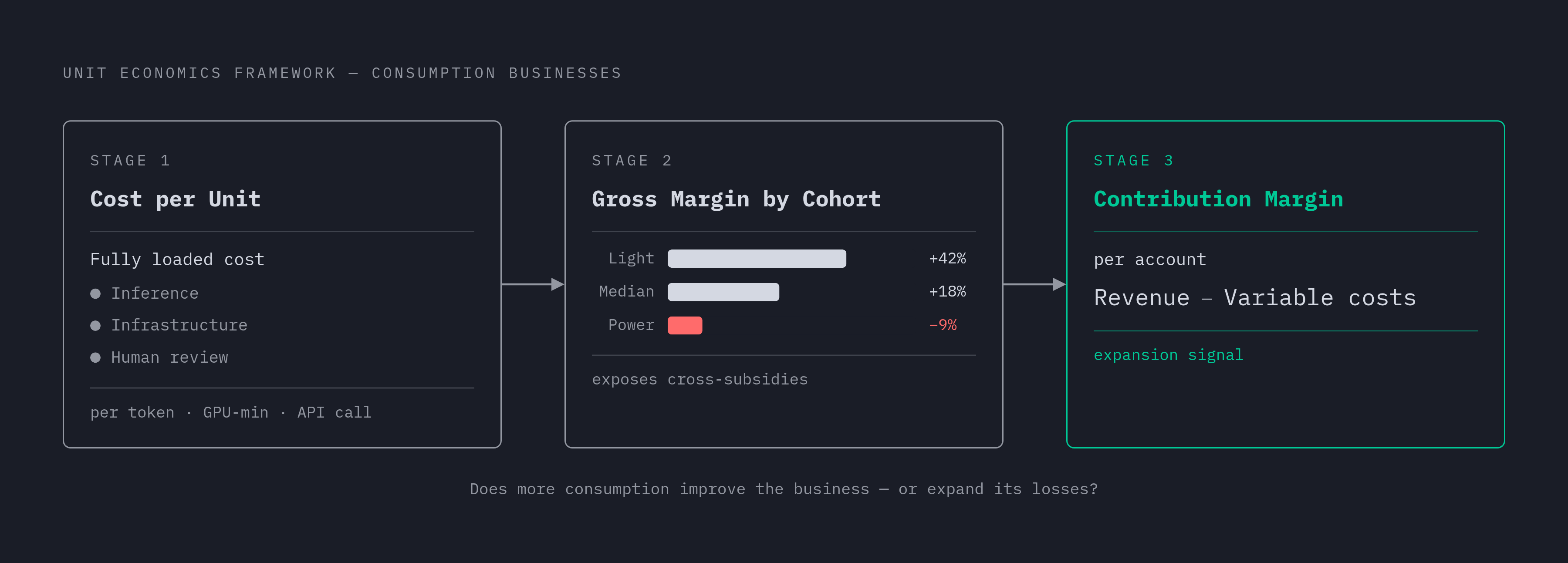
Consumption business models need a different approach to unit economics because usage brings recurring costs as well as revenue. Sustainable pricing and growth therefore depend on three connected measures, which are cost per unit, gross margin by cohort, and contribution margin by customer. Together, they show whether more consumption improves the business or expands its losses.
Why consumption pricing breaks the classic SaaS unit economics model
Traditional SaaS economics rest on a powerful assumption. Once the software is built, serving the thousandth customer costs roughly what serving the tenth costs. That near-zero marginal cost supports high gross margins and makes the classic customer acquisition cost and lifetime value playbook workable. That assumption breaks down for consumption businesses because each token they process, GPU-minute they use, or API call they answer adds a recurring variable cost. Inference does not amortize away as the customer base grows.
The consequence is a different relationship between growth and profit. More activity increases the cost of delivering the product, even when a flat monthly plan produces no additional revenue. An agentic workflow makes this divergence especially pronounced because a session can consume far more tokens than a single chat turn. A financial model that assumes delivery costs stay the same can mistake more engagement for better economics.
GitHub’s official Community FAQ described this change in concrete terms. Copilot had evolved to support more complex agentic workflows that consumed far more compute, making its previous per-request model “no longer sustainable”. GitHub moved all plans to usage-based billing as of June 1, 2026. The example illustrates a change in product economics while leaving open whether GitHub discovered losses among heavy users. An apparently healthy blended margin cannot settle that question because it does not show which usage patterns produce the costs.
The three variable costs that make consumption COGS structurally non-zero
For AI consumption products, three cost components explain why delivery costs cannot be treated as fixed overhead. They are inference per request, agent loop multiplication, and human-in-the-loop support. Each attaches to the work the product performs. Together, they make cost of goods sold sensitive to both the volume and the complexity of customer activity.
Inference is the first recurring cost line. Each query consumes input and output tokens billed at the model’s per-million-token rate. Agent loops multiply that cost because an autonomous agent reasons, retries, and re-prompts over several steps, making more than one call. A session can consequently consume orders of magnitude more tokens than a single chat turn. The economic uncertainty comes from how much work is required to complete the task.
Human review adds a separate delivery cost. Products that require people to handle edge cases or perform quality control incur costs that standard SaaS infrastructure accounting can miss. Those costs belong inside COGS when they are part of producing the service. Falling token prices do not automatically resolve the problem, either, because larger models and more complex tasks can absorb the savings. A fall in the cost of producing an outcome is the relevant test.
Cost per unit as the foundational metric consumption businesses must calculate first
Cost per unit begins with a precise denominator. Depending on the product, that denominator might be a token, GPU-minute, API call, resolved support ticket, or generated asset. The fully loaded cost must include inference, amortized infrastructure, and any human review allocated to that unit. Where completion requires an agent loop, the inference expense must reflect the work performed across the entire loop.
Flat pricing often leaves this calculation undone because a fixed monthly fee never forces the cost of an individual query into view. The practical first step is to disaggregate the blended delivery cost and attach it to the billable unit. Without that foundation, a margin calculation cannot reliably distinguish a costly workload from an inexpensive one. The denominator must match the service being measured.
Model routing is a major lever on this cost. Within a single inference provider, prices can differ by 5x or more between a small model and a frontier model. Routing routine work to a cheaper model while reserving the frontier model for genuinely difficult tasks can therefore change the cost of producing the same billable unit. Caching and model selection also affect the result, making cost per unit a product and engineering variable with direct profit-and-loss consequences. These levers reduce expense, but they do not turn consumption into a business with near-zero recurring delivery costs.
Why gross margin by cohort is the diagnostic consumption businesses need instead of blended averages
Blended gross margin conceals the distribution of delivery costs. With a flat monthly price, light users can subsidize heavy users while the business as a whole still seems profitable. The same arrangement can leave light users paying too much relative to their consumption and heavy users consuming more than their fees cover. That creates pressure at both ends of the customer base, which the average does not reveal.
Light, median, and power-user cohorts expose cost differences that contract value or acquisition channel may obscure. Comparing revenue and COGS within each cohort shows whether each usage pattern brings a profit or the business relies on a cross-subsidy. Agentic workloads make this distinction especially important because engagement can increase delivery expense much faster than a simple interaction count suggests.
A base subscription plus usage overage can produce different gross margins for light, median, and power users, with none matching the blended figure. The design goal is a structure in which every cohort has a non-negative gross margin. Cohort gross margin then becomes an input to pricing, tier design, and customer success priorities. It shows where a change is needed without assuming that every customer within the segment has identical economics.
Contribution margin at the customer level and why it replaces LTV as the core expansion metric
Customer-level contribution margin resolves the variation that remains inside a cohort. It is the customer’s revenue minus directly attributable variable costs, including inference, agent loops, and human review, over a given period. Two customers paying the same monthly fee can produce very different results. Their spending alone does not reveal their economic value.
This makes contribution margin more actionable than LTV for expansion decisions. Classic SaaS LTV calculations assume gross margin per customer stays fairly steady, but consumption margins change with workload and how customers use the product. Customer success and account management teams need to distinguish healthy consumption from activity delivered at a loss. A high-spending account is not necessarily the strongest expansion prospect if its workloads generate little or negative contribution.
The expansion opportunity lies in customers whose usage produces positive contribution and has room to grow within the product’s cost structure. Conversely, repricing or exiting a negative-contribution relationship can improve unit economics. When such an account leaves, the business loses its revenue but also sheds variable costs that were higher than that revenue.
That precision requires reliable attribution at the customer level. Usage events, pricing rules, and attributable costs must be connected in a single system so that revenue and expense can be reconciled. Multiple billing codepaths or manual usage reconciliation leave finance dependent on estimates, weakening the metric exactly where account-level decisions need precision.
How hybrid pricing structures translate these metrics into a sustainable operating model
Hybrid pricing translates the cost structure into a revenue structure. A base subscription covers fixed and semi-fixed costs, while variable consumption charges let revenue rise with the COGS that usage creates. Cost per unit informs the usage charge, cohort margins test the tiers, and customer contribution shows where the resulting economics still fail. The base also reduces the demand-driven revenue volatility of pure usage pricing.
Credits provide another way to package that consumption. Customers prepay for a pool of capacity and allocate it across use cases, gaining predictability without removing the link between usage and revenue. GitHub’s 2026 change illustrates the approach through metered GitHub AI Credits charged on actual token consumption. Its base subscription prices held while consumption became metered. The product thus moved from flat request allotments to a hybrid structure.
Outcome-based pricing moves the billable unit closer to customer value, but requires measurable outcomes attributable to the product. HubSpot’s published 2026 list prices charge for a resolved conversation through Breeze Customer Agent, at a rate reduced from its original level. Intercom’s published 2026 list prices charge for a resolved outcome through Fin, with a bill for each conversation that covers resolutions, procedure handoffs, and disqualifications.
Salesforce’s published 2026 list prices offer several Agentforce options. They include per-action pricing, a flat per-conversation rate, and monthly per-user rates starting at $5 for metered access requiring Flex Credits, with higher unmetered rates for employee access. These choices reflect differences in how customers use the product and how uncertain demand is. Hybrid pricing suits some businesses better than others, but its base-and-consumption structure balances predictable commitments with delivery costs that change with usage.
What metering infrastructure must do to make consumption unit economics computable in practice
The metering layer must capture billable events when they happen. An aggregation layer must then sum those events by customer and billing period, while a pricing engine applies the rate card to the totals. These functions form a continuous pipeline. At AI volumes, events come in at millisecond speeds, and operations teams need contribution data before the billing period ends.
Reliability depends on more than processing speed alone. Events must be traceable, and processing must be idempotent so that duplicate events do not become duplicate charges. Missing events create revenue leakage, while duplicates create invoice errors. Uncaptured revenue can also remain absent from margin reports because it was never counted in the first place. Metering and billing should stay separate parts of the architecture, but their data must match across event capture, pricing, and invoicing.
Adding credits, usage charges, or enterprise commitments means taking responsibility for a billing system, whether that responsibility was planned or not. Stytch’s engineering team concluded that an internal build would require a couple of engineers in perpetuity and chose to buy to reduce overhead and support its pricing needs. Vercel substantially reduced the time required to build and launch billing for new products after moving to purpose-built infrastructure.
Purpose-built infrastructure must support combinations of pricing dimensions, prepaid credit wallets, and postpaid invoices. It must also deploy where the customer’s infrastructure runs, including on-premises environments that exclude cloud-hosted platforms.
How finance teams should adapt revenue recognition and reporting for consumption contracts
Finance teams should identify how revenue recognition works for each part of a consumption contract. Under ASC 606, routine features of the model such as metered consumption, overages, prepaid credits, and contract modifications can change the amount expected to be collected or the period in which revenue is recognized. Treating them as exceptions to a subscription workflow leaves the accounting process misaligned with the product.
In a typical hybrid contract, the fixed subscription is recognized ratably over the service period, while qualifying usage-based fees are recognized as the customer consumes the service. A prepaid credit balance is deferred revenue until the credits are consumed, so payment alone does not determine recognition. Finance must reconcile credit drawdown with the meter so that what the customer bought is linked to the service they received.
That reconciliation links accounting directly to unit economics. When usage records, pricing rules, and billing outputs live in disconnected systems, finance inherits the first-week-of-the-month task of assembling them manually. Automated recognition requires the metering layer, pricing engine, and general ledger to operate on the same data. That shared foundation also supports auditable cohort-level margin reporting without a separate manual reconstruction.
Real-time usage dashboards, projected spend, and budget alerts serve as retention infrastructure by helping prevent invoice shock that leads to support costs, disputes, and churn. A consumption business needs its customers to understand the bill just as clearly as finance understands the margin behind it.