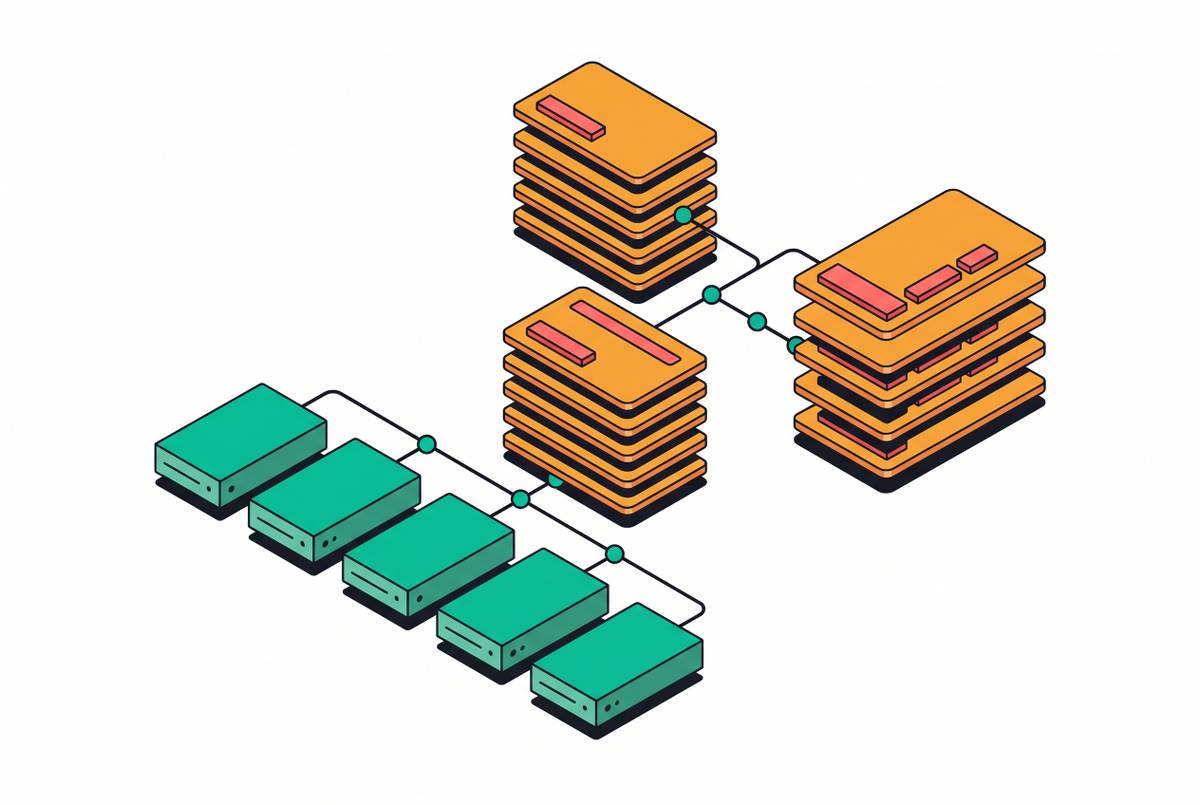
Price Differential Strategies Across Usage Tiers and Customer Segments
Per-seat pricing breaks when AI products have measurable compute costs machines incur.

Per-seat pricing worked when software had almost no marginal cost. AI-native products have broken that assumption, and the pricing models built for the old cost structure can no longer carry the new one without quietly eating margin.
Why per-seat pricing is breaking down
A traditional SaaS subscription charged per user because the cost of serving one more user was close to zero. AI changes that math at the root: every token processed, every model call made, every automated action taken carries a real, measurable compute cost. That cost accrues in compute regardless of whether a human being is sitting at a desk using the product, and that's the detail that breaks the old logic.
Consider what happens when an AI agent resolves a support ticket, drafts a contract, or reconciles an invoice on its own. None of that work ties to a named employee logging in and occupying a seat. The old link between headcount and software spend, the assumption that more employees using a tool means more revenue for the vendor, stops holding when the tool itself does the work. Per-seat pricing was built to track human usage. It has no mechanism for billing machine usage, and machine usage is where an increasing share of AI product value now gets created.
The industry's response has been to shift the unit of charge toward the unit of actual cost and actual value: tokens consumed, workflows executed, transactions processed, outcomes delivered. This isn't a wholesale rejection of the subscription. Most vendors layer usage and outcome-based charges on top of a subscription base. Credit-based systems have become a common middle layer in this shift: a customer buys a pool of AI capacity upfront and draws it down across whatever use cases apply, giving the vendor a way to recover margin on heavy consumption and giving the buyer something to budget against.
This split between access and consumption produces nearly every one of these new models: what a customer can reach through their subscription, versus what they actually burn once they're using it. The real design question going forward is how to combine seats and usage on purpose.
How value differs across usage tiers and customer segments
Before a team sets price differentials, it needs an honest map of how value actually differs across its customer base, because if tiers don't reflect real behavior patterns, they either leave revenue unclaimed or blindside customers with bills they didn't expect. That mapping runs along two separate axes, not one. A tier structure built only on volume ignores the second axis entirely, and the result is a system that misprices high-value, low-volume buyers right alongside low-value, high-volume ones, as if the two had anything in common.
Segment differences compound this. An enterprise finance team can plan around usage-based pricing, but a small business owner has no equivalent process in place, so the same structure will blindside them.
This blindsiding has a name: bill shock. When a small business owner opens an invoice after a routine week of using an AI product and finds a charge far larger than expected, it's a signal that the pricing tier was built for a different consumption profile than the one that customer actually has.
Mixpanel's pricing history illustrates how costly it is to pick the wrong unit of differentiation. Then, in 2026, Mixpanel moved back to event-based pricing as its default model, with MTU pricing now available only as a separate enterprise contract. The choice of pricing unit is a structural decision with real consequences, not a cosmetic choice made on the pricing page, and getting it wrong forces a costly reversal regardless of which direction the error runs.
A further distinction separates outcome-oriented buyers from consumption-oriented ones. A buyer who cares about resolved support tickets, completed compliance reviews, or reconciled invoices is measuring value in finished outcomes. But if a buyer cares about tokens processed or API calls made, they measure value by raw throughput. These two buyers have different willingness to pay for the same underlying product, and a vendor serving both may need to run two separate pricing logics simultaneously rather than force one group into a metric built for the other.
Structural design patterns for tiered pricing
Every pricing structure encodes an assumption about how value scales with use, and the moment that assumption no longer holds, the structure starts failing in a predictable direction. Reading these patterns for where they break is more useful than reading them as a neutral menu of options.
Tiered packaging, where features and usage limits are gated by plan, works when customer segments are genuinely distinct and the path from one tier to the next is obvious. It breaks when the boundaries between tiers are arbitrary, drawn from round numbers rather than real behavior, and customers pile up just under the ceiling of a tier. It isn't a punitive structure, and it doesn't tax heavy users with linear cost scaling. It rewards them with meaningfully better unit economics the more they use the product, giving a genuinely heavy user a real reason to move up.
Salesforce's Agentforce product shows what it looks like to run several of these models at once. Agentforce launched with conversation-based pricing in 2024. It added Flex Credits priced per AI action, then it brought in per-user licensing. The three pricing models didn't replace one another. They run at the same time, so different customer segments can each buy through whichever model matches how they actually consume the product.
The common thread across all of these failure modes is that choosing the wrong pricing metric is a structural error, not a tuning problem to fix later. You get the most leverage in the whole pricing design process from choosing the right metric at the outset, because every tier, boundary, and incentive built on top of it inherits whatever that metric gets wrong. Pricing also now needs to move faster than it used to: tiers, entitlements, usage limits, and add-ons are adjusted on an ongoing basis rather than reset once a year, so the underlying structure needs real knobs that can be turned without rebuilding the billing system every time.
Why the billing infrastructure underneath the pricing design is the binding constraint
If the billing system can't actually model a pricing structure, you don't just have an incomplete pricing strategy. It creates a manual reconciliation project, and the invoice errors it produces surface at month-end, quietly driving customers to churn.
Most subscription billing platforms were built to do one thing: track plans and renewal dates. They have no native concept of a token, a GPU-minute, an API call, or a Flex Credit, and bolting a separate metering layer on top to count those things turns into its own ongoing maintenance burden. Purpose-built usage billing infrastructure exists specifically to remove that structural inefficiency by handling metering and billing as one system.
Multi-model pricing raises the bar further. Agentforce's three simultaneous pricing models and Cursor's parallel seat tiers both need a billing system that can model several pricing dimensions in combination, not just one axis at a time. A platform built to handle only subscriptions, or only usage, cannot represent what either of these products actually charges for.
Prepaid credit wallets and postpaid invoicing aren't separate problems requiring separate systems. AI products routinely need both running against the same customer, sometimes in the same billing period, and a platform that only handles one forces a team to stand up a second system just to cover the gap.
AI inference runs fast, so credit consumption happens just as fast, and real-time metering is not optional. A billing system that processes usage in overnight batches creates a gap between what a customer did and what they were charged for, and that gap is where disputes start. One compromised event source can inflate or erase another customer's bill.
Pricing experimentation only works at the pace the market now demands if product and finance teams can adjust tiers, limits, and add-ons without filing an engineering ticket every time. If a billing platform needs a code change for every pricing tweak, it turns the fastest available growth lever into a bottleneck.
How to design price differentials that hold: a framework for aligning tier structure to segment behavior
Everything above points toward a design sequence, not a single decision. Each step addresses the specific failure the previous step exposes.
Identify the right value metric before setting any price. The metric chosen has to correlate with the value a customer actually extracts, not simply with whatever happens to be cheapest to measure. Mixpanel's move away from tracked users and back to events is the clearest example available of a company discovering, after the fact, that it had picked the wrong metric and having to unwind years of pricing structure to fix it.
Build upgrade incentives into the unit economics on purpose. A heavier user gets genuinely better economics by upgrading, which pulls the right customers up a tier instead of just taxing them for using the product as intended.
Separate access from consumption explicitly in the pricing structure itself. You need a billing engine that can handle both at once, without treating one as a special case bolted onto the other.
Design for bill-shock prevention directly, especially for SMB and developer segments, because they can least absorb a surprise charge. You build real-time usage visibility, spend alerts, and credit wallets with hard caps into the core pricing model from the start, because after a customer's first unexpectedly large invoice, these features are what keep them from leaving.
This work pays off in retention. Usage-based pricing models post structurally higher median net revenue retention than seat-based models do, and that gap compounds year over year. When a team gets tier and segment differentiation right, it pays off mainly in expansion revenue from existing customers, not just in new deals closed.
For segments where value is tied to specific automated outcomes, resolved tickets, completed compliance reviews, reconciled invoices, outcome-based pricing captures willingness to pay that a consumption metric like tokens or API calls simply cannot reach. But that only works if the billing infrastructure can measure and attribute outcomes natively. Attribution has to be built into the system from the start, not added as an afterthought once the pricing model is already live, because the question that remains is whether the billing infrastructure can actually model everything this framework calls for, or whether the team needs to go find one that can.
Build vs. buy for usage-aware billing infrastructure
The build-versus-buy decision for usage-aware billing isn't primarily a technical question. It comes down to whether billing is the company's core intellectual property or a cost center, and most AI and SaaS companies don't find out which one it is until they're well into building it.
The cost of building is routinely underestimated. That figure covers getting to a working system, not keeping one running.
The trigger point tends to arrive quietly. The moment a team layers credit wallets on top of usage, or usage on top of a subscription, or enterprise commit terms on top of either, that team is building a billing system whether or not it ever decided to. That's the exact point at which purpose-built infrastructure starts paying for itself in engineering hours saved, because the alternative is a growing pile of edge cases maintained by people whose job is supposed to be the product, not the invoice.
Compliance adds a recurring cost to the build path, and it's easy to miss up front. When the system is built in-house, every SOC 2 update, every GDPR requirement, and every new regulation that touches billing data turns into an internal engineering sprint. A vendor selling billing infrastructure absorbs that cost as part of what the product does, by default.
Building is still the right call in specific cases. And if data residency rules strictly prohibit cloud-hosted billing, an on-premises build may be the only option on the table, which also means that any vendor being evaluated needs to offer on-premises deployment or it's disqualified from the enterprise conversation before evaluation even starts.
Whatever path a team chooses, pricing experimentation only works if the billing platform's API and SDK are actually built for programmatic change, because this entire framework depends on it. A clumsy event ingestion API or a thin SDK forces engineers to build the same abstraction layer in-house that they were trying to avoid by buying the platform in the first place, which quietly cancels out the reason to buy. International pricing adds another hard constraint: a billing platform with currency or geographic limitations is disqualified from enterprise deals before the evaluation even gets underway, the same way a cloud-only platform is disqualified by data residency rules.
The consolidation case ties back to where this argument started. A company running separate billing codepaths for subscriptions, usage, and credits is paying a recurring tax in engineering time and finance time every single month just to reconcile three systems that were never designed to talk to each other. Moving onto a single platform built to handle all three at once does more than simplify the stack. It removes a cost that would otherwise keep appearing on the books every month, indefinitely, for as long as the fragmentation persists.